

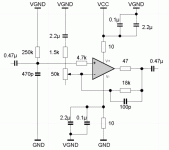
This is one of the gain stages of the clean channel
of a guitar preamp I'm building. It is driven by a
unity gain buffer and following it is a tonestack and
then another gain stage.
More important than keeping the 'hi-fi-ness'
of the amp is to suppress all kinds of noise
as much as possible since the working environment
is usually not the best (long cables, bad grounding,
tons of other equipment inducing noise on powerlines
and into signal path)
I'm just wondering if there are any errors in the
schematic or anything that can be improved.
of a guitar preamp I'm building. It is driven by a
unity gain buffer and following it is a tonestack and
then another gain stage.
More important than keeping the 'hi-fi-ness'
of the amp is to suppress all kinds of noise
as much as possible since the working environment
is usually not the best (long cables, bad grounding,
tons of other equipment inducing noise on powerlines
and into signal path)
I'm just wondering if there are any errors in the
schematic or anything that can be improved.
Attachments

Hi nosegoblin!nosegoblin said:I'm just wondering if there are any errors in the
schematic or anything that can be improved.
The upper 10 Ohms resistor must be conncted between the positif rail and the point of connection of the upper capacitors and the + pin of the op amp.
In the negatif side ,the resistor is correct but must be connected to the - rail and not the ground .
Cheers

PS: this will permit operation!
Re: Re: does this make sense?
it might be for single rail application. With one slight change, it will work.
Tube_Dude said:The upper 10 Ohms resistor must be conncted between the positif rail and the point of connection of the upper capacitors and the + pin of the op amp.
In the negatif side ,the resistor is correct but must be connected to the - rail and not the ground .
Cheers
PS: this will permit operation!
it might be for single rail application. With one slight change, it will work.
Re: Re: Re: does this make sense?
Yes it can...but in this case the input voltage divider is missing!!
And the capacitors and the resistor that are in the ground "rail " are not needed!
millwood said:
it might be for single rail application. With one slight change, it will work.
Yes it can...but in this case the input voltage divider is missing!!
And the capacitors and the resistor that are in the ground "rail " are not needed!
I haven't yet drawn the virtual ground driver
circuit. I figured a BUF634 would be perfect
for the job. Pretty common I guess. So if VCC
would be 30V then VGND is 15V and GND 0V.
I read an article* about decoupling and grounding
posted in the chip amps forum, but it left me
with more questions.
(*An IC Amplifier User's Guide to Decoupling,
Grounding and Making Things Go Right for
a Change - Paul Brokaw)
Yes, I am uncertain about the placement of the
10 Ohm resistors and possibly the decoupling
should be done directly from the positive pin
to the negative pin. Also most examples assumes
double rail operation while single rail operation
is rarely touched.
So if I understand you guys the upper 10 Ohm
resistor is in the wrong place, but the rest is
pretty much okay.
I have a quite similar circuit up on my bread
board. Some values are different and the pot
is missing, but the rest is pretty much the
same. Tinkering with the decoupling caps
gives somewhat inconclusive results as does
moving the 2.2uF connection from VGND to
GND, which pretty much suprised me since
I thought this would put the op outside the
linear region (=distortion).
As for the voltage divider the VGND is set by
a BUF634. It will keep VGND stable at half
the supply voltage. Measuring between the
positive input and ground shows ~15V at
30V supply voltage... It should work pretty
well...
circuit. I figured a BUF634 would be perfect
for the job. Pretty common I guess. So if VCC
would be 30V then VGND is 15V and GND 0V.
I read an article* about decoupling and grounding
posted in the chip amps forum, but it left me
with more questions.
(*An IC Amplifier User's Guide to Decoupling,
Grounding and Making Things Go Right for
a Change - Paul Brokaw)
Yes, I am uncertain about the placement of the
10 Ohm resistors and possibly the decoupling
should be done directly from the positive pin
to the negative pin. Also most examples assumes
double rail operation while single rail operation
is rarely touched.
So if I understand you guys the upper 10 Ohm
resistor is in the wrong place, but the rest is
pretty much okay.
I have a quite similar circuit up on my bread
board. Some values are different and the pot
is missing, but the rest is pretty much the
same. Tinkering with the decoupling caps
gives somewhat inconclusive results as does
moving the 2.2uF connection from VGND to
GND, which pretty much suprised me since
I thought this would put the op outside the
linear region (=distortion).
As for the voltage divider the VGND is set by
a BUF634. It will keep VGND stable at half
the supply voltage. Measuring between the
positive input and ground shows ~15V at
30V supply voltage... It should work pretty
well...
as far as decoupling is concerned, the caps can pretty much be tied to anything, from Vcc to Vgnd to Gnd, as they all are "gound" for a/c signals.
the decoupling resistors should really be between the power supply (Vcc or Vgnd) and the decoupling caps. But in this case, the time constant is simply too small for them to have any real effect so I would take them out.
another thing, I would use a pot to alter the gain of the circuit. in your case, the gain goes from 1/2 to 2x. a lot of opamps aren't stable at close to unity gain.
I would have put the pot upfront, as an attenuator to the non-inverting terminal.
the decoupling resistors should really be between the power supply (Vcc or Vgnd) and the decoupling caps. But in this case, the time constant is simply too small for them to have any real effect so I would take them out.
another thing, I would use a pot to alter the gain of the circuit. in your case, the gain goes from 1/2 to 2x. a lot of opamps aren't stable at close to unity gain.
I would have put the pot upfront, as an attenuator to the non-inverting terminal.
millwood said:as far as decoupling is concerned, the caps can pretty much be tied to anything, from Vcc to Vgnd to Gnd, as they all are "gound" for a/c signals.
I see. I guess I'll get hold of it in time with
a bit of a trail-and-error approach.
millwood said:the decoupling resistors should really be between the power supply (Vcc or Vgnd) and the decoupling caps. But in this case, the time constant is simply too small for them to have any real effect so I would take them out.
Hmm. My first intention was to make sure
that no rf noise wouldn't find its way to
the output of the opamp. When having long
cables it is not uncommon hearing long wave
radio broadcasts. Maybe just the caps are
more than enough?
millwood said:another thing, I would use a pot to alter the gain of the circuit. in your case, the gain goes from 1/2 to 2x. a lot of opamps aren't stable at close to unity gain. I would have put the pot upfront, as an attenuator to the non-inverting terminal.
This is a bit of a gamble and maybe my choice
was very much influenced by other guitar fx
rather than hi-fi equipment. I know that altering
the gain this way will also alter the frequency
response somewhat. I'll have a go putting
the pot in front since I have the circuit up on the
breadboard anyway. As for the selection of opamps
I have quite a few to chose from in my box-o-
many-things, OPA134, NE5532, TS922, even JRC4558,
and more. If none of these works with the 1.5 kOhm
resistor it will be replaced by a larger value.
One last question. The gain of this stage is
calculated according to G = 1+R1/R2, thus min
gain would be G = 1+18/(50+1.5) ~= 1.35, and
max gain G = 1+18/1.5 = 13 ( 2.6 dB to 22.3 dB ).
Or??? Is it just G = R1/R2? It's G = 1+R1/R2 for
non-inverting stages, right?
Thanx for all the feedback. When I'm grown up
I'll give it back.
nosegoblin said:
One last question. The gain of this stage is
calculated according to G = 1+R1/R2, thus min
gain would be G = 1+18/(50+1.5) ~= 1.35, and
max gain G = 1+18/1.5 = 13 ( 2.6 dB to 22.3 dB ).
Or??? Is it just G = R1/R2? It's G = 1+R1/R2 for
non-inverting stages, right?
Yes !...you are right!! with your set up the minimal gain will be 1,35 and the maximal gain 13.
You got it!
About op amp choice...i think guitar capsules have high impedance output...if that is the case then you must use a Fet input stage op amp for lower noise and not load the capsule.
Tube_Dude said:
Yes !...you are right!! with your set up the minimal gain will be 1,35 and the maximal gain 13.
You got it!
About op amp choice...i think guitar capsules have high impedance output...if that is the case then you must use a Fet input stage op amp for lower noise and not load the capsule.
When you refer to capsules, I am not really sure
what you mean. Guitar pickup (the microphone mounted
on the guitar), a guitar effect unit (small box on the
floor with some controlling knobs) or rack effect unit
(19" rack mounted unit usually with LED display and
tons of confusing possibilities).
As for guitar pickups there are passive ones and active
ones. The active ones have an opamp stage built-in
and you'll have to have a battery compartment in the
guitar. The passive ones are in essence just a copper
coil with an inducance in the range 2 to 8 henry and
DC resistance of about 5kOhm to 15kOhm. Good advice.
Using a FET input stage op is avery good idea I think. The
schematics posted shows the second stage. The first
stage is a unity gain buffer, however I have yet to choose
an op for it. Out of the ones I have available with
FET input the OPA134 is the one with the best spec.
About guitar pick ups...they are not my speciality...but in a nutshell:nosegoblin said:
As for guitar pickups there are passive ones and active
ones. The active ones have an opamp stage built-in
and you'll have to have a battery compartment in the
guitar. The passive ones are in essence just a copper
coil with an inducance in the range 2 to 8 henry and
DC resistance of about 5kOhm to 15kOhm. Good advice.
Using a FET input stage op is avery good idea I think. The
schematics posted shows the second stage. The first
stage is a unity gain buffer, however I have yet to choose
an op for it. Out of the ones I have available with
FET input the OPA134 is the one with the best spec.
If they are high impedance a fet op amp is better...if they have allready a incorporated buffer and the output impedance is lower...then the op amp requeriments are less stringent!
- Status
- This old topic is closed. If you want to reopen this topic, contact a moderator using the "Report Post" button.
- Home
- Amplifiers
- Solid State
- does this make sense?