

The amplifier bandwidth is limited by the current available to slew the compensation capacitor.
In an amplifier with no access to the compensation capacitor that is stabilised for unity gain the bandwidth is limited by the value of this capacitor, and in the voltage feedback scheme the current available to slew this capacitor is fixed.
In the CFB topology however the feedback resistor sets the current available to slew this capacitor, thus over a given range the bandwidth is only dependent upon this resistor, this is the Go term in the expression that I posted, Zt is constant for a given Cc provided that Rf is also constant, this is true over the range specified in the data sheets.
Your modeled circuits do not have the pole splitting capacitor, so I am assuming that the slew is limited by the transistor characteristics alone, putting the capacitor in the simulation might be informative.
rcw
Just coming back to this comment, I think your comment about the slewing current being set by the feedback resistor in CFA is the key insight, and this why it's the value of the feedback resistor that's often recommended as the primary method of comp for this topology. Because the output buffer is sourcing this current (and the feedback resistor can therefore be low in value), you can have very high slewing currents. Typically a VFB might have 10mA available but you can configure a CFB easily for 5x or 10x this figure.
Leach pointed out long ago that there is no bandwidth advantage in using a cascode in a feedback amplifier, it still needs a compensation capacitor that splits the poles and puts one high enough to ensure stability.
rcw
Leach was saying that the cascode doesn't add bennefits if it is positioned on both signals,the input and the feedback.
But if the input has 2 poles ,one at low and the feedback signal just one because of common base stage then you have a shift of 90 degrees at high F not at low like in VFB .
in vfb you have a pole at low because the fb signals enters in differential pair in base so we have a common emitter stage which introduce a pole with -20db/decade. and for phase a -90 degree.in cfb the input for the fb is the emitter and there is a common base stage but this stage does not have a pole at low because there is no -180 degrees phase shift like common emitter has. in common base stage the miller parasitic capacity is the output capacity but in common emitter the capacity seen at the output is multiplied by the gain of the stage.please review the transistor gain stages.

In a CFB, the impedance of the FB network is an essential part of the amplifier."First, your frequency analysis measures the open loop gain under forced VFB conditions (and extreme ones)" Can you explain ?
If you remove it by driving the - node at zero impedance, you make the measurement in a way that is totally disconnected from the reality, where the FB network sets the loop gain, slew rate etc.
OK, it is the "true" open loop gain, but it is purely virtual, and it is completely useless for stability analysis for example. This amplifier is unstable.
That is the proper way to analyze the loop gain (not totally accurate mathematically, but close enough since Zout is small compared to the FB network).Elvee please excuse but your explanations are wrong .
Firstly you analyze the OLG with the AC signal between the output and the negative feedback .The reference for the negative input must be the GND beacuse we transform the voltage in current .If the negative reaction is in current then we should add a current generator but spice don't have such thing and then we shoul transform the V in I .
See Keantoken posts for example for more details
Who said a VFB amplifier must have a classical, non-degenerated LTP at the input?You missplaced wrong the current source for the differentail input in Vfb .This will do other impedances in the nodes and will give small AC modified behaviour which is wrong .
The amplifier has been converted to a VFB one, the (-) input impedance has been raised by a Hfe factor, and the impedance of the FB network has no more influence on the behavior of the amplifier (within reasonable limits).
You could convert the schematic to a more familiar looking one by splitting the 180 ohm into two 90 ohm, but this changes nothing.
The emitter follower could also be replaced by a diamond buffer, thus freeing the amplifier completely from bias current constraints. It would still remain a VFB.
Now the gain is set by the degeneration resistor, R2.
That is basically what I want to show: a CFB amplifier is essentially a degenerated amplifier, it is like adding emitter resistors in the input LTP; additionaly, the tail current can be split and manipulated to remove slew rate constraints
The amplifier you show is not stable without compensation.Also I can show you a real amp CFB schematic has linear phase (0 degrees until 1 MHZ) who has also good phase reserve but you can't show me a VFB with the same phase because it doesn't exist .The theory says so !
You need to compensate it !
Always a Vfb will have one pole at very low F ,even there are no discrete capacitors .But the parasitic/internal Miller capacitor will give the look of my OLG VFB picture . If you use the cascode stage like CFB has, than Miller is not matter anymore .
Can you show a vfb compensated with linear phase ?I guess not ..
0° phase at 1MHz means nothing: what counts is the variation of the group delay as a function of the frequency. We see on the plots that the group delay at 1MHz is indeed very small, but at medium frequencies it increases to 1.5µs. That behavior is worst than an amplifier having a flat group delay of 1.5µs from DC to 1MHz
I mixed up the pics. Here is the correct one.The last 2 pictures are the same . Group delays will not be the same when you have a compensated VFB .
The VFB version does not need more compensation than its CFB counterpart, because it has been designed to mimic exactly its behavior.
Attachments
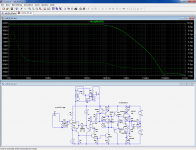


... in vfb you have a pole at low because the fb signals enters in differential pair in base so we have a common emitter stage which introduce a pole with -20db/decade
The most important question for this thread is: Why someone would place extra unlinear gain part in feedback path apart from resistors?, since the feedback current comes from the low Z output, so there's a plenty current to use. Intentionally putting unlinear gain part to FB path brings only bad stuff to the signal and correction. Plain logic. CFB OLG phase graph expalins it all.

Observation: I have noted that perceived soundstage size in monophonic changes size depending on feedback current. That's not the only way to do it, but the tallest order for a hi-fi grade audio amp needs all the help it can get. I wish this were easier to measure.The most important question for this thread is: Why someone would place extra unlinear gain part in feedback path apart from resistors?, since the feedback current comes from the low Z output, so there's a plenty current to use. Intentionally putting unlinear gain part to FB path brings only bad stuff to the signal and correction. Plain logic. CFB OLG phase graph explains it all.
Simple example with a simple part--LM1875 non-inverting:
180k feedback resistor--bankrupt sound stage smashed flat and drawing attention directly to the speaker
100k feedback resistor--great improvement and lovely tone--soundstage is weirdly hallway shape (deep but not wide)
10k feedback resistor--perfect (equally wide and deep) soundstage and improved dynamics, but poor tone caveats.
Except for nesting/composite, there wasn't a solid answer.
However, AndrewT's even balance answer was 47k and with a low gain setting (a computer sound chip at max would not clip the 25 watt amp).
Last edited:
The most important question for this thread is: Why someone would place extra unlinear gain part in feedback path apart from resistors?, since the feedback current comes from the low Z output, so there's a plenty current to use. Intentionally putting unlinear gain part to FB path brings only bad stuff to the signal and correction. Plain logic. CFB OLG phase graph expalins it all.
Lazy Cat
I'm still not getting this, can you or Catalin expand on what you mean by an additional nonlinear stage?
Fundamentally isn't the error current developed the same and subject to the same transistor characteristics? The difference being only that vfb has a limited current?
Thanks
-Antonio
I am well aware Catalin that all active devices have an input and output time constant, this is precisely why dominant pole compensation is used.
As Leach also showed the best place for this is the stage in a feedback amplifier that has the most voltage gain.
Dominant pole compensation in effect increases the input time constant of this stage and decreases the output one, the pole splitting effect, giving the closed loop a first order convergence.
In this all other device time constants are at a sufficiently high frequency as not to matter, and at very high frequencies local pole zero cancellation is often used.
Your arguments regarding the input ltp time constants are irrelevant because the dominant pole and its split pole are the only thing that matters in the pass band, and these are virtually identical for a given band width in both vfb and cfb schemes.
rcw
As Leach also showed the best place for this is the stage in a feedback amplifier that has the most voltage gain.
Dominant pole compensation in effect increases the input time constant of this stage and decreases the output one, the pole splitting effect, giving the closed loop a first order convergence.
In this all other device time constants are at a sufficiently high frequency as not to matter, and at very high frequencies local pole zero cancellation is often used.
Your arguments regarding the input ltp time constants are irrelevant because the dominant pole and its split pole are the only thing that matters in the pass band, and these are virtually identical for a given band width in both vfb and cfb schemes.
rcw
I am well aware Catalin that all active devices have an input and output time constant, this is precisely why dominant pole compensation is used.
As Leach also showed the best place for this is the stage in a feedback amplifier that has the most voltage gain.
Dominant pole compensation in effect increases the input time constant of this stage and decreases the output one, the pole splitting effect, giving the closed loop a first order convergence.
In this all other device time constants are at a sufficiently high frequency as not to matter, and at very high frequencies local pole zero cancellation is often used.
Your arguments regarding the input ltp time constants are irrelevant because the dominant pole and its split pole are the only thing that matters in the pass band, and these are virtually identical for a given band width in both vfb and cfb schemes.
rcw
Well RCW the issue is not the first pole from VAS.Is the one from the LTP which is at high f therefore we have then a 90+90 phase shift and a -20-20db/dec ,a second order "filter" . If we have 90 degr and -20db from the vas at the low F (because of the high gain) the ltp will add one pole more at high f which add-90 again thus making the condition for instability when gain is positive .Also shifting in VFB of the pole is good but the phase will suffer .This is regarding the stability .But the phase will suffer anyway .
So a solution with a pole at a higher f or no pole at all is better .The solution can be a common base stage/cascode like CFB has .
Last edited:
The question is do you really need such a thing for audio, when the difficulties of current feedback are mitigated by buffering with an emitter follower, ( the inverting input transistor of the ltp acts as an emitter follower, and not as a common emitter).
The answer is no.
As has been demonstrated time after time you only need a gbp of 8-10MHz. for audio, and there are perfectly adequate vfb chips that can do this, and they have been around for many years.
There are simply no practical benefits from using cfb devices in audio, and some practical difficulties, because they are more difficult to use.
rcw
The answer is no.
As has been demonstrated time after time you only need a gbp of 8-10MHz. for audio, and there are perfectly adequate vfb chips that can do this, and they have been around for many years.
There are simply no practical benefits from using cfb devices in audio, and some practical difficulties, because they are more difficult to use.
rcw
Last edited:
Catalin
I think I'm beginning to understand what your saying.
If one is being dominated by a secondary pole of a simple LTP then using a cacscode version can reduce this effect and allow a higher bandwidth, and that inherently a cfb type stage lacks at least this same secondary pole.
But generalizing this as vfb versus cfb may not be the gist of the arguement.
rcw66: what are the pratical difficulties in using a cfb, and of which emitter follower are you referring to. edit (re-read your post got the emitter follower reference), thanks
Thanks
-antonio
I think I'm beginning to understand what your saying.
If one is being dominated by a secondary pole of a simple LTP then using a cacscode version can reduce this effect and allow a higher bandwidth, and that inherently a cfb type stage lacks at least this same secondary pole.
But generalizing this as vfb versus cfb may not be the gist of the arguement.
rcw66: what are the pratical difficulties in using a cfb, and of which emitter follower are you referring to. edit (re-read your post got the emitter follower reference), thanks
Thanks
-antonio
Last edited:
@rcw
If you have a current mirror(majority has) in the Ltp than you have 2 paralel stages for the neg feedback.One is follower but the same stage is common emitter .From here the mirror will add a pole and a phase shift .So we gain good thd with the mirror but we loose bandwidth and phase .
Why should we use CFB in audio ?
I will respond you with a request .
Please share a VFB schematic with a common 100pF miller cap for compensation and current mirror in ltp.And then please measure the phase at 20 khz .In closed loop .
You will see then why .
@magnoman ,yes correct .But to use the cascode or common base only for the negative feedback .Because if it is used also/toghether by the input signal the advantage is 0 .
If you have a current mirror(majority has) in the Ltp than you have 2 paralel stages for the neg feedback.One is follower but the same stage is common emitter .From here the mirror will add a pole and a phase shift .So we gain good thd with the mirror but we loose bandwidth and phase .
Why should we use CFB in audio ?
I will respond you with a request .
Please share a VFB schematic with a common 100pF miller cap for compensation and current mirror in ltp.And then please measure the phase at 20 khz .In closed loop .
You will see then why .
@magnoman ,yes correct .But to use the cascode or common base only for the negative feedback .Because if it is used also/toghether by the input signal the advantage is 0 .
Last edited:
@magnoman ,yes correct .But to use the cascode or common base only for the negative feedback .Because if it is used also/toghether by the input signal the advantage is 0 .
Catalin
Any chance you have a circuit or reference to this type of single side cascode?
I was imagining something common like even used within the 741 input stage.
Thanks
-antonio

Member
Joined 2009
Paid Member
Observation: I have noted that perceived soundstage size in monophonic changes size depending on feedback current.
do you really mean 'sound stage' and 'mono' ? - please expand a little (I am a recent builder of a mono system)
I would like to see a double blind test of this device that improves a mono sound stage by increasing feedback current, I suspect a urine extraction exercise.
If you post your data about your assertions Catalin I would be interested, I however am not going to jump through hoops at your behest.
rcw
If you post your data about your assertions Catalin I would be interested, I however am not going to jump through hoops at your behest.
rcw
Lazy Cat
I'm still not getting this, can you or Catalin expand on what you mean by an additional nonlinear stage?
Fundamentally isn't the error current developed the same and subject to the same transistor characteristics? The difference being only that vfb has a limited current?
Catalin
I think I'm beginning to understand what your saying.
If one is being dominated by a secondary pole of a simple LTP then using a cacscode version can reduce this effect and allow a higher bandwidth, and that inherently a cfb type stage lacks at least this same secondary pole.
But generalizing this as vfb versus cfb may not be the gist of the arguement.
Thanks
-antonio
Hi Antonio
I'm glad that the topic attracted you and you're beginning to understand, nevertheles we could still have eternal theoretical discussion about VFB vs. CFB.
My suggestion would be more of a practical nature: try to build simple-basic 6 transistors VFB and simple-basic 6 transistors CFB amp and compare them sonically.
After this experience you'll also understand why top technical specification & complex VFB amplifiers sounds dull.
Why do you think VFB (or CFB for that matter) needs to stick to a frozen, preestablished scheme?@rcw
If you have a current mirror(majority has) in the Ltp than you have 2 paralel stages for the neg feedback.One is follower but the same stage is common emitter .From here the mirror will add a pole and a phase shift .So we gain good thd with the mirror but we loose bandwidth and phase .
Why should we use CFB in audio ?
I will respond you with a request .
Please share a VFB schematic with a common 100pF miller cap for compensation and current mirror in ltp.And then please measure the phase at 20 khz .In closed loop .
You will see then why .
@magnoman ,yes correct .But to use the cascode or common base only for the negative feedback .Because if it is used also/toghether by the input signal the advantage is 0 .
VFB simply means the voltage feedback mechanism is dominant. A topology usually associated with CFB can be converted lossessly to VFB, as I have shown.
Maybe you are not convinced the process is lossless, despite I went much further than most, by showing that the group delay remains unchanged in the transformation.
In fact, contrary to what Lazycat states, the process is not only lossless, but has gain: by including a non-linear element in the feedback resembling the one in the main path, the overall distortion is reduced. Since this is an open loop process, it affects in no way other good or bad characteristics of the looped system.
You can compare the merits of one specific type of topology against another one, but this is not related to the fundamental question of this thread: what are the merits of root CFB against the merits of root VFB.
If think there are none: it all boils done to idiosyncrasies usually associated with one or the other topology (or should I say philosophy?).
Typical are the completely worthless "vanity" graphs of phase vs. frequency shown: they simply look nice and make the poster feel good, but they bring no useful information, and they hide the most important aspect (in case it is relevant, which I am not even convinced of), the variation of group delay with frequency.
From a purely anecdotal point of view, I have heard systems that sounded good but were purely trash, from an objective point of view, and also some that were flawless, but didn't sound extraordinary (good, clean, OK, but no more)
Subjective impressions can be very misleading and as engineers, we first have to do our homework properly, and only then look into contentious details if we have time to.
Reversing the order of things leads to pure gold mains plugs and similar quirks.
Elvee, you want to bring a deviation to the true. You forget that the vfb is uncompensated.Therefore the group delay is the same.But an uncompensated vfb will not work ever.
So please compensate the vfb and I will bring also a cfb with good phase reserve.Let see than the real group delay.
Let 's do the things correctly and not loose time.
Thank you
So please compensate the vfb and I will bring also a cfb with good phase reserve.Let see than the real group delay.
Let 's do the things correctly and not loose time.
Thank you

I read Elvee's comment, and as he indicates it would be hard to support any particular theory here since the only difference in CFB opposed to VFB could be the inherent low or higher impedance of circuit.
Whether this would make a sonic difference at all is very debatable and subjectivity never have a definitive outcome.
Better and worse are measurable and relative. Subjectivity on the other hand merely indicates an emotion or opinion.
Whether this would make a sonic difference at all is very debatable and subjectivity never have a definitive outcome.
Better and worse are measurable and relative. Subjectivity on the other hand merely indicates an emotion or opinion.
- Status
- This old topic is closed. If you want to reopen this topic, contact a moderator using the "Report Post" button.
- Home
- Amplifiers
- Solid State
- Is the CFB topology superior, and why?