

Hello everyone.
A few months ago I made a couple of the follower and everything was good. Its current source is based on the NPN darlington TIP142, which is getting increasingly harder to find here. Soon I think it will become a totally unavailable antique discrete. If the ones installed ever die after say 2 or 3 years, I don't know what I'll do.
In the shadow of the above-mentioned condition of the darlington, I thought how would it be if the CCS was also made of a MOSFET.
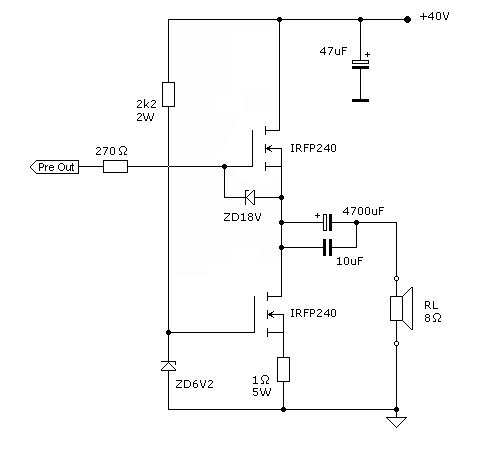
MOSFETs are fast. Appealing. I tried it, with an IRFP240 replacing the darlington's collector, base and emitter with drain, gate and source respectively. And for the zenner diode I used a 6V2 one instead of the default 3V3.
Before testing I ran a simulation and the config was a success. However, the simulator's current probe does not show quiescent current through them; don't know why. I'm complete newbie in the sim field.
I tried it with the changed config and at the time of writing this it's running quite good for about 8 hours since noon. Quiescent current is about 2.5 Amps. No sign of instability and/or oscillation. It's drawing pretty much the same power from the PS as it did with the darlington. It's also making the same noise(music) as loud and as tight as the previous. To say the truth the sound is little different from ago with nicer sounding highs, the sound is just different.
But that's all I could see through my ears, as I don't have sophisticated measuring instruments.
So, I humbly request PMA and all the interested and kind hearted people to give this a little of their precious time and let us know the details of the tests.
This is what the modified schematic looks like:-
Thanks
.
A few months ago I made a couple of the follower and everything was good. Its current source is based on the NPN darlington TIP142, which is getting increasingly harder to find here. Soon I think it will become a totally unavailable antique discrete. If the ones installed ever die after say 2 or 3 years, I don't know what I'll do.
In the shadow of the above-mentioned condition of the darlington, I thought how would it be if the CCS was also made of a MOSFET.
MOSFETs are fast. Appealing. I tried it, with an IRFP240 replacing the darlington's collector, base and emitter with drain, gate and source respectively. And for the zenner diode I used a 6V2 one instead of the default 3V3.
Before testing I ran a simulation and the config was a success. However, the simulator's current probe does not show quiescent current through them; don't know why. I'm complete newbie in the sim field.
I tried it with the changed config and at the time of writing this it's running quite good for about 8 hours since noon. Quiescent current is about 2.5 Amps. No sign of instability and/or oscillation. It's drawing pretty much the same power from the PS as it did with the darlington. It's also making the same noise(music) as loud and as tight as the previous. To say the truth the sound is little different from ago with nicer sounding highs, the sound is just different.
But that's all I could see through my ears, as I don't have sophisticated measuring instruments.
So, I humbly request PMA and all the interested and kind hearted people to give this a little of their precious time and let us know the details of the tests.
This is what the modified schematic looks like:-
Thanks
.
Last edited:
If the quiesient current is 2.5 amps, the 1 ohm resistor power rating is too low. What is the DC voltage at the output of the preamp?
If the quiesient current is 2.5 amps, the 1 ohm resistor power rating is too low. What is the DC voltage at the output of the preamp?
Yes the 1 ohm resistor's power rating is too low indeed. I am using a 10 watt resistor for this.
The DC voltage at the output of the preamp is 23.8 Volts.
You might like to place a cap across the ZD6V2 diode to reduse noise.
I am using a capacitance multiplier PS.
listening test update:- The amp sounds more natural and liquid with the MOSFET CCS. I noted this after running the one of the old ones(darlington CCS) side by side with it. There is more luster in the sound, vocals are more open, neutral.
Anyone please tell me why this could be... thanks.
Anyone please tell me why this could be... thanks.
Last edited:
Another thing. There seems to be some kind of temporary but repeating chirping noise coming from the speaker. It's of very low volume, but is unusual. Coming after about every 6-7 seconds. What could be the reason? There is a BLDC fan cooling the heat sink. But it was there before and there was no noise.
And funny thing is that the noise seems to vanish when I touch the heat sink! What is happening?!?!?
thanks.
And funny thing is that the noise seems to vanish when I touch the heat sink! What is happening?!?!?
thanks.
Last edited:

And funny thing is that the noise seems to vanish when I touch the heat sink! What is happening?!?!?
RF oscillation, most likely. As you noted, MOSFETs are fast, and like to make RF. Your schemo doesn't indicate that gate stoppers were used, and if not, that's probably what you've got. Touching the heat sink might just add enough RF loading to stop the oscillation. Try o'scoping, or running a SW xcvr near by to see if you have an RF problem.
RF oscillation, most likely. As you noted, MOSFETs are fast, and like to make RF. Your schemo doesn't indicate that gate stoppers were used, and if not, that's probably what you've got. Touching the heat sink might just add enough RF loading to stop the oscillation. Try o'scoping, or running a SW xcvr near by to see if you have an RF problem.
I don't have those apparatus but you may be right. I placed a 220pF cap parallel to the zenner as woody suggested(above) and the noise stopped.
Is the heatsink connected to chasis earth?
No it is not. It is electrically isolated. Then again I think I will earth it.
Thanks.
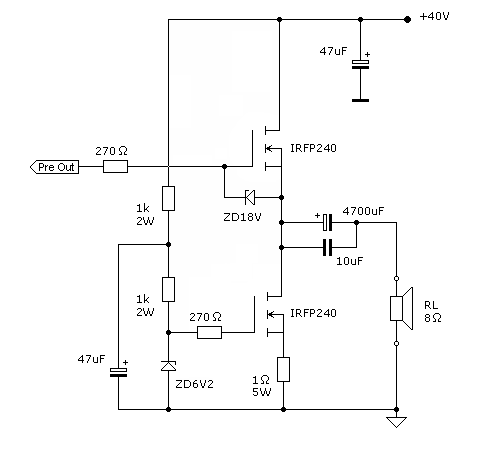
This is the current config. Taken some ideas of the CCS from ZEN V2. Thanks to Mr. Pass. This is working smoothly with 2.5A of stable quiescent current.
Last edited:
I got a problem. There seems to be a power-off transient from the speaker with the new config. Can anyone suggest some solution?


I got a problem. There seems to be a power-off transient from the speaker with the new config. Can anyone suggest some solution?
This is a guess...
Upon turn-off of the power supply the lower FET / current source is kept alive for a short time by the 47microF capacitor in your circuit. It continues to conduct and hence drains the large output capacitor via the speaker.

Pavel,
That would slowly turn on the current source, lessening any switchon pulse, but would it turn it off slowly?
Probably at turn off, a relay switching a 1R resistor across the output would do the job.
Hugh
That would slowly turn on the current source, lessening any switchon pulse, but would it turn it off slowly?
Probably at turn off, a relay switching a 1R resistor across the output would do the job.
Hugh
No, this issue would remain. I have shown the image for the reason of lowering noise and improving stability.
To improve switch-off, one can decrease supply divider cap from 47u (22u) to some 2u, it would still make a job.
To improve switch-off, one can decrease supply divider cap from 47u (22u) to some 2u, it would still make a job.
The amp turns off slowly. Remains on for about 1 second after turning off the mains switch.
The problem is that, the spark in the mains switch's contacts at turn off is making a single "Click" in the output, then the voltmeter at the filter caps shows gradually decreasing viltage. This transient was not there in the darlington CCS even though there were no parts connected to its base except a 2k2 resistor and a zenner. (please don't tell me to go back to darling-ton )
)
I am building the circuit above now and will post results.
thanks.
The problem is that, the spark in the mains switch's contacts at turn off is making a single "Click" in the output, then the voltmeter at the filter caps shows gradually decreasing viltage. This transient was not there in the darlington CCS even though there were no parts connected to its base except a 2k2 resistor and a zenner. (please don't tell me to go back to darling-ton
)I am building the circuit above now and will post results.
thanks.
- Status
- Not open for further replies.
- Home
- Amplifiers
- Solid State
- Pavel's MOSFET Follower - No Darlington Mod