


is R21 connected right?
do you care to explain your schematic?
R21 provides current for shunt-regulated power source for opamps (18V) and for bias reference (6.2V).
The explanation is, MOSFETS have big enough capacitances that are non-linear. In any case MOSFET stage will have a parasitic input capacitance. What I did, I shunted this capacitances intentionally, by a capacitive voltage divider, turning MOSFET into a kind of vacuum tube triode. However, it has big input capacitance, but it is well known, very linear, and under our control.
I loaded this "Vacuumless Triode" on a counter-modulated current source and got a single-ended triode amplifier, active-loaded (that is better than reactive-loaded in terms of distortions and frequency response).
Yes, I used OPAMPS. But all of them have JFET inputs, and are used in inverting mode, with no common mode errors that are one of weak points of opamps.
Last edited:

R21 provides current for shunt-regulated power source for opamps (18V) and for bias reference (6.2V).
The explanation is, MOSFETS have big enough capacitances that are non-linear. In any case MOSFET stage will have a parasitic input capacitance. What I did, I shunted this capacitances intentionally, by a capacitive voltage divider, turning MOSFET into a kind of vacuum tube triode. However, it has big input capacitance, but it is well known, very linear, and under our control.
I loaded this "Vacuumless Triode" on a counter-modulated current source and got a single-ended triode amplifier, active-loaded (that is better that reactive-loaded in terms of distortions and frequency response).
Yes, I used OPAMPS. But all of them have JFET inputs, and are used in inverting mode, with no common mode errors that are one of weak points of opamps.
My friend used some of these vacuumless-triodes. Until he turned the bias up too high...

jd
Attachments

My friend used some of these vacuumless-triodes. Until he turned the bias up too high...
Sure, class A needs proper cooling! Water cooling like on your picture is one of options!
It is a single ended vacuum-less triode amp. As drawn, you can get about 30W on 4 Ohm load, or 60W on 2 Ohm load. With no huge vacuum tubes, no B+ kilovolts, no filament heating. However, one of opamps must be capable of driving 160 Ohm load impedance, and a good heatsink will be needed. Source and emitter resistors mean you may parallel output devices spreading heat dissipation among them, so resistors must have higher resistance, number of devices times. Scott Wurcer gave me last year some samples of AD opamps that I may try in this amp.
this can be a good buddy to drive this solid state triode buffer:
http://www.next-tube.com/articles/lineamp/LinAmp-I.pdf
http://www.next-tube.com/articles/lineamp/LinAmp-I.pdf
Attachments
Wave,
what is a counter modulated CS? Could i use Nelson Pass over active CS?
I don't know, ask Nelson...
Hours later, this one just isn't explaining itself to me.
I don't even know where to begin? Differential input?
Better start from vacuumless triode output.


It is a single ended vacuum-less triode amp. As drawn, you can get about 30W on 4 Ohm load, or 60W on 2 Ohm load. With no huge vacuum tubes, no B+ kilovolts, no filament heating. However, one of opamps must be capable of driving 160 Ohm load impedance, and a good heatsink will be needed. Source and emitter resistors mean you may parallel output devices spreading heat dissipation among them, so resistors must have higher resistance, number of devices times. Scott Wurcer gave me last year some samples of AD opamps that I may try in this amp.
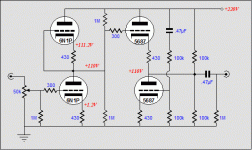
I have gone for a SRPP tube front end with MOSFET output transistors.
It gives a valve sound with lots of power at a very reasonable price.
How about capless bipolar psu version?
For bipolar psu it will be more complex.
By the way, some gate stoppers will be needed, depending on MOSFETs used.
- Status
- This old topic is closed. If you want to reopen this topic, contact a moderator using the "Report Post" button.
- Home
- Amplifiers
- Solid State
- Class-A-Burn: an amp with capacitive feedback divider around MOSFET