
Per an old thread, I'm been playing around with using four IXYS FRED rectifers to create a 25A bridge rectifier for use in my modded Hafler amplifier.
The new bridge works fine but I have a question:
- All stock Hafler amps use a .01mf capacitor across the AC leads on the stock 25A 'square' bridge rectifier.
- What is the purpose of putting a tiny value cap on a bridge rectifier? Is it necessary when using IXYS and/or Schottky rectifiers/bridges?
I've read some people say not use a cap on Ixys/Schottky, but I"m interested in what their purpose of the cap is is before I clip it off.
The new bridge works fine but I have a question:
- All stock Hafler amps use a .01mf capacitor across the AC leads on the stock 25A 'square' bridge rectifier.
- What is the purpose of putting a tiny value cap on a bridge rectifier? Is it necessary when using IXYS and/or Schottky rectifiers/bridges?
I've read some people say not use a cap on Ixys/Schottky, but I"m interested in what their purpose of the cap is is before I clip it off.
They are there to shunt switching noise. If the capacitors are of the wrong type, they can create more noise than they attempt to remove. The size of the cap vs the expected 'load' is key to their effectiveness.
With a linear Power Supply on a 'standard' power amp design, the rectifier switching noise can come through in a subtle fashion as the switching diode IS connected directly to the given PS rail and going from the charge state to the 'store-release' state and thus modulating the output--when the amplifier's given devices are 'active'. Now, the rail can be modulated by the active device, and thus make the diode junction do more than one single on-off cycle as the cascading voltage/current load is moving toward it's on/off point, and therefore, a well or properly 'shunted' diode junction is considered to do less harm to the output signal.
Once again, though..the loading of the junction is different at all levels and thus the shunting capacitor can have more or less effectiveness. The situation is not static due to music signals never being repetitive, so it can even be done (shunted/value-type-quality-loading change/no shunting) to personal taste, to some degree. The more local the capacitor to the diode itself, the more effective the capacitor. Right on the leads itself is the most effective. Fast switching diodes are not necessarily less noisy (to the human ear) than a regular type diode. Schottky diodes are considered to be fast but 'soft switchers' (as compared to regular 'ultra fast' diodes-which are considered to be 'hard sounding' and noisy switchers by many audio folk) so are far less likely to need the shunting caps under a greater variety of loading scenarios.
However, the saving grace is that the circuit itself has standardized static values of components and thus the system can be predicted on one level.
Every diode type seems to have its give and takes. If the given circuit has a voltage to be utilizing a diode where the possible peak reverse values can accept a Schottky, it is generally considered these days that this is the best scenario. However, schottky's tend to not be used in critical spots in commercially released designs as the failsafe levels are not great enough to cover the larger possible situations that the given audio gear may be subject to. A combination of costs vs. reliability in the field causes most commercial audio gear to use regular and ultra fast diodes in critical spots. Thus the shunting capacitors found at many a rectifier in the audio world.
Thus, for us, the major use of schottky diodes tends to be in hobby and self built circuits, when it comes to marginal reliability issues.
With a linear Power Supply on a 'standard' power amp design, the rectifier switching noise can come through in a subtle fashion as the switching diode IS connected directly to the given PS rail and going from the charge state to the 'store-release' state and thus modulating the output--when the amplifier's given devices are 'active'. Now, the rail can be modulated by the active device, and thus make the diode junction do more than one single on-off cycle as the cascading voltage/current load is moving toward it's on/off point, and therefore, a well or properly 'shunted' diode junction is considered to do less harm to the output signal.
Once again, though..the loading of the junction is different at all levels and thus the shunting capacitor can have more or less effectiveness. The situation is not static due to music signals never being repetitive, so it can even be done (shunted/value-type-quality-loading change/no shunting) to personal taste, to some degree. The more local the capacitor to the diode itself, the more effective the capacitor. Right on the leads itself is the most effective. Fast switching diodes are not necessarily less noisy (to the human ear) than a regular type diode. Schottky diodes are considered to be fast but 'soft switchers' (as compared to regular 'ultra fast' diodes-which are considered to be 'hard sounding' and noisy switchers by many audio folk) so are far less likely to need the shunting caps under a greater variety of loading scenarios.
However, the saving grace is that the circuit itself has standardized static values of components and thus the system can be predicted on one level.
Every diode type seems to have its give and takes. If the given circuit has a voltage to be utilizing a diode where the possible peak reverse values can accept a Schottky, it is generally considered these days that this is the best scenario. However, schottky's tend to not be used in critical spots in commercially released designs as the failsafe levels are not great enough to cover the larger possible situations that the given audio gear may be subject to. A combination of costs vs. reliability in the field causes most commercial audio gear to use regular and ultra fast diodes in critical spots. Thus the shunting capacitors found at many a rectifier in the audio world.
Thus, for us, the major use of schottky diodes tends to be in hobby and self built circuits, when it comes to marginal reliability issues.
re:
So I'm guessing it's a good idea to always have a cap of some sort on a bridge rectifier to cut potential noise?
From what I've read a cap is not needed on soft recovery diodes/bridges because they are low noise, and that putting a cap on can somehow affect performance. Can any enlightened soul verify this?
-Bryan
So I'm guessing it's a good idea to always have a cap of some sort on a bridge rectifier to cut potential noise?
From what I've read a cap is not needed on soft recovery diodes/bridges because they are low noise, and that putting a cap on can somehow affect performance. Can any enlightened soul verify this?
-Bryan

reiver said:I've read some people say not use a cap on Ixys/Schottky, but I"m interested in what their purpose of the cap is is before I clip it off.
Hi,
The best info I'm aware of on this subject comes from this excellent article by Jim Hagerman.
Standard bridge: high grade cap - on the pins if at all possible.
Soft recovery: not needed.
Ultra fast: High grade cap - On the pins if at all possible.
This is with regard to bridge rectification of PS rails, only.
The values are low as it is peak switching noise shunting here, that's all.
Soft recovery: not needed.
Ultra fast: High grade cap - On the pins if at all possible.
This is with regard to bridge rectification of PS rails, only.
The values are low as it is peak switching noise shunting here, that's all.
re:
Interesting stuff...thanks for the quick replies.
From Hagerman's article it appears that a cap only reduces the frequency of the ringing, not dampens it out. A resistor/cap snubber looks like the way to go but calculating the values could prove tricky.
I think I would feel right in simply upgrading to a soft recovery bridge rectifier such as IXYS which is available up to 68A.
"Keep it simple"
-Bryan
Interesting stuff...thanks for the quick replies.
From Hagerman's article it appears that a cap only reduces the frequency of the ringing, not dampens it out. A resistor/cap snubber looks like the way to go but calculating the values could prove tricky.
I think I would feel right in simply upgrading to a soft recovery bridge rectifier such as IXYS which is available up to 68A.
"Keep it simple"
-Bryan
It is possible to damp the noise out with the right kind of circuit- but far more effective and cheaper to use the correct diode type in the first place.
For example, half the capacitance (two caps) and a 500kohm between the two caps, tied to ground -this, as a three piece arrangement- across the junction. Vary the resistor-tune to suit. (CRC arrangement)
Drops like a rock.
I just looked at the problem, and fixed it. I dunno if anyone's ever done that particular trick before.
For example, half the capacitance (two caps) and a 500kohm between the two caps, tied to ground -this, as a three piece arrangement- across the junction. Vary the resistor-tune to suit. (CRC arrangement)
Drops like a rock.
I just looked at the problem, and fixed it. I dunno if anyone's ever done that particular trick before.

http://www.diyaudio.com/forums/showthread.php?s=&threadid=133916
Diode capacitance changes abruptly depending on reverse voltage and after reverse recovery.
The purpose of these capacitors is to provide a much smoother overall capacitance and prevent voltage spikes.
This applies to all diodes. RC snubbers are routinely used with schottky and ultrafast diodes in SMPS.
Diode capacitance changes abruptly depending on reverse voltage and after reverse recovery.
The purpose of these capacitors is to provide a much smoother overall capacitance and prevent voltage spikes.
This applies to all diodes. RC snubbers are routinely used with schottky and ultrafast diodes in SMPS.
Re: Re: What does .01 cap on bridge rectifiers do?
Thanks Andy, that is well written paper.
Nico
andy_c said:
Thanks Andy, that is well written paper.
Nico
In the following thread, the same principle described in Jim Hagerman's paper is applied to a real circuit. There are plenty of real oscilloscope captures showing the problem and the improvements.
http://www.diyaudio.com/forums/showthread.php?postid=753664#post753664
Only two capacitors and one resistor are required for each diode bridge or transformer winding.
http://www.diyaudio.com/forums/showthread.php?postid=753664#post753664
Only two capacitors and one resistor are required for each diode bridge or transformer winding.
My possible choices....
So... from an novice amp builder without a scope to use, here's what I've gleaned:
- If you want to build your own bridge use four soft-recovery diodes like the Ixys DSEP 15-12CR . No snubber cap is needed due to the soft recovery feature.
- Or use and all- in-one soft recovery bridge like the Ixys FBE 22-06N1, again no cap is needed due to the soft-recovery.
- The Ixys VBE 17-06NO7 looks interesting but doesn't look to be soft-recovery, so I guess a cap/resistor would be needed to dampen any rf trash.
Opinions..........?
-Bryan
So... from an novice amp builder without a scope to use, here's what I've gleaned:
- If you want to build your own bridge use four soft-recovery diodes like the Ixys DSEP 15-12CR . No snubber cap is needed due to the soft recovery feature.
- Or use and all- in-one soft recovery bridge like the Ixys FBE 22-06N1, again no cap is needed due to the soft-recovery.
- The Ixys VBE 17-06NO7 looks interesting but doesn't look to be soft-recovery, so I guess a cap/resistor would be needed to dampen any rf trash.
Opinions..........?
-Bryan
Hi !
sorry to take up again a very old thread
if the bridge is of this type ...
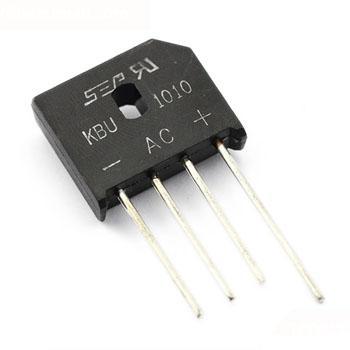
could it be enough to place just one 0.1uF cap across + and - output terminals ?
I do not have instruments to see what actually happens 😱
sorry to take up again a very old thread
if the bridge is of this type ...
could it be enough to place just one 0.1uF cap across + and - output terminals ?
I do not have instruments to see what actually happens 😱

The first post was clear on placement, across the AC or transformer connection.
Snubbing across each diode is dependant on a particular combination and not generic in nature.
Snubbing across each diode is dependant on a particular combination and not generic in nature.
The first post was clear on placement, across the AC or transformer connection.
Snubbing across each diode is dependant on a particular combination and not generic in nature.
Hi ! thanks for the helpful explanation
clearly I got it wrong. Yes I was thinking to diodes snubbing.
I understand that diodes switching creates a high Hz noise difficult to suppress.
I wonder if Schottky integrated bridges exist. I like extremely the convenience of an integrated bridge, with markings to ease connections. 😱

So I'm guessing it's a good idea to always have a cap of some sort on a bridge rectifier to cut potential noise?
-Bryan
On low voltage class ab amps I have never needed caps across bridge.
The only time I found I needed them was a on a valve mixer running at 200 volts. Later I found out I was simply using wrong diodes and the ones I was using switched very noisily.
I now use HER158G diodes and don't need caps.
On low voltage class ab amps I have never needed caps across bridge.
The only time I found I needed them was a on a valve mixer running at 200 volts.
Later I found out I was simply using wrong diodes and the ones I was using switched very noisily.
I now use HER158G diodes and don't need caps.
Hi and thanks for the helpful advice.
May I ask you if you heard the noise or you have only seen it on instruments ?
And if you have seen it where it was located in Hz ?
My opinion is that lab instruments are very important because if I do not see problems using the instruments I will not hear problems.
Because there are no problems.
I am not sure that if I see issues with the instruments I will be able to hear them.
For instance some equipment with good level of distortion can sound quite enjoyable.
Personally since I discovered a spectrum analyzer software I think this instruments is the key to all kind of investigation.
I would love to have the opportunity to play with one.
I understand the good one are very expensive.
Thanks a lot again.
If you can genuinely hear it then it is genuinely there. This does not guarantee that you will see it using instruments; it does guarantee that it is there to be seen by using the right instrument in the right way and interpreting the results in the right way.ginetto61 said:My opinion is that lab instruments are very important because if I do not see problems using the instruments I will not hear problems.
Because there are no problems.
If you can genuinely hear it then it is genuinely there. This does not guarantee that you will see it using instruments;
it does guarantee that it is there to be seen by using the right instrument in the right way and interpreting the results in the right way
Hi and I see your point.
But the last check I had of my ears has left me confused
I am 55, the result was ok for my age but not exceptional. Average.
This means that I have not been able to hear a lot of high Hz signals.
And maybe some lower ones (I did not get the complete lab report, unfortunately 😱 ).
So I tend to trust instruments a lot.
Noise is quite easy to spot with instruments, if it is not minimal of course but in that case it will be hardly an issue.
For instance I can see very easily noise floors of about -100 dB with most of the usb soundcards, even cheap ones. So it is not a problem.
Distortion and the way to measure it for me is the key.
I have been exposed sometime to complete playback system with very low distortion ... the sound was spectacular.
Like looking through a clean glass. I could see/hear everything of the recording.
I still think that the ear can be replaced by instruments correctly used.
However I have the feeling that distortion measurements are not that easy to perform. 🙄
For instance they have almost disappeared from magazine reviews 🙁
I like them a lot.
I would replace my ear with a Spectrum analyzer with trust.
Thanks a lot again.
Yes I could hear the noise on the audio.
Hi ! yes i can believe that.
But i also believe you can also measure it in some way.
I am a little puzzled when i read that designers use instruments to check the performance of their prototypes but perform the final fine-tuning of them by ear 🙄
Maybe the real problem is to understand what to measure and how.
They can even measure resistors noise ...
- Status
- Not open for further replies.
- Home
- Amplifiers
- Solid State
- What does .01 cap on bridge rectifiers do?