
Hello,
I would like to ask if an Opamp with system negative feedback is ever used in an Class A power amplifier. From my humble understanding so far of Class A amps, there is no contradiction. However I fail to see any design that uses it.
I would assume that placing an Opamp in this way would reduce the distortion even further. Without an crossover problems (the OpAmp could be operate as a class A device as well) there should be good results - no?
I would like to ask if an Opamp with system negative feedback is ever used in an Class A power amplifier. From my humble understanding so far of Class A amps, there is no contradiction. However I fail to see any design that uses it.
I would assume that placing an Opamp in this way would reduce the distortion even further. Without an crossover problems (the OpAmp could be operate as a class A device as well) there should be good results - no?
Op-amps have a wide variety of output stages, but the most common is Class B. In addition, they are usually limited to rail-to-rail swings of +/- 15v, have relatively low Gain-Bandwidth products, and are usually internally compensated with a small dominant-pole, which limits the slew-rate and is impossible to remove/alter.
For these reasons, op-amps are rarely found in large-output stages, including power amps of any kind, but are sometimes found in inexpensive preamps, equalizers, active filters, etc.
However, there have been recent op-amps with excellent specs that can be
used in output modules, especially low rail-voltage Class-A stages. Check out the NatSemi LM4562 or similar.
For these reasons, op-amps are rarely found in large-output stages, including power amps of any kind, but are sometimes found in inexpensive preamps, equalizers, active filters, etc.
However, there have been recent op-amps with excellent specs that can be
used in output modules, especially low rail-voltage Class-A stages. Check out the NatSemi LM4562 or similar.
Especially considering the component you note (I was looking at that family from NS) it seems that they have exceptional specs with very low distortion. Most of this distortion would probably still come from crossover, and so biasing the opamp to work in class A itself would remove also part of that.
With this type of performance, I can only imagine that incorporating the opamp into the class A amp feedback would linearlize the whole design and therefore improve it. Apart of feedback fear, are there other reasons why this is avoided in most designs?
Can anyone point me to some designs that actually implement this? All I managed to find is opamps driving output transistors in a class A/B amp.
thanks...
With this type of performance, I can only imagine that incorporating the opamp into the class A amp feedback would linearlize the whole design and therefore improve it. Apart of feedback fear, are there other reasons why this is avoided in most designs?
Can anyone point me to some designs that actually implement this? All I managed to find is opamps driving output transistors in a class A/B amp.
thanks...
Class A operation is inefficient so heat removal is a major issue for small monolithic op amp packages:
removing ~30W from 6x TPA6120 op amps (mounted upside down to contact the op amp's "PowerPad" to the external heatsink)
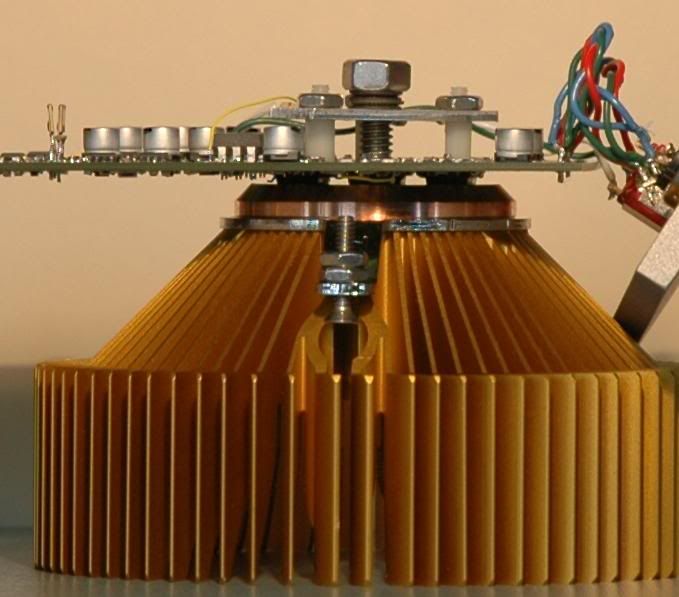
images from a Head-fi Thread where I explained some Class A op amp concepts in my (jcx) posts:
http://www.head-fi.org/forums/f6/ad8397-class-188758/index2.html#post2264079
the above thread shows the TPA6120 Class A biased amp I buit primarily for headphone drive
more bridged/paralleled TPA6120 op amps could give a few 10's of W into loudspeaker loads, higher power class A amps could be made similarly with "GainClone" power audio amp chips which are monolithic power op amps
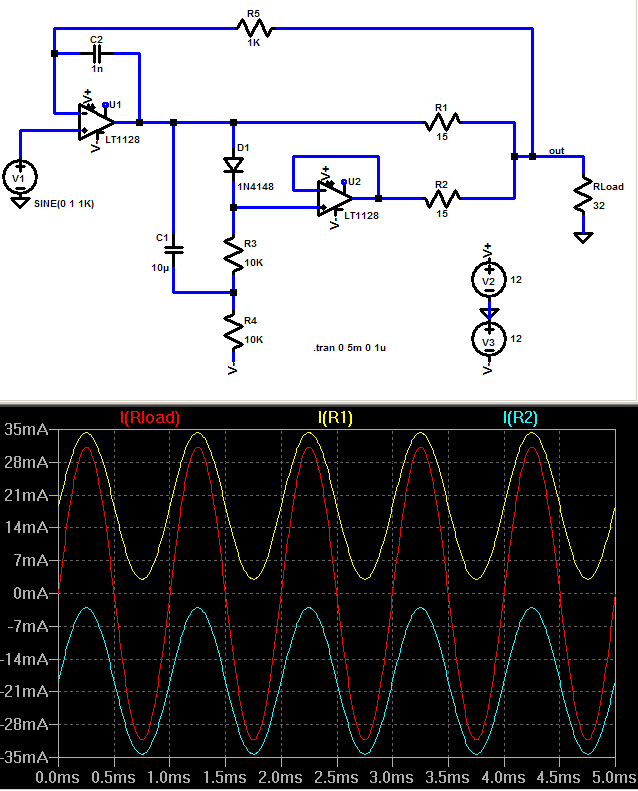
simplified Class A push-pull output bias circuit:
removing ~30W from 6x TPA6120 op amps (mounted upside down to contact the op amp's "PowerPad" to the external heatsink)
images from a Head-fi Thread where I explained some Class A op amp concepts in my (jcx) posts:
http://www.head-fi.org/forums/f6/ad8397-class-188758/index2.html#post2264079
the above thread shows the TPA6120 Class A biased amp I buit primarily for headphone drive
more bridged/paralleled TPA6120 op amps could give a few 10's of W into loudspeaker loads, higher power class A amps could be made similarly with "GainClone" power audio amp chips which are monolithic power op amps
simplified Class A push-pull output bias circuit:
- Status
- Not open for further replies.