
I built a simple preamp based on 1 of Randy slone ciruits from his DIY Audio book. I have Built it on strip board, all the interconnets are screened cable, but I think it seems to be suffering from a poor Signal to noise ratio, when connected to a power amp the white noise quadrupples or more and dominates. I have a 20mhz scope but not sure how to measure and check the SNR. The chip is TL074
Can anyone help weith any advice on what to do
to improve the noise as much as possible. The transformer is in seperate box, so is kept well away from the preamp. The regualtor board is in the same enclosure however.
Thanks
Steevo
Can anyone help weith any advice on what to do
to improve the noise as much as possible. The transformer is in seperate box, so is kept well away from the preamp. The regualtor board is in the same enclosure however.
Thanks
Steevo
Without seeing the circuit, some general things to look out for are oscillations and noise on the regulator board. Be sure to use generous input and output capacitors, and a bypass on the control pin if using something like a 317. The TL074 isn't the lowest noise opamp in the world, but be sure it has good bypass caps right at the power pins of the chip. Keep feedback resistors low, but not so low that the opamp can't drive 'em, or so low that distortion increases. Don't use thick film resistors if doing SMT. Your scope probably won't have enough gain to do s/n directly, but if the power amp is quiet you can take advantage of it's gain of ten or so, just don't overdrive it while making measurements. You're better off to build a small quiet gain stage to help with measurements, but it would have to be way better than your preamp! S/n is just that, divide the maximum amplitude signal the device can output, by the noise with the input shorted. Convert to dB if desired- 20*log(s/n).

steevo said:I have Built it on strip board, all the interconnets are screened cable, but I think it seems to be suffering from a poor Signal to noise ratio, when connected to a power amp the white noise quadrupples or more and dominates.
You haven't mentioned anything about the source feeding your preamp. Is the preamp noisy with the inputs shorted?
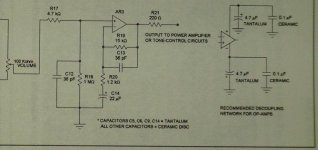
IMO, you just need a quieter opamp. If the opamp were better, you could delete R18 since bias current is taken care of through the pot. You could also attach C12 to the pot side of R17 (Sometimes an HF short directly from input to ground leads to instability, but probably not with the 074). You could also halve the values of the feedback resistors, but none of these things are apt to make much difference until you upgrade the opamp.
Low noise preamp circuit
Has anyone got a good circuit using Ne5532 op amp for a low noise
basic preamp. I have tried the TL074, but not happy with it with poor SNR.
All I want to do is amplify line level output from CD player/ digital reciever to a quad 306. Something basic but low noise. And also a recomneded power supply would usefull as I assume it all connected to the SNR figure. Any other tips on wiring etc would be appreciated.
Thanks
Steevo
Has anyone got a good circuit using Ne5532 op amp for a low noise
basic preamp. I have tried the TL074, but not happy with it with poor SNR.
All I want to do is amplify line level output from CD player/ digital reciever to a quad 306. Something basic but low noise. And also a recomneded power supply would usefull as I assume it all connected to the SNR figure. Any other tips on wiring etc would be appreciated.
Thanks
Steevo
Preamp noise
The preamp I built using the TL074 produces about 0.2678 mv pk to pk of noise, I measure the noise ouput of the amp with and without the preamp connected. The quad 405-2 has a gain of 56.
Is this high for the preamp, does it indicate there is a problem, not sure.
Steevo
The preamp I built using the TL074 produces about 0.2678 mv pk to pk of noise, I measure the noise ouput of the amp with and without the preamp connected. The quad 405-2 has a gain of 56.
Is this high for the preamp, does it indicate there is a problem, not sure.
Steevo

The TL072 is fine and you shouldn't have any noise problems with it. Leave R18 1meg in - it's purpose is not for bias current, but to prevent catastrophic op-amp latchup if the pot goes noisy or open circuit.
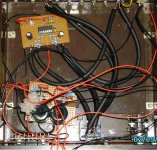
Can you photograph your board? I wonder if your grounding is OK.
If your source is a CD player driving an amp from the 70s I'm surprised you need any form of gain to be honest.
Can you photograph your board? I wonder if your grounding is OK.
If your source is a CD player driving an amp from the 70s I'm surprised you need any form of gain to be honest.

Noise comes from resistance -- so if you can take the 100K volume pot and substitute 25k the noise will go down by 50%
Bypass C14 with a polypropylene or polyester cap...and under no circumstances should C14 be a tantalum cap.
The supply bypass cap leads should be as short as possible. Try the amp without the tantalum bypass caps as well (although this shouldn't be a problem, it can be...)
Don't socket the opamp -- solder it right in.
The TL074 is OK, not a particularly fast opamp, not particularly quiet -- as time equals money you are probably better off spending a few more bucks and purchasing some of the higher end Burr-Brown amps from TI, ADI, National or Linear Tech. the aforementioned NE5532 is a good contender as previously mentioned.
Bypass C14 with a polypropylene or polyester cap...and under no circumstances should C14 be a tantalum cap.
The supply bypass cap leads should be as short as possible. Try the amp without the tantalum bypass caps as well (although this shouldn't be a problem, it can be...)
Don't socket the opamp -- solder it right in.
The TL074 is OK, not a particularly fast opamp, not particularly quiet -- as time equals money you are probably better off spending a few more bucks and purchasing some of the higher end Burr-Brown amps from TI, ADI, National or Linear Tech. the aforementioned NE5532 is a good contender as previously mentioned.


Keruskerfuerst said:You should use a modern opamp like BB OPA627, OPA143PA, AD AD825 or LM4562.
These opamps do produce much less noise and have a much higher slew rate.
I can particularly recommend the National LM4562, it's extremely quiet, and is about as transparent an op-amp as I have heard..
As previously recommended I would change the pot to something like 25K. Note also that the feedback components can be scaled downward for a significant further improvement, and you probably don't need more than 10dB of gain so I would go as far as to scale those resistors to 2K and 4.01K in the feedback network.
The TL072/74 is not particularly quiet and when you gain up the measured output noise with your Quad amp the noise amplitude at the speakers is around 5.3mVrms - quite a lot actually. (And most of it is probably 1/F noise which sounds a lot like a distant rumbling waterfall)
Noisy preamp
Could the reason that it seems noisy is because i am using am amplifier with such a high gain. Even my quad 306 has a gain of about 53. Most modern amp have voltage gain lower than this with an input sensitivty of 1 volt rms. I have built a Giovasni stochino amp which has an low freq loop gain of 32db = voltage 39.81 although this is not that much lower than the quad. The noise I am getting from the preamp is still about 15mv/56 = 0.2678 mv which I think is way too high.
Steevo
Could the reason that it seems noisy is because i am using am amplifier with such a high gain. Even my quad 306 has a gain of about 53. Most modern amp have voltage gain lower than this with an input sensitivty of 1 volt rms. I have built a Giovasni stochino amp which has an low freq loop gain of 32db = voltage 39.81 although this is not that much lower than the quad. The noise I am getting from the preamp is still about 15mv/56 = 0.2678 mv which I think is way too high.
Steevo
Richie is right, best to leave the 1M, as pots do go intermittent over time. From the photo, be absolutely sure your tantalums are installed with correct polarity- tants will generate huge amounts of noise before they fail if installed backwards. Are they even slightly warm?

- Status
- This old topic is closed. If you want to reopen this topic, contact a moderator using the "Report Post" button.
- Home
- Amplifiers
- Solid State
- Poor preamp Singal To Noise Ratio