
Dear forum,
My problem is that I want to eliminate switching noises from light switches into my power supply - and finally to my speakers.
Initial situation:
Power Supply: (from mains 230V in, to DC out +/- 35VDC)
1.) Mains Inlet Filter Schurter FKH 4304.4003 Medicinal Version (http://www.schurter.se/pdf/german/typ_FKH.pdf)
2.) 500VA Noratel Toroid Transformer (Encapsulated Series)
3.) Two Rectifier Bridges (35 Amp. Glass Passivated Bridge Rectifier (Fagor FB 3510)
4.) Fuse
5.) Smoothing caps (2 x 47’000 uF per Rail)
6.) Filtering Caps (2 x 1000uF, 2 x 100 uF 2 x 10 uf, 2 x 0.1 uF) per Rail
Problem:
I can hear switching noises thru my speakers when lights are turned of by light switch or for example also by taking of an electric iron power plug from mains and …
Till now I installed a 0.1uF/630V cap in parallel after the Mains Inlet Filter and in front of the Toroid Transformer. It helped a little bit, but the switching noises are still present.
How can I eliminate those switching noises ? Any opinions ?
Where can i find a frequency spectrum of such a noise to design a filter for it ?
Thanks in advance
artQuake
My problem is that I want to eliminate switching noises from light switches into my power supply - and finally to my speakers.
Initial situation:
Power Supply: (from mains 230V in, to DC out +/- 35VDC)
1.) Mains Inlet Filter Schurter FKH 4304.4003 Medicinal Version (http://www.schurter.se/pdf/german/typ_FKH.pdf)
2.) 500VA Noratel Toroid Transformer (Encapsulated Series)
3.) Two Rectifier Bridges (35 Amp. Glass Passivated Bridge Rectifier (Fagor FB 3510)
4.) Fuse
5.) Smoothing caps (2 x 47’000 uF per Rail)
6.) Filtering Caps (2 x 1000uF, 2 x 100 uF 2 x 10 uf, 2 x 0.1 uF) per Rail
Problem:
I can hear switching noises thru my speakers when lights are turned of by light switch or for example also by taking of an electric iron power plug from mains and …
Till now I installed a 0.1uF/630V cap in parallel after the Mains Inlet Filter and in front of the Toroid Transformer. It helped a little bit, but the switching noises are still present.
How can I eliminate those switching noises ? Any opinions ?
Where can i find a frequency spectrum of such a noise to design a filter for it ?
Thanks in advance
artQuake


artquake said:Thx Eva, but I blame it, because the switching noise is existing also when all other audio components (preamp, cdp and other) are turned off. So only the Amps (PSU) are turned on while this happens.
Do your amplifier's inputs have lowpass RF filters?
Well it's a BPA200 Bridged/Parallel Circuit consisting of two LM4780 including servos. For example HERE (Page 12) In my case all Op's are non-inverted (Gain 22) while using a symmetric input. There is no DC blocking input capacitor @ the input.
Gootee there is no low pass RC filter. But why it should be one in there ?
When i can here the clicks of the light switches thru the speakers, then the noise frequency spectrum is allready in the audible frequenciy range. A filter in here, makes no sense. Or did i missunderstand it ?
Knowledge about the frequency spectrum of a switching noise would be the basic to create a Filter for it. Right ? Any FFT available ?
Best regards
artQuake
Gootee there is no low pass RC filter. But why it should be one in there ?
When i can here the clicks of the light switches thru the speakers, then the noise frequency spectrum is allready in the audible frequenciy range. A filter in here, makes no sense. Or did i missunderstand it ?
Knowledge about the frequency spectrum of a switching noise would be the basic to create a Filter for it. Right ? Any FFT available ?
Best regards
artQuake
Strong picked up RF can disturb op-amps and amplifier circuits resulting in audible noise. Low-pass filters are required on each signal input to keep ambient RF under control. Reducing the gain of op-amp circuits at RF is also recommended, particularly when there are remote potentiometers.
This "less components in the signal path result in better sound" philosophy is completely wrong. It creates noisy, unreliable and unstable circuits most of the time.
This "less components in the signal path result in better sound" philosophy is completely wrong. It creates noisy, unreliable and unstable circuits most of the time.
Thanks Eva,
How does that LP circuit look like ?
In the Feedback:
(For Reducing the gain of op-amp circuits at RF)
At the Input:
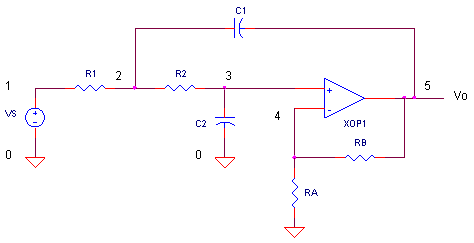
Wich one do i need ? Both ? or only @ Input ? How to calculate the the values ?
Best regards
artQuake
How does that LP circuit look like ?
In the Feedback:
(For Reducing the gain of op-amp circuits at RF)
An externally hosted image should be here but it was not working when we last tested it.
At the Input:
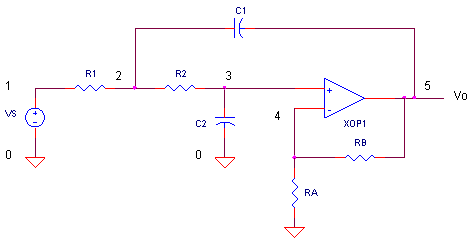
Wich one do i need ? Both ? or only @ Input ? How to calculate the the values ?
Best regards
artQuake
You can start by placing a capacitor from the right side of Rb (1k) to ground (LM4780 schematic). Chose a value to get -0.x dB or so at 20Khz, it may be 2.2nF if the input is driven directly from a low impedance source like that DRV IC, 1nF if it's driven from 1k, etc... Long leads and far ground connections are not desirable. Then check for improvement.
You should not use the RC in the feedback network with a power amplifier because they are not unity gain stable, the gain reduction stuff is only for op-amps, where you can use a capacitor alone to roll off gain above 20Khz.
Sallen-Key filters are not efficient at supressing frequencies well above the audio band because filtering performance is strongly dependent on op-amp output impedance and bandwidth. One or more straight RC filter(s) with buffer(s) inbetween provide better RF rejection (if required, for example in A/D and D/A systems and class D amplifiers to prevent aliasing).
You should not use the RC in the feedback network with a power amplifier because they are not unity gain stable, the gain reduction stuff is only for op-amps, where you can use a capacitor alone to roll off gain above 20Khz.
Sallen-Key filters are not efficient at supressing frequencies well above the audio band because filtering performance is strongly dependent on op-amp output impedance and bandwidth. One or more straight RC filter(s) with buffer(s) inbetween provide better RF rejection (if required, for example in A/D and D/A systems and class D amplifiers to prevent aliasing).
Here's another one i made now ... LP-Filter on Input of LM ...
Ups ... now i realized your post ... OK i'll read it and come back again ...
Thanks in advance
An externally hosted image should be here but it was not working when we last tested it.
Ups ... now i realized your post ... OK i'll read it and come back again ...
Thanks in advance
Ok Eva thanks again,
Here's the revised schematic ...
Is this correct now ?
I only know the formula to get the -3dB Point so if i take your mentioned value of 2.2 nF i get a f-3dB approx. @ 72 kHz. If i use 4.7 nF i get still a f-3dB approx @ 34 kHz.
How do you calculate the frequency roll off @ -0.5 dB Would't you go higher than 2.2 nF due of affection to the music signal ?
Best regards
artQuake
Here's the revised schematic ...
An externally hosted image should be here but it was not working when we last tested it.
Is this correct now ?
I only know the formula to get the -3dB Point so if i take your mentioned value of 2.2 nF i get a f-3dB approx. @ 72 kHz. If i use 4.7 nF i get still a f-3dB approx @ 34 kHz.
How do you calculate the frequency roll off @ -0.5 dB
Would't you go higher than 2.2 nF due of affection to the music signal ?Best regards
artQuake
 muchas gracias !


Eva it works so far but:
As first i must say that i tested it with a biamped LM3886 set.
Each chip had the same input from source, but each chip has it's own LP-Filter with 2.2 nF mounted. What i noticed was that the soundimage wasn't that wide as before adding the caps. I used Kemet Ceramic Caps C0G Type, but i don't think that this results of the cap type. I did not match the caps before i soldered them (I do not have precision measurement apparatuses) I think that the closer soundimage results of small phaseshift if the caps deviate 10% of their values. Or possibly maybe in cause of the low f-3dB point ?
Possible ?
I want to ask this before, because in a speaker crossover setup deviation only changes the crossover frequency between two speakers and for me that was allways unnoticeable. But in the case of a BPA Set consisting of two LM4780 (each LM would have indeed only one LP-Filter) but in "bridged" thoughts would it be possible that the soundstage would result anymore closer as yet ?
I don't now if i think wrong, but is matching those caps in this point of sense indispensable ?
Thanks in advance
Best regards
artQuake
As first i must say that i tested it with a biamped LM3886 set.
Each chip had the same input from source, but each chip has it's own LP-Filter with 2.2 nF mounted. What i noticed was that the soundimage wasn't that wide as before adding the caps. I used Kemet Ceramic Caps C0G Type, but i don't think that this results of the cap type. I did not match the caps before i soldered them (I do not have precision measurement apparatuses) I think that the closer soundimage results of small phaseshift if the caps deviate 10% of their values. Or possibly maybe in cause of the low f-3dB point ?
Possible ?
I want to ask this before, because in a speaker crossover setup deviation only changes the crossover frequency between two speakers and for me that was allways unnoticeable. But in the case of a BPA Set consisting of two LM4780 (each LM would have indeed only one LP-Filter) but in "bridged" thoughts would it be possible that the soundstage would result anymore closer as yet ?
I don't now if i think wrong, but is matching those caps in this point of sense indispensable ?
Thanks in advance
Best regards
artQuake
It *seems* more likely that the -3dB point is just set too low. However, 1.05k and 2.2nF would put the signal down by only 0.5 dB at about 24 kHz, and down by 0.1 dB at about 10.5 kHz. Maybe you have golden ears.
At any rate, you can try a lower capacitance. If that is not satisfactory, maybe then you could try matching the capacitors.
At any rate, you can try a lower capacitance. If that is not satisfactory, maybe then you could try matching the capacitors.
Eva said:Maybe you were finding pleasant the disturbance produced by ambient RF on the input stage of the chip amp...
Wow. I hadn't thought of that! Good one.
That could open up a whole new field of audiophile research: finding just the right type and amount of RF to inject into an amplifier, so that in double-blind testing most audiophiles agree that it has the best [substitute the usual undefinable buzzwords].
 )
)- Status
- This old topic is closed. If you want to reopen this topic, contact a moderator using the "Report Post" button.
- Home
- Amplifiers
- Power Supplies
- Eliminate influence of switching noise from light switch in to power supply