
Dear audio diyers,
I hope that this is the right forum to put my question in, it's more on power-supply than on the amplifier...
To plug my E-Guitar directly into a Mixer or Soundcard, I want to build a tiny battery-powered buffer.
The output of the E-Guitar is high impedance (roughly 100k to 250kOhm).
I decided to use a 3V CR2032.
They're cheap and with 200mAh and more, they should be ok for about 500 hours
The 3V doesn't give me room for some gain, but should just leave enough headroom for my guitar's output/dropping battery voltage/with the rail-to rail Max4236.
There are lower power devices around, but Max4236 was the lowest power device I found with an ok THD...
While probably not really important for an E-Guitar most of the time, I didn't like that most of the lower power devices (0,2mA or less) had an early rising THD and many reached more than 0,1% (but rather 1%) at 10kHz.
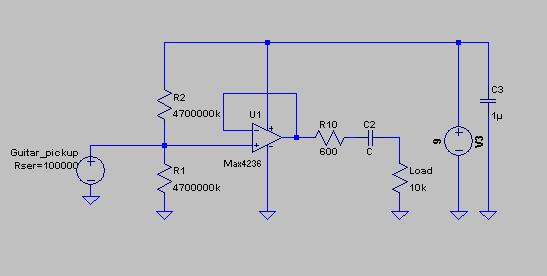
Now I imagined two circuits that should work.
A) Single supply
--------------------------------
B) Split supply
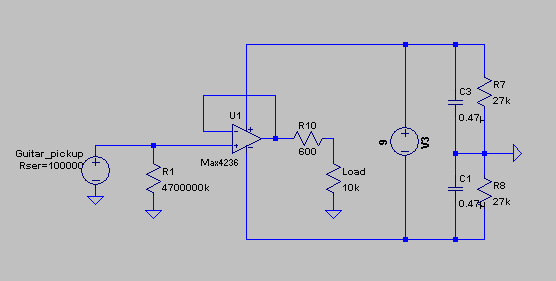
While I use a low offset device anyway, I prefer the one with the Split supply and capacitor-less output.
As the current drain is low (about 0.4mA) I think I'd unify the supply buffer caps and the op-amp's decoupling caps, I think that 0.47uF polyester should be fine here.
But I'm not sure if the split supply via resistors behaves fine.
How would I calculate the output impedance of my circuit?
The op-amp has a rather low output impedance, but don't the high value (27k) split resistors get into the calculation too?
Thanks for reading!
Cheers,
Dominique
I hope that this is the right forum to put my question in, it's more on power-supply than on the amplifier...
To plug my E-Guitar directly into a Mixer or Soundcard, I want to build a tiny battery-powered buffer.
The output of the E-Guitar is high impedance (roughly 100k to 250kOhm).
I decided to use a 3V CR2032.
They're cheap and with 200mAh and more, they should be ok for about 500 hours
The 3V doesn't give me room for some gain, but should just leave enough headroom for my guitar's output/dropping battery voltage/with the rail-to rail Max4236.
There are lower power devices around, but Max4236 was the lowest power device I found with an ok THD...
While probably not really important for an E-Guitar most of the time, I didn't like that most of the lower power devices (0,2mA or less) had an early rising THD and many reached more than 0,1% (but rather 1%) at 10kHz.
Now I imagined two circuits that should work.
A) Single supply
--------------------------------
B) Split supply
While I use a low offset device anyway, I prefer the one with the Split supply and capacitor-less output.
As the current drain is low (about 0.4mA) I think I'd unify the supply buffer caps and the op-amp's decoupling caps, I think that 0.47uF polyester should be fine here.
But I'm not sure if the split supply via resistors behaves fine.
How would I calculate the output impedance of my circuit?
The op-amp has a rather low output impedance, but don't the high value (27k) split resistors get into the calculation too?
Thanks for reading!
Cheers,
Dominique
Go for the single supply. The split supply's caps are in the signal path anyway, in parallel with the 47Ks. Distortion of the output cap in the single supply circuit is negligible.
I think you'll need an input capacitor as well, unless there's no harm in putting a DC voltage across your guitar pickup. I would also lower the input resistors unless you're sure that the 4.7M resistors will supply enough bias current.
I think you'll need an input capacitor as well, unless there's no harm in putting a DC voltage across your guitar pickup. I would also lower the input resistors unless you're sure that the 4.7M resistors will supply enough bias current.
The single supply wouldn't work right anyway, unless there was a DC blocking cap on the input. The DC resistance of a guitar is going to be much lower than the voltage divider resistors, and it will vary from guitar to guitar, and also depending on switch and control settings.
What you might want to try is use another opamp as a buffer for the divider in the second circuit, tie the inverting input to the output and the center of the divider to the non-inverting input, then the output will give you a low impedance virtual ground.
What you might want to try is use another opamp as a buffer for the divider in the second circuit, tie the inverting input to the output and the center of the divider to the non-inverting input, then the output will give you a low impedance virtual ground.
- Status
- Not open for further replies.