

Hallo Kontra, ich schlage vor du wiederholst dein Posting #196 in Deutsch und ich übersetze dann.
Dieses Posting #196 ist bisher die beste Zusammfassung aller technischen Daten deines Designs. Daran sind hier alle sehr interessiert.
Hello Kontra, I suggest you repeat your posting #196 in German and I try to translate.
This posting #196 is your best summary of the technical specifications of your design until now. People around here are interested the most in this.
Michael
 I anderstud u. Completely. Qualitatively. I shall write when I will be helped by friends from Russia.
 Thank all of you for understanding.
Vollstдndig. Qualitativ. Ich werde schreiben wenn mir die Freunde aus Russland helfen werden.
Danke Ihnen alle fur das Verst?ndnis.

i just found this as i have not yet read the compleat thread in its entirety yet.since the summer of 2006 i had been throwing around the same idea.only i was planning to use it strictly for a bass unit thus dramaticly increasing the displacement for a given surface area using esl technology.therefore keeping thd very low and increasing surface area for a higher output .i would like to hear some thoughts on this meanwhile i'll go back to page one and finnish reading, thanks. jer

There was a guy who used to place ads in SpeakerBuilder a bunch of years ago. He was selling ESL kits, including one designed to generate bass. The ads were a bit strange, and my impression was that the person running the business accumulated a less than stellar reputation, but what little information was included in his ads led me to believe he was stacking ESL panels front to back. I don't know if the diaphragms all operated in phase, or whether alternating diaphragms operated out of phase (which would make it somewhat like an AMT). Perhaps someone here has more information or even built one.
Few
Few
yes, i remember that, and almost fell a victim of it .his name was dave some thing(it's on the tip of my tounge too) there were some that claimed i good product and some claimed lack of support and alot that got ripped off as i almost did it was in the very early 90's. by the looks of the drawings in the magazine it had 2 or 4 panels aranged in a v shape using the corner walls as a type of corner loaded horn i searched this site and all over the web. his name came up but never any details of the system.if i remember the name i'll post it for you. jer

There was a guy who used to place ads in SpeakerBuilder a bunch of years ago. He was selling ESL kits, including one designed to generate bass. The ads were a bit strange, and my impression was that the person running the business accumulated a less than stellar reputation, but what little information was included in his ads led me to believe he was stacking ESL panels front to back. I don't know if the diaphragms all operated in phase, or whether alternating diaphragms operated out of phase (which would make it somewhat like an AMT). Perhaps someone here has more information or even built one.
Few
I'd forgotten all about those David Lucas ESL kits. I remember seeing ads for the ESL "subwoofer" with what appeared to be stacked stators with multiple diaphragms. But, like you, I could not figure out if it was an AMT configuration, or a multiple diaphragm arrangement like the ML CLX. It sure got me curious though...
A friend of mine purchased one if the double impact kits. The perforated sheet metal was thin and soft and not coated well enought to keep from geting shocked or arcing. The diaphragm material was crinkly 1 mil. The "special" foam tape was of poor quality with variably thickness, and poor adhesive. The "high-power" fullrange step-up transformers were 15Watt tube amp transformers run backwards. The cores saturated easily with any signal information below 200Hz or so. We used the metal and pitched the rest.
Based on that experience, I quickly lost interest in his ESL subwoofer.
Last edited:
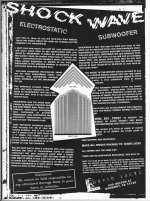
David Lucas Shock Wave ESL Subwoofer
I finally located a copy of the ad for the David Lucas ESL subwoofer.
Obviously not much detail here, but looks to be a 2 pleat AMT using multiple diaphragms in each pleat to increase the available Force per unit area as suggested by Baxandall.
Enjoy this "Secret of the Century"...haha
There was a guy who used to place ads in SpeakerBuilder a bunch of years ago. He was selling ESL kits, including one designed to generate bass. The ads were a bit strange, and my impression was that the person running the business accumulated a less than stellar reputation, but what little information was included in his ads led me to believe he was stacking ESL panels front to back. I don't know if the diaphragms all operated in phase, or whether alternating diaphragms operated out of phase (which would make it somewhat like an AMT). Perhaps someone here has more information or even built one.
Few
I finally located a copy of the ad for the David Lucas ESL subwoofer.
Obviously not much detail here, but looks to be a 2 pleat AMT using multiple diaphragms in each pleat to increase the available Force per unit area as suggested by Baxandall.
Enjoy this "Secret of the Century"...haha
Attachments
Century -11 approximately
LOL. But surely there can be only one "The Century". I think it was 1111 - 910 B.C.
So was that the secret of this century or the last one? I don't want to waste time seeking this century's secret if he already has dibs on it.
Few
LOL. But surely there can be only one "The Century". I think it was 1111 - 910 B.C.
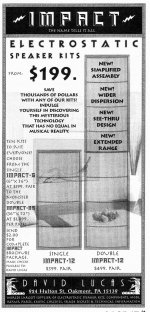
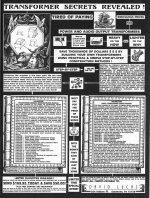
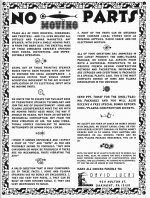
David Lucas Ads from 1998
Since folks seem to have enjoyed the David Lucas ESL subwoofer ad, thought I'd post a couple more I found.
Some of the verbage is so over the top I can't help but laugh out loud.
"We invite you to escape the twilight zone of prehistoric speaker technology and join the age of enlightenment"
Notice also the reference to air-core step-up transformers...how's that for thinking outside the box?
Whoa! What a flashback! Thanks for the memories.
Since folks seem to have enjoyed the David Lucas ESL subwoofer ad, thought I'd post a couple more I found.
Some of the verbage is so over the top I can't help but laugh out loud.
"We invite you to escape the twilight zone of prehistoric speaker technology and join the age of enlightenment"
Notice also the reference to air-core step-up transformers...how's that for thinking outside the box?
Attachments


Last edited:

Hi,
what a great deal! *rotfl*. "Think about this... We are the worlds largest supplier of...........trade secrets and obsure technical information"
To my knowledge obsure has the meaning of: "dubious, insignificant, weird????
Well at least a tiny crumb of truth in his ads ;-)
jauu
Calvin
what a great deal! *rotfl*. "Think about this... We are the worlds largest supplier of...........trade secrets and obsure technical information"
To my knowledge obsure has the meaning of: "dubious, insignificant, weird????
Well at least a tiny crumb of truth in his ads ;-)
jauu
Calvin

I wonder which asylum or penitentiary he now calls home.
Handmade Electronics Indexpage
An externally hosted image should be here but it was not working when we last tested it.
-Since 1992-
Same guy?! If so, the irony of his choice to include this on his site is a bit much:
Beware of the Baghdad Bob's of audio.
A little misinformation can go a long way.
An externally hosted image should be here but it was not working when we last tested it.
Beware of the Baghdad Bob's of audio.
A little misinformation can go a long way.
I saved the website in my favorite for just in case all of the other electronics companys happen to go out of bussiness(or if I need a good laugh)!ha ha ha ha ha !!!
Imagine that,you get to pay all the extra taxes and surcharges and a little more to boot and he still gets a kickback from you buying through his website.
Also make sure you get your order there on Friday otherwise you will have to wait for "Friday after next"!
FUNNY, phone number and addresses but no name incase you need to track or cancel or change or order just get on the UPS website and they will find it for,how conveinent,wish I had thought of that.
I hope anyone smart enough to do diy anything is smart enough to order parts from a reputiable company.
If it is the same guy ,I'm in the right frame of mind to get a plane ticket and go there and frisk him for the plans of the SHOCKWAVE that he owes me and(not or) get my $20 back
It was in 1993 or 1994 that my friend Victor sent him the money.
I have read of people recieving or aquiring his kits and plans but they never came forth to explain the results including the SHOCKWAVE plans.
The gromme circuit is real something using "CONVENTIONAL PARTS" but exclude the phono preamp because its outdated but it DOES have a TONE SECTION,YEAAAA!
Need I quote anymore?
I've had enough.
The last link I had when he went defunct went to a porn site and a crappy one at that! jer
Imagine that,you get to pay all the extra taxes and surcharges and a little more to boot and he still gets a kickback from you buying through his website.
Also make sure you get your order there on Friday otherwise you will have to wait for "Friday after next"!
FUNNY, phone number and addresses but no name incase you need to track or cancel or change or order just get on the UPS website and they will find it for,how conveinent,wish I had thought of that.
I hope anyone smart enough to do diy anything is smart enough to order parts from a reputiable company.
If it is the same guy ,I'm in the right frame of mind to get a plane ticket and go there and frisk him for the plans of the SHOCKWAVE that he owes me and(not or) get my $20 back
It was in 1993 or 1994 that my friend Victor sent him the money.
I have read of people recieving or aquiring his kits and plans but they never came forth to explain the results including the SHOCKWAVE plans.
The gromme circuit is real something using "CONVENTIONAL PARTS" but exclude the phono preamp because its outdated but it DOES have a TONE SECTION,YEAAAA!
Need I quote anymore?
I've had enough.
The last link I had when he went defunct went to a porn site and a crappy one at that! jer
Last edited:

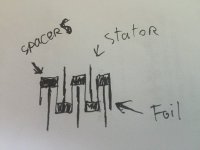
hmmm i was thinking about this setup, again for the 100000 time. and i see one flaw. correct me if im wrong but using normal esl panels wont get you what you want i believe.
in my opinion the stators need to be closed ? i mean the foil is already acoustical transparent. if the stators are as well, we get allot of out of phase issues ?
should be easy to make and test. i just slit 10 stators from pcb, add spacers to one side. cnc bottom and top plate with slits where the stators can sit in.
coat some mylar with licron, and zigzag the foil between the stator and clamp it at both ends.
, no need to reverse polarisation. since if you did all membrames would move in phase to eachother wich then does not result in the pump function the amt s have.
in my opinion the stators need to be closed ? i mean the foil is already acoustical transparent. if the stators are as well, we get allot of out of phase issues ?
should be easy to make and test. i just slit 10 stators from pcb, add spacers to one side. cnc bottom and top plate with slits where the stators can sit in.
coat some mylar with licron, and zigzag the foil between the stator and clamp it at both ends.
, no need to reverse polarisation. since if you did all membrames would move in phase to eachother wich then does not result in the pump function the amt s have.
Attachments


- Status
- This old topic is closed. If you want to reopen this topic, contact a moderator using the "Report Post" button.
- Home
- Loudspeakers
- Planars & Exotics
- Electrostatic AMT?