
Hi,
Thanks for concerns. But, er... do you mean those un-baffled speakers on sides? Hehe...
If so, I didn't keep posting in that thread is because there's no response. So I thought there's no interest. Also, there've been already a lot of threads related to dipole speakers, so why bother?
Thanks for concerns. But, er... do you mean those un-baffled speakers on sides? Hehe...
If so, I didn't keep posting in that thread is because there's no response. So I thought there's no interest. Also, there've been already a lot of threads related to dipole speakers, so why bother?
So I just found this thread last night, and after several hour of reading I thought I might add my 2 cents. Firstly, it seems that people are not treating these as being open baffle di-pole which means that you can actually choose your bass cut off based on the size of the baffle. If you want to get an 80 Hz cutoff, you only need a 40" square of material. This means that you can actually make 2 decent sounding speakers with a single 8'x4' sheet of gatorboard. Also, it seems likely that a round baffle would give the best dispersion pattern, but that is not very easy to make.
The other thing no one has mentioned is using multiple baffle materials to make multi-way, crossoverless speakers. I've seen multiple people mention that the highs can be really finiky, and also that glass makes for really good sounding highs but terrible bass. It seems to me that if you got a 6" square piece of really thin glass, you could mount one exciter on it, suspend it in front of a medium sized gatorboard speaker and then run all the exciters from the same source. This would give you incredibly clear highs (including the overlap from the glass, and gatorboard speakers), without sacrificing on bass.
I have 6 of these on order from Parts Express, and I will do some experiments with them and report back on the possibility of making 2-way, crossoverless, DMLs. Also, thanks for all the very interesting information. Did Ziggy ever report back on how he ended up mounting his speakers?
The other thing no one has mentioned is using multiple baffle materials to make multi-way, crossoverless speakers. I've seen multiple people mention that the highs can be really finiky, and also that glass makes for really good sounding highs but terrible bass. It seems to me that if you got a 6" square piece of really thin glass, you could mount one exciter on it, suspend it in front of a medium sized gatorboard speaker and then run all the exciters from the same source. This would give you incredibly clear highs (including the overlap from the glass, and gatorboard speakers), without sacrificing on bass.
I have 6 of these on order from Parts Express, and I will do some experiments with them and report back on the possibility of making 2-way, crossoverless, DMLs. Also, thanks for all the very interesting information. Did Ziggy ever report back on how he ended up mounting his speakers?
Hi,
Some good points. And I'm looking forward to see your findings on the following experiments.
Multiway is a double sided sword, same here.
In my experiences, DML panel can be very good down to about 40Hz and wonderfully real in playing drums. ( Of course, drum skin is a bending wave device, LOL ! )
Under that, my cone drivers do better. I haven't tried heavier panels, though...
Good luck
Some good points. And I'm looking forward to see your findings on the following experiments.
Multiway is a double sided sword, same here.
In my experiences, DML panel can be very good down to about 40Hz and wonderfully real in playing drums. ( Of course, drum skin is a bending wave device, LOL ! )
Under that, my cone drivers do better. I haven't tried heavier panels, though...
Good luck
I know that DML are still gonna be big, but I was referring to finding the proper size to get me a predetermined bass cut-off.
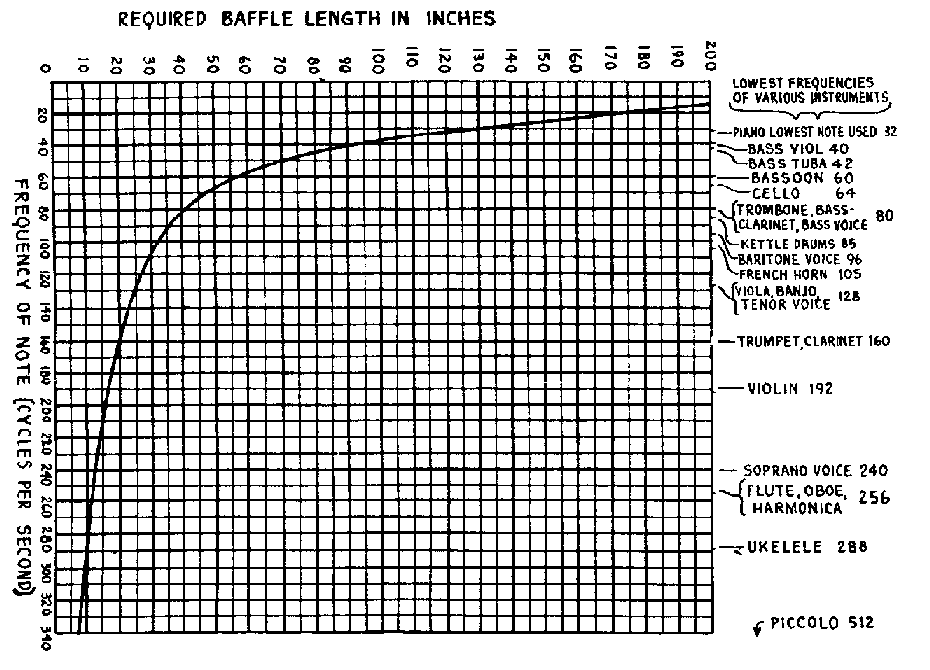
Based on what I know about open baffle speakers (of which I believe these are a variant), the low end cut off occurs when the sound waves produced by the front, destructively interfere with the sound waves from the back. This cut off point is determined by the size of the baffle in relation to the wavelength of the sound waves. I don't know the exact formula, but I have attached a graph that shows baffle length vs frequency.
[image]
 [/image]
Based on the graph, a cut off of 80 Hz would need a 40"x40" pieces of gatorboard which I would say is "small" compared to your behemoth (but awesome) center channel. If I were to use these as rear or side speakers, I might consider making them full wall sized so that I would get great surround imaging. I'm not sure they would make good room dividers thought because you would sound out of both side.
I still haven't gotten my exciters, so I am not 100% sure that these actually act as open baffles or something totally different wrt being dipoles. I should have them next week and then I can start experimenting.
I've also been working on some potential designs for mounting the panels, and I will try to get them drawn up this week.
CLS - do you have any bass cutoff measurements for your panel, and what are the dimensions of your panel? Also, do you get dead sound areas when you stand directly on the side of the panel?
Based on what I know about open baffle speakers (of which I believe these are a variant), the low end cut off occurs when the sound waves produced by the front, destructively interfere with the sound waves from the back. This cut off point is determined by the size of the baffle in relation to the wavelength of the sound waves. I don't know the exact formula, but I have attached a graph that shows baffle length vs frequency.
[image]
Based on the graph, a cut off of 80 Hz would need a 40"x40" pieces of gatorboard which I would say is "small" compared to your behemoth (but awesome) center channel. If I were to use these as rear or side speakers, I might consider making them full wall sized so that I would get great surround imaging. I'm not sure they would make good room dividers thought because you would sound out of both side.
I still haven't gotten my exciters, so I am not 100% sure that these actually act as open baffles or something totally different wrt being dipoles. I should have them next week and then I can start experimenting.
I've also been working on some potential designs for mounting the panels, and I will try to get them drawn up this week.
CLS - do you have any bass cutoff measurements for your panel, and what are the dimensions of your panel? Also, do you get dead sound areas when you stand directly on the side of the panel?
I'm afraid real world LF performances of these panels would vary a lot by many factors.
This is (was) the panel I mentioned which plays down to 40Hz and excellent on playing drums
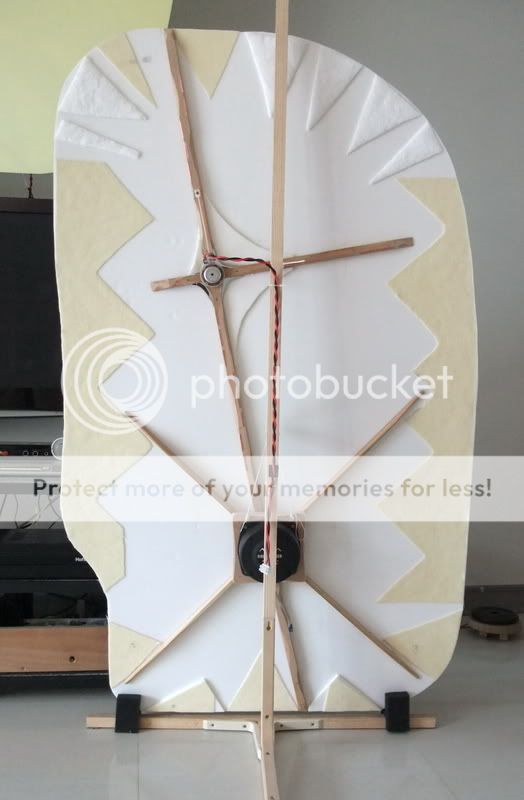
It's a 5mm thick PS foam board with wooden frame (ribs) as can be seen on the picture. Overall dimensions are 150cm by 90cm or so. There're 2 drivers on the panel, the small one on top plays fullrange and the bottom bigger one (a bass shaker actually) plays LF only.
Despite the decent bass sound, I dropped it for other drawbacks and lackings.
The central panel in my current system is 180cm by 90cm overall, 3mm thick foamcore board. It's limited by the HPF in line level. I've not tried running it fullrange to see its bass capability. No need, anyway.
As to the null, yes I hear it on the side of the panel. The null zone is very narrow, and can be detected only in higher frequency. Mid to bass is more like bipole or even nearly omni. Basically, you just hear full band everywhere in the room.
This is (was) the panel I mentioned which plays down to 40Hz and excellent on playing drums
It's a 5mm thick PS foam board with wooden frame (ribs) as can be seen on the picture. Overall dimensions are 150cm by 90cm or so. There're 2 drivers on the panel, the small one on top plays fullrange and the bottom bigger one (a bass shaker actually) plays LF only.
Despite the decent bass sound, I dropped it for other drawbacks and lackings.
The central panel in my current system is 180cm by 90cm overall, 3mm thick foamcore board. It's limited by the HPF in line level. I've not tried running it fullrange to see its bass capability. No need, anyway.
As to the null, yes I hear it on the side of the panel. The null zone is very narrow, and can be detected only in higher frequency. Mid to bass is more like bipole or even nearly omni. Basically, you just hear full band everywhere in the room.
So after some more research on DMLs and based on your observations it looks like the dipole theory is totally wrong.
I have been trying to do some research on how to calculate the necessary size panel in order to achieve a chosen low frequency cut-off, but I do not understand enough about audio engineering to work my way through the math. I still think that the bass is going to be limited by the shortest dimension (as opposed to total area), but I will have to wait for my exciters to come before I can test that theory.
I did have an idea for making a light weight, super thin panel by tensioning a mylar film over a frame (like the head of a drum). I am not sure how well this would work, but if it does it would likely allow for better HF sound than foam panels. Also, the panel would have a higher sensitivity because there is less mass to be moved. This would basically be the extreme opposite of current designs on this thread (fully clamped edges vs unclamped). If it works, a tensioned panel might even be cheaper than the gatorboard, and with the right film, it could be totally clear. I will also test this design out once I get my exciters.
I have been trying to do some research on how to calculate the necessary size panel in order to achieve a chosen low frequency cut-off, but I do not understand enough about audio engineering to work my way through the math. I still think that the bass is going to be limited by the shortest dimension (as opposed to total area), but I will have to wait for my exciters to come before I can test that theory.
I did have an idea for making a light weight, super thin panel by tensioning a mylar film over a frame (like the head of a drum). I am not sure how well this would work, but if it does it would likely allow for better HF sound than foam panels. Also, the panel would have a higher sensitivity because there is less mass to be moved. This would basically be the extreme opposite of current designs on this thread (fully clamped edges vs unclamped). If it works, a tensioned panel might even be cheaper than the gatorboard, and with the right film, it could be totally clear. I will also test this design out once I get my exciters.
- Status
- This old topic is closed. If you want to reopen this topic, contact a moderator using the "Report Post" button.
- Home
- Loudspeakers
- Planars & Exotics
- PIEZO NXT type panel