


This idea is easier to do than it is to explain. Find a simple “full-range” cone driver (no tweeters, no cross-over, and no box). Any piece of junk which is about 4” or larger will do. A car speaker, a paper speaker from an old radio, anything like that will do. Momentarily connect a 1.5 volt battery across its terminals. The cone will either pop out toward you or pop into toward the magnet. You can confirm it by touching the cone gently with your fingers if the cone doesn’t move visually very much. Now you know the polarity of the cone. Whichever terminal on the cone driver that corresponds to the cone going out toward the listener when the positive side of the battery is connected should be labeled the “+” terminal. We’ll use that cone as a polarity reference. Now attach wires to both the Heil and the cone (in parallel) and connect one lead to the battery. Leave the other battery connection loose as you will touch the wire momentarily to the battery to make some popping sounds. Now hold the drivers up close to your ears like headphones (they do NOT have to be very close for this to work, and we don’t want to deafen you). A helper might be necessary. Momentarily touch the free end of the wire to the battery. You will hear pops. Alternate the polarity of the wires going to the Heil relative to the cone. In one polarity the pops will appear to be coming from inside your head. With the other polarity the pops will sound diffuse and be outside your head. Try this over and over again until you’re sure (this is not hard to do). When the sound of the pop is distinctly inside your head, the Heil and the reference cone are “in phase”. In that configuration, note which terminal of the Heil driver is connected to the “+” terminal on the cone. Mark that Heil terminal with a red dot or a “+” mark. You can also play a 1KHz square or triangle wave through both drivers, or even play music or noise to determine phasing, but the pops are the easiest to create and are easy to discern.
PS: Make sure that the Heil's cross-over is not in the circuit; the connection should be directly to the Heil's terminals. And - keep that marked reference cone for future use.
PS: Make sure that the Heil's cross-over is not in the circuit; the connection should be directly to the Heil's terminals. And - keep that marked reference cone for future use.

That agrees with some more info I've gotten, but it gets more interesting because it appears that ESS used different color pairs at different times.
Don't take this as gospel, but I think these pairings and polarity are correct:
If Pair of
Light Pink and Violet
Light Pink = neg
Violet = pos.
If Pair of
Blue and Grey(ish)
Blue = neg
Grey = pos
If Pair of
Blue and Violet.
Blue = neg.
Violet = pos.
That last pair I call Blue and Violet are probably the same as your Blue and Purple. I think Purple and Violet might be similar to different people, especially after wires get old, sunfaded, and stained or discolored some.
Note that there IS some continuity in that Violet is positive no matter what pair it's in, and Blue is negative no matter what pair it's in.
That's all I've got...
Don't take this as gospel, but I think these pairings and polarity are correct:
If Pair of
Light Pink and Violet
Light Pink = neg
Violet = pos.
If Pair of
Blue and Grey(ish)
Blue = neg
Grey = pos
If Pair of
Blue and Violet.
Blue = neg.
Violet = pos.
That last pair I call Blue and Violet are probably the same as your Blue and Purple. I think Purple and Violet might be similar to different people, especially after wires get old, sunfaded, and stained or discolored some.
Note that there IS some continuity in that Violet is positive no matter what pair it's in, and Blue is negative no matter what pair it's in.
That's all I've got...
OH!!!!! The people who say their wires are light pink must be describing what has happened to the pair I have......
UV FADE!!!!
On the bottom of my Heils the wires are a rich blue/purple(violet), but on the top at the connector they are an extremely faded pink/washed out violet color. I guess some of the pink wire could also be described as grey(ish).
UV FADE!!!!
On the bottom of my Heils the wires are a rich blue/purple(violet), but on the top at the connector they are an extremely faded pink/washed out violet color. I guess some of the pink wire could also be described as grey(ish).
theAnonymous1 said:On my pair + is purple and - is blue.
Yes, but what happens when you turn the magnet body 180 deg
around?
As I stated above the only way to know for sure is to look at
what the diaphragm is doing, pushing or pulling air with a +
electrical pulse.
cheers
T
The SURE way is to use some FFT software and a mic - set it to show the impulse response.
Of course start with a driver of known polarity, in case something in ur signal chain is inverting polarity.
_-_-bear
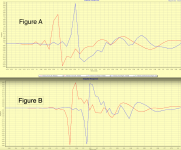
Quoting a very old post here but can you or anyone help me with which of these is positive polarity ?
Figure A or Figure B is positive polarity?
I read on other forums the Heils are internally phase reversed .
I'm colour blind so can't determine by looking at the wiring colours
Attachments

- Status
- This old topic is closed. If you want to reopen this topic, contact a moderator using the "Report Post" button.
- Home
- Loudspeakers
- Planars & Exotics
- Determining the Polarity of a Great Heil