

Hi all,
I've read lots of recommendations for the use of dual bridge rectifiers in PSUs, but have not read any clear justification for this design. Can anyone point me at a good reference or state the reasoning here?
Examples:
Diagram 3 here: http://www.tnt-audio.com/clinica/ssps1_e.html
http://www.kk-pcb.com/power-2.html
Cheers,
Dan
I've read lots of recommendations for the use of dual bridge rectifiers in PSUs, but have not read any clear justification for this design. Can anyone point me at a good reference or state the reasoning here?
Examples:
Diagram 3 here: http://www.tnt-audio.com/clinica/ssps1_e.html
http://www.kk-pcb.com/power-2.html
Cheers,
Dan

This might explain best:
Originally posted by Nelson Pass
Most customers want total silence from the amplifier, including
mechanical noise. If there is not complete matching between the
secondary coils and only 1 rectifier bridge, any net DC imbalance
between the current of the + supply and the - will tend to
saturate the core of the transformer and create noise. This is
seen for quite low current differences and can also show up with
low frequency output. Using two bridges eliminates the problem.
In the eyes of a manufacturer, any other subtle differences
pale in comparison to the cost of having to replace a transformer
in the field due to mechanical noise.
Originally posted by Nelson Pass
Most customers want total silence from the amplifier, including
mechanical noise. If there is not complete matching between the
secondary coils and only 1 rectifier bridge, any net DC imbalance
between the current of the + supply and the - will tend to
saturate the core of the transformer and create noise. This is
seen for quite low current differences and can also show up with
low frequency output. Using two bridges eliminates the problem.
In the eyes of a manufacturer, any other subtle differences
pale in comparison to the cost of having to replace a transformer
in the field due to mechanical noise.

The tnt-audio article goes on to state:
"But the real reason why this is done is twofold. First, this allows for much better channel separation, since each supply line is independent, and is therefore much less likely to transmit signal from one channel to the other. The other reason is essentially the same, but with regard to ground planes - this method produces more ground planes, but avoids mixing them, thus once again minimizing possibilities of crosstalk and improving our signal to noise ratios. For this to be so, one also needs dedicated transformer secondary windings, for a stereo amp a total of four, rather than the classic two. Obviously, while good and with many advantages, this is a considerably more expensive design."
Any merit in this explaination? Or, is toroidal core saturation the only reason?
Perhaps a better question would be, if the two windings happened to be perfectly matched, is there any benefit in using two bridge rectifiers?
Babowana - I know I read that note from Nelson sometime in the past, but somehow missed it when reading today. Where was it from out of interest?
Cheers,
Dan
"But the real reason why this is done is twofold. First, this allows for much better channel separation, since each supply line is independent, and is therefore much less likely to transmit signal from one channel to the other. The other reason is essentially the same, but with regard to ground planes - this method produces more ground planes, but avoids mixing them, thus once again minimizing possibilities of crosstalk and improving our signal to noise ratios. For this to be so, one also needs dedicated transformer secondary windings, for a stereo amp a total of four, rather than the classic two. Obviously, while good and with many advantages, this is a considerably more expensive design."
Any merit in this explaination? Or, is toroidal core saturation the only reason?
Perhaps a better question would be, if the two windings happened to be perfectly matched, is there any benefit in using two bridge rectifiers?
Babowana - I know I read that note from Nelson sometime in the past, but somehow missed it when reading today. Where was it from out of interest?
Cheers,
Dan
monarodan said:But the real reason why this is done is twofold. First, this allows for much better channel separation, since each supply line is independent, and is therefore much less likely to transmit signal from one channel to the other.
I don't know very well.
But, in my opinion, if the supply voltage rails provide a virtually perfect AC-ground at the location of PSU caps, the two cannel signals would not be mixed. If so, the transformer having either one or two secondaries do not matter.
Babowana - I know I read that note from Nelson sometime in the past, but somehow missed it when reading today. Where was it from out of interest?
http://www.diyaudio.com/forums/showthread.php?s=&threadid=90728&perpage=10&pagenumber=15

hi
Some 2-windings transformers are said in Feature: can be paralleled
I guess this means that such transformers 2 windings are VERY Good matched.
That the difference is very small.
Say one winding is 12.1 V AC and the other is 11.9 V AC
in an 2x12 Volt AC transformer.
If I read Nelson right, he says that EVEN small differences
can cause unwanted disturbance in a bridge recitifier,
where each 2 windings will alternate to supply both positive and negative.
When using 2 bridge rectifiers,
one winding is used only for positive
and the other is used only for negative.
And there is no interference.
I also think you need 2 completely separated windings = 4 wires.
To use 2 bridges on one 3 wires 12-0-12 transformer is not possible.
Transformers with 3 wires and middle 0V are not as useful as
two windings transformers.
lineup
Some 2-windings transformers are said in Feature: can be paralleled
I guess this means that such transformers 2 windings are VERY Good matched.
That the difference is very small.
Say one winding is 12.1 V AC and the other is 11.9 V AC
in an 2x12 Volt AC transformer.
If I read Nelson right, he says that EVEN small differences
can cause unwanted disturbance in a bridge recitifier,
where each 2 windings will alternate to supply both positive and negative.
When using 2 bridge rectifiers,
one winding is used only for positive
and the other is used only for negative.
And there is no interference.
I also think you need 2 completely separated windings = 4 wires.
To use 2 bridges on one 3 wires 12-0-12 transformer is not possible.
Transformers with 3 wires and middle 0V are not as useful as
two windings transformers.
lineup
Thankyou - I hade read that thread but only searched the PSU and Pass Labs forums today! The follow on discussion from that post is useful also.
Thanks!
The claim that two bridges (in this configuration) give better isolation between channels is utter balderdash. However, using a separate bridge (or, by extension dual bridges) for each channel can help.
The floating ground argument is valid.
Grey
The floating ground argument is valid.
Grey

US patent 4555751
Similar idea but for use with a Centre tapped transformer, points out that the filter caps are seldem the same value also. I think James Bongiorno speced bifilar power transformers, maybe for a similar reason?
Regards
James
A DC power supply circuitry comprises an AC power source transformer with its secondary winding having a center tap; a rectifier circuit; a smoothing circuit; and a bidirectional switching circuit having predetermined threshold values, interposed in between the center tap and the smoothing circuit.
Similar idea but for use with a Centre tapped transformer, points out that the filter caps are seldem the same value also. I think James Bongiorno speced bifilar power transformers, maybe for a similar reason?
Regards
James

lineup said:
Some 2-windings transformers are said in Feature: can be paralleled
I guess this means that such transformers 2 windings are VERY Good matched.
That the difference is very small.
Do you need to load the parallelized transformer heavily before you can hear the hum if any?
Wiring secondaries in parallel can be done--I've got two amps downstairs right now that do so--but that's not the point of using dual rectifiers. The rails in the post above are in series.
Grey
Grey

Can i use different diode bridge ( kbpc3504 & kbpc3506, different manufacturer ) for each transformer windings for my dual power supply.


This might explain best:
Originally posted by Nelson Pass
Most customers want total silence from the amplifier, including
mechanical noise. If there is not complete matching between the
secondary coils and only 1 rectifier bridge, any net DC imbalance
between the current of the + supply and the - will tend to
saturate the core of the transformer and create noise. This is
seen for quite low current differences and can also show up with
low frequency output. Using two bridges eliminates the problem.
If a +/- voltage PSU is built using dual bridges (with two secondary outputs) and then have common Gnd after the caps......if one bridge has slightly larger voltage drop than the other so an imbalance is created this way.....could this also cause DC in the transformer core and create transformer noise?
This would fit with my observations......
dual bridge config is exactly there to prevent DC imbalance between two windings with center tap
when two windings are isolated from each other , current imbalance is not resulting in core saturation
when two windings are isolated from each other , current imbalance is not resulting in core saturation
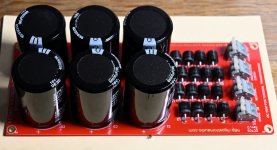

Nelson Pass invented the dual bridge rectifier psu afaik, and the justification was to get rid of the transformer center tap and isolate galvanically the power traffo to the filter caps...
one reason to avoid the center tapped power traffo secondary is when there is a slight imbalance in ac secondary voltage due the the winding technic of one coil atop the other and not bifillar winding...
in the Audio circa 1980 GAS Ampzilla amplifier article at the Audio magazine, Jim Bonjiorno made mention of this, he said unbalanced secondary's can cause ground loops owing to unequal voltages at the secondary wrt to the center tap...
one reason to avoid the center tapped power traffo secondary is when there is a slight imbalance in ac secondary voltage due the the winding technic of one coil atop the other and not bifillar winding...
in the Audio circa 1980 GAS Ampzilla amplifier article at the Audio magazine, Jim Bonjiorno made mention of this, he said unbalanced secondary's can cause ground loops owing to unequal voltages at the secondary wrt to the center tap...
- Home
- Amplifiers
- Pass Labs
- Dual Bridge Rectifiers in PSU - why?