
Hi all,
It's weekend again, so I find myself sitting in front of my PC, runnning hunderds of spice simmulation. This time I have come up with a variation of the Zen amplifier.
Originally the Zen amp constitues of a MOSFET working through a constant current source (CCS). In the Aleph's and the AX-200 and the later Zen versions the output stage is similar, but the CCS is replaced by a current source that varies it's current output by reacting upon the current put through a sensing resistor in series woth the speaker output. It's a patented topology.
I never understood what the big advantage was of this topology. Isn't it essentially a push-pull output topology in which the upper transistor is driven by the voltage variation over the sensing resistor and not by a same AC signal as the lower transistor?
If you look at the original Zen, you can easely identify two MOSFETs: the lower one configured as amplifying stage, the upper one as CCS. This upper MOSFET can very easely be configured as a gainstage, thereby doubling efficiency, lowering distrtion by a factor of at least 4 and improving damping factor. Essentially the same benefits as the latest Zen variation.
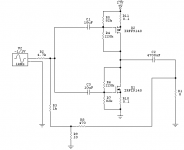
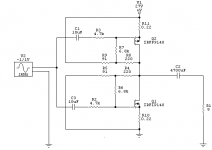
So I draw such a Zen variation in my spice and here it is for you all to critisize.....
It's just a Zen with the upper MOSFET configured similar as the lower MOSFET, a stabilizing resistor, and some way to keep the feedback network low impedance to reduce MOSFET cap related distortion.
greetings,
Thijs
PS What IS the big benefit of the patented output stage? I'm sure there is but I don't undertstand yet.
It's weekend again, so I find myself sitting in front of my PC, runnning hunderds of spice simmulation. This time I have come up with a variation of the Zen amplifier.
Originally the Zen amp constitues of a MOSFET working through a constant current source (CCS). In the Aleph's and the AX-200 and the later Zen versions the output stage is similar, but the CCS is replaced by a current source that varies it's current output by reacting upon the current put through a sensing resistor in series woth the speaker output. It's a patented topology.
I never understood what the big advantage was of this topology. Isn't it essentially a push-pull output topology in which the upper transistor is driven by the voltage variation over the sensing resistor and not by a same AC signal as the lower transistor?
If you look at the original Zen, you can easely identify two MOSFETs: the lower one configured as amplifying stage, the upper one as CCS. This upper MOSFET can very easely be configured as a gainstage, thereby doubling efficiency, lowering distrtion by a factor of at least 4 and improving damping factor. Essentially the same benefits as the latest Zen variation.
So I draw such a Zen variation in my spice and here it is for you all to critisize.....
It's just a Zen with the upper MOSFET configured similar as the lower MOSFET, a stabilizing resistor, and some way to keep the feedback network low impedance to reduce MOSFET cap related distortion.
greetings,
Thijs
PS What IS the big benefit of the patented output stage? I'm sure there is but I don't undertstand yet.
Attachments
The Aleph current source is simply a way to increase the efficiency of a single-ended class A amp.
By using the current sensing array at the output, it's able to monitor the current actually being drawn by the load, rather than assuming that the output stage knows what it's doing.(Not always a good assumption.) This constitutes a separate feedback loop and helps lower distortion.
You can remove the current sensing array and set it up to sense voltage if you want.
Is it push-pull? In a sense, yes. In another, no. It depends on whether you define a push-pull output stage as receiving its drive <i>only</i> from the input stage. There's no requirement that I've ever seen that an output get its signal from any particular place. You could beam it in from Mars if you wanted. However, most people think of it as coming from the front end. The lower MOSFET in an Aleph clearly gets its drive from the front end differential. The upper MOSFET has a number of options:
--You can run it as a conventional current source. There are a number of designs like this on the web. Or you can simply remove a few parts from the Aleph current source. A member here did this to a production Aleph, then seemed unable to understand that it was no longer an Aleph <i>per se</i> since he had disabled the very thing that made the Aleph current source unique. At that point, you have a Zen with a front end.
--You can run it as an Aleph current source, deriving its signal from the current.
--You can run it as an Aleph current source, deriving its signal from the voltage.
--Or you can contrive a drive signal (remove all the Aleph stuff) and make it a 'normal' push-pull output. This would be more efficient, but by definition would no longer be single-ended. You're off into another topology entirely.
Grey
By using the current sensing array at the output, it's able to monitor the current actually being drawn by the load, rather than assuming that the output stage knows what it's doing.(Not always a good assumption.) This constitutes a separate feedback loop and helps lower distortion.
You can remove the current sensing array and set it up to sense voltage if you want.
Is it push-pull? In a sense, yes. In another, no. It depends on whether you define a push-pull output stage as receiving its drive <i>only</i> from the input stage. There's no requirement that I've ever seen that an output get its signal from any particular place. You could beam it in from Mars if you wanted. However, most people think of it as coming from the front end. The lower MOSFET in an Aleph clearly gets its drive from the front end differential. The upper MOSFET has a number of options:
--You can run it as a conventional current source. There are a number of designs like this on the web. Or you can simply remove a few parts from the Aleph current source. A member here did this to a production Aleph, then seemed unable to understand that it was no longer an Aleph <i>per se</i> since he had disabled the very thing that made the Aleph current source unique. At that point, you have a Zen with a front end.
--You can run it as an Aleph current source, deriving its signal from the current.
--You can run it as an Aleph current source, deriving its signal from the voltage.
--Or you can contrive a drive signal (remove all the Aleph stuff) and make it a 'normal' push-pull output. This would be more efficient, but by definition would no longer be single-ended. You're off into another topology entirely.
Grey

Thijs
I've always felt the same way about the Aleph topology. The purity of SE seems corrupted in order to improve the efficiency. And a lytic involved. These are just observational thoughts as i've never built one. Interestingly, the people who build them don't seem to feel the patented current source sounds inferior. As often the case in audio there may be more than meets the eye.
cheers
peter
I've always felt the same way about the Aleph topology. The purity of SE seems corrupted in order to improve the efficiency. And a lytic involved. These are just observational thoughts as i've never built one. Interestingly, the people who build them don't seem to feel the patented current source sounds inferior. As often the case in audio there may be more than meets the eye.
cheers
peter


GRollins said:--You can run it as an Aleph current source, deriving its signal from the current.
--You can run it as an Aleph current source, deriving its signal from the voltage.
Grey
Are there any advantages to using current-sensing
over voltage-sensing (or vise versa)?
Dennis
Hi all,
The circuits are only concepts and now real pratical plans. I wanted to make a point about the alephs output stages:
That's my question also!
If not, than the Penultimate Zen uses a unnessecary complicated way of establishing push-pull functioning.
I do understand the benifits of push-pull and I have shown how easy it is to modify the traditional Zen amp into push-pull ( about 4 resistors and a capacitor). So what is the benefit of Pass patented output stage besides a marketing hype about being Single Ended?
gr,
Thijs
The circuits are only concepts and now real pratical plans. I wanted to make a point about the alephs output stages:
Are there any advantages to using current-sensing over voltage-sensing (or vise versa)?
That's my question also!
If not, than the Penultimate Zen uses a unnessecary complicated way of establishing push-pull functioning.
I do understand the benifits of push-pull and I have shown how easy it is to modify the traditional Zen amp into push-pull ( about 4 resistors and a capacitor). So what is the benefit of Pass patented output stage besides a marketing hype about being Single Ended?
gr,
Thijs
- Status
- This old topic is closed. If you want to reopen this topic, contact a moderator using the "Report Post" button.
- Home
- Amplifiers
- Pass Labs
- Zen modification