

Hi A.wayne,
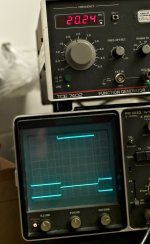
I have some extra square waves on 8 ohms.
The amp bandwidth is from DC to 2 MHz . .
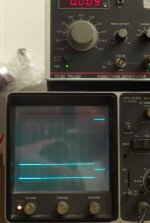
10 Hz (scope set on DC) Not bad . . . 🙂
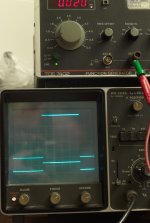
20 Hz
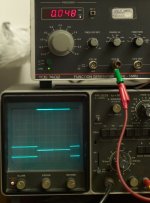 -
- 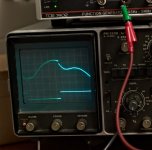
50 Hz, with 50 Hz PS reaction
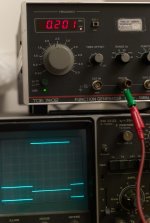
200 Hz (it is getting boring, they are all the same)
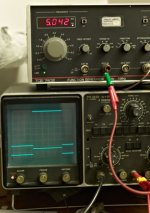
5.000 Hz
 ,
, 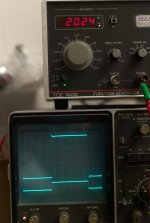
20 K on 8 ohm and 4 ohm
Here we see a slight overshoot that is not harmful and does not impact real life music.
I have some extra square waves on 8 ohms.
The amp bandwidth is from DC to 2 MHz . .
10 Hz (scope set on DC) Not bad . . . 🙂
20 Hz
- 50 Hz, with 50 Hz PS reaction
200 Hz (it is getting boring, they are all the same)
5.000 Hz
, 20 K on 8 ohm and 4 ohm
Here we see a slight overshoot that is not harmful and does not impact real life music.
Attachments

I changed the feedback a few days back, by taking out the 2,7 nF caps I had across the 50 ohms resistors.
Immediately I got the much wanted 'laid back' character, easy listening.
Of course the power supply caps are now getting 'burned in' (formatted), that is positive too.
Really funny because the pole it introduced was as high as 1,2 MHz - still you can hear it clearly.
I listened to a Charlin recording (two microphone concept) and indeed the hall characteristics are good to hear. (Sorry, that is Dinglish).
In fact, the amplifier is 'disappearing'. The sound now is completely transparent. 🙂
albert
Immediately I got the much wanted 'laid back' character, easy listening.
Of course the power supply caps are now getting 'burned in' (formatted), that is positive too.
Really funny because the pole it introduced was as high as 1,2 MHz - still you can hear it clearly.
I listened to a Charlin recording (two microphone concept) and indeed the hall characteristics are good to hear. (Sorry, that is Dinglish).
In fact, the amplifier is 'disappearing'. The sound now is completely transparent. 🙂
albert
I've been away for some time.
On returning - - - I loved the sound, so relaxed and full of fine details. Bebel Gilberto; Charpentier sung messes pour les trépasses. Authentic voice and stage.
The characteristics that the sound has the same atmosphere regardless of the pot setting still surprises me, this means the amp can very well follow low and lowest sound levels.
A hint of highs expanding, but that recedes as 'the sound settles'.
albert
On returning - - - I loved the sound, so relaxed and full of fine details. Bebel Gilberto; Charpentier sung messes pour les trépasses. Authentic voice and stage.
The characteristics that the sound has the same atmosphere regardless of the pot setting still surprises me, this means the amp can very well follow low and lowest sound levels.
A hint of highs expanding, but that recedes as 'the sound settles'.
albert

Hi,I've been away for some time.
On returning - - - I loved the sound, so relaxed and full of fine details. Bebel Gilberto; Charpentier sung messes pour les trépasses. Authentic voice and stage.
The characteristics that the sound has the same atmosphere regardless of the pot setting still surprises me, this means the amp can very well follow low and lowest sound levels.
A hint of highs expanding, but that recedes as 'the sound settles'.
albert
Please if you are able to give this schematic makes the final amplifier F5?
Since I am not much versed in electronics.
thank you
Hi,
Please if you are able to give this schematic makes the final amplifier F5?
Since I am not much versed in electronics.
thank you
Hi Formula,
the schematics are the standard F5, though I used other output devices than the stock ones [IRF9p0920].
To cater for the Toshiba's I had to change the fixed drain resistors of the input (a bit down in value), but really not to a value the potmeter in the stock schema won't get. And the source resistors are 0.47 ohms too.
So the standard set of components will work good. And with these Toshiba's the thermistor is not needed.
Why Toshiba's: they have less capacitance (and less current) than the IRF mosfets, this helps in the bandwidth.
The (standard) set can be bought with boards and all components by the way.
albert
Gees..... I had never considered using my F5 as a final-stage power amp for my 160-meter ham rig.....but now I'll have to reconsider...! 😀
Gees..... I had never considered using my F5 as a final-stage power amp for my 160-meter ham rig.....but now I'll have to reconsider...! 😀
The output has to be shielded and pasband optimised (like Roscoe Primrose says) and the PS fitted with snubbers, coils etc.
In my setting there is a slight peak around 6,5 MHz, with proper layout this can be remedied. Note that the resistors are coils at these frequencies. For instance a common metalized 10 ohm resistor could rise to 100 ohm.
But the basic structure could work . . . low harmonics and low impedance is just what you will like. 🙂
Of course you saw that Papa's new SITS make great radar amplifiers - likewise these Toshiba's have been used in RF equipment too.
Of course you saw that Papa's new SITS make great radar amplifiers - likewise these Toshiba's have been used in RF equipment too.
Was kinda kidding about using/abusing the F5 as a ham power amp. I've already built some 1 kw solid-state linears that are broadband--as in no tuning, for any ham band between 80 to 10 meters.
I also worked on a team that used similar SiC technologies for a large UHF (430 Mhz) phased-array radar. SiC, SiT.....amazing technologies!

One of my F5's looking into the HP3577a
An externally hosted image should be here but it was not working when we last tested it.

Jack,
Nice to see your confirmation of what I saw. I assume top is voltage, lower phase.
Perfect isn't it?
Interesting, you get the same 6/7 MHz bump as I (but I assumed mine was higher, but out of range anyway for my measurement), and thought: it could as well be an artifact.
What output did you use? Which PCB?
albert
Nice to see your confirmation of what I saw. I assume top is voltage, lower phase.
Perfect isn't it?
Interesting, you get the same 6/7 MHz bump as I (but I assumed mine was higher, but out of range anyway for my measurement), and thought: it could as well be an artifact.
What output did you use? Which PCB?
albert
I think you can make the bump go away by matching the gate stoppers on the JFETs and MOSFETs. The original design just used a 1K resistor and tied the gates together.
I used my own PCB's -- I provisioned them so I could adjust the source resistors on the input stage for lowest THD% It turns out that the 200 ohm pot (P3) is much easier to implement.
I used my own PCB's -- I provisioned them so I could adjust the source resistors on the input stage for lowest THD% It turns out that the 200 ohm pot (P3) is much easier to implement.
differential version of the B1 Buffer
We have built a differential version of the B1 Buffer. It sounds very good. Much more detail for the DIY set at
intrator.dyndns.org/Audio.html
We have built a differential version of the B1 Buffer. It sounds very good. Much more detail for the DIY set at
intrator.dyndns.org/Audio.html
Update
In the past months I have enjoyed my F5.
At times i heard that there was some slew rate limiting. This can be heard with violins or complex symphonics or singing. Either from my Aikido preamp or from my F5.
I have Quad ESL 57's, with a low impedance of 1 ohm virtual at 20 KHz. Hence my choice to implement it. But if it triggers, it hurts the ears. So I took out the limiter function of the F5 by disconnecting the collector legs of the transistors Q4 and Q6.
This gave some more clarity. But not enough.
So I decided to oust the Aikido. I had found that the Aikido is great for pop music and non complex material, but sort of dominated a lot of complex music like classical music. My choice fell on the SP6, for which I had made a test circuit in the past using ECC82 in the first position.
I now settled on the ECC81 and 12.5 dB of amplification and this way I came up with a very dynamic line amplifier. The combo gives an infinite dynamic levels of sounds. Less than 0,01% by the way and able to output 20V RMS.
It surprises me how the F5 shows all the small tinkering of the preamps, of DACs and other active components.
In the past months I have enjoyed my F5.
At times i heard that there was some slew rate limiting. This can be heard with violins or complex symphonics or singing. Either from my Aikido preamp or from my F5.
I have Quad ESL 57's, with a low impedance of 1 ohm virtual at 20 KHz. Hence my choice to implement it. But if it triggers, it hurts the ears. So I took out the limiter function of the F5 by disconnecting the collector legs of the transistors Q4 and Q6.
This gave some more clarity. But not enough.
So I decided to oust the Aikido. I had found that the Aikido is great for pop music and non complex material, but sort of dominated a lot of complex music like classical music. My choice fell on the SP6, for which I had made a test circuit in the past using ECC82 in the first position.
I now settled on the ECC81 and 12.5 dB of amplification and this way I came up with a very dynamic line amplifier. The combo gives an infinite dynamic levels of sounds. Less than 0,01% by the way and able to output 20V RMS.
It surprises me how the F5 shows all the small tinkering of the preamps, of DACs and other active components.

We have built a differential version of the B1 Buffer. It sounds very good. Much more detail for the DIY set at
intrator.dyndns.org/Audio.html
Nice to see some quality projects on your website dude 😉 Especially interconnects 😉
Best,
nAr
You can give a schematic that preamplifier with ecc82 or ecc81In the past months I have enjoyed my F5.
At times i heard that there was some slew rate limiting. This can be heard with violins or complex symphonics or singing. Either from my Aikido preamp or from my F5.
I have Quad ESL 57's, with a low impedance of 1 ohm virtual at 20 KHz. Hence my choice to implement it. But if it triggers, it hurts the ears. So I took out the limiter function of the F5 by disconnecting the collector legs of the transistors Q4 and Q6.
This gave some more clarity. But not enough.
So I decided to oust the Aikido. I had found that the Aikido is great for pop music and non complex material, but sort of dominated a lot of complex music like classical music. My choice fell on the SP6, for which I had made a test circuit in the past using ECC82 in the first position.
I now settled on the ECC81 and 12.5 dB of amplification and this way I came up with a very dynamic line amplifier. The combo gives an infinite dynamic levels of sounds. Less than 0,01% by the way and able to output 20V RMS.
It surprises me how the F5 shows all the small tinkering of the preamps, of DACs and other active components.
thank you and cheers!
You can give a schematic that preamplifier with ecc82 or ecc81
thank you and cheers!
I'll work on it.
Too bad when I made my distortion measurements I did not have my camera at hand.
The basic schema is:
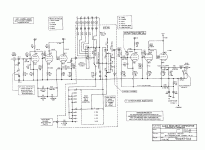
It took me quite some time to get it under control, I started this time with ECC83 and I ended with ECC801S.
albert

In the past months I have enjoyed my F5.
At times i heard that there was some slew rate limiting. This can be heard with violins or complex symphonics or singing. Either from my Aikido preamp or from my F5.
I have Quad ESL 57's, with a low impedance of 1 ohm virtual at 20 KHz. Hence my choice to implement it. But if it triggers, it hurts the ears. So I took out the limiter function of the F5 by disconnecting the collector legs of the transistors Q4 and Q6.
This gave some more clarity. But not enough.
So I decided to oust the Aikido. I had found that the Aikido is great for pop music and non complex material, but sort of dominated a lot of complex music like classical music. My choice fell on the SP6, for which I had made a test circuit in the past using ECC82 in the first position.
I now settled on the ECC81 and 12.5 dB of amplification and this way I came up with a very dynamic line amplifier. The combo gives an infinite dynamic levels of sounds. Less than 0,01% by the way and able to output 20V RMS.
It surprises me how the F5 shows all the small tinkering of the preamps, of DACs and other active components.
Thanks for the update, glad to hear you are enjoying your f5 on the quads ...
- Status
- Not open for further replies.
- Home
- Amplifiers
- Pass Labs
- 1M-F5 - A 1 MHz F5 project