
I have been reading up on loudspeaker impedance matching using transformers. From what i understand, a step down transformer can be used to allow an amplifier to drive a speaker with a lower than the rated maximum impedance, with optimum power output.
Does this actually work?
For (simplistic) eg, a 100 W amp rated for 8 Ohm loads. Using I^2R rule, maximum current is only 3+ amp (sqrt(12.5) at 30+ volts. If a 2 ohm speaker is hooked up, assuming the amp does not blow, it drive its rated current (or a bit more) into the 2 ohm load, giving only 12.5x2 = 25 watts (or a bit more).
If a 4:1 ratio transformer is connected between the amp and the speaker, the 30+ volt and 3+amp (100W) output from the amp is converted to a 30+/4 volt 3+X4 amp output (with some heating losses in the transformer) for the speaker.
This means that, effectively, the amp can now drive the 2 ohm speaker using its full 100W rated power into 8 ohm, yet with a high current lower voltage signal going into the 2 ohm speaker.
What are the drawbacks? My thoughts below:
1) The windings of the transformer act as a inductor, effectively becoming a low pass filter in the signal path. This may be a good thing (or negligible) if driving a subwoofer.
2) Heating losses in the transformer, ie 100 W transformer for 100W amp?
3) How does this otherwise affect the sound quality? I understand that this is commonly used in PA systems for long speaker wire runs at higher voltages and lower currents.
Comments and thoughts appreciated!! Cheers!
Does this actually work?
For (simplistic) eg, a 100 W amp rated for 8 Ohm loads. Using I^2R rule, maximum current is only 3+ amp (sqrt(12.5) at 30+ volts. If a 2 ohm speaker is hooked up, assuming the amp does not blow, it drive its rated current (or a bit more) into the 2 ohm load, giving only 12.5x2 = 25 watts (or a bit more).
If a 4:1 ratio transformer is connected between the amp and the speaker, the 30+ volt and 3+amp (100W) output from the amp is converted to a 30+/4 volt 3+X4 amp output (with some heating losses in the transformer) for the speaker.
This means that, effectively, the amp can now drive the 2 ohm speaker using its full 100W rated power into 8 ohm, yet with a high current lower voltage signal going into the 2 ohm speaker.
What are the drawbacks? My thoughts below:
1) The windings of the transformer act as a inductor, effectively becoming a low pass filter in the signal path. This may be a good thing (or negligible) if driving a subwoofer.
2) Heating losses in the transformer, ie 100 W transformer for 100W amp?
3) How does this otherwise affect the sound quality? I understand that this is commonly used in PA systems for long speaker wire runs at higher voltages and lower currents.
Comments and thoughts appreciated!! Cheers!

rhapsodee said:Does this actually work?
...
What are the drawbacks? My thoughts below:
1) The windings of the transformer act as a inductor, effectively becoming a low pass filter in the signal path. This may be a good thing (or negligible) if driving a subwoofer.
2) Heating losses in the transformer, ie 100 W transformer for 100W amp?
3) How does this otherwise affect the sound quality? I understand that this is commonly used in PA systems for long speaker wire runs at higher voltages and lower currents.
Yes, it works. Of course the transformer adds its own distortion, particularly
on the bottom end, but it may still be less than the amplifier will suffer into
2 ohms instead of 8. And of course if it's a tube amp, it probably already
has the transformer, so you simply ask for additional secondary taps.

Thanks!
So how about the low pass filter part? Or does the inductance of the primary and secondary windings somehow cancel each other out?
Otherwise full-range PA systems using high voltage with a step down transformers would have a significantly rolled off high frequency extension, which is not the case...
So, the question remains, any good sources for a 4:1 winding ratio transformer? To present an 8 ohm load to the amp, from a 2 ohm voice coil...
Thanks again!
So how about the low pass filter part? Or does the inductance of the primary and secondary windings somehow cancel each other out?
Otherwise full-range PA systems using high voltage with a step down transformers would have a significantly rolled off high frequency extension, which is not the case...
So, the question remains, any good sources for a 4:1 winding ratio transformer? To present an 8 ohm load to the amp, from a 2 ohm voice coil...
Thanks again!

Hi !
..check this out:
http://www.zeroimpedance.com/Zero-New.html
..they work great in (after) my Atmasphere OTL' s and Paul Speltz is a nice guy...
Best regards,
Dragan P.
..check this out:
http://www.zeroimpedance.com/Zero-New.html
..they work great in (after) my Atmasphere OTL' s and Paul Speltz is a nice guy...
Best regards,
Dragan P.
Hi,
the turns ratio determines the voltages at the input and output.
If you want to work with impedances then use [turns ratio]^2.
For conversion from 8ohm to 2ohm you need a turns ratio of 2:1
One of the common uses for an output transformer is to drive a ribbon tweeter. This does not need any bass nor mid and it becomes much easier to design the transformer for the much reduced bandwidth.
the turns ratio determines the voltages at the input and output.
If you want to work with impedances then use [turns ratio]^2.
For conversion from 8ohm to 2ohm you need a turns ratio of 2:1
One of the common uses for an output transformer is to drive a ribbon tweeter. This does not need any bass nor mid and it becomes much easier to design the transformer for the much reduced bandwidth.
rhapsodee said:So how about the low pass filter part? Or does the inductance of the primary and secondary windings somehow cancel each other out?
Sort of.
Hi,
Thanks a lot for the responses, and pointing out my mistakes.
The speaker i'm planning to drive is a 2 ohm subwoofer, using a NAD amp.
After more thought, i note the following:
1) Theoratically, if the amp is ideal, an amp rated at 100W into 8 ohm should produce 400W into 2Ohm, assuming the amp output voltage stays constant, and the current is able to scale up 4x into the low impedance load.
a) Now if i hook up the non-ideal 100W NAD amp into the 2 0hm sub, i'm probably getting maybe 200W, together with distortion, straining the amp risking overheat due to the high current. But i am getting more power (200W) into the speaker.
b) The alternative with the 2:1 (i stand corrected) matching transformer to present a nice 8ohm load to the amp, i would get only 100W, but cleaner, less distortion and no risk of damaging the amp.
The question is, how does a) sound compared to b) in terms of loudness, and sound quality? I'm assuming the sub would play 3dB louder when connected per a) and getting maybe 200W, and conversely play 3dB softer with only 100W with b), but with less distortion.
What would be a good compromise? Transform the 2ohm load into a 4 ohm load to get more power, with managable distortion? That would need a 1.41:1 ratio transformer.
Thanks for the patience reading my ramblings. Hope to get a better understanding and start modifying my setup.
PS: I'm actually currently running the 2 ohm sub direct from the amp at the moment, i don't know if the sound quality is affected, but the amp does not overheat or go into protection under normal listening. It did once, when i was playing 30Hz test tones, lol.
Thanks a lot for the responses, and pointing out my mistakes.
The speaker i'm planning to drive is a 2 ohm subwoofer, using a NAD amp.
After more thought, i note the following:
1) Theoratically, if the amp is ideal, an amp rated at 100W into 8 ohm should produce 400W into 2Ohm, assuming the amp output voltage stays constant, and the current is able to scale up 4x into the low impedance load.
a) Now if i hook up the non-ideal 100W NAD amp into the 2 0hm sub, i'm probably getting maybe 200W, together with distortion, straining the amp risking overheat due to the high current. But i am getting more power (200W) into the speaker.
b) The alternative with the 2:1 (i stand corrected) matching transformer to present a nice 8ohm load to the amp, i would get only 100W, but cleaner, less distortion and no risk of damaging the amp.
The question is, how does a) sound compared to b) in terms of loudness, and sound quality? I'm assuming the sub would play 3dB louder when connected per a) and getting maybe 200W, and conversely play 3dB softer with only 100W with b), but with less distortion.
What would be a good compromise? Transform the 2ohm load into a 4 ohm load to get more power, with managable distortion? That would need a 1.41:1 ratio transformer.
Thanks for the patience reading my ramblings. Hope to get a better understanding and start modifying my setup.
PS: I'm actually currently running the 2 ohm sub direct from the amp at the moment, i don't know if the sound quality is affected, but the amp does not overheat or go into protection under normal listening. It did once, when i was playing 30Hz test tones, lol.

Having built Graham's T-bass circuit I found that it works great for Open baffle bass speakers. However, the circuit has a downside: it presents a very low impedance load to the amp. I have driven it with the Sony TA-N511 amp. At normal volumes it is OK, but if played louder, at bass transients it tends to go into protection mode. The solution with the transformers may help to overcome this. Four F4's would certainly work wonders, but that would be too hot...

nagard said:..they work great in (after) my Atmasphere OTL' s and Paul Speltz is a nice guy...
An output transformer in an OTL is just hilarious. $450 for a pair of basically power supply quality transformers?
Ok, i rewired the sub today. Previously, i was driving each of the 2ohm voice coil (DVC sub) with one channel of the NAD.
Today, i series-ed the sub to make 4 ohm, and bridged the NAD. I then used a 240V/110V 200VA transformer to connect the sub to the bridged amp. 110V side to sub, 240V side to amp.
By my calculations, 240/110 = 2.182. Giving a impedance multiplication of 4.76. This presents a 19ohm load to the bridged NAD.
When i first hooked it up, i did a tap test of the woofer to see if it had better damping. One of my main gripes with the sub previously was boominess into the midbass frequencies, despite a 3rd low pass with 60hz corner freq. Anyway, it had greater control of the woofer, with a well damped thud.
When i played music, it was very soft!!! i turned up the sub output to max (+10dB) and it was still sounded like 10dB softer than the previous connection method.
I was stunned for a while, and obviously quite disappointed. Then it struck me that the small 200VA transformer had quite a bit of DC resistance. A quick check confirmed it: 10ohms. Is this the cause of the low output? How does it affect the power transfer between the amp and the sub?
1) Is the 19 ohm effective impedance after the matching transformer too high? As a result, the bridged NAD is not able to effectively drive the sub?
2) How does the 10ohm resistance in the transformer coils affect the whole equation? I'm thinking of getting a 500VA transformer, would it help? Will measure the DC resistance of the windings, how low should it be to be negligible? 1 ohm?
3) I'm in singapore, so the recommended transformers are not readily available. What would be my best option? Get a custom wound transformer? What would be the optimum turns ratio with the 4ohm series voice coil and the bridged amp?
4) Lastly, what is an F4? Sorry, for my ignorance.
Thanks for the time and comments!
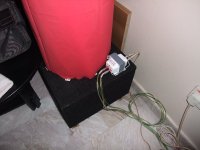
I guess a picture speaks a thousand words...
Today, i series-ed the sub to make 4 ohm, and bridged the NAD. I then used a 240V/110V 200VA transformer to connect the sub to the bridged amp. 110V side to sub, 240V side to amp.
By my calculations, 240/110 = 2.182. Giving a impedance multiplication of 4.76. This presents a 19ohm load to the bridged NAD.
When i first hooked it up, i did a tap test of the woofer to see if it had better damping. One of my main gripes with the sub previously was boominess into the midbass frequencies, despite a 3rd low pass with 60hz corner freq. Anyway, it had greater control of the woofer, with a well damped thud.
When i played music, it was very soft!!! i turned up the sub output to max (+10dB) and it was still sounded like 10dB softer than the previous connection method.
I was stunned for a while, and obviously quite disappointed. Then it struck me that the small 200VA transformer had quite a bit of DC resistance. A quick check confirmed it: 10ohms. Is this the cause of the low output? How does it affect the power transfer between the amp and the sub?
1) Is the 19 ohm effective impedance after the matching transformer too high? As a result, the bridged NAD is not able to effectively drive the sub?
2) How does the 10ohm resistance in the transformer coils affect the whole equation? I'm thinking of getting a 500VA transformer, would it help? Will measure the DC resistance of the windings, how low should it be to be negligible? 1 ohm?
3) I'm in singapore, so the recommended transformers are not readily available. What would be my best option? Get a custom wound transformer? What would be the optimum turns ratio with the 4ohm series voice coil and the bridged amp?
4) Lastly, what is an F4? Sorry, for my ignorance.
Thanks for the time and comments!
I guess a picture speaks a thousand words...
Attachments
Ok, went to get a new transformer over the weekend.
Settled on a toroid for 50bucks, customised the turns ratio to 1.41, to give a impedance ratio of 2X.
So this gives a 8 0hm load from the 4 ohm series voice coils, and the amp is happily driving, with better control and less distortion.
Subjectively, there is much less boom in the bass, and it blends much better with my mains.
Thanks a lot for the help and advice, truly appreciate it!
Not sure of the VA rating, but it does not even feel warm after prolonged playing at high volumes. The amp runs cool too! Amazing!
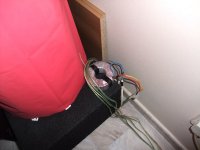
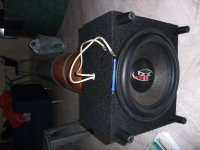
Pic attached. Will prob install the toriodal trafo inside the box when i finally get round to building the proper transmission line box for the sub.
Settled on a toroid for 50bucks, customised the turns ratio to 1.41, to give a impedance ratio of 2X.
So this gives a 8 0hm load from the 4 ohm series voice coils, and the amp is happily driving, with better control and less distortion.
Subjectively, there is much less boom in the bass, and it blends much better with my mains.
Thanks a lot for the help and advice, truly appreciate it!
Not sure of the VA rating, but it does not even feel warm after prolonged playing at high volumes. The amp runs cool too! Amazing!
Pic attached. Will prob install the toriodal trafo inside the box when i finally get round to building the proper transmission line box for the sub.
Attachments
- Status
- This old topic is closed. If you want to reopen this topic, contact a moderator using the "Report Post" button.
- Home
- Amplifiers
- Pass Labs
- Impedance matching transformer