
OK, so it looks like we should see the B1 buffer boards from Mr. Pass soon. Got my LSK170s from the group buy and getting all ready for this. I know others are too.
Part of getting ready is matching these transistors. So I just want to bring this up as a separate thread as I buried it in another thread on the B1 buffer a while back. Alos, I searched and a lot otf the matching posts have to do with high current output devices, not small signal like these.
For myself and the benefit of others, I would like to know how to match LSK170 "B" devices for use in the B1 buffer.
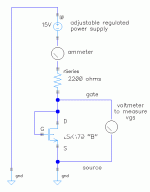
I built a little setup based on Nelsons FET matching article found at passdiy.com. It uses a 15 volt regulated supply, and a 2.2K series resistor as called out in the article. I added a current meter in series with the power supply so I could monitor the current flowing through the FET.
Diagram of setup:
note: diagram attatched below, expand to full size to see all connections, otherwise (on my computer at least) gate to drain wire is missing. Shows up when full screen.
Basically, how does this circuit work? I see that the gate is tied up to the drain.
That’s makes the gate positive with respect to the source. But that’s all I know.
What’ happening here?
Anyway, when I measured, I got what I thought were strange results. Basically across 20 devices I measured roughly a vgs of .240 volts. The current in all cases was approx 6.6mA. I would think that a vgs of .240V would hardly turn on the device, plus that means only .240 was across the device (drain to source) which does not seem like much, but what do I know?
Anyway, thinking that the results were odd, I posted about the results in the B1 buffer thread.
Someone wrote back to say 2.2k was the wrong value resistor and I should be using 10 volts and 100 ohms instead. When I did that, my little trimpot that sets the resistance got hot quite quickly. The current flowing was 94mA for the second or two I had it turned on.
Is that because 10V/100ohms = 100mA? Seems like it . But can the LSK170 pass that kind of current even for a moment?
OK, so I am in need of more help. To match the LSK170, using the circuit called out in Nelsons article, what value resistor do I use? What do I set the power supply to?
And when all is working well, what vgs values should I expect to read in this test setup? That’s what I really need to know.
I mean roughly. What should vgs be? Is it 200mV, a volt, 2 volts, I have no idea.
Also, what sets the current that flows in the resistor and the FET (which are in series with each other) during the test?
I would think that since it’s a series circuit, the current that flows is the power supply voltage divided by the sum of the series resistor and the resistance of the FET.
Since the gate is tied up to the drain, and it’s an NFET, I assume the FET is turned on hard. But I have no idea what the resistance of the FET is during this condition.
Basically, what knob can I turn to get the current through the FET to be roughly 6 to 8 mA so I can do the vgs matching at a current similar to the current that the FETs will see when used in the B1 buffer? (That was a mouthful)
Lots of questions I know, but I do know that I’m not the only one with them.

Thanks for all the help, much appreciated
Curt
Part of getting ready is matching these transistors. So I just want to bring this up as a separate thread as I buried it in another thread on the B1 buffer a while back. Alos, I searched and a lot otf the matching posts have to do with high current output devices, not small signal like these.
For myself and the benefit of others, I would like to know how to match LSK170 "B" devices for use in the B1 buffer.
I built a little setup based on Nelsons FET matching article found at passdiy.com. It uses a 15 volt regulated supply, and a 2.2K series resistor as called out in the article. I added a current meter in series with the power supply so I could monitor the current flowing through the FET.
Diagram of setup:
note: diagram attatched below, expand to full size to see all connections, otherwise (on my computer at least) gate to drain wire is missing. Shows up when full screen.
Basically, how does this circuit work? I see that the gate is tied up to the drain.
That’s makes the gate positive with respect to the source. But that’s all I know.
What’ happening here?
Anyway, when I measured, I got what I thought were strange results. Basically across 20 devices I measured roughly a vgs of .240 volts. The current in all cases was approx 6.6mA. I would think that a vgs of .240V would hardly turn on the device, plus that means only .240 was across the device (drain to source) which does not seem like much, but what do I know?
Anyway, thinking that the results were odd, I posted about the results in the B1 buffer thread.
Someone wrote back to say 2.2k was the wrong value resistor and I should be using 10 volts and 100 ohms instead. When I did that, my little trimpot that sets the resistance got hot quite quickly. The current flowing was 94mA for the second or two I had it turned on.
Is that because 10V/100ohms = 100mA? Seems like it . But can the LSK170 pass that kind of current even for a moment?
OK, so I am in need of more help. To match the LSK170, using the circuit called out in Nelsons article, what value resistor do I use? What do I set the power supply to?
And when all is working well, what vgs values should I expect to read in this test setup? That’s what I really need to know.
I mean roughly. What should vgs be? Is it 200mV, a volt, 2 volts, I have no idea.
Also, what sets the current that flows in the resistor and the FET (which are in series with each other) during the test?
I would think that since it’s a series circuit, the current that flows is the power supply voltage divided by the sum of the series resistor and the resistance of the FET.
Since the gate is tied up to the drain, and it’s an NFET, I assume the FET is turned on hard. But I have no idea what the resistance of the FET is during this condition.
Basically, what knob can I turn to get the current through the FET to be roughly 6 to 8 mA so I can do the vgs matching at a current similar to the current that the FETs will see when used in the B1 buffer? (That was a mouthful)
Lots of questions I know, but I do know that I’m not the only one with them.
Thanks for all the help, much appreciated
Curt
Attachments

Seems like there are a few to many questions 
You are likely interested in matching for Idss for the B1. That would be connecting the Gate to the Source with 10V also conectted Drain to Source. At 0V G-S some current flows(<20mA). You can insert your ammeter but measuring the Voltage across a known value resistor is also easy. The standard Vds for this test is 10V but the Idss does not vary much with Vds. And to be more accurrate for a B1, it runs the JFETs at 9Vds. And the bottom one does have it's Gate shorted to it's Source
You are likely interested in matching for Idss for the B1. That would be connecting the Gate to the Source with 10V also conectted Drain to Source. At 0V G-S some current flows(<20mA). You can insert your ammeter but measuring the Voltage across a known value resistor is also easy. The standard Vds for this test is 10V but the Idss does not vary much with Vds. And to be more accurrate for a B1, it runs the JFETs at 9Vds. And the bottom one does have it's Gate shorted to it's Source

Hi Curt,
This is a very common method for matching J FET devices. Many manufacturers do it this way for field service. I have done this for many, many years.
You will find that you have to let the part reach thermal equilibrium. Some parts are more sensitive than others. The higher current devices will heat up more before they reach their "happy state".
Hi flg,
Curt, you may want to wire up a transistor socket to make a jig. It will be easier and faster reducing mis connections at the same time. Those contact strips (socket part) make wonderful transistor sockets. They are less expensive to use in quantity also.
-Chris
This is a very common method for matching J FET devices. Many manufacturers do it this way for field service. I have done this for many, many years.
You will find that you have to let the part reach thermal equilibrium. Some parts are more sensitive than others. The higher current devices will heat up more before they reach their "happy state".
Hi flg,
Exactly.And the bottom one does have it's Gate shorted to it's Source
Curt, you may want to wire up a transistor socket to make a jig. It will be easier and faster reducing mis connections at the same time. Those contact strips (socket part) make wonderful transistor sockets. They are less expensive to use in quantity also.
-Chris
HI Guys
OK, Chris wrote
"Hi Curt,
This is a very common method for matching J FET devices. "
Question Chris: are you referring to the circuit in my original post, or the above posters (flg) way of doing it?
Just checkin
And yeah flg, I admit, my original post was a long one and had a lot of questions. But I was setting the stage so to speak so that the thread might be of some benefit to others noobs like me. Let me digest your post and I will get back to you, thanks!
Curt
OK, Chris wrote
"Hi Curt,
This is a very common method for matching J FET devices. "
Question Chris: are you referring to the circuit in my original post, or the above posters (flg) way of doing it?
Just checkin
And yeah flg, I admit, my original post was a long one and had a lot of questions. But I was setting the stage so to speak so that the thread might be of some benefit to others noobs like me. Let me digest your post and I will get back to you, thanks!
Curt
Hi All
Followup to the above.
After digesting this a bit and becoming more familiar with whats going on, I re-read Mr Pass' B1 article.
Somewhere I got the notion that for best performance, I needed to match vgs. Wrong, according to the article.
Nelson says best performance is achieved when matching Idss.
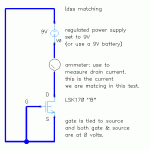
With that and flg's post (above), I set up a very simple test jig and re-measured my 20 LSK170's.
I also read the manufacturers spec sheet while I was at it.
I applied 9 volts from a regulated supply through an ammeter to the drain.
I tied the gate to the source, and set them to 0 V (ground).
The results I got across the same 20 devices was anywhere from 7.4mA to 13.47 mA, quite a spread.
Also, I was surprised to see 6 of the devices I measured had an Idss of greater than 12mA.
12mA is the max listed by the manufacturer for this part. So 6 of them are out of spec.
These are the "B" versions of the LSK170. Should I toss those out of spec devices?
Anyway, the real question. Now that I have the numbers, how closely do I need to match the Idss for use in the B1?
1%, 10% etc. I have no idea!
Thanks again
Curt
Followup to the above.
After digesting this a bit and becoming more familiar with whats going on, I re-read Mr Pass' B1 article.
Somewhere I got the notion that for best performance, I needed to match vgs. Wrong, according to the article.
Nelson says best performance is achieved when matching Idss.
With that and flg's post (above), I set up a very simple test jig and re-measured my 20 LSK170's.
I also read the manufacturers spec sheet while I was at it.
I applied 9 volts from a regulated supply through an ammeter to the drain.
I tied the gate to the source, and set them to 0 V (ground).
The results I got across the same 20 devices was anywhere from 7.4mA to 13.47 mA, quite a spread.
Also, I was surprised to see 6 of the devices I measured had an Idss of greater than 12mA.
12mA is the max listed by the manufacturer for this part. So 6 of them are out of spec.
These are the "B" versions of the LSK170. Should I toss those out of spec devices?
Anyway, the real question. Now that I have the numbers, how closely do I need to match the Idss for use in the B1?
1%, 10% etc. I have no idea!
Thanks again
Curt
Attachments
Hi,
replace the ammeter with a 100r precision resistor (<1%).
Measure the volts drop across the resistor using your most accurate DC voltmeter.
Remeasure your jFET's Idss.
Try to get pairs that match to better than 10% and a few better than 5%.
You may get one or two pairs that match to 1% or 2%, keep them for very special uses, not the B1.
By way of comparison 2sk389 and Lsk389 are guaranteed to match <11%. You should be able to do better than that unless you were unlucky with your 20 devices.
Do not throw away your C grade devices, measure them and keep them for the occasions that the circuit requires high Idss devices (V or C grade)
From the ~10% pairs select the lower Idss device for the lower FET position and the higher Idss device for the upper position.
This ensures that at quiescent condition the upper device has a current just below Idss and thus has a low value of Vgs at the input pin.
replace the ammeter with a 100r precision resistor (<1%).
Measure the volts drop across the resistor using your most accurate DC voltmeter.
Remeasure your jFET's Idss.
Try to get pairs that match to better than 10% and a few better than 5%.
You may get one or two pairs that match to 1% or 2%, keep them for very special uses, not the B1.
By way of comparison 2sk389 and Lsk389 are guaranteed to match <11%. You should be able to do better than that unless you were unlucky with your 20 devices.
Do not throw away your C grade devices, measure them and keep them for the occasions that the circuit requires high Idss devices (V or C grade)
From the ~10% pairs select the lower Idss device for the lower FET position and the higher Idss device for the upper position.
This ensures that at quiescent condition the upper device has a current just below Idss and thus has a low value of Vgs at the input pin.
Wow Andrew,
Thank you for the great information.
I will re do it the way you reccomend here.
I believe I have a precision 100 ohm resistor.
But I am curious. Why the need for such a precision?
If I know the value of the resistor I am using in the test setup,
does the actual value matter as long as its close to the 100 ohm you specify?
Again, thanks for the great insight here.
Best regards
Curt
Thank you for the great information.
I will re do it the way you reccomend here.
I believe I have a precision 100 ohm resistor.
But I am curious. Why the need for such a precision?
If I know the value of the resistor I am using in the test setup,
does the actual value matter as long as its close to the 100 ohm you specify?
Again, thanks for the great insight here.
Best regards
Curt
Hi Curt,
Andrew is bang on here.
-Chris
Andrew is bang on here.
The DC voltmeter sections are far more accurate and stable than their ammeter sections. Also, the sensing element in your average meter (often a 5% resistor) tends to increase it's resistance at higher temperatures. If you are going to measure these, you may as well get the correct answers. Use a higher powered precision resistor if you can. They are not all that expensive and you will have to order more parts to meet minimum order levels.But I am curious. Why the need for such a precision?
Not at all. I use 10 and 1 ohm resistors and sometimes a 100 ohm resistor. Try to keep the math easy!If I know the value of the resistor I am using in the test setup, does the actual value matter as long as its close to the 100 ohm you specify?
Yes! looking at the VGS value also will provide better matches. The IDSS values are more important.Nelson says best performance is achieved when matching Idss.
-Chris

The high current devices are lower noise devices as well.
Erno Borbely wrote a great 2 part series of JFET articles and they are archived on his website.
http://www.borbelyaudio.com/adobe/ae599bor.pdf
Erno Borbely wrote a great 2 part series of JFET articles and they are archived on his website.
http://www.borbelyaudio.com/adobe/ae599bor.pdf

I've used this successfully.....
http://www.geofex.com/Article_Folders/fetmatch/fetmatch.gif
This is an active FET matching fixture. I've made a PCB layout in expresspcb for it, and it works well. If anyone wants it, send me an e-mail for the file.
http://www.geofex.com/Article_Folders/fetmatch/fetmatch.gif
This is an active FET matching fixture. I've made a PCB layout in expresspcb for it, and it works well. If anyone wants it, send me an e-mail for the file.
Hi Andrew,
-Chris
You need to control the device temperature in that case.Today's results should compare to yesterday's and last year's and next year's.
-Chris
Matching Idss amongst bottom and top transistors should assure a median voltage at the output, I guess it's cap coupled though anyway But, this also gives max + and - voltage swing at the outpuit It also suggests gain to be very similar between the 2 devices.
I've read were because both transistors are not operting in the same configuration, that matching dosent matter??? It dose not take much mismatch to cauase the output to go to one rail. Therby having 0 volt swing to one rail
Output queicent offset voltage may not be best at midpoint of the supplies though. It is good not to draw to much gate current or saturate the device to much
But, this also gives max + and - voltage swing at the outpuit It also suggests gain to be very similar between the 2 devices.I've read were because both transistors are not operting in the same configuration, that matching dosent matter??? It dose not take much mismatch to cauase the output to go to one rail. Therby having 0 volt swing to one rail
Output queicent offset voltage may not be best at midpoint of the supplies though. It is good not to draw to much gate current or saturate the device to much

Re: I've used this successfully.....
Fuchs;
Looks interesting. Is that rig temperature stable, it looks like it? The usual way with a power-resistor is very edgy, temp-wise.
Please turn on your email. (or mail me)
Cool looking amps on your homepage. Just spotted that my hero Joe Bonamassa has one
BTW, nice thread.
FUCHSAUDIO said:http://www.geofex.com/Article_Folders/fetmatch/fetmatch.gif
This is an active FET matching fixture. I've made a PCB layout in expresspcb for it, and it works well. If anyone wants it, send me an e-mail for the file.
Fuchs;
Looks interesting. Is that rig temperature stable, it looks like it? The usual way with a power-resistor is very edgy, temp-wise.
Please turn on your email. (or mail me)
Cool looking amps on your homepage. Just spotted that my hero Joe Bonamassa has one
BTW, nice thread.
Yes it is.
I buy a bag of 100 or 200 Fets for production, and group them in bins by the test numbers. Makes life so much easier. I believe the rig can be considered temperature stable, as the FET is not under any stress that might heat it up or make it vary it's operating point.
I'll check my settings to make sure I'm open for getting e-mails.
I buy a bag of 100 or 200 Fets for production, and group them in bins by the test numbers. Makes life so much easier. I believe the rig can be considered temperature stable, as the FET is not under any stress that might heat it up or make it vary it's operating point.
I'll check my settings to make sure I'm open for getting e-mails.

Re: I've used this successfully.....
FUCHSAUDIO said:This is an active FET matching fixt...the file. [/B][/QUOTE] Welcome Andy! :cool:
Back at cha !
Howdy Nelson. Thanks for the welcome !
FET Matcher artwork is attached. www.expresspcb.com
Howdy Nelson. Thanks for the welcome !
FET Matcher artwork is attached. www.expresspcb.com
Attachments
Hi FUCHSAUDIO,
You need to control your ambient temperature. For me in the basement of my house, that's a problem. For a business office, might not be. I still had to watch the vent air in my business.
I just wanted to point out that the FET may measure differently if the ambient drifts. It's the same with BJTs.
I take this one step further and thermally tie transistors together in a diff pair jig (posted in a couple places here). As long as the temperature is the same on each part, you can see how they balance in the testing jig. It's just a common emitter/source through a current source with collector/drain and base/gate sensing resistors. It works very well for matching parts closely. It does take time to allow the parts to reach thermal equilibrium.
-Chris
You need to control your ambient temperature. For me in the basement of my house, that's a problem. For a business office, might not be. I still had to watch the vent air in my business.
I just wanted to point out that the FET may measure differently if the ambient drifts. It's the same with BJTs.
I take this one step further and thermally tie transistors together in a diff pair jig (posted in a couple places here). As long as the temperature is the same on each part, you can see how they balance in the testing jig. It's just a common emitter/source through a current source with collector/drain and base/gate sensing resistors. It works very well for matching parts closely. It does take time to allow the parts to reach thermal equilibrium.
-Chris
- Status
- This old topic is closed. If you want to reopen this topic, contact a moderator using the "Report Post" button.
- Home
- Amplifiers
- Pass Labs
- small signal device matching procedure (as in LSK170)