
After buying an old Pioneer SA-510 from an Ebay like website in Holland, I was very happy to hear some nice music in my room again. After a while the left channel broke down. So, I opened up the amplifier and checked the fuses. Two of them were dead. After replacing both of them, I fired the amp up with an variac to see one fuse die again immediately.
Nevertheless the amp was functioning as expected. All the lights went on, and both channels were playing music again. With one dead fuse, this is not the behaviour you would expect. I replaced this fuse once again, and saw the other one burn out! WTF?? Same thing, the amplifier was functioning. I left it as it was but would really like to know the function of this dual fuse. Anyone who has had the same experience?
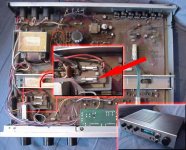
See picture for more details on the particular fuses. Arrow indicates dead fuse.
ErikH.
Nevertheless the amp was functioning as expected. All the lights went on, and both channels were playing music again.
With one dead fuse, this is not the behaviour you would expect. I replaced this fuse once again, and saw the other one burn out! WTF?? Same thing, the amplifier was functioning. I left it as it was but would really like to know the function of this dual fuse. Anyone who has had the same experience? See picture for more details on the particular fuses. Arrow indicates dead fuse.
ErikH.
Attachments

Netlist said:Maybe their purpose is to protect the AC-voltage outlets on the back of the amplifier.
/Hugo
They aren't used, there are no shorts and it's not always the same one that blows if you replace them. But I'll check the outlets.

Cr3ator said:
They aren't used, there are no shorts and it's not always the same one that blows if you replace them. But I'll check the outlets.
Checked: All work ok. So what we got is a perfectly working amplifier, but still one fuse missing
Netlist said:Does the amp still work when you take out both fuses?
Where are the wires that come from the fuses lead to?
Time for a new Signature:
If it's broken and it works...don't fix it.
/Hugo
With both fuses removed the amp doesn't work at all.
I like the signature
 I think I have to use that one for some time...
Stocker said:That looks a bit nasty inside. Hit it with some compressed air and see how it does.
It sure can use some cleaning, but it's a very sticky, grease like substance... Perhaps better leave it there. Even if that causes a short, how can the amp still work??
fuses
I'm retired from Sears, but we used to repair lots of every brand of stereo. Stereo's of modern design used split supplies. the preamp mains would be +15vdc and -15vdc so guess what? They have a fuse for each main, plus and minus. Same goes for the outputs, that run off of split supplies a fuse for the plus and a fuse for the minus supply's
Make sure the fuse clips are clean and tight. Loose clips will cause fuse to overheat and even though you are nowhere near the current rating of the fuse the heat will blow them out.
Let nothing block the air vents on older units as they tend to draw more current with age. Capacitors become leaky, causing the supply to draw more current.
I'm retired from Sears, but we used to repair lots of every brand of stereo. Stereo's of modern design used split supplies. the preamp mains would be +15vdc and -15vdc so guess what? They have a fuse for each main, plus and minus. Same goes for the outputs, that run off of split supplies a fuse for the plus and a fuse for the minus supply's
Make sure the fuse clips are clean and tight. Loose clips will cause fuse to overheat and even though you are nowhere near the current rating of the fuse the heat will blow them out.
Let nothing block the air vents on older units as they tend to draw more current with age. Capacitors become leaky, causing the supply to draw more current.
That's very interesting... if the ciruit were ... tolerant enough of only running off one rail, and one dies, the other plays but it might not sound as good or get as loud. Both rails go and it stops playing... hmm. Wow.
If that is grease, it could be the whole cause of your problem. A coworker gave me a computer that had killed TWO power supplies with grease contamination only. It lived near the kitchen & they fry alot... the heat builds up under the grease. Rather, the grease won't let the heat out... and then goes the fuse. Get some 90% or more pure isopropyl alcohol and some non-conducting brushes and scrub it out and see how it does.
If that is grease, it could be the whole cause of your problem. A coworker gave me a computer that had killed TWO power supplies with grease contamination only. It lived near the kitchen & they fry alot... the heat builds up under the grease. Rather, the grease won't let the heat out... and then
goes the fuse. Get some 90% or more pure isopropyl alcohol and some non-conducting brushes and scrub it out and see how it does.After buying an old Pioneer SA-510 from an Ebay like website in Holland, I was very happy to hear some nice music in my room again. After a while the left channel broke down. So, I opened up the amplifier and checked the fuses. Two of them were dead. After replacing both of them, I fired the amp up with an variac to see one fuse die again immediately.
Nevertheless the amp was functioning as expected. All the lights went on, and both channels were playing music again.
See picture for more details on the particular fuses. Arrow indicates dead fuse.
ErikH.
I know this is an old thread, but all answers are wrong so I answer to people having troubles with this amp.
If you look closely, one fuse position is for 220V and the other for 240V.
So there should only be one fuse!!!
It is all in the service manual also.
My pioneer rx -510 keeps blowing a fuse 125 volts 3.6 amps . I was listening to the radio and I went to turn it up and for a few minutes it was fine but it started cuting out but keep playing then it quit I gust figured that one of the speaker wiers was loose that's what I thought when it was cuting out but clearly that was not the case . Also the display for the radio display works only ones or twice then shuts off then it dosent work and some times it dosent turn on at all . Can some one help me
- Status
- This old topic is closed. If you want to reopen this topic, contact a moderator using the "Report Post" button.
- Home
- Design & Build
- Parts
- Weird fuses in Pioneer SA-510