
I salvaged some capacitors but I can't find any source on google on how to determine the voltage ratings based on the dots seen on the picture. The upper one is 250V, is it too much to use in a gainclone (250V is a real overkill for 20V use)? The 0.22uF one has accuracy rating in dots too?
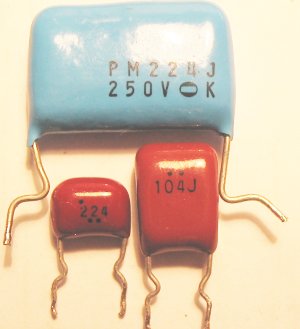

You won't find any small caps like that rated at less than 40V, so they will be fine for a Gainclone.
Ok that's a good generalization, but no real definition for the dots? Is the 0.22uF little red one OK for audio use (the 0.1uF one will go to power chain only)?

My guess is the the other caps are max 63 V, possibly lower. The tolerance is 10 or 20%, no precision.
I've used both of those red/brown colored types in audio circuits with good results.
I usually scavenge them from old PC boards and stuff. 😀
I usually scavenge them from old PC boards and stuff. 😀
They are from an old display. Why I'm asking is because the 0.1uF one is larger than 0.22uF, so the 0.22uF should have some really low voltage rating.
Not necessarily. Depends on the type and quality of construction.
Just use them, they will all be more than enough voltage for a chip amp 🙂
Just use them, they will all be more than enough voltage for a chip amp 🙂
And another question, is there some way to tell by their look if they are polyester or polypropylene?
olev said:And another question, is there some way to tell by their look if they are polyester or polypropylene?
No, though polypropylene are usually coded MKP, KP or PP.
"metallised" polyester are usually coded MKT or KT. Ordinary polyester caps are usually uncoded.
http://www.electronics2000.co.uk/data/itemsaf/capmarks.htm has useful information.
Your salvaged caps all look like ordinary polyester. The orange 104J is probably 100nF 100V. The orange 224 is probably 220nF 63V.
- Status
- Not open for further replies.
- Home
- Design & Build
- Parts
- Capacitor voltage rating in dots?