
Hi,
I am new to this hobby but I did some projects before but it did not sound as what I have expected. Well anyway I need someone's advice, I have an old cabinet with a measurment of W14 3/4, H40, D9 inches and the tweeter and midrange died on me. I'm still on the process of understanding the Xover. I saw on the connection their were 75V and a something uF capacitor with black thing it looks like mH. But anyway I wanted to redesign the Xover with a 12" woofer using 2nd order. Any suggestion is highly appreciated. I am going to fix my old speaker cabinet before planning to build my speaker projects.
Thanks,
Sonny
I am new to this hobby but I did some projects before but it did not sound as what I have expected. Well anyway I need someone's advice, I have an old cabinet with a measurment of W14 3/4, H40, D9 inches and the tweeter and midrange died on me. I'm still on the process of understanding the Xover. I saw on the connection their were 75V and a something uF capacitor with black thing it looks like mH. But anyway I wanted to redesign the Xover with a 12" woofer using 2nd order. Any suggestion is highly appreciated. I am going to fix my old speaker cabinet before planning to build my speaker projects.
Thanks,
Sonny
This comes up fairly regularly...unfortunately, the answer is always the same.
To properly mate a driver with a cabinet requires some homework. The most common method is to use the Thiele-Small parameters (these are the funky looking specs that are printed in the catalogs & websites) to calculate the size of the box needed for a given driver.
To run the process in reverse--attempt to find a driver that will work well in an existing box--might conceivably be possible, but it's not how I'd choose to spend the next month or two of my life.
Designing a crossover to go along with a given set of drivers is difficult even if you have the proper test equipment. Don't even consider the generic crossovers that claim to mate '8 ohm drivers' with a crossover at X frequency. That's about like trying to choose a wife for a stranger you just met and know nothing about. You might get lucky in your first outing as matchmaker, but the odds are very much against it.
One of the questions you have to ask yourself is what level of performance you expect from a speaker. Be honest. In the long run, it's you who will have to live with the result. You can put some drivers into the cabinets, install a generic crossover, and sound will come out...but it won't be particularly refined. If you're looking for a speaker to put in your garage while you work on your car, that might appeal to you. If you listen carefully to classical music and care deeply about whether the violin sounds like a violin instead of a cat whose tail just got stepped on, you might want to reconsider.
On the other hand, Beranek's law applies: If you chose the drivers, paid the money, and built the speaker, then to you it's the best sounding speaker in the world.
You might want to consider a kit from a reputable speaker company. It would most likely involve new cabinets to go along with the drivers, but you'd end up with something more likely to sound good. The next step above that would be to buy a few books and learn a bit about what goes into putting a speaker together. After laying some groundwork, you'd be in a better position to begin your own project from the ground up.
Grey
To properly mate a driver with a cabinet requires some homework. The most common method is to use the Thiele-Small parameters (these are the funky looking specs that are printed in the catalogs & websites) to calculate the size of the box needed for a given driver.
To run the process in reverse--attempt to find a driver that will work well in an existing box--might conceivably be possible, but it's not how I'd choose to spend the next month or two of my life.
Designing a crossover to go along with a given set of drivers is difficult even if you have the proper test equipment. Don't even consider the generic crossovers that claim to mate '8 ohm drivers' with a crossover at X frequency. That's about like trying to choose a wife for a stranger you just met and know nothing about. You might get lucky in your first outing as matchmaker, but the odds are very much against it.
One of the questions you have to ask yourself is what level of performance you expect from a speaker. Be honest. In the long run, it's you who will have to live with the result. You can put some drivers into the cabinets, install a generic crossover, and sound will come out...but it won't be particularly refined. If you're looking for a speaker to put in your garage while you work on your car, that might appeal to you. If you listen carefully to classical music and care deeply about whether the violin sounds like a violin instead of a cat whose tail just got stepped on, you might want to reconsider.
On the other hand, Beranek's law applies: If you chose the drivers, paid the money, and built the speaker, then to you it's the best sounding speaker in the world.
You might want to consider a kit from a reputable speaker company. It would most likely involve new cabinets to go along with the drivers, but you'd end up with something more likely to sound good. The next step above that would be to buy a few books and learn a bit about what goes into putting a speaker together. After laying some groundwork, you'd be in a better position to begin your own project from the ground up.
Grey
Thanks Grey for your time. But I think I don't want to spend more effort on this box rather start planning with my first loudspeaker.
I am planning to build a tower with 2 woofer one midrange and a tweeter. I might be using an 8" 8 ohms driver. Do you have any ideas how to link them on a Xover in order to produce 8 ohms not 16 or 4 ohms. I need your expert advice.
Thanks
I am planning to build a tower with 2 woofer one midrange and a tweeter. I might be using an 8" 8 ohms driver. Do you have any ideas how to link them on a Xover in order to produce 8 ohms not 16 or 4 ohms. I need your expert advice.
Thanks

ndestruckt said:I might be using an 8" 8 ohms driver. Do you have any ideas how to link them on a Xover in order to produce 8 ohms not 16 or 4 ohms. I need your expert advice.
To get 8 ohms you would have to start with 2 4 ohm or 2 16 ohm speakers.
dave
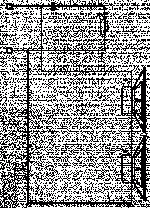
ndestruckt said:Do you have any diagram to a 2 woofer and a tweeter?
I'll go for 4 ohms for the woofers and 8 ohms for the tweeters.
2 4 ohm woofers connected for 8 ohms
This is a minimal solution. Usually the XOs will be more complex.
dave
Attachments

Hello dave,
With the diagram that you posted above, if I were to use one woofer instead of two, what cap value spec I should be using consider the followings;
1. Woofer is the Triangle full range
2. tweeter is one of those Audax dome tweeter
3. No crossover
4. Bi-wire for now, Bi-amp later
5. Open baffle, no box
Thanks
Chris
With the diagram that you posted above, if I were to use one woofer instead of two, what cap value spec I should be using consider the followings;
1. Woofer is the Triangle full range
2. tweeter is one of those Audax dome tweeter
3. No crossover
4. Bi-wire for now, Bi-amp later
5. Open baffle, no box
Thanks
Chris
Re: Speaker Drawings
It is VectorWorks -- a full-fledged CAD program that sells for just over $1k CAD.
Too bagged to go looking for URLs, but there is Creative Sound, McBride, & Solen to name 3. If you are cautious (ie don't get anything sent except by USPostalService) and factor in the costs you shouldn't be fearful of ordering out of the US either.
Where in Canada are you?
dave
ndestruckt said:Thank you for the diagram and I was wondering if where could I get this drawing software?
It is VectorWorks -- a full-fledged CAD program that sells for just over $1k CAD.
Do you have any idea where could I possibly buy part here in Canada? Any links or any suggestions?
Too bagged to go looking for URLs, but there is Creative Sound, McBride, & Solen to name 3. If you are cautious (ie don't get anything sent except by USPostalService) and factor in the costs you shouldn't be fearful of ordering out of the US either.
Where in Canada are you?
dave
chris ma said:With the diagram that you posted above, if I were to use one woofer instead of two, what cap value spec I should be using consider the followings;
1. Woofer is the Triangle full range
2. tweeter is one of those Audax dome tweeter
3. No crossover
4. Bi-wire for now, Bi-amp later
5. Open baffle, no box
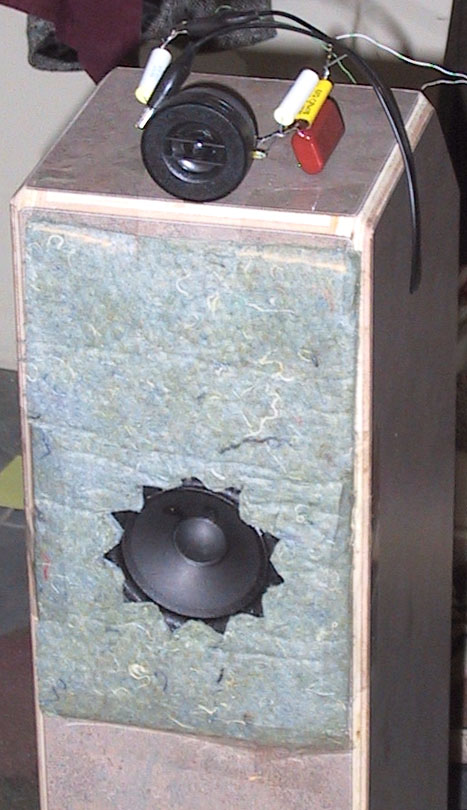
Well you need a crossover on the tweeter -- that's what the cap is. I'm not sure how high the Triangle's go, but i'd think they go high enuff that you can get away with just a cap on the Audax (is it ferrofluid? -- that smooths out the resonance peak and makes a single cap work better).
What i do to figure out how big a cap to use is get a whole bunch of caps -- including quite a few small values -- and starting out with what should be way to small a cap (ie XO too high), keep adding caps in parallel until the tweeter starts getting "in the way". Then i back off the size of the cap a bit. You are now in the ballpark. Some fine tuning might be needed. Here is a tweeter during tuning.
dave
chris ma said:But I need to know the range of values of the caps normally used in crossover, like
100uf 50V mono or polarised etc.
Any hint?
To get a ballpark you need to know the nominal impedance of your speaker and the neighborhood of where you want to XO.
a 2 uF cap into a nominal 8 ohms gives an XO of 10kHz. Making it 2x as big moves the XO to 5 kHz, halving it moves it to 20k.
If you have a 4 ohm T, double the cap value, if a 16 ohm T halve them.
Typically the higher the voltage the better the cap sounds, but 50V is probably a reasonable rating for most situations (althou i have seen many a 5V cap on vintage stuff)
dave
- Status
- This old topic is closed. If you want to reopen this topic, contact a moderator using the "Report Post" button.
- Home
- Loudspeakers
- Multi-Way
- Driver/Xover Replacement on an Old Cabinet