

I love the shotgun approach. How many forums did you post this question on?
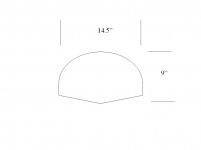
If the program you drew that in ia worth anything it will give you an area, then you multiply by 40 and there's your volume. IF it doesn't give you an area, you need to break up the figure into areas you can calculate.
If all else fails, make a 1" grid and start counting squares
If the program you drew that in ia worth anything it will give you an area, then you multiply by 40 and there's your volume. IF it doesn't give you an area, you need to break up the figure into areas you can calculate.
If all else fails, make a 1" grid and start counting squares

Draw a line through the figure where the circle turns to verticle edges and consult this link:
http://mathforum.org/dr.math/faq/faq.circle.segment.html
to get the area of that circle section.
Divide the remaining area into rectangles and right triangles and calculate their areas.
Add all the areas together and multiply by 40. There's your volume.
It won't be perfect because the circle section is not really a section of a perfect circle.
http://mathforum.org/dr.math/faq/faq.circle.segment.html
to get the area of that circle section.
Divide the remaining area into rectangles and right triangles and calculate their areas.
Add all the areas together and multiply by 40. There's your volume.
It won't be perfect because the circle section is not really a section of a perfect circle.

The calculate volume, you need to find the area of that shape and multiply the area by the height.
What I see in that shape is a semi-circle (top half), two rectangles (under the semi-circle), and one triangle. Find the area of each and add them together. Multiply by the height.
EDIT: Yikes. That isn't a perfect semi-circle, it's a semi-ellipse. If you can somehow figure out the equation of the ellipse, you can integrate to find the area. The rest will be easy.
What I see in that shape is a semi-circle (top half), two rectangles (under the semi-circle), and one triangle. Find the area of each and add them together. Multiply by the height.
EDIT: Yikes. That isn't a perfect semi-circle, it's a semi-ellipse. If you can somehow figure out the equation of the ellipse, you can integrate to find the area. The rest will be easy.

Your drawing doesn't quite have enough information...
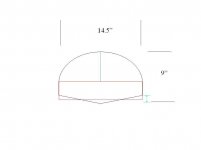
See the additions to your drawing. You'll need the length of the blue line, and the distance indicated by the green arrow. The red box incorporates the straight sided section from where the ellipse meets, down to one-half the length of the green arrow.
The area of the ellipse:
=1/2 x pi x 7.25 x the length of the blue line.
(7.25 is half of the 14.5 inch width)
Add that to the area of the red rectangle and multiply by 40" tall.
BTW, how are you planning to build this?
Tim
See the additions to your drawing. You'll need the length of the blue line, and the distance indicated by the green arrow. The red box incorporates the straight sided section from where the ellipse meets, down to one-half the length of the green arrow.
The area of the ellipse:
=1/2 x pi x 7.25 x the length of the blue line.
(7.25 is half of the 14.5 inch width)
Add that to the area of the red rectangle and multiply by 40" tall.
BTW, how are you planning to build this?
Tim
Attachments
I have always found it is easist to 'break' the shape into easy to calculate shapes, find the volume (or area) for each and then add them all up. Based on your drawing, you should be able to break the shape into a triangle, rectangle, and 1/2 circle.
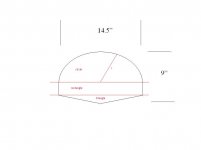
From there, the calculations become fairly simple. A triangle is (height x width) / 2. The rectangle is height x width. The half circle is (pi x (r squared)) / 2. After the area of each basic shape is found, then add them together. After that, multiply by the cabinet height.
This is assuming that the radius of the curve is constant and not changing. Your drawing has the curve being slightly eliptical, but this may be just the drawing and I made the assumption that your cabinet would circular in that area. If not, you will need to find the formula for the area of a elipse.
Hope this helps.
Scott
From there, the calculations become fairly simple. A triangle is (height x width) / 2. The rectangle is height x width. The half circle is (pi x (r squared)) / 2. After the area of each basic shape is found, then add them together. After that, multiply by the cabinet height.
This is assuming that the radius of the curve is constant and not changing. Your drawing has the curve being slightly eliptical, but this may be just the drawing and I made the assumption that your cabinet would circular in that area. If not, you will need to find the formula for the area of a elipse.
Hope this helps.
Scott
Attachments
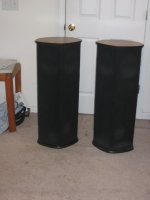
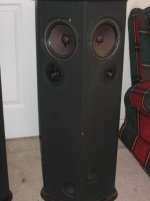
Does anyone remember the DCM Time Windows? My wife has asked me to build a pair of speakers tha look like our old Time Windows but sound better. She just loved the way they looked because they were elegant and made nice stands for picture or statues. Here's what it looked like.
Attachments
- Status
- This old topic is closed. If you want to reopen this topic, contact a moderator using the "Report Post" button.
- Home
- Loudspeakers
- Multi-Way
- Calculating Cabinet Volume?