
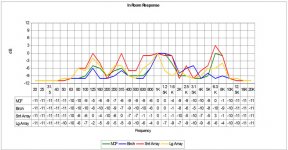
Here is a chart of the frequency response measurements of four different speaker systems made using the PE closeout 4" Pioneer drivers.
Basic Test Equipment:
* Radio Shack Analog SPL Meter
* Rives Audio Test CD 2 with Radio Shack meter compensation
* Response measured "in room" with no attempt to create a good listening environment
Source Equipment:
* BrianGT Gainclone
* Aiwa DVD player
Setup:
* The SPL meter was mounted on a tripod 79" (2 meters) from the plane of the speaker baffles centered between the speakers.
* The microphone opening of the meter was 22 inches (~56cm) above the floor
* I sat behind and to the right of the meter during measuring
* The small speakers (MDF and Birch) were stacked with the speaker being measured on top. This put the tweeters of those systems 20" (~51cm) above the floor
* The "arrays" are floor standing models
* Speakers faced forward, no toe-in
* SPL meter was set for the 80dB range
* The 1K Hz track (RS compensated) was played and volume adjusted until the meter read 0dB
Measuring:
* Each track was played in succession and each reading noted
* Entire sequence was repeated 3 times for each set of speakers and readings were averaged
Graphing:
* Graph was created in Excel. +12 to -12 dB Y axis
* No smoothing applied
Results:
Pretty interesting. These drivers have similar curves regardless of the enclosure size and shape. In the small speakers the drivers' spike at around 7K is pretty obvious. It is lessened somewhat in both arrays. The large "array" (6 drivers) has the flatest overall response.
My middle aged ears have spent too many hours listening to Mott the Hoople at too high a volume. I have slightly depressed upper midrange acuity so bright speakers tend to sound better to me.
What can we learn from this? Probably not much. The test was conducted in room, I have not calibrated the meter or the amplifier. It is useful though as a direct comparison between the speaker's I've built in this single room. It may also yield a little info about enclosures but don't count on it!
Basic Test Equipment:
* Radio Shack Analog SPL Meter
* Rives Audio Test CD 2 with Radio Shack meter compensation
* Response measured "in room" with no attempt to create a good listening environment
Source Equipment:
* BrianGT Gainclone
* Aiwa DVD player
Setup:
* The SPL meter was mounted on a tripod 79" (2 meters) from the plane of the speaker baffles centered between the speakers.
* The microphone opening of the meter was 22 inches (~56cm) above the floor
* I sat behind and to the right of the meter during measuring
* The small speakers (MDF and Birch) were stacked with the speaker being measured on top. This put the tweeters of those systems 20" (~51cm) above the floor
* The "arrays" are floor standing models
* Speakers faced forward, no toe-in
* SPL meter was set for the 80dB range
* The 1K Hz track (RS compensated) was played and volume adjusted until the meter read 0dB
Measuring:
* Each track was played in succession and each reading noted
* Entire sequence was repeated 3 times for each set of speakers and readings were averaged
Graphing:
* Graph was created in Excel. +12 to -12 dB Y axis
* No smoothing applied
Results:
Pretty interesting. These drivers have similar curves regardless of the enclosure size and shape. In the small speakers the drivers' spike at around 7K is pretty obvious. It is lessened somewhat in both arrays. The large "array" (6 drivers) has the flatest overall response.
My middle aged ears have spent too many hours listening to Mott the Hoople at too high a volume. I have slightly depressed upper midrange acuity so bright speakers tend to sound better to me.
What can we learn from this? Probably not much. The test was conducted in room, I have not calibrated the meter or the amplifier. It is useful though as a direct comparison between the speaker's I've built in this single room. It may also yield a little info about enclosures but don't count on it!
Attachments
Speaker photos and measurements
I'll post photos of the speakers a little later if anyone is interested.
Speaker Measurements:
Small Speakers
* MDF and Birch have identical internal volumes of .11 cu.ft.
* The MDF is 5/8", the birch is 3/4".
* Each have one 4" driver and one Goldwood $1.95 tweeter
* "Crossover" is just a highpass filter with a 1uF Solen cap
* Ports are 1" dia. 1.5" long on both
* Outside dimensions of birch 5 1/4" x 7 1/2" x 11 1/4"
Small Arrays
* 5/8" particle board
* 4 drivers mounted from inside with no rounding over of the holes.
* 1 Goldwood tweeter
* 2.2 uF cap for highpass
* 1 rectangular port 1/2" high, 5/8" deep, 7" wide
* Outside dimensions 5 7/8" deep, 10 1/4" wide, 37 1/2" high
Large Arrays
* 5/8" MDF
* 6 drivers flush mounted 4 1/16" on center
* 2 Goldwood tweeters
* 1uF Solen cap for highpass
* 2 ports, 3" dia. 2 1/2" long
* Outside dimensions 9" deep x 13 1/4" wide x 49 1/2" high
I'll post photos of the speakers a little later if anyone is interested.
Speaker Measurements:
Small Speakers
* MDF and Birch have identical internal volumes of .11 cu.ft.
* The MDF is 5/8", the birch is 3/4".
* Each have one 4" driver and one Goldwood $1.95 tweeter
* "Crossover" is just a highpass filter with a 1uF Solen cap
* Ports are 1" dia. 1.5" long on both
* Outside dimensions of birch 5 1/4" x 7 1/2" x 11 1/4"
Small Arrays
* 5/8" particle board
* 4 drivers mounted from inside with no rounding over of the holes.
* 1 Goldwood tweeter
* 2.2 uF cap for highpass
* 1 rectangular port 1/2" high, 5/8" deep, 7" wide
* Outside dimensions 5 7/8" deep, 10 1/4" wide, 37 1/2" high
Large Arrays
* 5/8" MDF
* 6 drivers flush mounted 4 1/16" on center
* 2 Goldwood tweeters
* 1uF Solen cap for highpass
* 2 ports, 3" dia. 2 1/2" long
* Outside dimensions 9" deep x 13 1/4" wide x 49 1/2" high
BillFitzmaurice said:I measured my line array TL ( uses eight of these) outdoors, flat within plus,minus 2dB from 100 to 6 kHz. Pretty impressive for chump change.
That is amazing response! I still have a case of these drivers so I'm thinking a 9 driver array is next. I definitely have to get better tweeters for those though.
I plan to repeat this all outdoors, weather permitting, within a week. It will be interesting to see the response then. I'm thinking for all of these systems I may need a notch filter to even out the response. That or using a quality tweeter and a real crossover.
Photo
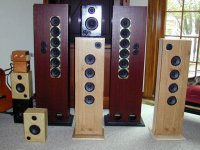
OK, here is a photo with all the speakers. The smaller arrays are just covered in a wood grain contact paper. The larger arrays are covered with the "cherry" woodgrain vinyl laminate from PE. The birch speakers are natural finish with tung oil and the small MDF speakers are just sprayed black.
OK, here is a photo with all the speakers. The smaller arrays are just covered in a wood grain contact paper. The larger arrays are covered with the "cherry" woodgrain vinyl laminate from PE. The birch speakers are natural finish with tung oil and the small MDF speakers are just sprayed black.
Attachments

Sherman said:
TI plan to repeat this all outdoors, weather permitting, within a week.
I would suggest also getting a sweep with the speakers toed in and pointing at the microphone, or better yet, you don't actually need to test both speakers. Just do one and have the mic two or three meters/yards in front of it and then same distance off axis if that helps relate to the previous set of measurenments. IMO the sweep will be most meaningful if it is measured at the distance you find the line array phases into focus. I find with my larger arrays this distance can easily be four meters.
I listen to all my array speakers pointed towards me. It is critical for the very best sound. When off axis walking around the room is almost as good I consider the design a re-sound-ing success.

BillFitzmaurice said:I measured my line array TL ( uses eight of these) outdoors, flat within plus,minus 2dB from 100 to 6 kHz. Pretty impressive for chump change.
I have to laugh. I bought 100 at $0.40 each, and the shipping
was more than twice that much.

Can you open up any of those boxes (or rather, remove the baffle)?
small box interaction seemed (in my experiments) to introduce an interesting hump right where you're finding one (my experimentation was less scientific - sine wave sweeps and my ears).
I end up putting ~.3 cubic feet each driver.
But open baffle is where I like them most.
Some crossed at 3200hz, some at 3800hz.
Fun stuff.
C
small box interaction seemed (in my experiments) to introduce an interesting hump right where you're finding one (my experimentation was less scientific - sine wave sweeps and my ears).
I end up putting ~.3 cubic feet each driver.
But open baffle is where I like them most.
Some crossed at 3200hz, some at 3800hz.
Fun stuff.
C
cjd said:Can you open up any of those boxes (or rather, remove the baffle)?
small box interaction seemed (in my experiments) to introduce an interesting hump right where you're finding one (my experimentation was less scientific - sine wave sweeps and my ears).
I end up putting ~.3 cubic feet each driver.
But open baffle is where I like them most.
Some crossed at 3200hz, some at 3800hz.
Fun stuff.
C
I can remove the backs only on the smaller speakers and the bottoms on the larger ones. Not much help there I think. Though I can add more stuffing to all of them. I suspect stuffing in the MDF box would improve it quite a bit.
I do have a case of these (32) left so I can continue playing with different designs. I think my next set will be a nine driver line array with a much smaller volume. Like this one-
http://ceramicsubs.web1000.com/4x4x42/index.htm
I don't yet know how I'll mount tweeters though. I suppose I could just mount them at the top but that would make the high-end a point source while the lower end is an array.
Any ideas how that would work?
I suppose I could just mount them at the top but that would make the high-end a point source while the lower end is an array.
Bad idea. The reason why is contained in your statement.
BillFitzmaurice said:
Bad idea. The reason why is contained in your statement.
Yeah, sometimes I state the obvious but it doesn't quite register until my mind has a chance to sleep on it!
If I do that array I'll have to either run the Pioneers full-range and without tweeters or come up with a mounting scheme to run a line of tweeters down the side. Maybe sort of a "wing" attached to the side. Hmmm...
rcavictim said:
I would suggest also getting a sweep..., you don't actually need to test both speakers. ...have the mic two or three meters/yards in front of it and then same distance off axis... the sweep will be most meaningful if it is measured at the distance you find the line array phases into focus. ... this distance can easily be four meters.
I'll try this with one speaker. I have noticed that the larger arrays sound better when I am sitting at least 3 meters away. The sound becomes "crisper" for lack of a better word. Is this the effect of the array "phasing into focus"?
The smaller arrays don't really exhibit that effect but I think they aren't operating as true arrays since the drivers aren't mounted as close together.
When I do the tests outdoors to eliminate room effects I'll do one set at 2 meters as I did inside and another at 3 or 4 meters and compare them.
Chris8sirhC said:maby you could do some tests on some of the mods people have been doing to these drivers?
Part of my "master plan"
is to do some tests before and after Damar application. I have applied Damar to a couple of speakers and believe I hear a difference. It would be nice to know if the difference is measurable!
I used polyurethane varnish to treat some 5 1/4" paper drivers I bought from Mc Gee Radio quite a few years ago. The mid range was a bit nasty before treatment, and smoothed out quite a bit after the varnish. One thing I have also thought of trying is using a silicone compound like Dow Corning Sylgard 184. As mixed, it is a viscous liquid, which sets into a clear elastomer. I'm thinking it would provide damping for a paper cone.
I am almost done coating all 32 of my NSB's using "Hasbro Liquid Puzzle Saver" that can be found at any Wal-Mart. Its clear, water soluble, oderless, and can be found in matte and gloss finish. I havnt ever heard anyone mention this brand of puzzle coating on the forums before, so there ya go.
wrenchone said:.....One thing I have also thought of trying is using a silicone compound like Dow Corning Sylgard 184. As mixed, it is a viscous liquid, which sets into a clear elastomer. I'm thinking it would provide damping for a paper cone.
I fear that the silicone rubber may act like rubber cement tried by another here. It reportedly sucked all the highs and thus the life out of the driver. This might be good for a woofer to reduce the level of unwanted HF or the level of unwanted harmonic distortions in the speaker of the wanted fundamentals while lowering Fs a bit, at the expense of some efficiency though.
You live in the silicon valley. Why not try coating some cones with silicon!
Sherman said:
I'll try this with one speaker. I have noticed that the larger arrays sound better when I am sitting at least 3 meters away. The sound becomes "crisper" for lack of a better word. Is this the effect of the array "phasing into focus"?
The smaller arrays don't really exhibit that effect but I think they aren't operating as true arrays since the drivers aren't mounted as close together.
When I do the tests outdoors to eliminate room effects I'll do one set at 2 meters as I did inside and another at 3 or 4 meters and compare them.
You're hearing phase cancellation in the highs, I'll bet, when you're sitting close to your array. The path length from the end drivers is longer than from the centre drivers, which means the end drivers lag the centre ones because of the speed of sound, and ergo you get a frequency dependent phase shift between them.
Say you have a 1 metre long array from which you sit 2 metres away. The centre will be 2 metres away, of course, but the end will be (assuming the array is symmetric wrt your ears) sqrt(2^2 + 0.5^2) away from you (right angle triangle, root of the squares of sides, you know the rest), or about 2.06 metres away. The difference is (2.06 - 2.00) = 0.06 metres, which is a half wavelength at about 2860 Hz, so that's where I'd expect the response to start rolling off.
The effect isn't as drastic as I've shown since:
1) the other drivers in the array tend to be closer to the centre and thus fill in the highs, and
2) off axis response on 4" drivers isn't really wide at the frequencies of interest.
Cheers,
Francois.
- Status
- This old topic is closed. If you want to reopen this topic, contact a moderator using the "Report Post" button.
- Home
- Loudspeakers
- Multi-Way
- Some FR Measurements of 4" Pioneers