

This is perceptual. All the same, show me single change in set up that causes change in image that cannot be measured with a microphone.
Regards,
Andrew
Regards,
Andrew

"Can not be measured with a microphone" is not necessarily the same thing as knowing what to measure, or how, or what to look for in those measurements...show me single change in set up that causes change in image that cannot be measured with a microphone.
Linkwitz Pluto type speaker with SEAS Prestige L16RN-SL and Peerless 830970 allows driver centers to be closer together than when on flat baffle.
Top firing woofer only sees reflection from far end of pipe, after sound travels through more than 70" of stuffing. Very little sound re-radiation. No panel resonance.
Fascinating! I know you've shown us stellar measurements, but in this case I just can't imagine how it will actually sound. Really, how does it sound?
Do we picture an approximate hemisphere of pressure radiating upwards and outwards from the woofer, some of which reaches the listener, but most hitting the ceiling and rear wall? Plus another hemisphere radiating out from the tweeter with a different proportion of its output hitting the walls, floor and ceiling?
I can't help but reproduce this quote from Rod Elliott when talking about baffle step effects:
The absolute worst enclosure is a circular tube (cylinder), with the driver mounted in the exact centre of an end-cap. The response ripples caused by this are extreme, but with most systems this is not an issue, since this would be a very unusual shape for an enclosure. The response in a cylinder shows fluctuations in level that are quite unacceptable, and it is not a shape I would recommend to anyone.
Baffle Step Compensation
Is what he says wrong/not relevant in this situation?
Do we picture an approximate hemisphere of pressure radiating upwards and outwards from the woofer, some of which reaches the listener, but most hitting the ceiling and rear wall? Plus another hemisphere radiating out from the tweeter with a different proportion of its output hitting the walls, floor and ceiling?
What I mean is, at the crossover frequency.
Last edited:
It is fascinating. Linkwitz describes this speaker quite well. Speaker is completely omnidirectional at crossover, and becomes directional with tweeter.
When critically damped with stuffing, their is no ripple.
Coppertop,
It is very easy to implement this speaker, build it and listen for yourself. It seems like you have measurement microphone and are willing to use it.
I read Rod Elliot's quote before reading about Pluto and had much the same reaction. In scientific fashion I recreated Linkwitz's experiment, and it sounds fantastic.
Regards,
Andrew
When critically damped with stuffing, their is no ripple.
Coppertop,
It is very easy to implement this speaker, build it and listen for yourself. It seems like you have measurement microphone and are willing to use it.
I read Rod Elliot's quote before reading about Pluto and had much the same reaction. In scientific fashion I recreated Linkwitz's experiment, and it sounds fantastic.
Regards,
Andrew
I don't understand this fully. Doesn't the woofer begin to get a bit directional at the upper end of its range, presumably around the crossover frequency?Speaker is completely omnidirectional at crossover, and becomes directional with tweeter.
In scientific fashion I recreated Linkwitz's experiment, and it sounds fantastic.
Will it do 'big sound'? Could it be scaled up in size if necessary?
I like the Pluto quite a bit, I've heard Mr. Linwitz's own version. I have to say I liked it better than the Orion. IMO, the Pluto will not do "big sound", but does small/medium sound very well. Maybe with a sub or two to give it some body, it could really shine.
As Andrew says, it's easy to build, you should try it!
As Andrew says, it's easy to build, you should try it!
Really, pop something together and check polar pattern. SEAS driver as mounted has very spherical response to 1kHz crossover. Listening is 90 degrees off axis, which means response in horizontal plane is identical all the way around. As mounted 2" driver is extremely omnidirectional at 1kHz.
I first implemented Pluto type speaker with much less capable Peerless 830392 in combination with NorthCreek D25 1" tweeter. DCX2496 was used with LR8 crossover at 1400Hz. With several bands of EQ and a little digital delay I suddenly had speaker that blew away any similar sized speaker I had ever heard.
On hearing them a friend who is exceptional woodworker built cabinets for pair and subwoofer:
jcrytzerwoodworking:
Towers have pipe inside to constrain enclosure volume.
Jeremy is also accomplished jimbe player and instructor, and finds speaker to reproduce percussion very realistically.
Current version with DSP corrections based on measurements is reference performance.
Trade off is speaker is limited to small/moderate sized domestic scale listening spaces. Plus is that wavefront formation is coherent even up very close, and may be listened to up close as nearfield monitors.
And yes, Pluto forms more coherent wavefront than Orion at much closer distance, and subs do make it really shine.
Regards,
Andrew
I first implemented Pluto type speaker with much less capable Peerless 830392 in combination with NorthCreek D25 1" tweeter. DCX2496 was used with LR8 crossover at 1400Hz. With several bands of EQ and a little digital delay I suddenly had speaker that blew away any similar sized speaker I had ever heard.
On hearing them a friend who is exceptional woodworker built cabinets for pair and subwoofer:
jcrytzerwoodworking:
An externally hosted image should be here but it was not working when we last tested it.
Towers have pipe inside to constrain enclosure volume.
Jeremy is also accomplished jimbe player and instructor, and finds speaker to reproduce percussion very realistically.
Current version with DSP corrections based on measurements is reference performance.
Trade off is speaker is limited to small/moderate sized domestic scale listening spaces. Plus is that wavefront formation is coherent even up very close, and may be listened to up close as nearfield monitors.
And yes, Pluto forms more coherent wavefront than Orion at much closer distance, and subs do make it really shine.
Regards,
Andrew
Yes, very much so.Plus is that wavefront formation is coherent even up very close, and may be listened to up close as nearfield monitors.

Kudo's to your buddy and his woodwork, those are very pretty.
I can't help but reproduce this quote from Rod Elliott when talking about baffle step effects:
If the driver is crossed over below its baffle step the issue is reduced, if low enuff no issue at all. 4" pipe, BS -3dB ~1140 Hz, 5" 912 Hz.
dave
The piston doesn't have a baffle stop. Baffle may me considered to start at effective edge of radiating surface. In case of SEAS Prestige L16RN-SL (H1480) 6" driver, SD is given as 104 square centimeters, which is effective diameter of roughly 4.5", and in my case this is centered in a pipe with OD of 6.75", leaving a baffle that is 2.25". Radiation aperture at 1kHz is much closer to a sphere than to a flat plane. Thus why it is described as omnidirectional below 1kHz. When the physics in space immediately behind the driver are understood, it becomes clear that no lateral wave transmission occurs below 1kHz in a 6" ID pipe. Think inside a box 6" on a side, 1kHz is single mode.
Regards,
Andrew
Regards,
Andrew
The piston doesn't have a baffle step... in my case this is centered in a pipe with OD of 6.75"
Your speaker is immune to the laws of physics?
On-axis response will look something like this (with a 6.75" baffle -- frequency scale multiplied by ~3.5). Since thr real driver is not a point source, actual response will be more complex (more ripple, less amplitude)
Now in this instance the listening axis is at 90 degrees which will affect things.
dae
Attachments


Your speaker is immune to the laws of physics?
Law's of physics on which planet?
Nice cartoon. How about reality:
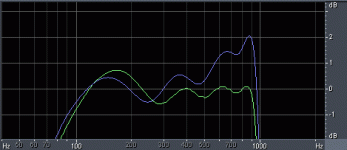
Above are measurements of woofer mounted in pipe pointing at ceiling. Woofer has been equalized on listening axis as used in 2-2way set up. Yellowish trace is listening axis, blueish is vertical axis above woofer. Tweeter arm is not present. Measurements are gated to about 6ms.
Law's of physics on which planet?
Nice cartoon. How about reality:
View attachment 319948
Above are measurements of woofer mounted in pipe pointing at ceiling. Woofer has been equalized on listening axis as used in 2-2way set up. Yellowish trace is listening axis, blueish is vertical axis above woofer. Tweeter arm is not present. Measurements are gated to about 6ms.
Well, well. Your actual measures show pretty much what the "cartoon" from Olson (real world studies done at RCA in the lates 40s. early 50s) would predict given the realative size of the membrance in the pipe, but worse than i would have expected in the sense that the baffle-step ripple is extending lower in frequency than expected.
You have to be careful dissing giants like Harry Olson. "Acoustics" is one of the must reads for anyone designing speakers. The graph is from page 23, and represents a real-world measurement -- no screen grabs in those days.
dave
Cartoon shows +/-5dB. Results are likely for tiny radiator, and is just the kind of stuff that leaves potentially great approach unexplored till the 21st century.
And yes, always something has to give. I'm sure narrow baffle towers with thin skinned full range drivers show more interesting response. The display FFT is 8192 point, so low end shows a little more ripple.
Mind this is quick setup, and a real live result. Pick at it all day.
We are all working with the same physics.
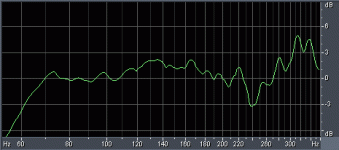
Same listening axis measurement, no gate, 65k point FFT spectrum. Wall, floor, and ceiling reflections are clearly seen in IR, and contribute to the result.
As infrequent as real results of current designs are on this, and other audio forums, I've seen many that look a whole lot lumpier:

The above result is considered promising. Even with heavy stock, internal bracing, and more damping, low end response will likely remain like this. But maybe some published results exist for an optimized version/variation of this.
Nobody seems in a rush to post up, likely because nothing fundamentally has changed in decades.
Linkwitz offers up something a little different, and with DSP techniques it is taken further.
I've no disrespect for Olson and the other giants, quite the contrary. I show great respect in repeating and duplicating experiments, demonstrating scientific approach, and learning from hands on reality.
Regards,
Andrew
And yes, always something has to give. I'm sure narrow baffle towers with thin skinned full range drivers show more interesting response. The display FFT is 8192 point, so low end shows a little more ripple.
Mind this is quick setup, and a real live result. Pick at it all day.
We are all working with the same physics.
Same listening axis measurement, no gate, 65k point FFT spectrum. Wall, floor, and ceiling reflections are clearly seen in IR, and contribute to the result.
As infrequent as real results of current designs are on this, and other audio forums, I've seen many that look a whole lot lumpier:
The above result is considered promising. Even with heavy stock, internal bracing, and more damping, low end response will likely remain like this. But maybe some published results exist for an optimized version/variation of this.
Nobody seems in a rush to post up, likely because nothing fundamentally has changed in decades.
Linkwitz offers up something a little different, and with DSP techniques it is taken further.
I've no disrespect for Olson and the other giants, quite the contrary. I show great respect in repeating and duplicating experiments, demonstrating scientific approach, and learning from hands on reality.
Regards,
Andrew
- Status
- Not open for further replies.
- Home
- Loudspeakers
- Multi-Way
- Active vrs passive