


If you have been involved in woodworking for a bit, you'll find that screws are more bother than they are worth for speaker cabinets. Pilot holes, pass holes, counter sinking, filling and sanding are all steps you eliminate if you use cleats, clamps and a finish nailer.
What are you building?
What are you building?
Ok, thats an easy one:
the glue helps you keep your cabinet air-tight,
surpresses the inevitable dimensional changes in the wood
and is stronger than the glued wood anyway. (if done right!)
Screws on the other hand wont help a single bit in keeping you cabinet air-tight,
will not survive the "working" of the wood when humidity changes
and are a pita when the wall thickness is not very high.
Did that help ;-)
Michael
the glue helps you keep your cabinet air-tight,
surpresses the inevitable dimensional changes in the wood
and is stronger than the glued wood anyway. (if done right!)
Screws on the other hand wont help a single bit in keeping you cabinet air-tight,
will not survive the "working" of the wood when humidity changes
and are a pita when the wall thickness is not very high.
Did that help ;-)
Michael


Screws are just non-removable clamps, they add little to the structure. Glue is the strength.
That's what I use screws for. They just stop things moving while the glue sets.

The glue not only makes a cabinet airtight. Because the joints are fully glued from end to end and side to side, it makes them way stiffer than with just a few screws.
You may use screws to clamp the pieces together, but why not use clamps for that? It may sound rediculously short, but using bog standard wood glue, panels may only need to be clamped together for about an hour!
When using clamps you can also forgo filling and sanding the srew-holes, like Cal alreday mentioned. If you paint the cabinet, you will always see where the screw holes are, despite filling and sanding flush, especially with high gloss paint.
You may use screws to clamp the pieces together, but why not use clamps for that? It may sound rediculously short, but using bog standard wood glue, panels may only need to be clamped together for about an hour!
When using clamps you can also forgo filling and sanding the srew-holes, like Cal alreday mentioned. If you paint the cabinet, you will always see where the screw holes are, despite filling and sanding flush, especially with high gloss paint.
Last edited:
Screws have their place. Inside the cabinet (blocking, bracing) where conventional clamping could be near impossible for instance.
Finer exterior finishes have a higher chance of success if their surfaces aren't penetrated. Fastener telegraphing can ruin an otherwise fine paint/veneered exterior finish.
Finer exterior finishes have a higher chance of success if their surfaces aren't penetrated. Fastener telegraphing can ruin an otherwise fine paint/veneered exterior finish.
yeah, but all the above under the assumption that only one kind of wood will be used.
If for the outside we use (I don't know how it's called in english) another layer (like IKEA does with everything), then it is possible to use glue AND screws. Not?
I've done little in woodwork, but I was under the impression that when we need something strong and solid (and handle weight) we should use screws. Of course the appropriate depending, on position, type of wood, angle etc...
If for the outside we use (I don't know how it's called in english) another layer (like IKEA does with everything), then it is possible to use glue AND screws. Not?
I've done little in woodwork, but I was under the impression that when we need something strong and solid (and handle weight) we should use screws. Of course the appropriate depending, on position, type of wood, angle etc...
Ah, but PVA is flexible, and usually not waterproof. Cascamite (resin) or epoxy are more rigid. I used to make skateboards, and PVA glued layers creep. Also battening the internal corners will give a much larger surface area for the glue, assuming you DON'T want a bit of flex.

When gluing pre-veneered panels, anyone know a good way to keep the glue off the veneer but still have a flush seam?
Clean it off with a damp towel?
I used brown leatherette to finish my K15+4 so screw heads are absolutely invisible.
what's that?
Not a problem, my drivers aren't either so the glue doesn't need to be, I'll keep them out of the rain.Ah, but PVA is flexible, and usually not waterproof.
And unnecessary for speaker boxes, no?Cascamite (resin) or epoxy are more rigid.
Sounds like you have to much interply glue?I used to make skateboards, and PVA glued layers creep.
Cleats, corner blocks, battens, call them what you want but they were mentioned starting back in post #2.Also battening the internal corners will give a much larger surface area for the glue
No thanks. No like'm flexy boxes.assuming you DON'T want a bit of flex.
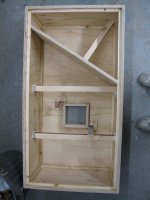
Cleats are what you see on the inside corners of the attached box. A finish nailer is an air tool that fires small, almost headless nails. You install the cleats on one panel using a scrap piece for a spacer, using your nailer and glue and by the time you've done them all, it's time to assemble the whole box. Glue by using big clamps to hold the panels while you fire your nails on the inside through the cleats and you can release the big clamps because the little nails are holding it now and go onto the next panel. You need only a few clamps, you can assemble faster than any other way, you have no exposed fasteners except on the back panel (and only if you're lazy or it's too tight to fit the nailer inside the cabinet's woofer holes.)I know clamps, but what are cleats and finish nailer??
I used to dread making even the test cabinets but no more. Gone are the screws, biscuits and all those other headaches. Perfect alignment of panels, no heartaches, no oop's or ah sh!7's, no extra bleeding, nada. Me and my air nailer are in a long term relationship.

Attachments
I'm not sure why you felt it neccessary to comment point by point, as my post was aimed at someone WITHOUT experience. Or was it for your own amusement? You didn't actually add anything to the OPs knowledge there.Not a problem, my drivers aren't either so the glue doesn't need to be, I'll keep them out of the rain.
And unnecessary for speaker boxes, no?
Sounds like you have to much interply glue?
Cleats, corner blocks, battens, call them what you want but they were mentioned starting back in post #2.
No thanks. No like'm flexy boxes.
Anyway,
Damp as well as rain can affect glue.
Rigid corners are unneccessary, yet you don't like flexy boxes? A mixed message there. Besides, some speakers, BBC designs for example allow for flex, no?
Too much interply glue? How is that relevant? It just demonstrates possible problems, and a beginner might easily use too much glue.
Cleats, etc were already mentioned? That's just pedantry.
Also your love of your nail gun doesn't really help someone who needs to ask about screws and glue, does it? Besides, if you not expert with one, it's very easy to get in a real mess, nails coming out of the sides etc.
I usually try not to react to these types of posts, but in this case I think you do the OP a disservice, and with your obvious expertise you could offer so much more.
- Status
- This old topic is closed. If you want to reopen this topic, contact a moderator using the "Report Post" button.
- Home
- Loudspeakers
- Multi-Way
- glue or screws