

For the origins of this speaker, first a brief history lesson for the younger half of the forum 😀
Some 20+ years ago, speakers were square boxes (with dark brown cloth in front of the drivers).
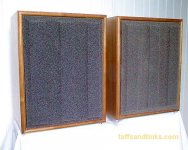
If you wanted a "proper" speaker, it had to be a 3 way. This would mean a larger square box, with an 8 or 10 inch woofer in a sealed box. This speaker will be one of those, a square box with a 10" woofer (but no cloth, sorry).
I had planned on building a 3way for some time, but finally got to building it when CSS introduced their new high end tweeter and midrange. For a decent woofer CSS is also the right place to shop; for this 3way either the Trio8 or the SDX10 would suit. I decided for the SDX10 for it would provide (as expected) a deeper more powerfull bass.
To start with the end in mind, here is a picture of the speaker as it is now:
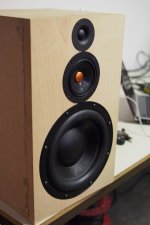
I will write some more posts later...
Some 20+ years ago, speakers were square boxes (with dark brown cloth in front of the drivers).
If you wanted a "proper" speaker, it had to be a 3 way. This would mean a larger square box, with an 8 or 10 inch woofer in a sealed box. This speaker will be one of those, a square box with a 10" woofer (but no cloth, sorry).
I had planned on building a 3way for some time, but finally got to building it when CSS introduced their new high end tweeter and midrange. For a decent woofer CSS is also the right place to shop; for this 3way either the Trio8 or the SDX10 would suit. I decided for the SDX10 for it would provide (as expected) a deeper more powerfull bass.
To start with the end in mind, here is a picture of the speaker as it is now:
I will write some more posts later...

Q: Henkjan, why the "heavyweight" in the thread title?
A: it has to do with the cabinet walls
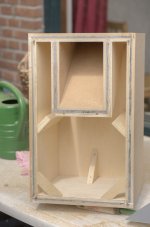
Since the drivers are better than average, I wanted to put more than average effort in building the cabinet. I decided to go for a "constrained layer" apporach: a heavy damping material in between 2 wood panels. This heavy material can be the usual bitumen, but I chose Merford Isomat TS 14. On the outside I have applied 8mm MDF, the inside of the cab is 9mm baltic birch plywood. This should give a good "dead" enclosure. It also means you need a lot of glue and time to glue everything together, with the rather long drying time of the PU glue I used it took me more than a week per box. And you need a lot of clamps....:
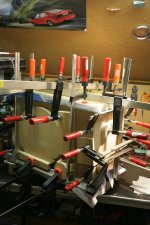
The mid enclosure is not square, but triangular towards the rear to "catch" the backwave (with the help of the Twaron Angel Hair damping material). This is an easy way (80/20 rule: 80% of result with 20% of the effort) to do what B&W does with the Nautilus midrange.
To prepare for construction, I made a 3D model in Sketchup. This proved helpful to see if everything fitted together and where to make some adjustmenst:
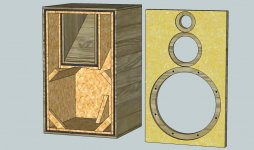
The baffle I made of normal 25mm MDF (in retrospect plywood would have been better). The main thing here is to create sufficient breathing space for the midrange.
And then this is how it looks without the baffle on it, all 20 kg of it
A: it has to do with the cabinet walls
Since the drivers are better than average, I wanted to put more than average effort in building the cabinet. I decided to go for a "constrained layer" apporach: a heavy damping material in between 2 wood panels. This heavy material can be the usual bitumen, but I chose Merford Isomat TS 14. On the outside I have applied 8mm MDF, the inside of the cab is 9mm baltic birch plywood. This should give a good "dead" enclosure. It also means you need a lot of glue and time to glue everything together, with the rather long drying time of the PU glue I used it took me more than a week per box. And you need a lot of clamps....:
The mid enclosure is not square, but triangular towards the rear to "catch" the backwave (with the help of the Twaron Angel Hair damping material). This is an easy way (80/20 rule: 80% of result with 20% of the effort) to do what B&W does with the Nautilus midrange.
To prepare for construction, I made a 3D model in Sketchup. This proved helpful to see if everything fitted together and where to make some adjustmenst:
The baffle I made of normal 25mm MDF (in retrospect plywood would have been better). The main thing here is to create sufficient breathing space for the midrange.
And then this is how it looks without the baffle on it, all 20 kg of it

Impressive! That looks amazing. How are you going to amplify and cross those over?
KM
KM
Last edited:
for those with a good eye for volumes, they will have noticed that the cabinet is rather small for an SDX10. That is correct, a bit below 25 lietrs remain for the woofer, what gives a q of ~0.9. To get a decent sounding bass out of this, one can apply a large capacitor in series with the woofer. This will flatten the bump in the response, and also boost somewhat the output below fb:
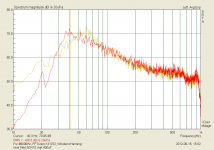
btw: this is nothing new, KEF did this often in the 70's, and maybe even before that. but it is a good way to get a decent bass out of the smallest cabinet size for a given woofer. For drivers with a high Qts this is usually the only way, and can even get the output to below fs
btw2: for those who want a more audiophile bass, you can turn the design into a floorstander ("continue" the cabinet at the bottom), this way you can increase the volume for the woofer a lot; thus the series cap is no longer needed. maybe you'll need to tweak the mid/woof filtering a bit (there is a dB or so difference in output in the 300Hz area acc to the sim I did with 'The Edge'), but the mid/tweet filter can remain the same
btw: this is nothing new, KEF did this often in the 70's, and maybe even before that. but it is a good way to get a decent bass out of the smallest cabinet size for a given woofer. For drivers with a high Qts this is usually the only way, and can even get the output to below fs
btw2: for those who want a more audiophile bass, you can turn the design into a floorstander ("continue" the cabinet at the bottom), this way you can increase the volume for the woofer a lot; thus the series cap is no longer needed. maybe you'll need to tweak the mid/woof filtering a bit (there is a dB or so difference in output in the 300Hz area acc to the sim I did with 'The Edge'), but the mid/tweet filter can remain the same
thanks. crossover will be passive (I'll write more on that tomorrow), so a single amp will do. but that amp will have to be able to deliver sufficient power for the SDX10's SPL into 4pi space is rather low. So biamping is a good if you have the amps available. I played the first version on a DIY gathering last month, and it was then driven by a not so heavy amp, all went fine until we played some music with serious low bass (iirc Strawinski's Firebird), the amp did not like that at all.. If you keep volumes to a level at which you'll remain good friends with your downstairs neighbours then the demands on the amp are normal of course, but if you play it like you'll want to play a good 3way a heavier amp is a good idea.Impressive! That looks amazing. How are you going to amplify and cross those over?
I did consider making it a semi active filter, with passive for the mid/high and active for the mid/woof (using the Hypex AS2.100 for example), but wanted to keep it passive so you woudn't need new amps for this
Hi,
I'm thinking about a special bundle price on at least the drivers, perhap the crossover parts as well.
Bob
I'm thinking about a special bundle price on at least the drivers, perhap the crossover parts as well.
Bob
Hi,
FWIW though the SDX10 is an impressive bass driver the speaker is not
like typical speakers from 20 years ago. The reason being for a 3 way
you need a lot more sensitivity for the bass unit over the mid and treble.
Here the sensible choice might be an active x/o biamping
the bass to mid x/o with a passive mid to treble x/o.
Otherwise with a 85dB bass unit your looking at 80dB to 82dB mid/treble
sensitivity depending on how much of the baffle step is taken into account.
20 (or more) years ago a typical 10" would run up to around 1KHz,
thus including the baffle step in its range, and then x/o to a fairly
mundane sealed back midrange and tweeter of lower sensitivity.
rgds, sreten.
Generally for a 3 way you are looking at 3dB to 5dB worth of baffle
step correction, which means for an 85dB midrange the bass section
should be 88dB to 90dB into half space, a little lower if your prepared
to include minor midrange attenuation for flexibility / tuning.
FWIW though the SDX10 is an impressive bass driver the speaker is not
like typical speakers from 20 years ago. The reason being for a 3 way
you need a lot more sensitivity for the bass unit over the mid and treble.
Here the sensible choice might be an active x/o biamping
the bass to mid x/o with a passive mid to treble x/o.
Otherwise with a 85dB bass unit your looking at 80dB to 82dB mid/treble
sensitivity depending on how much of the baffle step is taken into account.
20 (or more) years ago a typical 10" would run up to around 1KHz,
thus including the baffle step in its range, and then x/o to a fairly
mundane sealed back midrange and tweeter of lower sensitivity.
rgds, sreten.
Generally for a 3 way you are looking at 3dB to 5dB worth of baffle
step correction, which means for an 85dB midrange the bass section
should be 88dB to 90dB into half space, a little lower if your prepared
to include minor midrange attenuation for flexibility / tuning.
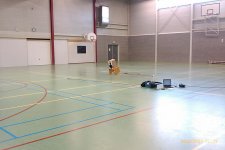
The next step was measuring the units in the actual box. Since the anticipated x-over mid/bass would be rather low, I could not do measurements in my home (gated I can measure downto ~300Hz, what would not be enough now). So I arranged that I could use the local school's gym, and did a ground plane measurement which allowed me to measure down to 50Hz:
And here are the results:
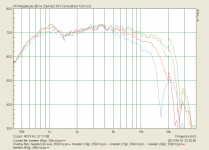
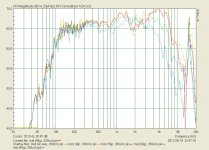
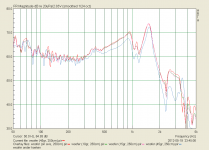
The main challenge in the filter design will be the square baffle induced diffraction hump and sink between 1 and 2kHz that is present in both the tweeter and mid curve.
And here are the results:
The main challenge in the filter design will be the square baffle induced diffraction hump and sink between 1 and 2kHz that is present in both the tweeter and mid curve.

Henkjan,
That is a very strange looking set-up for measuring. It's not half-plane (speaker is not on the floor (ot in the floor), and it is not "as far away as possible from the floor" which is the reason for a big room.
dave
That is a very strange looking set-up for measuring. It's not half-plane (speaker is not on the floor (ot in the floor), and it is not "as far away as possible from the floor" which is the reason for a big room.
dave
the idea is that the mic is on the floor and therefore "sees" 2 speakers mirrored If I had put the speaker on the floor, the baffle step would not have been the same as with the speaker on a stand; raising the LOT 'decouples' the two mirror images (see also the book by Joe d'A)

As far as I was aware you need to get the speaker quite a distance off of the floor for this to work properly. Also your measurements certainly don't look like ones that are free from unwanted artefacts.
Since the drivers are better than average, I wanted to put more than average effort in building the cabinet.
How come you didn`t round over the edges?
the impuls looks clean, I used a gated measurement to keep reflections out.As far as I was aware you need to get the speaker quite a distance off of the floor for this to work properly.
a) to have any effct they need to be rather large and b) I want to veneer them which asks for sharp edges.How come you didn`t round over the edges?
the impuls looks clean, I used a gated measurement to keep reflections out.
Its quite strange how jagged those measurements are then, especially below the frequency of any cone breakup the response should really be pretty smooth.
the impuls looks clean, I used a gated measurement to keep reflections out.
a) to have any effct they need to be rather large
Eh. While larger roundovers are better, I think this:
MurphyBlaster Productions
disproves that.
and b) I want to veneer them which asks for sharp edges.
You can still do a veneer with a roundover. For example:
An externally hosted image should be here but it was not working when we last tested it.

they are not smoothed, as you usually see. this is the same measurement with the usual 1/3 octave smoothed:Its quite strange how jagged those measurements are then, especially below the frequency of any cone breakup the response should really be pretty smooth.
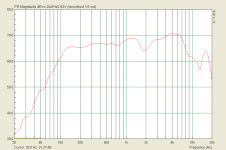
yes yes, the fact that it can be done, does not mean that that is my choice for this box... My starting point was a 3way with a classic look, and that means boxy, square, with the disadvantage of more diffraction than rounded of chamfered edges. But is has the added advantage that a lot more will be able to build this design successfully than if it had rounded edges etc.You can still do a veneer with a roundover.
btw: If I sound grumpy, that has nothing to do with the responses nor with the EC footbal 😱 ... I'm happy with all reactions, keep 'm coming. but just don't expect changes to what is already built 😉
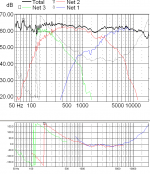
so here we go with the filter. this is the current state of it:The main challenge in the filter design will be the square baffle induced diffraction hump and sink between 1 and 2kHz that is present in both the tweeter and mid curve.
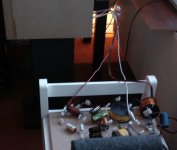
I wanted to use the VWR126X from somewhere 200Hz upwards, to benefit from its very low distortion there. I did not want to fix any filter slopes, just the end result would count. after a few iterations there was a filter layout with basically 2nd order electric slopes on all x-overs, with a extra RCL in the mid LP part that will both flatten the hump and somewhat fill in the dip in the 1-2kHz area. That on-axis the dip is still there is not a problem, since under angles it disappeared. The main thing was that the phases of the tweet and the mid are equal over ~3 octaves. With some tweaking (shunt RCL in the tweet HP to suppress the diffraction bump, small C over the series L in both mid and woof to suppress the sharp peaks at both drivers top end) the filtered curves are nice and smooth in the passband down to -40dB.
A sports hall is a very eco'ey enviroment... wouldnt you be better of at the top of a hill... or at least in a hot air balloon.
and if that probably isnt possable, surely halfspace in a field is more accurate than a hall that bounces sound around as efficently as a basket ball
and if that probably isnt possable, surely halfspace in a field is more accurate than a hall that bounces sound around as efficently as a basket ball
Last edited:
- Status
- Not open for further replies.
- Home
- Loudspeakers
- Multi-Way
- all CSS heavyweight compact 3way