
OTOH, eventually, Qts is not a keypoint. You may adjust it to whatever you want, if you are willing to leave the mainstream camp of "amps should have low output impedance".
Any woofer with decent Xmax and proper fs can be tuned to fit OB well. Low Qts (or Qes) of the driver is not a problem at all. Once it's working with high impedance amp, the system can be tuned to a proper Q.
Again, Nelon brought that up with a series of tests on fullrangers. I made a thread about that for OB bass purpose, too. Still largely ignored. Sigh~
I thought I would give this topic its own thread rather than bury it this inside that long, long NP slotted open baffle thread, where the post by CLS is located.
I used to espouse this same thing - that you can "adjust the Qts" of a driver by playing with the amp's output impedance. Recently, however, I (finally) arrived at the conclusion that this is not "physically" increasing the Qts. You can "effectively" increase the Qts by:
(A) by adding series resistance, or
(B) by increasing the amplifier's output impedance.
But what is really happening???????????????(B) by increasing the amplifier's output impedance.
For (A), it should be easy to see that a resistance in series with the driver is creating a voltage divider. We all know that the impedance of a driver varies with frequency, that there is a "peak" around resonance, and voice-coil inductance causes a slow rise at higher frequencies. When the impedance is high, e.g. very close to resonance, the voltage division directs proportionally more power to the driver than when the impedance is low(er), e.g. in the low-to-middle part of the passband. But don't forget that at high frequencies the slow impedance rise in the driver also causes the voltage divider to increasingly direct the power to the driver and away from the series resistor.
We have a very similar situation in (B). In this case, it is the amp's output impedance that is in series with the driver, but the same argument applies.
In my mind, this is NOT increasing the Qts of the driver. The driver is still as before, only the "apparent" behavior has changed. In either case, there has effectively been a change in the voltage reaching the driver, so that it is no longer frequency independent. You could call it "frequency shaping via output voltage manipulation" or you could call it a "tone control".
Another interesting example of this is when feedback is used around a driver, such as that employed by Stahl in his "ACE-BASS" system. For years when I was younger, I stared at the patent and his JAES (?) publication trying to figure out what the heck he was talking about when he said "the parameters of the driver have changed, in fact if an engineer measured the amp+driver they would measure the new (ACE-BASS imposed) parameters". Wow! I wondered why everyone didn't use this approach? It seemed you could basically dial in whatever driver parameters you wanted, and somehow the driver would be magically transformed in to a high efficiency, low resonance, bass machine! It was like Hoffman's Iron Law was lifted! But I finally realized, after downloading the very nice, and interesting program Basta!, that what is actually happening is the amp is called on to deliver electrical power (e.g. with some magnitude and phase) that is crafted to cause the response to take on that of the "new, imposed" driver parameters, but the DRIVER STAYS THE SAME!!! Thus, no magic. It's just another fancy "tone control", really. In fact, once I could see the amplifier demand when the ACE-BASS circuit was engaged in Basta! I realized that I could just as effectively shape/boost the response using the standard line-level filter circuits (placed before the amplifier), without resorting to a dicey feedback resistor, and all the problems that it introduces. I can't tell you how many hours I spent thinking about thermal tracking of teh driver's Re... Now, about the only thing left over about the ACE-BASS circuit that seems interesting is the claim that some orders of distortion related to the suspension compliance are reduced if the imposed compliance swamps the true compliance.
Anyway, since it took me awhile to wake up to this reality, that the laws of physics can't be broken, I thought I would share my thoughts on this here in hopes that everyone will chime in with their usual uplifting comments and such. 😉
-Charlie

I've got no problem with manipulating Qts, other than not feeling great about wasting power in resistance. If it is done with feedback being used to raise the output impedance then I guess I have no objections at all. I know people will jump in with the horrors of loosing the magical properties of amplifier damping but in the end it is simply providing an EQ curve based on the impedance curve.
I've also mentioned on a thread or two that I've done distortion tests with variable output impedance amps and at low frequencies there was no difference in distortion level with high or low driving impedance, as long as the comparison was otherwise equalized to the same response curve.
With regards to thermal issues, constant current means constant SPL so you will actually be better off with higher source impedances.
Uplifting enough?
David
I've also mentioned on a thread or two that I've done distortion tests with variable output impedance amps and at low frequencies there was no difference in distortion level with high or low driving impedance, as long as the comparison was otherwise equalized to the same response curve.
With regards to thermal issues, constant current means constant SPL so you will actually be better off with higher source impedances.
Uplifting enough?
David


Hi Charlie,
The driver can't be separated from what it is driven by : the amplifier. They form an indissociable whole. As all amps are different from the point of view of ouptut impedance (most often by fractions of ohm but not always), you can't refer to standard driving conditions implied by saying "THE DRIVER STAYS THE SAME". What you may mean is that the response to the voltage across the driver's terminals is not affected by the driving impedance. If there is no significant voice coil heating, this is right.
The driver can't be separated from what it is driven by : the amplifier. They form an indissociable whole. As all amps are different from the point of view of ouptut impedance (most often by fractions of ohm but not always), you can't refer to standard driving conditions implied by saying "THE DRIVER STAYS THE SAME". What you may mean is that the response to the voltage across the driver's terminals is not affected by the driving impedance. If there is no significant voice coil heating, this is right.
So I usually use the term "system Q" for describing the behavior of amp + driver (or + associated loads).
In fact the system Q is what listeners are facing eventually. Say, many ported boxes are designed to be Q=1.1 or so to get the loudest boom, thus the somewhat inferior impressions in subjective sound quality (transient response). However the woofer in that box might have a Qts of lower then 0.3.
Oh no, I'm drifting off topic again. But actually not. The drivers are never working alone. In the ported example above, the acoustic load of the box largely affects the 'system Q' -- or usually named as Qtc.
While in the case of OB, the air (acoustic) load is too little to affect system Q, so we look for another partner -- driving amp. It's just another factor in the chain.
As to the comparison of case (A) series resistor and (B) higher Zo by feedback, "feelings" aside, I guess there's no reason against (B). The characters of much less waste in efficiency, and lower cost of components...etc are just an obvious choice in the engineering POV.
In fact the system Q is what listeners are facing eventually. Say, many ported boxes are designed to be Q=1.1 or so to get the loudest boom, thus the somewhat inferior impressions in subjective sound quality (transient response). However the woofer in that box might have a Qts of lower then 0.3.
Oh no, I'm drifting off topic again. But actually not. The drivers are never working alone. In the ported example above, the acoustic load of the box largely affects the 'system Q' -- or usually named as Qtc.
While in the case of OB, the air (acoustic) load is too little to affect system Q, so we look for another partner -- driving amp. It's just another factor in the chain.
As to the comparison of case (A) series resistor and (B) higher Zo by feedback, "feelings" aside, I guess there's no reason against (B). The characters of much less waste in efficiency, and lower cost of components...etc are just an obvious choice in the engineering POV.
Speaking of OB's didn't Martin King's H baffel lower the driver's fs and raise the QTS ? Of course it also lost some sensitivity to.
Yes, H baffle loads the woofer slightly more than flat OB, but still too little to effectively alter the whole thing.
In my trials of slot loaded OB (as proposed by Nelson Pass), the measured system Q is 0.35 (raised from 0.28 of nude driver in free air). For a low Q woofer like that, such acousitc load is not enough.
In my trials of slot loaded OB (as proposed by Nelson Pass), the measured system Q is 0.35 (raised from 0.28 of nude driver in free air). For a low Q woofer like that, such acousitc load is not enough.
I used to espouse this same thing - that you can "adjust the Qts" of a driver by playing with the amp's output impedance. Recently, however, I (finally) arrived at the conclusion that this is not "physically" increasing the Qts. You can "effectively" increase the Qts by:
(A) by adding series resistance, or
(B) by increasing the amplifier's output impedance.
But what is really happening???????????????
About a year ago I went so far as to travel to the library of a local university to photocopy an article by W.J.J. Hoge in the Aug. 1976 issue of AUDIO magazine. That article was given as a reference by Dickason in his Cookbook for the method of increasing Qes by the connection of a resistor in-series with a driver. So I thought that Hoge's article would provide an explanation about how it works. Unfortunately the article doesn't explain it at all and barely makes a reference to the technique.
If anyone can explain how this works, I'm all ears.
Regards, Pete
Thiele/Small - Wikipedia, the free encyclopedia
In which you may see the equation of Qes. "Re" in that equation means DCR of the voice coil. To get a 'real' Re (and Qes), one should add all resistances in series with voice coil onto this value, i.e., resistances of all wiring, connectors, and output impedance of driving amp.
In 'normal' situation, those resistances are very small, so normally ignored. Now if driven by a high output impedance amp, than the effective Re would be changed significantly, thus altering the Qes.
In some speaker design software, there's also such a variable for the simulation. For example, WinISd and hornresp have it. Other than those who are using tube amps might set 2~3 Ohm for this, I guess most poeple just leave it as default 0, and almost nobody would put a number >10 in that blank. Hehe...
In which you may see the equation of Qes. "Re" in that equation means DCR of the voice coil. To get a 'real' Re (and Qes), one should add all resistances in series with voice coil onto this value, i.e., resistances of all wiring, connectors, and output impedance of driving amp.
In 'normal' situation, those resistances are very small, so normally ignored. Now if driven by a high output impedance amp, than the effective Re would be changed significantly, thus altering the Qes.
In some speaker design software, there's also such a variable for the simulation. For example, WinISd and hornresp have it. Other than those who are using tube amps might set 2~3 Ohm for this, I guess most poeple just leave it as default 0, and almost nobody would put a number >10 in that blank. Hehe...
Last edited:

Yes, Unibox also takes this into account. It changes the effective Qt of the driver. Important to know if you have big coils and/or a high impedance amp.

Thiele/Small - Wikipedia, the free encyclopedia
In which you may see the equation of Qes. "Re" in that equation means DCR of the voice coil. To get a 'real' Re (and Qes), one should add all resistances in series with voice coil onto this value, i.e., resistances of all wiring, connectors, and output impedance of driving amp.
In 'normal' situation, those resistances are very small, so normally ignored. Now if driven by a high output impedance amp, than the effective Re would be changed significantly, thus altering the Qes.
In some speaker design software, there's also such a variable for the simulation. For example, WinISd and hornresp have it. Other than those who are using tube amps might set 2~3 Ohm for this, I guess most poeple just leave it as default 0, and almost nobody would put a number >10 in that blank. Hehe...
Looks like CLS beat me to it. (It pays to read to the end of a thread before replying 😀 )I thought I would give this topic its own thread rather than bury it this inside that long, long NP slotted open baffle thread, where the post by CLS is located.
I used to espouse this same thing - that you can "adjust the Qts" of a driver by playing with the amp's output impedance. Recently, however, I (finally) arrived at the conclusion that this is not "physically" increasing the Qts. You can "effectively" increase the Qts by:(A) by adding series resistance, orBut what is really happening???????????????
(B) by increasing the amplifier's output impedance.
For (A), it should be easy to see that a resistance in series with the driver is creating a voltage divider. We all know that the impedance of a driver varies with frequency, that there is a "peak" around resonance, and voice-coil inductance causes a slow rise at higher frequencies. When the impedance is high, e.g. very close to resonance, the voltage division directs proportionally more power to the driver than when the impedance is low(er), e.g. in the low-to-middle part of the passband. But don't forget that at high frequencies the slow impedance rise in the driver also causes the voltage divider to increasingly direct the power to the driver and away from the series resistor.
We have a very similar situation in (B). In this case, it is the amp's output impedance that is in series with the driver, but the same argument applies.
In my mind, this is NOT increasing the Qts of the driver. The driver is still as before, only the "apparent" behavior has changed. In either case, there has effectively been a change in the voltage reaching the driver, so that it is no longer frequency independent. You could call it "frequency shaping via output voltage manipulation" or you could call it a "tone control".
Qes is a measure of the electrical damping caused by the generator action of the moving cone and the Re of the driver sets the maximum amount of electrical damping possible (and therefore the lowest possible Qes) with a source impedance of zero.
Try moving the cone of a large woofer by hand while the terminals are open circuit, and again when they're shorted. While shorted it will strongly resist rapid movements that attempt to deviate from the rest point. Likewise it will tend to suppress (or at least add additional losses to) any mechanical resonances that try to make the cone oscillate independently of the drive waveform.
However any pure resistance added in series will further reduce the electrical damping as for a given motion of the cone less induced current will flow, so there is less back EMF to generate a countering field that will resist the movement.
Call it "effective Qes" if you like, but a pure resistance added in series with a driver will increase the Qes of the combined driver+resistor "device" in exactly the same way as if you had made the voice coil have inherently greater resistance without changing it in any other way.
For example increasing Re by changing from copper to aluminium with exactly the same wire dimensions and layout, and a tiny bit of weight added to the VC former to compensate for the change in weight, and you will get the same effective Qes as if that resistance had been added externally.
What matters is the total loop resistance that the voltage generated by the speaker through generator action "sees". Without a completed circuit there is no Qes. Leave the speaker terminals open or drive it from a pure current source amplifier and Qts will equal Qms.
However, there are a couple of caveats for having the extra resistance external to the driver instead of built into the voice coil Re - one is that you will get a rise in response at high frequencies because the extra resistance is lumped instead of distributed resistance along the inductance of the voice coil, thus the external resistance and voice coil inductance will work together to cause a rising response, but this is usually well beyond the resonance area where Qes applies.
The other is that any shunt components connected to the driver will obviously modify the response. (Normally it would be impossible to connect such a component when all the resistance is in the voice coil, unless you had a tapped voice coil) For the extra resistance to be equivalent to increased Re there should be a series resistor from the network to the driver, and nothing connected in parallel with the driver.
What you describe with the series resistor and the driver forming a voltage divider that changes the shape of the frequency response applied to the driver is not wrong - its just another way of looking at the same thing.
Where I think you stumbled is that Qes as a driver parameter is only meaningful when the source impedance is zero, and it is always quoted for a source impedance of zero in driver parameter calculations, but the "effective Qes" is going to change depending on the effective source impedance at the driver terminals...
Last edited:
Here is a teas for you guys. When we measure driver impedance we place a series resistor in the loop. It doesn't make much difference what the value of the resistor is. It can be on the order of Re or on the order of 100 time Re. Yet the measured values of Q (Qts, Qms, Qes) remain constant. Why?
The driver parameters are indeed changed with the ACE circuit but it doesn't come for free.
If you use a closed box you will not gain anything IMO (haven't tested it with a closed box though) over the use of EQing.
With reflex tuning you are actually able to "design" your parameters (within physical limitations of course) such that you have optimal ones for your targeted reflex tuning.
You can knock slightly on the woofer cones when the circuit is in action and you will clearly hear the altered fs of the driver. If you can hear it with this simple test you will also be able to measure these change in parameters mechanically.
Still the efficiency will drop at the lower end while it stays original in the midband.
The advantage is that one is more flexible in the choice of reflex tuning compared to using the original driver.
Regards
Charles
If you use a closed box you will not gain anything IMO (haven't tested it with a closed box though) over the use of EQing.
With reflex tuning you are actually able to "design" your parameters (within physical limitations of course) such that you have optimal ones for your targeted reflex tuning.
You can knock slightly on the woofer cones when the circuit is in action and you will clearly hear the altered fs of the driver. If you can hear it with this simple test you will also be able to measure these change in parameters mechanically.
Still the efficiency will drop at the lower end while it stays original in the midband.
The advantage is that one is more flexible in the choice of reflex tuning compared to using the original driver.
Regards
Charles
Hi Charles
The driver parameters are indeed changed with the ACE circuit but it doesn't come for free. If you use a closed box you will not gain anything IMO (haven't tested it with a closed box though) over the use of EQing.
According to various authors (Werner and Carell or Macaulay for exemple), an amp having a negative output impedance should lower the distorsion of a driver in a closed box.
The driver parameters are indeed changed with the ACE circuit but it doesn't come for free. If you use a closed box you will not gain anything IMO (haven't tested it with a closed box though) over the use of EQing.
According to various authors (Werner and Carell or Macaulay for exemple), an amp having a negative output impedance should lower the distorsion of a driver in a closed box.
There are people claiming that current-drive (i.e. a high positive output impedance) would reduce harmonic distortion. OTOH I wasn't able to measure THD of the contraption when I tried out the ACE almost twenty years ago.
Regards
Charles
Regards
Charles
There are people claiming that current-drive (i.e. a high positive output impedance) would reduce harmonic distortion. OTOH I wasn't able to measure THD of the contraption when I tried out the ACE almost twenty years ago.
Regards
Charles
Here is a link to Hawksford's paper on current driver/distortion reduction, FWIW.
No takers on my other post?
Hello Charles,
Here is my own mesurement on a TD2001 mounted on a horn when driven in current or in tension.
Notice the distortion reduction when the TD2001 is current driven.
Best regards from Paris, France
Jean-Michel Le Cléac'h
There are people claiming that current-drive (i.e. a high positive output impedance) would reduce harmonic distortion. OTOH I wasn't able to measure THD of the contraption when I tried out the ACE almost twenty years ago.
Here is my own mesurement on a TD2001 mounted on a horn when driven in current or in tension.
Notice the distortion reduction when the TD2001 is current driven.
Best regards from Paris, France
Jean-Michel Le Cléac'h
Attachments
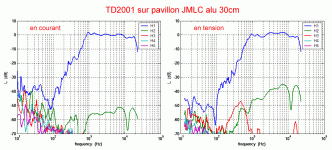
Thanks J-M. That's a 10dB reduction of H2 and significance reduction of H3 (-20dB?).
Of course, the distortion is pretty low already - credit to the driver and horn.
Of course, the distortion is pretty low already - credit to the driver and horn.
Salut Jean-Michel
That looks cool indeed. It does even linearize the (already nice) amplitude response to some degree.
regards
Charles
That looks cool indeed. It does even linearize the (already nice) amplitude response to some degree.
regards
Charles
Hello Charles,
Here is my own mesurement on a TD2001 mounted on a horn when driven in current or in tension.
Notice the distortion reduction when the TD2001 is current driven.
Best regards from Paris, France
Jean-Michel Le Cléac'h
This pretty much mirrors my woofer tests. I saw no reduction of distortion around resonance so no signs of current drive linearizing anything to do with nonlinear compliance, etc. But the 2nd harmonic midrange distortion due to flux modulation effect (this was a simple driver with no flux mod reduction ring, copper cap, etc.) was significantly reduced. My particular effect, and apparently your horn/throat distortion, made the device a nonlinear load resistance. High source impedance linearizes the current by swamping the nonlinear device resisitance with a larger external resisitance.
That is, low source Z would have low voltage distortion but higher current distortion. High source Z gives the opposite. Drive comes from current so linear current is more important.
David S.
- Status
- Not open for further replies.
- Home
- Loudspeakers
- Multi-Way
- raising driver Qts - you can't tuna fish