

I am asking this,
because i am in the move to get rid of my Vitavox S2/Coral H104 horn combo, and replacing them with Beyma TPL-150. I bought the Beymas a month ago, and playing around with them since then.
Beyma Tpl-150 - Page 3 - Audio Voice Acoustics
In the beginning, the first impressions, i was rather unimpressed, because the Beymas sound rather unspectacular. But after some more different kind of music was played, i came to the conclusion, that there is a remarkable advantage of the Beymas. Before i take this step, and sell the horns, i am considering if the coloration in the mid range i hear, compared to the Beyma's, are because my setup is not optimal configured, or because its a inherent characteristic of horns, where there is no remedy. Until i made direct comparisons, i actually believed my horn setup were sounding quit natural, without coloration.Until i made A/B comparisons. I believed LeCleac'h horns were sounding natural/neutral. The revelation was actually quit a surprise to me, but confirmed, what Peter ( PK ) observerd and commented here and elsewere ( He gave me the motivation to try the Beyma's ). True, the horns do sound more dynamic, but naturalness and neutrality is one of the most important things i look for, far more important than dynamics. Many horn installations, which do go 4 ways, use above 1khz small horns, not rarely with 20cm diameter (see goto ) . So my doubt is : Could it be, that colorations are result of a too big horn employd ? At the moment, i use the mid channel above 1,8khz, first order. ( external diameter of the LeCleac'h horn is 60cm , Fc of this horn is ~ 500hz ) If i employ a smaller horn, could it be that i get rid completely of colorations, getting naturalness/neutrality, and horn dynamics at the same time ? If so, it might be worth to make such a small horn, and give try. Maibe someone here has some experience to share.
Angelo
because i am in the move to get rid of my Vitavox S2/Coral H104 horn combo, and replacing them with Beyma TPL-150. I bought the Beymas a month ago, and playing around with them since then.
Beyma Tpl-150 - Page 3 - Audio Voice Acoustics
In the beginning, the first impressions, i was rather unimpressed, because the Beymas sound rather unspectacular. But after some more different kind of music was played, i came to the conclusion, that there is a remarkable advantage of the Beymas. Before i take this step, and sell the horns, i am considering if the coloration in the mid range i hear, compared to the Beyma's, are because my setup is not optimal configured, or because its a inherent characteristic of horns, where there is no remedy. Until i made direct comparisons, i actually believed my horn setup were sounding quit natural, without coloration.Until i made A/B comparisons. I believed LeCleac'h horns were sounding natural/neutral. The revelation was actually quit a surprise to me, but confirmed, what Peter ( PK ) observerd and commented here and elsewere ( He gave me the motivation to try the Beyma's ). True, the horns do sound more dynamic, but naturalness and neutrality is one of the most important things i look for, far more important than dynamics. Many horn installations, which do go 4 ways, use above 1khz small horns, not rarely with 20cm diameter (see goto ) . So my doubt is : Could it be, that colorations are result of a too big horn employd ? At the moment, i use the mid channel above 1,8khz, first order. ( external diameter of the LeCleac'h horn is 60cm , Fc of this horn is ~ 500hz ) If i employ a smaller horn, could it be that i get rid completely of colorations, getting naturalness/neutrality, and horn dynamics at the same time ? If so, it might be worth to make such a small horn, and give try. Maibe someone here has some experience to share.
Angelo
Last edited:
c/o?
Please describe the c/o slopes and frequencies you are using.
Regards,
WHG
So my doubt is : Could it be, that colorations are result of a too big horn employd ? At the moment, i use the mid channel above 1,8khz, first order. ( external diameter of the LeCleac'h horn is 60cm , Fc of this horn is ~ 500hz ) If i employ a smaller horn, could it be that i get rid completely of colorations, getting naturalness/neutrality, and horn dynamics at the same time ? If so, it might be worth to make such a small horn, and give try. Maibe someone here has some experience to share.
Angelo
Please describe the c/o slopes and frequencies you are using.
Regards,
WHG
Please describe the c/o slopes and frequencies you are using.
Regards,
WHG
lower midrange: 150hz - 1,2khz ; 1st. order
midrange: 1,8khz 1st.order / - no lowpass
Coral H104 > 10khz 2nd.order
probably this week i will make measurements.

My experience with horns and compression drivers is limited (see sig.), but I think coloration is not necessarily an inherent horn quality. When I first listened to my system, after some time I did feel the horn had a sound of its own. But when I took the time to perfect the frequency response with DSP, that sound of which I thought it was horn-coloration disappeared.
Most people don't use DSP on their horns and their speakers inevitably have some resonances. How far have you gone in perfecting the response?
BTW, I wonder what speaker dave has to say about this subject (hi Dave, are you reading along?) 🙂.
Most people don't use DSP on their horns and their speakers inevitably have some resonances. How far have you gone in perfecting the response?
BTW, I wonder what speaker dave has to say about this subject (hi Dave, are you reading along?) 🙂.
In the beginning, the first impressions, i was rather unimpressed, because the Beymas sound rather unspectacular. But after some more different kind of music was played, i came to the conclusion, that there is a remarkable advantage of the Beymas.
Interesting. When I first hooked up my Beymas I had the same impression. They did not seem to be what I expected and sounded a little dull and underwhelming.
After playing a little while they really seemed to open up and now sound amazing. The dispersion is also great. I don't know if they need to break in or what.

Angelo, I can't tell what your speakers are from the link... or the amplification... but in general I prefer a system (horn or otherwise) where the widest possible range centered in the "voice" frequencies is covered by one driver. That refers to what is also known as the "telephone" frequencies of <300--> >3,000Hz. I feel that breaking up this range is never entirely successful.
Also, somewhat to my surprise (now some years ago) I found that "horn sound" (assuming a decent horn to begin with) seems to be dependent upon the compression driver, not so much the specific horn! Having said that bit of heresy, there are precious few compression drivers that are 'happy' on a given horn. Otoh, some horns do work better with a wider range of compression drivers. Regardless of the $$cost of the driver, the determining factor imo is the compression driver... how one determines which drivers are desirable is another discussion.
Another issue is the signal chain and amplification.
Compression drivers on horns tend to be lower in distortion at average room listening levels than most direct radiator systems, and by some margin. So, GIGO is what you get.
In other words, just because it is a horn system it might sound like dog poop anyhow, just more dynamic doggie poop? 😀
As far as using DSP to correct - while I am open to the concept in principle, at the present state of the art I am skeptical that the DSP box doesn't add artifacts that are more objectionable than not having it. Best is to not need EQ, especially electronic EQ. I guess this depends where your personal sonic thresholds are and your auditory preferences.
Having said all this, I am operating under the delusion (likely via self hypnosis?) that my horn system is essentially uncolored... what leads me to believe that I am not incorrect is that one can hear "into" the soundfield and discern almost instantly the "nature" of almost any component placed into the system, and/or any recording played - and importantly, people who are not terribly familiar with the system can do this quickly as well. (the reason I mention the last is that our brains learn to "decode" our own systems so that various deficits are overcome, new listeners however do not have that ability...)
So, yes, horns can disappear... as in "...I like the music, what are those BIG THINGS doing down that end of the room anyhow?..."
_-_-bear
Also, somewhat to my surprise (now some years ago) I found that "horn sound" (assuming a decent horn to begin with) seems to be dependent upon the compression driver, not so much the specific horn! Having said that bit of heresy, there are precious few compression drivers that are 'happy' on a given horn. Otoh, some horns do work better with a wider range of compression drivers. Regardless of the $$cost of the driver, the determining factor imo is the compression driver... how one determines which drivers are desirable is another discussion.
Another issue is the signal chain and amplification.
Compression drivers on horns tend to be lower in distortion at average room listening levels than most direct radiator systems, and by some margin. So, GIGO is what you get.
In other words, just because it is a horn system it might sound like dog poop anyhow, just more dynamic doggie poop? 😀
As far as using DSP to correct - while I am open to the concept in principle, at the present state of the art I am skeptical that the DSP box doesn't add artifacts that are more objectionable than not having it. Best is to not need EQ, especially electronic EQ. I guess this depends where your personal sonic thresholds are and your auditory preferences.
Having said all this, I am operating under the delusion (likely via self hypnosis?) that my horn system is essentially uncolored... what leads me to believe that I am not incorrect is that one can hear "into" the soundfield and discern almost instantly the "nature" of almost any component placed into the system, and/or any recording played - and importantly, people who are not terribly familiar with the system can do this quickly as well. (the reason I mention the last is that our brains learn to "decode" our own systems so that various deficits are overcome, new listeners however do not have that ability...)
So, yes, horns can disappear... as in "...I like the music, what are those BIG THINGS doing down that end of the room anyhow?..."
_-_-bear
Angelo, I can't tell what your speakers are from the link... or the amplification
Sorry for not telling of what speakers and amplification i am talking about - since i presented my system here at DIYAudio , i thought, most would know it already :
AV Eikon : finished - Audio Voice Acoustics
The Beymas do sound more natural. more relaxed, and are easyer to listen to. I can listen for hours, and don't get tired. With the S2/LeCleac'h horns, it sounds like voices are squeezed out of the horn, crumpled (the right word in english ? in german verdrueckt ) and with coloration ( thats mostly observed with voices ) . However , dinamics make jazz, instrumental , orchestra etc. sound more real, more lifelike, its easyer to get the " wow " effect. So both solutions do have their advantage/disadvantages.
this is the response i have with S2/H104:
An externally hosted image should be here but it was not working when we last tested it.

highpass was however at 1khz S2 first order, and 700hz Radian 950pb in the lower midrange horn.
now i made some changes, using Fane Studio 8m in the lower midrange horn, crossed at 1,2khz, and S2 at 1,8khz, also first order.
coloration remains the same.
later today my acoustic engeneer maibe will visit me, and we will make new measurements.
I've moved away from horn-type systems in the bass, largely because of the potential for horn coloration from the enclosure due to lack of cabinet material rigidity. Also, I feel that high conversion efficiency direct radiators (above 97db/w/m) potentially used in multiples to augment system efficiency can offer much of the dynamic performance that horns are noted for.
For MF/HF, I use either concrete or heavily damped aluminum for the horn flares to keep their coloration as low as possible. Earl Geddes has documented reflection modes inside the horn flares which apparently always exist to a certain extent but my impression is that they can be reduced to the point where they are not a primary source of coloration.
For MF/HF, I use either concrete or heavily damped aluminum for the horn flares to keep their coloration as low as possible. Earl Geddes has documented reflection modes inside the horn flares which apparently always exist to a certain extent but my impression is that they can be reduced to the point where they are not a primary source of coloration.
Last edited:
I am asking this,
because i am in the move to get rid of my Vitavox S2/
Hello Angelo,
The Vitavox S2 is an old driver and it doesn't fit so well with modern horns having very low horn coloration and diffraction (Tractrix, Kugelwellen, Le Cleach...).
As an illustration, please give a look to the measurements I have done on 16 horns during ETF'2010.
http://forums.melaudia.net/attachment.php?aid=1760
It happened that 2 drivers were measured on the very same tractrix horn (Stereolab 600)
N°13 : with the Vitavox S2
N°14 : with the Yamaha 6681
Please notice the flatness of the frequency response obtained with the Yamaha driver while we observe a huge bump between 800 and 3000Hz with the Vitavox S2.
Notice on the group delay curve the anomaly between 800Hz and 3000Hz with the Vitavox S2 (probably linked to the anomaly seen on the wavelets graph around 0.7ms )
Such feature is basically due to the design of the S2.
Good horns need the best drivers.
Best regards from Paris, France
Jean-Michel Le Cléac'h
Beyma's TPL 150 H should give you back a bit of the dynamics you lost, but without any coloration.
I used this version of the driver in several projects, and it is a really great driver!
I used this version of the driver in several projects, and it is a really great driver!
Beyma's TPL 150 H should give you back a bit of the dynamics you lost, but without any coloration.
I used this version of the driver in several projects, and it is a really great driver!
Are you comparing the TPL-150 vs TPL-150H?
I don't have the horn version, but if you have experience with both versions I would welcome your observations.

Every driver has coloration IMO.
I use horns to and hear also some thing about them. But I have it with every transducer because like I stated they al have their own sound. It about what coloration you can live with and choose your system.
I use horns to and hear also some thing about them. But I have it with every transducer because like I stated they al have their own sound. It about what coloration you can live with and choose your system.
@ Loren42
Yes, I was comparing the version with and without horn. Although I must admit, that I only used the "H" version myself and know the normal one from a friend, who changed it to the "H" version.
The normal TPL 150 is a great driver, that gives a natural and clear sound at any volumen. It never sounds harsh or misses any detail, but it could be a bit more "in your face".
The TPL 150 H gives you more efficiency and a flater frequency response, so a passive crossover is much easier to find. It can be crossed very low (1kHz) and still has loads and loads of headroom. It has near perfect constant directivity and it has all the qualities the normal version has, but adds more dynamics to it.
For me, it is the best tweeter I used or heard so far!
Yes, I was comparing the version with and without horn. Although I must admit, that I only used the "H" version myself and know the normal one from a friend, who changed it to the "H" version.
The normal TPL 150 is a great driver, that gives a natural and clear sound at any volumen. It never sounds harsh or misses any detail, but it could be a bit more "in your face".
The TPL 150 H gives you more efficiency and a flater frequency response, so a passive crossover is much easier to find. It can be crossed very low (1kHz) and still has loads and loads of headroom. It has near perfect constant directivity and it has all the qualities the normal version has, but adds more dynamics to it.
For me, it is the best tweeter I used or heard so far!
Yes! I have REALLY been able to get rid of horn coloration, by using an Altec 32 bent horn with 802-8G driver. I can honestly say, hand on my heart, that I do not hear any horn colorations with this setup, and I consider myself very sensitive to the sound of horns.
One curious aspect of the 32 horn is its 90 degree bend. The driver is actually facing straight up and the horn curves toward the front so its mouth is flush with the front panel. I was concerned whether the highest frequencies would make it around the bend. I don't know how other drivers would fare on the 32, but one of the secrets with the 802 is to use a little equalization to compensate for the driver's actual rolloff and whatever rolloff may be due to the bent horn. This turns out to be easy to implement because Altec's 9849 also used the 802-8G/32 combination and its crossover includes some eq which sounds just right to my ears.
I have used the 32/802 with an Altec 414 and a Jensen P15LL, and in my opinion it sounds great with each combination. Here's a photo of a custom speaker using a Jensen and 32 horn, but with an unobtainium WE driver:
Vintage Audio Products Collection at Deja Vu Audio. (first photo on page)
If anyone is interested in trying the eq circuit, send me an email and I will forward a copy.
Dave
One curious aspect of the 32 horn is its 90 degree bend. The driver is actually facing straight up and the horn curves toward the front so its mouth is flush with the front panel. I was concerned whether the highest frequencies would make it around the bend. I don't know how other drivers would fare on the 32, but one of the secrets with the 802 is to use a little equalization to compensate for the driver's actual rolloff and whatever rolloff may be due to the bent horn. This turns out to be easy to implement because Altec's 9849 also used the 802-8G/32 combination and its crossover includes some eq which sounds just right to my ears.
I have used the 32/802 with an Altec 414 and a Jensen P15LL, and in my opinion it sounds great with each combination. Here's a photo of a custom speaker using a Jensen and 32 horn, but with an unobtainium WE driver:
Vintage Audio Products Collection at Deja Vu Audio. (first photo on page)
If anyone is interested in trying the eq circuit, send me an email and I will forward a copy.
Dave
@ Loren42
Yes, I was comparing the version with and without horn. Although I must admit, that I only used the "H" version myself and know the normal one from a friend, who changed it to the "H" version.
The normal TPL 150 is a great driver, that gives a natural and clear sound at any volumen. It never sounds harsh or misses any detail, but it could be a bit more "in your face".
The TPL 150 H gives you more efficiency and a flater frequency response, so a passive crossover is much easier to find. It can be crossed very low (1kHz) and still has loads and loads of headroom. It has near perfect constant directivity and it has all the qualities the normal version has, but adds more dynamics to it.
For me, it is the best tweeter I used or heard so far!
Thanks. I have the non-horn version and have considered getting/adding the horns. Primarily to help fill the directivity gap between my Acoustic Elegance TD15H and the TPL-150 in a 2-way design.
To the original post's question, do you feel Beyma's horn adds any coloration to the raw TPL-150 driver?
The driver without the horn is excellent (in my opinion).
I have not heard any coloration with the horn. Also in impedance measurments there is no sign of any resonance, in fact it looks better than some resistors do.
And directivity matches 15" drivers perfect, when crossing somewhere between 1.1 and 1.4kHz.
And directivity matches 15" drivers perfect, when crossing somewhere between 1.1 and 1.4kHz.
I have not heard any coloration with the horn. Also in impedance measurments there is no sign of any resonance, in fact it looks better than some resistors do.
And directivity matches 15" drivers perfect, when crossing somewhere between 1.1 and 1.4kHz.
Thanks. I really saw the Beyma TPL-150 and the 150H as a good candidate to replace a horn.

I am asking this,
because i am in the move to get rid of my Vitavox S2/Coral H104 horn combo, and replacing them with Beyma TPL-150. I bought the Beymas a month ago, and playing around with them since then.
Beyma Tpl-150 - Page 3 - Audio Voice Acoustics
In the beginning, the first impressions, i was rather unimpressed, because the Beymas sound rather unspectacular. But after some more different kind of music was played, i came to the conclusion, that there is a remarkable advantage of the Beymas. Before i take this step, and sell the horns, i am considering if the coloration in the mid range i hear, compared to the Beyma's, are because my setup is not optimal configured, or because its a inherent characteristic of horns, where there is no remedy. Until i made direct comparisons, i actually believed my horn setup were sounding quit natural, without coloration.Until i made A/B comparisons. I believed LeCleac'h horns were sounding natural/neutral. The revelation was actually quit a surprise to me, but confirmed, what Peter ( PK ) observerd and commented here and elsewere ( He gave me the motivation to try the Beyma's ). True, the horns do sound more dynamic, but naturalness and neutrality is one of the most important things i look for, far more important than dynamics. Many horn installations, which do go 4 ways, use above 1khz small horns, not rarely with 20cm diameter (see goto ) . So my doubt is : Could it be, that colorations are result of a too big horn employd ? At the moment, i use the mid channel above 1,8khz, first order. ( external diameter of the LeCleac'h horn is 60cm , Fc of this horn is ~ 500hz ) If i employ a smaller horn, could it be that i get rid completely of colorations, getting naturalness/neutrality, and horn dynamics at the same time ? If so, it might be worth to make such a small horn, and give try. Maibe someone here has some experience to share.
Angelo
Hello Angelo,
Nice system build and to answer your question , i have never heard a horn system that did not suffer from coloration of sometype, even the ones costing a 100 K ....😉
Coloration or dynamics ... pick your poison ...🙂
Yes! I have REALLY been able to get rid of horn coloration, by using an Altec 32 bent horn with 802-8G driver. I can honestly say, hand on my heart, that I do not hear any horn colorations with this setup, and I consider myself very sensitive to the sound of horns.
One curious aspect of the 32 horn is its 90 degree bend. The driver is actually facing straight up and the horn curves toward the front so its mouth is flush with the front panel. I was concerned whether the highest frequencies would make it around the bend. I don't know how other drivers would fare on the 32, but one of the secrets with the 802 is to use a little equalization to compensate for the driver's actual rolloff and whatever rolloff may be due to the bent horn. This turns out to be easy to implement because Altec's 9849 also used the 802-8G/32 combination and its crossover includes some eq which sounds just right to my ears.
I have used the 32/802 with an Altec 414 and a Jensen P15LL, and in my opinion it sounds great with each combination. Here's a photo of a custom speaker using a Jensen and 32 horn, but with an unobtainium WE driver:
Vintage Audio Products Collection at Deja Vu Audio. (first photo on page)
If anyone is interested in trying the eq circuit, send me an email and I will forward a copy.
Dave
Interesting Salectric ........
we observe a huge bump between 800 and 3000Hz with the Vitavox S2.
Hi Jean Michel
yes, i know about the bump. As shown in the measurements of my system, its there as well : so that might be the reason of the colorations. I crossed the S2 at 1,8khz ( the measurement was made, crossing at 1khz ), and Fane Studio 8m at 1,2khz, but colorations remain. Instead using a different driver ( coming back to my question in the opening thread ), could it not be, that a smaller horn adds less gain in that frequency range, avoiding the bump, and as a result less colorations ?
Beyma's TPL 150 H should give you back a bit of the dynamics you lost, but without any coloration.
Hi Meister-gue
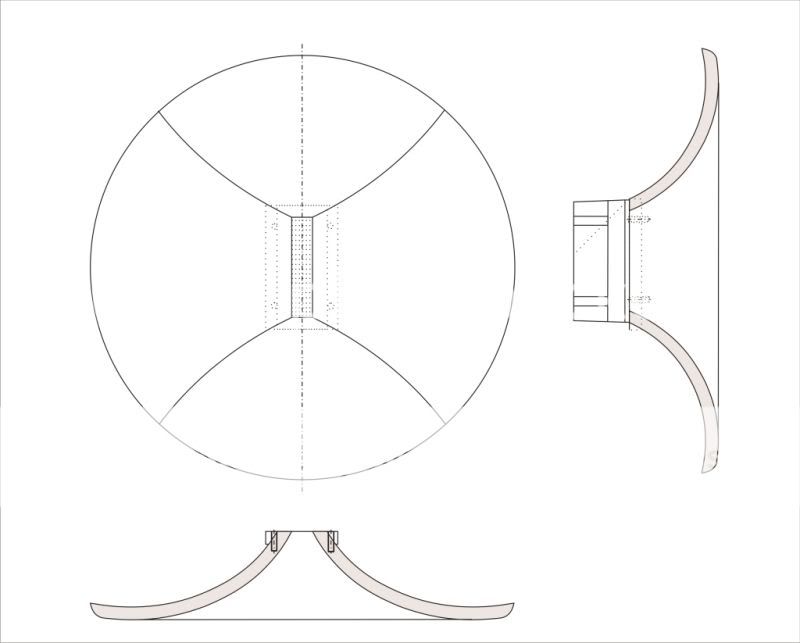
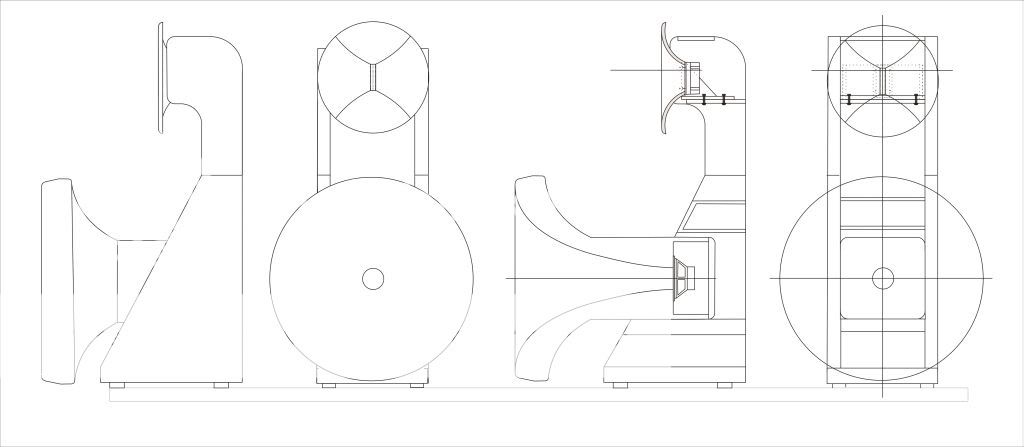
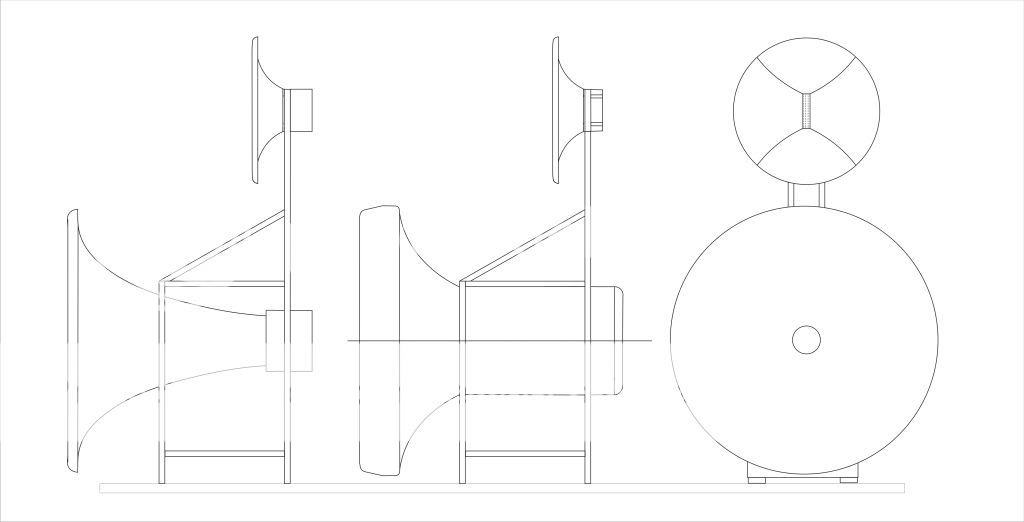
yes, to try the Beyma with a waveguide is my next goal. I feel much more motivated, to go ahead with the Beyma, than with the S2.
It will look as shown below. I will try to insert it as good as possible, in the existing system.
Yes! I have REALLY been able to get rid of horn coloration, by using an Altec 32 bent horn with 802-8G driver. I can honestly say, hand on my heart, that I do not hear any horn colorations with this setup, and I consider myself very sensitive to the sound of horns.
hi Dave
I remember when i was a kid, my dad used Electro Voice horns with T25a drivers, square as the ones shown in the picture. They were amongst the most colored horns i heard, but it became only evident after comparing with direct radiator midrange. I don't think its easy to observe colorations, if you don't compare side by side with direct radiators. The ear can easily be cheated. Have you done comparisons ?
Last edited:
- Status
- Not open for further replies.
- Home
- Loudspeakers
- Multi-Way
- Has someone here REALLY been able to get rid of horn coloration ?