

I haven't been doing a lot of posting lately, mostly too involved elsewhere. But this should make up for it.
I've been trying various iterations of open baffle (OB) speakers. My goal is the least linear error (on and off axis frequency response as flat and regular as possible). Here is some background:
The Violet DSP, which achieved a pretty highly linear response
I've been trying for a more aesthetic design, and failing...
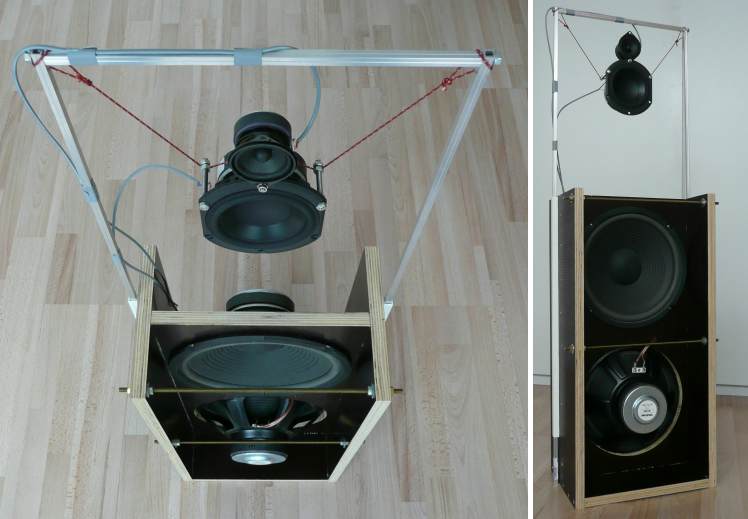
Anyway, my latest design I think is the best looking. It also incorporates some significant design changes.
Firstly, I added subwoofers. I really wanted deep bass, which OB just can't do, unless you really go all out. I'm more budget and aesthetic minded. So the sub does what it is supposed to - the room really gets that sensation of pressure. Its real fun. The only drawback is that I cross them at 60Hz to the OB woofer section. I definately noticed a change in the transient response of low bass instruments. The subwoofer is just not as clean.
(There is a pretty good quanatative demonstration of this at this website. I've seen another study like this that suggested the same thing - OB bass has better transient response - BUT only down to about 40Hz or so. Someday I'll do another redesign of my OB woofer so that I can cross it lower. For right now, I prefer its low cost and small size.)
The other significant change is that I have phase linearized the system. I use SoundEasy, which recently developed the ability to do this. This tool has tons of potential, but I have serious reservations about its usability. How to use it, and my issues with it are a whole other topic, so I won't go into it here. The main thing is that used properly, it does something that no other piece of software, or hardware, can currently do (welll, maybe there are a couple other, but they are questionable).
Another important change is my using miniDSP for all crossover functions. I got seriously sick of the hassle involved in using a normal computer to do this (after several years of trying to get it right), and so switched to miniDSP. Having the hardware and software specifically designed for each other is a godsend (are you listening Bozido?). I seriously hate using a computer in the audio chain - it has so many problems.
The main point of writing this thread is to show actual ACOUSTIC measurement of the system's performance, both without phase correction, and then corrected. So here we go:
The system is a 4-way. Per side, one 12" sub cover 60Hz down , two 10" woofers cover 60-300Hz, a 4" driver covers 300-3000Hz, and the tweeter covers 3000Hz up. All crossovers are LR4 acoustic. The mid and tweeter drivers are very specifically selected for the their polar response. There is plenty more to read about that in the Violet DSP thread.
Here are the raw, unequalized responses of the woofer, mid and tweeter. Obviously a traditional crossover has no business here. Remember that all these measurements are actual acoustic measurements, with very long gate times. The are effectively anechoic because I measure the speaker 12' off the ground.
Here is the final system response, including off axis measurements. Starting from top to bottom, the lines represents the 0deg (on axis) frequency response, then 30deg off axis, then 45deg, then 60deg. An 'ideal' dipole response has the 30deg response down 1dB, the 45deg response down 3dB, and the 60deg response down 6dB. As you can see, this is about as good as it gets. (Note that the subwoofer was not included in these measurement.)
Here is the on axis response only, with phase included (on the bottom) - this is the response before phase correction. As you can see, at each crossover point, there is 360deg of phase wrap, due to the LR4 crossover.
Here is the response with phase correction:
The yellow line represents the uncorrected response, and the green line represents the corrected response - they differ below 200Hz because of environmental noise. If I had been more patient, they would have been the same, and the final phase response would have been flatter. But the bottom line is that the phase stays +/- 20deg across its bandwidth. There is only one other speaker I know of that does this (maybe two, but I haven't seen measurement for the second).
Anyway, I'm pretty proud of the final result - a linear response on and off axis, and nearly flat phase response. Its been a long time coming, but its been a lot of fun too. 😀
So how does it sound? Very nice. Many people are of the opinion that phase errors are inaudible. There are arguments for both sides - but the proof is in the pudding. Yes, phase nonlinearity is definitely audible. If you don't believe me, come have a listen. What does it sound like? Just like what the measurements suggest - the treble is forward and the bass is recessed. It is a subtle error, but when corrected, it becomes obvious. Thing come much more into focus, particularly in the bass region. It is a lot like putting on reading glasses.
I will add this qualifier - there are many recording that don't show much difference. In my opinion, only well made acoustic recording are worth the trouble of phase correction. Correction makes a big difference on good recordings where realism is the goal. For casual listening, or heavily processed, multi-tracked recordings, the differences are little to none. But for serious classical music aficionados (SL, are you listening? 😀), it is seriously worth the trouble.
What should I call it? I think 'Fin' - because I'm done designing speaker for a while. Also coming to mind is Huck Finn, Finn Family Moomintroll, and Finisterre, Spain, where I might end up one day.
Please feel free to ask any questions, and enjoy!
I've been trying various iterations of open baffle (OB) speakers. My goal is the least linear error (on and off axis frequency response as flat and regular as possible). Here is some background:
The Violet DSP, which achieved a pretty highly linear response
I've been trying for a more aesthetic design, and failing...
Anyway, my latest design I think is the best looking. It also incorporates some significant design changes.
Firstly, I added subwoofers. I really wanted deep bass, which OB just can't do, unless you really go all out. I'm more budget and aesthetic minded. So the sub does what it is supposed to - the room really gets that sensation of pressure. Its real fun. The only drawback is that I cross them at 60Hz to the OB woofer section. I definately noticed a change in the transient response of low bass instruments. The subwoofer is just not as clean.
(There is a pretty good quanatative demonstration of this at this website. I've seen another study like this that suggested the same thing - OB bass has better transient response - BUT only down to about 40Hz or so. Someday I'll do another redesign of my OB woofer so that I can cross it lower. For right now, I prefer its low cost and small size.)
The other significant change is that I have phase linearized the system. I use SoundEasy, which recently developed the ability to do this. This tool has tons of potential, but I have serious reservations about its usability. How to use it, and my issues with it are a whole other topic, so I won't go into it here. The main thing is that used properly, it does something that no other piece of software, or hardware, can currently do (welll, maybe there are a couple other, but they are questionable).
Another important change is my using miniDSP for all crossover functions. I got seriously sick of the hassle involved in using a normal computer to do this (after several years of trying to get it right), and so switched to miniDSP. Having the hardware and software specifically designed for each other is a godsend (are you listening Bozido?). I seriously hate using a computer in the audio chain - it has so many problems.
The main point of writing this thread is to show actual ACOUSTIC measurement of the system's performance, both without phase correction, and then corrected. So here we go:
An externally hosted image should be here but it was not working when we last tested it.
An externally hosted image should be here but it was not working when we last tested it.
The system is a 4-way. Per side, one 12" sub cover 60Hz down , two 10" woofers cover 60-300Hz, a 4" driver covers 300-3000Hz, and the tweeter covers 3000Hz up. All crossovers are LR4 acoustic. The mid and tweeter drivers are very specifically selected for the their polar response. There is plenty more to read about that in the Violet DSP thread.
Here are the raw, unequalized responses of the woofer, mid and tweeter. Obviously a traditional crossover has no business here. Remember that all these measurements are actual acoustic measurements, with very long gate times. The are effectively anechoic because I measure the speaker 12' off the ground.
An externally hosted image should be here but it was not working when we last tested it.
Here is the final system response, including off axis measurements. Starting from top to bottom, the lines represents the 0deg (on axis) frequency response, then 30deg off axis, then 45deg, then 60deg. An 'ideal' dipole response has the 30deg response down 1dB, the 45deg response down 3dB, and the 60deg response down 6dB. As you can see, this is about as good as it gets. (Note that the subwoofer was not included in these measurement.)
An externally hosted image should be here but it was not working when we last tested it.
Here is the on axis response only, with phase included (on the bottom) - this is the response before phase correction. As you can see, at each crossover point, there is 360deg of phase wrap, due to the LR4 crossover.
An externally hosted image should be here but it was not working when we last tested it.
Here is the response with phase correction:
An externally hosted image should be here but it was not working when we last tested it.
The yellow line represents the uncorrected response, and the green line represents the corrected response - they differ below 200Hz because of environmental noise. If I had been more patient, they would have been the same, and the final phase response would have been flatter. But the bottom line is that the phase stays +/- 20deg across its bandwidth. There is only one other speaker I know of that does this (maybe two, but I haven't seen measurement for the second).
Anyway, I'm pretty proud of the final result - a linear response on and off axis, and nearly flat phase response. Its been a long time coming, but its been a lot of fun too. 😀
So how does it sound? Very nice. Many people are of the opinion that phase errors are inaudible. There are arguments for both sides - but the proof is in the pudding. Yes, phase nonlinearity is definitely audible. If you don't believe me, come have a listen. What does it sound like? Just like what the measurements suggest - the treble is forward and the bass is recessed. It is a subtle error, but when corrected, it becomes obvious. Thing come much more into focus, particularly in the bass region. It is a lot like putting on reading glasses.
I will add this qualifier - there are many recording that don't show much difference. In my opinion, only well made acoustic recording are worth the trouble of phase correction. Correction makes a big difference on good recordings where realism is the goal. For casual listening, or heavily processed, multi-tracked recordings, the differences are little to none. But for serious classical music aficionados (SL, are you listening? 😀), it is seriously worth the trouble.
What should I call it? I think 'Fin' - because I'm done designing speaker for a while. Also coming to mind is Huck Finn, Finn Family Moomintroll, and Finisterre, Spain, where I might end up one day.
Please feel free to ask any questions, and enjoy!

Well done Sir ! I have to say, out of audio consideration, that the "Art deco" style is funny (including the tiles).
now the (interested) questions :
1. Why this H frame for the 10" ? Isn't it a risk of resonance ? Is it better than a plain flat baffle ? Isn't the top driver more severely high passed ?
2. watching your first plot, how comes this general overshoot after 8 Khz ? Mike issues ? Positioning ? Reflections ?...strange
3. hat down in front of the phase curves, have you been using the 2 channels process in arta ?
4. can you show step, impulse or square waves ?
Fin (ah ah ah)
now the (interested) questions :
1. Why this H frame for the 10" ? Isn't it a risk of resonance ? Is it better than a plain flat baffle ? Isn't the top driver more severely high passed ?
2. watching your first plot, how comes this general overshoot after 8 Khz ? Mike issues ? Positioning ? Reflections ?...strange
3. hat down in front of the phase curves, have you been using the 2 channels process in arta ?
4. can you show step, impulse or square waves ?
Fin (ah ah ah)

I would be interested in the impulse and step response, as well as CSD.
Also, what kind of EQ, how much of it and where?
Great work!
Also, what kind of EQ, how much of it and where?
Great work!
Thanks for the response!
Radugazon,
1) the main reason to use a H frame is just to have a visually smaller baffle. A flat baffle would work about the same, but just be a bit wider. My main concern for this iteration was having it look good and not be too big. I don't see any issues with resonances.
2)you're right, I never noticed that. I think it is just coincidence, my mic is calibrated and when measuring known drivers, always gives the results one would expect.
3)I don't know ARTA well, I just started using it - I use both channels for measurements, I think.
4)I have the impulse, and will post it. It isn't that impressive, IMO. To go back an do more measurement is daunting, because the setup is really complex - I use 4 computers, and everything has to be up in the air. I may do that stuff sometime, but not soon.
ra7 - I'll post the impulse shortly. About the EQ - I use tons of it! I use miniDSP, and can post my file if anyone want to use it - but I don't think it can be opened without having the hardware. If people really want, I could list all the EQ, but really there is tons, and I don't think anyone could really do much with it.
It would be cool to take a picture of a square wave on a scope though...
Radugazon,
1) the main reason to use a H frame is just to have a visually smaller baffle. A flat baffle would work about the same, but just be a bit wider. My main concern for this iteration was having it look good and not be too big. I don't see any issues with resonances.
2)you're right, I never noticed that. I think it is just coincidence, my mic is calibrated and when measuring known drivers, always gives the results one would expect.
3)I don't know ARTA well, I just started using it - I use both channels for measurements, I think.
4)I have the impulse, and will post it. It isn't that impressive, IMO. To go back an do more measurement is daunting, because the setup is really complex - I use 4 computers, and everything has to be up in the air. I may do that stuff sometime, but not soon.
ra7 - I'll post the impulse shortly. About the EQ - I use tons of it! I use miniDSP, and can post my file if anyone want to use it - but I don't think it can be opened without having the hardware. If people really want, I could list all the EQ, but really there is tons, and I don't think anyone could really do much with it.
It would be cool to take a picture of a square wave on a scope though...
Here is the impulse response - I'm going to add though that I don't think there is much more to be gained by looking at it. It is just another way of looking at the same data. And, what you see is totally dominated by the treble response - if I took the impulse without the tweeter hooked up, you'd see very little. If I showed you the impulse of just the woofer section, you'd see nothing. Thats my two cents. I've also expanded it vertically and horizontally to make it easier to see - I could easily skew perception of it by shrinking it - it would look much tighter...
An externally hosted image should be here but it was not working when we last tested it.

Very nice job which is the final of long researches 😉
I'm very intriguing because drivers are minimum phase. If you are in the pistonic range, the phase is nearly flat ?
If I understand this correction is useful out of the pistonic range ? It also modifies the directivity ?
A simple in ARTA burst decay gives a lot of information 🙂
The other significant change is that I have phase linearized the system
I'm very intriguing because drivers are minimum phase. If you are in the pistonic range, the phase is nearly flat ?
If I understand this correction is useful out of the pistonic range ? It also modifies the directivity ?
A simple in ARTA burst decay gives a lot of information 🙂
Why would the H frame not be "diffraction City" with the forward edges? How does that work?
What does that do to the directionality of the system?
What does that do to the directionality of the system?
I'm very intriguing because drivers are minimum phase. If you are in the pistonic range, the phase is nearly flat ?
If I understand this correction is useful out of the pistonic range ? It also modifies the directivity ?
Well, yes and no. The main culprit in phase non-linearity (assuming you have a system with a flat amplitude response) is the phase shift caused by the crossovers, and the phase shift caused by the roll-off of the speaker's limited bandwidth. These can be seen in the uncorrected phase graphs.
Directivity (polar response) is a function of driver and enclosure geometry, and cannot be altered with any sort of EQ, no matter how fancy.
Why would the H frame not be "diffraction City" with the forward edges? How does that work?
What does that do to the directionality of the system?
Diffraction, as it pertains to boxes, is fairly different when it comes to open baffle systems. Personally, I find it easier to think of it in different terms. What happens with an OB system (and not a boxed speaker) is that there is sound radiating from the front, and sound radiating from the back. The both wrap around the sides of the speaker, and as long as they are identical in amplitude and time, they will create an ideal dipole figure-of-eight polar pattern. This is highly desirable. So the main thing isn't to have the smoothest edge roundovers, like in box speakers, but to have a symmetrical acoustic response front to back.

That is awesome! Both the looks and measured performance. You better be proud. I want to see the baffle 'fin'ished if you don't mind. That's great work.
Excellent job and thanks for sharing,
Dan
Excellent job and thanks for sharing,
Dan

Why would the H frame not be "diffraction City" with the forward edges? How does that work?
Wikipedia states: "While diffraction occurs whenever propagating waves encounter such changes, its effects are generally most pronounced for waves where the wavelength is roughly similar to the dimensions of the diffracting objects."
cuibono simply keeps the size of his drivers smaller than the wavelength transmitted by the driver. The forward edges of the H frame would be a source of diffraction for waves of >1 kHz for instance. But those are no longer transmitted by the H frame. Only up in the tweeter region he can't make the driver small enough. The on axis dip at 8-9 kHz is the first real diffraction "desaster" encountered in that design.
Rudolf
cuibono,
your new system looks to be a killer. Everything done right.🙂
I have to say that because my latest iteration shares some "features" with yours:
It's still very much a prototype and has not been EQed properly. But the performance as yet is promising.
your new system looks to be a killer. Everything done right.🙂
I have to say that because my latest iteration shares some "features" with yours:
It's still very much a prototype and has not been EQed properly. But the performance as yet is promising.
Attachments


Have you done any music-based maximum SPL testing?
I wish I had a SPL meter. I have played them quite loudly - I would estimate near live levels for classical music. They are at their best when played at that level. IMO, listening to classical music 'quietly' really ruins the intent of the piece... Same thing with punk rock...
cuibono,
your new system looks to be a killer. Everything done right.🙂
Thanks! I'm happy with it, for sure.
I like your setup too - that is an interesting choice for tweeter - what is the model?
Good luck with it.
Problem is, music that is edited poorly sounds terrible at any volume, but especially at high volumes. Heavily-compressed music will fatigue to no end at high volumes.I wish I had a SPL meter. I have played them quite loudly - I would estimate near live levels for classical music. They are at their best when played at that level. IMO, listening to classical music 'quietly' really ruins the intent of the piece... Same thing with punk rock...
EDIT: What clips/limits first? i.e. which amp channel, or which driver?

Looks like Visaton FRS5X-8.
Nice setup cuibono. The response ends up very flat and very equal off axis which is great! As you say, lots of EQ, but the off axis response shows that you've developed a well considered speaker design.
Nice setup cuibono. The response ends up very flat and very equal off axis which is great! As you say, lots of EQ, but the off axis response shows that you've developed a well considered speaker design.
Member
Joined 2009
Congratulations, cuibono!
I think your efforts have produced something great! Thank you for sharing it with the diy community!
I have a question regarding the back wave. How does the phase correction affect the rear radiation. Does it fix the phase irregularity there too or does it make it worse?
I think your efforts have produced something great! Thank you for sharing it with the diy community!
I have a question regarding the back wave. How does the phase correction affect the rear radiation. Does it fix the phase irregularity there too or does it make it worse?
- Status
- Not open for further replies.
- Home
- Loudspeakers
- Multi-Way
- Fin, a full range phase linear open baffle speaker, with measurements