

Not to open a tin of worms here.
Sellers of expensive caps would have me believe that sound quality of a given tweeter can be improved by making up the desired value of C by wiring smaller value capacitors in parallel, (cascading or bypassing is 'their' terminology for this).
Funny thing is, I don't see alot of XO designs with this feature, which kind of rings alarm bells.
Is there any real advantages by doing this or, is it just a way of flogging a few more expensive caps???
Mick.
Sellers of expensive caps would have me believe that sound quality of a given tweeter can be improved by making up the desired value of C by wiring smaller value capacitors in parallel, (cascading or bypassing is 'their' terminology for this).
Funny thing is, I don't see alot of XO designs with this feature, which kind of rings alarm bells.
Is there any real advantages by doing this or, is it just a way of flogging a few more expensive caps???
Mick.

I strongly suspect the last. Having tried it (with an open mind) I'd always rather just use one cap of sufficient value/quality.
North Creek Music Systems has long been a proponent of bypassing. They sell caps for that very purpose and have one of their web pages devoted to the subject.
Bypassing
OTOH, I've worked on a number of the popular brand Snell vintage speakers, Peter Snell developed. He commonly used bundles of NPE's bypassed with a single pico-farad mylar cap in his famous & much sought after Model A's and others. I have pictures to prove it.
The less known Kindel Phantom speaker had a very complex crossover with numerous stacked caps of different types. Also have pics if anyone is interested.
Bypassing
OTOH, I've worked on a number of the popular brand Snell vintage speakers, Peter Snell developed. He commonly used bundles of NPE's bypassed with a single pico-farad mylar cap in his famous & much sought after Model A's and others. I have pictures to prove it.
The less known Kindel Phantom speaker had a very complex crossover with numerous stacked caps of different types. Also have pics if anyone is interested.

Bypassing larger caps with smaller-value, higher-quality caps is a well-accepted procedure in hi-end audio. Lots of manufacturers use it; speakers I've owned that had bypass caps in the original crossovers include the Eminent Tech. LFT-8 and -12, Kindel PLS-A and other Kindels, and the truly-5-star-quality Vandersteen 5As.
Conrad-johnson and Audio Research, among dozens of others, bypass coupling caps in their hi-end preamps and poweramps.
It has to be done carefully, but it works very well, generally in the higher frequencies where the large caps are a little 'slow'-sounding. Some object to the process, saying they can hear the addition. Well of course; that's why one does it.
A typical bypassed combo would be a SoniCap Gen.1 'propylene with (in ascending prices) a MultiCap RTX ('styrene), Mundorf Silver/Oil, or SoniCap Platinum (Teflon-film) bypass.
Conrad-johnson and Audio Research, among dozens of others, bypass coupling caps in their hi-end preamps and poweramps.
It has to be done carefully, but it works very well, generally in the higher frequencies where the large caps are a little 'slow'-sounding. Some object to the process, saying they can hear the addition. Well of course; that's why one does it.
A typical bypassed combo would be a SoniCap Gen.1 'propylene with (in ascending prices) a MultiCap RTX ('styrene), Mundorf Silver/Oil, or SoniCap Platinum (Teflon-film) bypass.
too convineint that "cascade bypass theory" requires you to buy more Northcreek caps?
keeping esr low so that if needed by the XO alignment it can be defined by intentional, accurately controlled external R is good design practice
if you can't get low enough esr in a single cap then paralleling n equal 1/n value caps can help
the question of "how accurate" is acceptable can be estimated from XO, driver circuit properties and ABX detectable frequency response thresholds:
ABX Amplitude vs. Frequency Matching Criteria
the numbers suggest nearly all tiny "fast" film/mica/whatever audiophile flavor of the month bypass cap of only a few % of the main cap value will give inaudible difference in DBT ABX testing
naive subjective "just listen" evaluation is worthless - Blinding, level matching are absolute minimum controls for valid subjective evaluation - short switching times gives better resolution - and don't move that box or anything big (like your listening position) around the room or that alone will change frequency response by clearly audible frequency response differences
adding enough C will change XO response and at some point it will become audible - but you could also change response by fiddling with the inductors - why isn't that a common tweak suggestion?
driver type, quality, unit-to-unit variation, box diffraction, orientation, room treatment are all going to give much larger measurable and audible differences and attention to these should repay your tweaking efforts with much higher "dividends"
not to say that proper XO design, implementation and trimming aren’t equally important - just that the "I'll add a audiophile approved bypass" to the caps is poor a paradigm
keeping esr low so that if needed by the XO alignment it can be defined by intentional, accurately controlled external R is good design practice
if you can't get low enough esr in a single cap then paralleling n equal 1/n value caps can help
the question of "how accurate" is acceptable can be estimated from XO, driver circuit properties and ABX detectable frequency response thresholds:
ABX Amplitude vs. Frequency Matching Criteria
the numbers suggest nearly all tiny "fast" film/mica/whatever audiophile flavor of the month bypass cap of only a few % of the main cap value will give inaudible difference in DBT ABX testing
naive subjective "just listen" evaluation is worthless - Blinding, level matching are absolute minimum controls for valid subjective evaluation - short switching times gives better resolution - and don't move that box or anything big (like your listening position) around the room or that alone will change frequency response by clearly audible frequency response differences
adding enough C will change XO response and at some point it will become audible - but you could also change response by fiddling with the inductors - why isn't that a common tweak suggestion?
driver type, quality, unit-to-unit variation, box diffraction, orientation, room treatment are all going to give much larger measurable and audible differences and attention to these should repay your tweaking efforts with much higher "dividends"
not to say that proper XO design, implementation and trimming aren’t equally important - just that the "I'll add a audiophile approved bypass" to the caps is poor a paradigm
Last edited:
The D.F. of a Bennic 150 uF 150 V NPE was cut in half with the addition of a 0.22 uF 50 V Vitamin Q bypass cap (i.e. 4.3% > 1.95%).
Jcx - thanks for typing-out most of what came to my mind!
Apart from value drift, ESR and similar effects, another problem is this: if you have some [less than perfect] cap and add a 'high quality' bypass or two - just what are you hearing ? (apart from change in total value = crossover summation drift):
- No bypass cap can make up for losses due to dialectric absorption in crap caps, mechanical Q losses, or other similar problems. It becomes a frequency-dependant loss instead. You now have two caps in parallel with differing losses, that's all.
- Adding low-esr/low-ESL/low-DA low-value film caps may well add a small peak due to basic shunt L-C resonance. Yes really: given the large loop areas involved in typical crossover wiring, such resonances from C and wiring and layout can fall well within the audible bandwidth, esp. for larger value (eg midrange-xover) caps in 3-way crossovers. It always seems to occur at the top of the presence band by measurement - 'more detail' ? Uh-huh... BT,DT, learned a lot.
- Just how much time and money are you prepared to invest in dicking-around on this stuff before buying just one good polyprop cap anyway?
Apart from value drift, ESR and similar effects, another problem is this: if you have some [less than perfect] cap and add a 'high quality' bypass or two - just what are you hearing ? (apart from change in total value = crossover summation drift):
- No bypass cap can make up for losses due to dialectric absorption in crap caps, mechanical Q losses, or other similar problems. It becomes a frequency-dependant loss instead. You now have two caps in parallel with differing losses, that's all.
- Adding low-esr/low-ESL/low-DA low-value film caps may well add a small peak due to basic shunt L-C resonance. Yes really: given the large loop areas involved in typical crossover wiring, such resonances from C and wiring and layout can fall well within the audible bandwidth, esp. for larger value (eg midrange-xover) caps in 3-way crossovers. It always seems to occur at the top of the presence band by measurement - 'more detail' ? Uh-huh... BT,DT, learned a lot.
- Just how much time and money are you prepared to invest in dicking-around on this stuff before buying just one good polyprop cap anyway?
Last edited:
Bypassing caps is a controversial issue. In fact capacitors are a controversial issue.
There are some serious articles on this issue, like the one by Jung-Marsh. But there's also many people stating their opinion (and their taste) as if it was "the truth".
If you believe the lower the Dissipation Factor (DF), the better the sound (I do believe so), you should try to lower it bypassing the larger caps with smaller ones.
Now we have relatively affordable film caps available, particularly polypropylene, but you can also get bipolar electrolytics, designed for speaker use, that do seem to sound good.
So, try this: get some smaller film caps and alligator clip them to your larger capacitors. And listen if there's any change, for better or worst. Keep trying until there's a combination that you like. This routine generally pays off and it's what serious pros do. It takes time though.
There are some serious articles on this issue, like the one by Jung-Marsh. But there's also many people stating their opinion (and their taste) as if it was "the truth".
If you believe the lower the Dissipation Factor (DF), the better the sound (I do believe so), you should try to lower it bypassing the larger caps with smaller ones.
Now we have relatively affordable film caps available, particularly polypropylene, but you can also get bipolar electrolytics, designed for speaker use, that do seem to sound good.
So, try this: get some smaller film caps and alligator clip them to your larger capacitors. And listen if there's any change, for better or worst. Keep trying until there's a combination that you like. This routine generally pays off and it's what serious pros do. It takes time though.
Bypassing caps is a controversial issue. In fact capacitors are a controversial issue.
There are some serious articles on this issue, like the one by Jung-Marsh. .............
QUOTE]
This one's even more serious...
DIYCore.com - Home
I don't think so...
the worst number I see on Bennic's site for "low loss" BiPolar Electros is 20% DF at 10 KHz
|Xc| = 1/(150u*2*pi*10KHz) =~ 100 mOhms
20% DF gives 20 mOhm ESR
1/(2*pi*RC) = 1/(2*pi*20m*0.22u) = 34 MHz
that is the frequency where 0.22uF "cuts DF in half"
even 100x worse DF/esr numbers won't have audio frequency effect
as mentioned the parasitic LC resonance from the parallel connection will occur lower than that
for even 4 Ohm drivers 20 mOhm is 0.5 % for ~= 0.05 dB response difference so the "high"/unbypassed ESR is not itself expected to have any audible audio frequency consequence
the worst number I see on Bennic's site for "low loss" BiPolar Electros is 20% DF at 10 KHz
|Xc| = 1/(150u*2*pi*10KHz) =~ 100 mOhms
20% DF gives 20 mOhm ESR
1/(2*pi*RC) = 1/(2*pi*20m*0.22u) = 34 MHz
that is the frequency where 0.22uF "cuts DF in half"
even 100x worse DF/esr numbers won't have audio frequency effect
as mentioned the parasitic LC resonance from the parallel connection will occur lower than that
for even 4 Ohm drivers 20 mOhm is 0.5 % for ~= 0.05 dB response difference so the "high"/unbypassed ESR is not itself expected to have any audible audio frequency consequence
Last edited:
the worst number I see on Bennic's site is for "low loss" BiPolar Electros is 20% DF at 10 KHz
|Xc| = 1/(150u*2*pi*10KHz) =~ 100 mOhms
20% DF gives 20 mOhm ESR
1/(2*pi*RC) = 1/(2*pi*20m*0.22u) = 34 MHz
that is the frequency where 0.22uF "cuts DF in half"
even 100x worse DF/esr numbers won't have audio frequency effect
as mentioned the parasitic LC resonance from the parallel connection will occur lower than that
for even 4 Ohm drivers 20 mOhm is 0.5 % for ~= 0.05 dB response difference so the "high"/unbypassed ESR is not itself expected to have any audible audio frequency consequence
As you found, good quality audio grade caps (NPE's included) from the likes of Bennic and others have both low ESR and D.F.
OTOH, DIY'rs need to be careful and not grab just any NPE. I've tested some from RS with ESR's over 2 ohms! Now that's audible!
There's some very interesting info out there concerning this topic, and there are some very credible studies which correlate measured performance to audible differences.Jcx - thanks for typing-out most of what came to my mind!
Apart from value drift, ESR and similar effects, another problem is this: if you have some [less than perfect] cap and add a 'high quality' bypass or two - just what are you hearing ? (apart from change in total value = crossover summation drift):
- No bypass cap can make up for losses due to dialectric absorption in crap caps, mechanical Q losses, or other similar problems. It becomes a frequency-dependant loss instead. You now have two caps in parallel with differing losses, that's all.
- Adding low-esr/low-ESL/low-DA low-value film caps may well add a small peak due to basic shunt L-C resonance. Yes really: given the large loop areas involved in typical crossover wiring, such resonances from C and wiring and layout can fall well within the audible bandwidth, esp. for larger value (eg midrange-xover) caps in 3-way crossovers. It always seems to occur at the top of the presence band by measurement - 'more detail' ? Uh-huh... BT,DT, learned a lot.
- Just how much time and money are you prepared to invest in dicking-around on this stuff before buying just one good polyprop cap anyway?
1) It isn't just about ESR and DF...a lot of caps behave differently when there is a dc bias applied... Recommendation: read Cyril Bateman's papers on the issue, it's a gold-mine of information from someone who was a professional capacitor development engineer. If his methodology and conclusions were correct, and they sure seem to be, minute changes in distortion, etc. correlated very well with subjective listening tests. However, some of the biggest surprises came from caps with a DC bias, where some of the metallized units that had very low ESR and DF turned out to be not so good with a DC bias applied.
2) Then also look at the studies published by Clarity cap about internal mechanical resonances .... yes, that's INSIDE the the cap, and it's significant. It's not so much about microphonics, it's the film inside the cap reacting to the changes in the internal electrical field and moving around in response to that, similar to an electrostat or piezo element.
https://www.madisound.com/store/manuals/ClarityCap - Data Sheet - MR issue 2 July 2010.pdf
When it comes to using paralleled caps:
According to the Clarity info, most caps show internal mechanical resonances in the 5KZ to 25KHz range.
Different caps have different resonances and so, sometimes pairing different types and constructions can lead to some averaging out of the resonant characteristics; the ClarityCap graphs are showing resonances in the -55 to -75dB range, they are almost certainly going to be audible differences.
So then, armed with the above studies, might it be logical to extrapolate that some combinations would sound worse by reinforcing each other's resonances? And that others would "spread" and average the resonances in the spectrum... and possibly sound clearer? YES!.... just from resonance averaging.
Clarity has designed a MR line that purports to address this, see Madisound
In their graphs it would appear the resonances are reduced by about 6 to 10dB over regular film caps.https://www.madisound.com/store/manuals/ClarityCap - Data Sheet - MR issue 2 July 2010.pdf
AND...of course...ClarityCaps low resonance MR caps are VERY expensive.... 2.2uF for $55 at Madisound.
BUT...
for a somewhat more affordable cap, some of the more recent tin-foil caps like Mundorf Zn and the Obbligato tin-foil caps, exhibit relatively low internal resonances. And for an even less expensive option, the Dayton Tinfoil caps (fairly small values, only up to 0.47uF) is also very good.
I ended up getting some Mundorf Zn and they are VERY heavy for the size, about 6 to 8 times heavier than poly-propylene film caps of similar size. Mundorf claims the extra weight of the tin-foil makes a huge difference in the internal resonances.
I guess that makes sense:
if you increase the mass of of the film/foil by X6, it's going to take 6X more force to move it...
So if the damping is comparable, a 6X increase in mass would reduce the amplitude of an internal resonance by about 10x log6 = 7.78 dB, which looks pretty much like it's the same resonance reduction as what is offered by the ClarityCap... and the 2.2uF Mundorf Zn is about $20... about 3X less expensive than the MR.
Last but not least, the Zn caps really do sound extraordinarily good and clear, perhaps comparable to Mundorf's Uber-pricey Silver/Gold/Oil range or even Duelund's stuff.
So, in the last line of your comment, I would change that to:
Just how much time and money are you prepared to invest in dicking around before buying just one good tin-foil cap anyway?
My reply would be to use Mundorf Zn and Dayton Tin-foil bypasses.
Last edited:

I guess that makes sense:
if you increase the mass of of the film/foil by X6, it's going to take 6X more force to move it...
So if the damping is comparable, a 6X increase in mass would reduce the amplitude of an internal resonance by about 10x log6 = 7.78 dB, which looks pretty much like it's the same resonance reduction as what is offered by the ClarityCap... and the 2.2uF Mundorf Zn is about $20... about 3X less expensive than the MR.
That pushes me over the edge to try those out in the future. I hadn't considered the mass relationship, but it holds water.
If only the Intertechnik True Copper Caps were sold in the US, I'd be trying those out too. I have the 1.2uF in a single as a sample from a distributor who thought about selling them, but that's all I have. HEAVY is an understatement for these!! Heaviest caps for their size I've ever had myself.
Later,
Wolf
I don't dispute there can be differences, but simple things first:
1) there is no DC bias on an AC signal such as is applied to a speaker and
2) others have also chosen to address the mechanical damping/resonance issue also, and at low cost: e.g. Jantzen Superior caps come potted in epoxy in a solid aluminium sleeve, and are <1/3 the price of ClarityCap MR in the UK. I can't speak for value judgements between the two of course.
1) there is no DC bias on an AC signal such as is applied to a speaker and
2) others have also chosen to address the mechanical damping/resonance issue also, and at low cost: e.g. Jantzen Superior caps come potted in epoxy in a solid aluminium sleeve, and are <1/3 the price of ClarityCap MR in the UK. I can't speak for value judgements between the two of course.
Jantzen Superior caps come potted in epoxy in a solid aluminium sleeve, and are <1/3 the price of ClarityCap MR in the UK. I can't speak for value judgements between the two of course.
The original models weren't in the tubes, but they are now. I've used both Superior and Silver, and prefer them to CC.
Later,
Wolf
AC/DC Bias
1) About DC bias. Here's a link to Cyril Bateman's papers DIYCore.com - Home
If I read it right, Cyril Bateman found that the caps that showed bigger differences in their distortion when subjected to a DC bias also were caps that subjectively rated lower.
One theory is that a high amplitude bass signal could create a "moving bias" on these caps that increases their distortion also.
But the essential point remains valid: the caps that showed markedly worse distortion under DC bias did not sound as good as the caps that did not "react" to the bias.
2) I wasn't suggesting we all rush out and get ClarityCap MR, rather that the Mundorf Zn, also about 1/3 of the MR price, seems to offer comparable performance in suppressing resonances, and the Zn is where I have placed my bet for now.
3) I haven't tested or compared with the Jantzen Superior, but it's in the same price range as the Mundorf Zn. The reviews I've seen on the Jantzen are good, however when compared directly to the Mundorf, in the same reviews the Mundorf came out slightly ahead. So, if in your area the Mundorfs are priced like the Jantzens, now you have TWO good options at similar cost.
What I'd really like is Mundorf Gold/Silver/Oil or Duelund... but that'll have to wait until it seems financially practical.
I don't dispute there can be differences, but simple things first:
1) there is no DC bias on an AC signal such as is applied to a speaker and
2) others have also chosen to address the mechanical damping/resonance issue also, and at low cost: e.g. Jantzen Superior caps come potted in epoxy in a solid aluminium sleeve, and are <1/3 the price of ClarityCap MR in the UK. I can't speak for value judgements between the two of course.
1) About DC bias. Here's a link to Cyril Bateman's papers DIYCore.com - Home
If I read it right, Cyril Bateman found that the caps that showed bigger differences in their distortion when subjected to a DC bias also were caps that subjectively rated lower.
One theory is that a high amplitude bass signal could create a "moving bias" on these caps that increases their distortion also.
But the essential point remains valid: the caps that showed markedly worse distortion under DC bias did not sound as good as the caps that did not "react" to the bias.
2) I wasn't suggesting we all rush out and get ClarityCap MR, rather that the Mundorf Zn, also about 1/3 of the MR price, seems to offer comparable performance in suppressing resonances, and the Zn is where I have placed my bet for now.
3) I haven't tested or compared with the Jantzen Superior, but it's in the same price range as the Mundorf Zn. The reviews I've seen on the Jantzen are good, however when compared directly to the Mundorf, in the same reviews the Mundorf came out slightly ahead. So, if in your area the Mundorfs are priced like the Jantzens, now you have TWO good options at similar cost.
What I'd really like is Mundorf Gold/Silver/Oil or Duelund... but that'll have to wait until it seems financially practical.
Thanx guys,
Obviously bypassing is something I haven't tried before, but in the traditional Aussie 'I'll try anything once' spirit........
I have a bit of a grainy sound coming through my XT25TG vifa ringed radiator. The crossover is only a 'voicing' exercise at the moment, the crossover is voicing sweetly enough, but since I dropped a zobel onto it, it has picked up a grainy edge.
After several days of serious listening/ and A and B-ing, what I 'think' has happened is, the zobel has tidied up the overall sound leaving the grainy edge as the now dominant and unwanted flavor of the sound.
I currently have two 3.3uf metallized poly caps of the standard yellow no name variety wired parallel in series with the tweeter (and a .22mH air wound shunt, the zobel is 47uf (!)/3.3 ohm) which has the xo point around 3800hz. I was just kind of thinking, would it be advantages to use a 5.6uf with a 1.0uf bypass?
Mick.
Obviously bypassing is something I haven't tried before, but in the traditional Aussie 'I'll try anything once' spirit........
I have a bit of a grainy sound coming through my XT25TG vifa ringed radiator. The crossover is only a 'voicing' exercise at the moment, the crossover is voicing sweetly enough, but since I dropped a zobel onto it, it has picked up a grainy edge.
After several days of serious listening/ and A and B-ing, what I 'think' has happened is, the zobel has tidied up the overall sound leaving the grainy edge as the now dominant and unwanted flavor of the sound.
I currently have two 3.3uf metallized poly caps of the standard yellow no name variety wired parallel in series with the tweeter (and a .22mH air wound shunt, the zobel is 47uf (!)/3.3 ohm) which has the xo point around 3800hz. I was just kind of thinking, would it be advantages to use a 5.6uf with a 1.0uf bypass?
Mick.
Probably no advatange on the bypass, but up the 47 to around 150uF NPE cap, and use a 1.0mH also in series to make that an LCR with the 3.3 ohm, you'll nuke the Fs completely and know if it was that you were hearing.
Later,
Wolf
Later,
Wolf
Ah, awesome, thanx Wolf, that makes good sense, I'll give that a whirl and post back my findings.
Thanx heaps guys for the links, opinions and such, very helpful/useful.
Cheers,
Mick.
Thanx heaps guys for the links, opinions and such, very helpful/useful.
Cheers,
Mick.

Bypass of the 3.9 uF capacitor of the KEF Q100 5.25" coaxial tweeter.
Measurements made by Zvu.
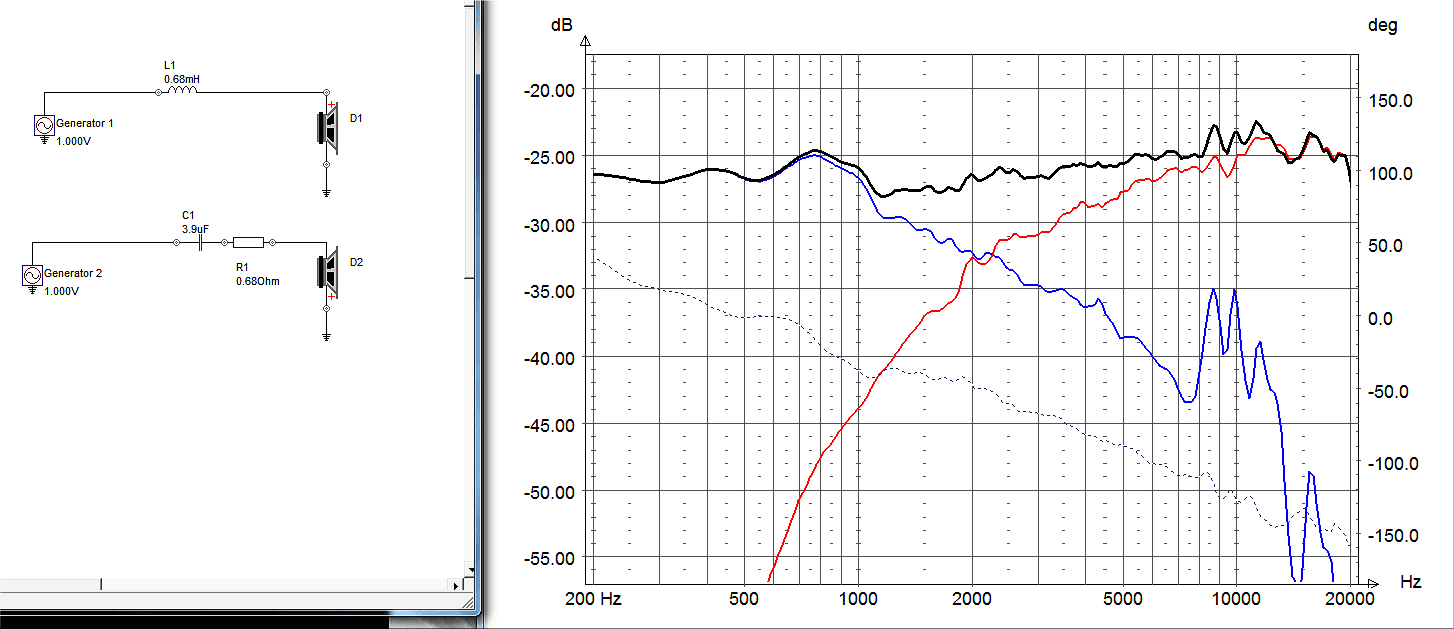
Minimum Phase vs Linear Phase | Page 7 | Audio Science Review (ASR) Forum
Minimum Phase vs Linear Phase | Page 16 | Audio Science Review (ASR) Forum
I have changed the cheap NOS Polystyrene 10 nF 600Vdc +/-10% with an expensive Copper Foil Paper / Polypropylene in Oil Capacitor 22 nF 600Vdc +/- 5% (Miflex KPCU-01 0.022uF) and the improvement is amazing.
Looking for a new pair of 0.22uf coupling caps.
KPCU01H322J: 0.022uF 600V Miflex KPCU Copper Foil Paper / Polypropylene in Oil Capacitor | Hifi Collective
(MRA05-075) - 0R68 5W MRA05 Mills Resistor (0.68R) | Hifi Collective
Next week, Mills resistors, with very low internal inductance. Step by step.
Measurements made by Zvu.
Minimum Phase vs Linear Phase | Page 7 | Audio Science Review (ASR) Forum
Minimum Phase vs Linear Phase | Page 16 | Audio Science Review (ASR) Forum
I have changed the cheap NOS Polystyrene 10 nF 600Vdc +/-10% with an expensive Copper Foil Paper / Polypropylene in Oil Capacitor 22 nF 600Vdc +/- 5% (Miflex KPCU-01 0.022uF) and the improvement is amazing.
Looking for a new pair of 0.22uf coupling caps.
An externally hosted image should be here but it was not working when we last tested it.

An externally hosted image should be here but it was not working when we last tested it.

An externally hosted image should be here but it was not working when we last tested it.

An externally hosted image should be here but it was not working when we last tested it.

KPCU01H322J: 0.022uF 600V Miflex KPCU Copper Foil Paper / Polypropylene in Oil Capacitor | Hifi Collective
(MRA05-075) - 0R68 5W MRA05 Mills Resistor (0.68R) | Hifi Collective
Next week, Mills resistors, with very low internal inductance. Step by step.
Last edited:
- Home
- Loudspeakers
- Multi-Way
- capacitor bypassing/cascading......