

Hi guys, some of you will have seen the results of our previous shoot out where we measured and listened to various popular waveguides and compression drivers in one day.
http://www.diyaudio.com/forums/full-range/181253-waveguide-shootout.html
Here is part 2.
Who is we? A small group of Aussies into DIY who are building speakers with waveguides and compression drivers. Previously we changed more than one thing at a time, but here we wanted to get a bit more nitty gritty.
We found that the Selenium titanium compression driver used on the Econowave was quite harsh. We used both times some torture tracks intended to reveal any harshness. It's not subtle - you hear it and wince. We wanted to know if the waveguide or the compression driver were to blame.
This time we found that when we put a better CD on the waveguides, the harshness was much less. Put the B&C DE250 on the Econowave style JBL clone and it will play very loud and clean without that harshness.
Here is how it measures:
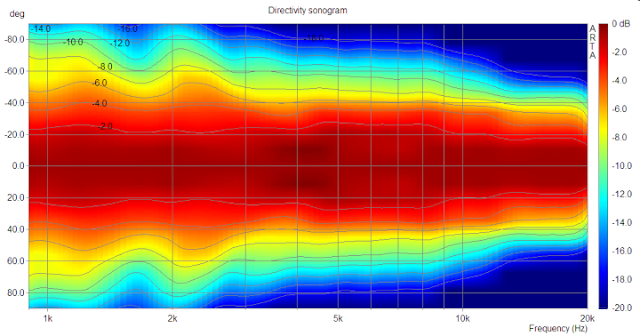
Does that look good or does that look good?!
Full details here:
http://redspade-audio.blogspot.com/2011/03/waveguide-gtg-2.html
http://www.diyaudio.com/forums/full-range/181253-waveguide-shootout.html
Here is part 2.
Who is we? A small group of Aussies into DIY who are building speakers with waveguides and compression drivers. Previously we changed more than one thing at a time, but here we wanted to get a bit more nitty gritty.
We found that the Selenium titanium compression driver used on the Econowave was quite harsh. We used both times some torture tracks intended to reveal any harshness. It's not subtle - you hear it and wince. We wanted to know if the waveguide or the compression driver were to blame.
This time we found that when we put a better CD on the waveguides, the harshness was much less. Put the B&C DE250 on the Econowave style JBL clone and it will play very loud and clean without that harshness.
Here is how it measures:
Does that look good or does that look good?!
Full details here:
http://redspade-audio.blogspot.com/2011/03/waveguide-gtg-2.html

The ARTA polar maps always look so heavily smoothed compared to what I get. Do you have any idea what smoothing is used? With a polar map there are two dimensions that can/should be smoothed so just knowing the frequency one is not enough. I never see anything as smooth as what you are showing above and I've seen a lot. I know exactly how much smoothing I use and ARTA always looks like a lot of smoothing.
Great Job guys! The B&C again proves it's overall superiority as CD. IMO the best $$$ to donuts option available.
First reply comes form Mr Waveguide himself!
I don't know how much smoothing. One of the other guys was running the measurements both times - learning how to drive Arta properly is on my to do list. But as you say it does look smoothed. Also keep in mind that you are seeing a normalised plot, which makes it look better. We want to see there what the directivity would look like relative to a perfectly flat response.
What do you use to measure, Earl?
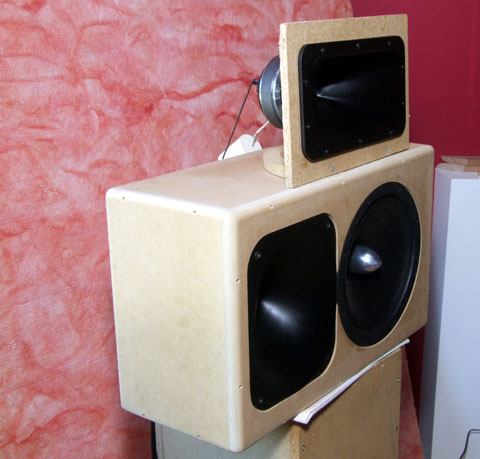
I like to see both, although I also keep in mind that with axi-symmetric guides, I might want to see the non normalised plot if I'm going to toe them in to avoid the axial dip Earl talks about. That particular one is the JBL clone shown in the picture above it.
Mayhem,
The B&C was as good or better than the BMS 4550 and Faital pro HF100TX. I want to do more comparisons, but my feeling is at this point that those other two are quite comparable where the response is the same. The B&C is smoother on the top end than the Faital and appeared to give a better response overall. The BMS has some extra efficiency in the mid band, it appears they went for as much as they could get, but could not maintain it over the full range. That means you have to do some extra EQ to pull back the midband, but the B&C needs less work to get flat. In fact, in my little 6" oblate waveguide, if measured at the mouth, it's ruler flat as if it were a good dome tweeter measured in an anechoic chamber!
One of the perks of hosting this GTG is that some of the guys left some of their bits with me. I've had a chance to do some more comparisons of my own.
One of the things we have learnt, which was not too surprising, is that a good polar plot does not necessarily mean it sounds better. The Selenium compression driver for example yielded by far the worst sounding results. From memory, it measured exceptionally well on the Dayton 10" waveguide, which has a profile that I don't quite know what it is. We found though that this waveguide and the Selenium driver were the worst sounding. By that I mean, they had the most harshness.
When I figure out how to cut it, I'll be putting foam in 3 of the waveguides.
I don't know how much smoothing. One of the other guys was running the measurements both times - learning how to drive Arta properly is on my to do list. But as you say it does look smoothed. Also keep in mind that you are seeing a normalised plot, which makes it look better. We want to see there what the directivity would look like relative to a perfectly flat response.
What do you use to measure, Earl?
I like to see both, although I also keep in mind that with axi-symmetric guides, I might want to see the non normalised plot if I'm going to toe them in to avoid the axial dip Earl talks about. That particular one is the JBL clone shown in the picture above it.
Mayhem,
The B&C was as good or better than the BMS 4550 and Faital pro HF100TX. I want to do more comparisons, but my feeling is at this point that those other two are quite comparable where the response is the same. The B&C is smoother on the top end than the Faital and appeared to give a better response overall. The BMS has some extra efficiency in the mid band, it appears they went for as much as they could get, but could not maintain it over the full range. That means you have to do some extra EQ to pull back the midband, but the B&C needs less work to get flat. In fact, in my little 6" oblate waveguide, if measured at the mouth, it's ruler flat as if it were a good dome tweeter measured in an anechoic chamber!
One of the perks of hosting this GTG is that some of the guys left some of their bits with me. I've had a chance to do some more comparisons of my own.
One of the things we have learnt, which was not too surprising, is that a good polar plot does not necessarily mean it sounds better. The Selenium compression driver for example yielded by far the worst sounding results. From memory, it measured exceptionally well on the Dayton 10" waveguide, which has a profile that I don't quite know what it is. We found though that this waveguide and the Selenium driver were the worst sounding. By that I mean, they had the most harshness.
When I figure out how to cut it, I'll be putting foam in 3 of the waveguides.
What do you use to measure, Earl?
I use HolmImpulse to take data at the polar angles, but the analysis techniques and plotting that I use are all custom software. This is how I know how important the smoothing characteristics can be. Yes, I did not realize that the data was normalized, that too makes everything look better. I don't like normalization because it wipes out resonances. And it will make an axial hole look completely unrealistic. Unnormalized is what you are listening to so thats what you should look at.

Very interesting test, thank you Paul!
from the conclusion page:
It would be interesting to add some "vintage" titanium compression drivers like the JBL 2416H (screw-on budget CD used in the 4425 studio monitor) and 2426H (used in the 4430 studio monitor, and has an integrated adapter to fit both screw and bolt horns) to the test, to see if the problem with the selenium driver is purely due to the fact that it is titane.
from the conclusion page:
Could you please elaborate?If you already have the Selenium driver, the good news is the sound can be improved a great deal.
It would be interesting to add some "vintage" titanium compression drivers like the JBL 2416H (screw-on budget CD used in the 4425 studio monitor) and 2426H (used in the 4430 studio monitor, and has an integrated adapter to fit both screw and bolt horns) to the test, to see if the problem with the selenium driver is purely due to the fact that it is titane.
Could you please elaborate?
Replace the Selenium with the B&C! That's what I meant. It isn't expensive.
It would be interesting to add some "vintage" titanium compression drivers like the JBL 2416H (screw-on budget CD used in the 4425 studio monitor) and 2426H (used in the 4430 studio monitor, and has an integrated adapter to fit both screw and bolt horns) to the test, to see if the problem with the selenium driver is purely due to the fact that it is titane.
The problem I see with this is anything vintage usually has an inflated price because of the perception of having some kind of magic. These drivers get viewed through rose coloured glasses. I had a look the other day at an Altec 1 3/4" CD ... huge! (As they all are at that size). The designs haven't changed much from what I can see.
A new driver like the B&C is cost effective with no premium added for some vintage aura of magic. You simply pay for something decent and well designed.
I'd like to spend some time comparing to the other drivers, I think they are probably quite comparable. The other two have annular diaphragms.
I have photos of them as well on the blog:
Red Spade Audio: Introducing B&C DE250
Have you looked at the 1" Celestions yet? I'm running a CDX1-1745 (as used in the QSC HPR152i) and it sounds very nice now I've managed to sort out the CD EQ. That same 1.4" diaphragm is used in the 1731 and a couple others too.
The smooting is adjusted upon creation of the polar map (in the Window where you load the .pir files).I don't know how much smoothing. One of the other guys was running the measurements both times - learning how to drive Arta properly is on my to do list.
Arta offers 1/1, 1/3, 1/6, 1/9 and 1/12 Oct. 1/3 Oct. seems to be the default.

Smoothing was 1/3 octave. Gating 5ms.
This was outdoor but with heavy wind. Otherwise I normally don't gate. Distance is 200cm.
Selenium's harshness is due to 12khz resonance. This is effectively mitigated by notching that frequency.
This was outdoor but with heavy wind. Otherwise I normally don't gate. Distance is 200cm.
Selenium's harshness is due to 12khz resonance. This is effectively mitigated by notching that frequency.
Last edited:
Smoothing was 1/3 octave. Gating 5ms.
Selenium's harshness is due to 12khz resonance. This is effectively mitigated by notching that frequency.
One would presume, and it should be done, that some smoothing is also done in the angular direction and this is where things get tricky.
I would dispute the claim for harshness for two reasons. 12 kHz is hardly audible and the B&C DE250 also has a large resonance at close to this same frequency. In my experince harshness is caused by the waveguide not the CD.
And I agree completely with the "vintage driver" comments. I have tested these drivers and the modern ones are usually much better. The DE250 is very hard to beat which is why I use so many of them.
The resonance is most definitely audible. With DSP I could toggle the notch on and off.
D220Ti:
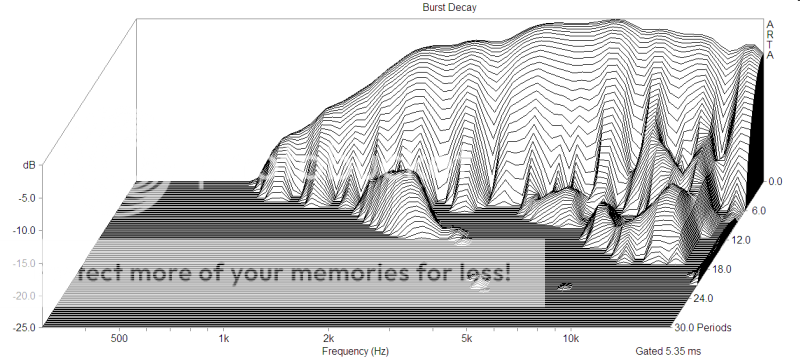
DE250
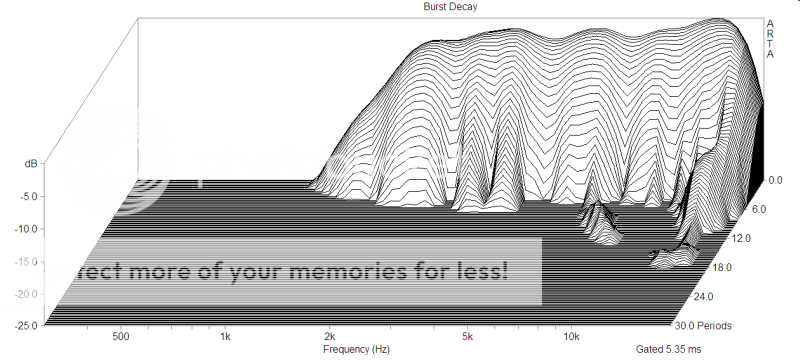
A high Q notch at 12khz effectively eliminate this issue. The waveguide is fine as could be heard and plotted really well with DE250 despite crappy $9 adapter.
DE250+plastic adapter

This becomes interesting as one could build a decent wg+cd combination, and allows easy upgrade as the funds permit.
This one was D220Ti+ JBL clone waveguide. I think it's either 1/6 or 1/9th octave smoothing and you clearly see the wiggle. They plotted well too, and this time with less wind.

This are the speakers in question:

D220Ti:
DE250
A high Q notch at 12khz effectively eliminate this issue. The waveguide is fine as could be heard and plotted really well with DE250 despite crappy $9 adapter.
DE250+plastic adapter
This becomes interesting as one could build a decent wg+cd combination, and allows easy upgrade as the funds permit.
This one was D220Ti+ JBL clone waveguide. I think it's either 1/6 or 1/9th octave smoothing and you clearly see the wiggle. They plotted well too, and this time with less wind.
This are the speakers in question:
Last edited:
Can you give more details on the JBL Clone please. What exactly is it a clone of, and where can it be got? Some closer pictures would also be nice.
Also maybe I'm missing it, but do you have a directivity plot of the JBL Clone with the DE250?
Also maybe I'm missing it, but do you have a directivity plot of the JBL Clone with the DE250?
Last edited:

And I agree completely with the "vintage driver" comments. I have tested these drivers and the modern ones are usually much better. The DE250 is very hard to beat which is why I use so many of them.
Have you specifically used JBL 2425H/2426H? (same driver but 2426 changes the silver pole coating to copper and can be screw on as well as bolt)
Do you have an opinion on coating titanium phragms, or the merits of embossed vs. smooth CD phragms?
Just curious, thx.
Have you specifically used JBL 2425H/2426H? (same driver but 2426 changes the silver pole coating to copper and can be screw on as well as bolt)
Do you have an opinion on coating titanium phragms, or the merits of embossed vs. smooth CD phragms?
Just curious, thx.
As to specific models of JBL I cannot be sure, but I believe that I had a pair of 2425H drivers in my 4430 speakers, but that was a while ago.
As to all of the other questions it comes down to one thing - are these changes cost effective? Coating works, at least on the measurements, titanium extends the response further into the range of inaudibility, and embossing makes any structure more rigid, so this too extends the response (again for whatever that is worth). But for "value" you can't beat mylar, and you can't beat a DE-250. So I am sure that all these things make a difference at some level, but to me that level is too low and I would argue insignificant.
You of course are aware of the blind listening test that I did comparing identical speaker designs but with different driver sets. B&C and TAD, the TAD were 10x more expensive - statistically 15 listeners found no difference in sound quality. Oh well, so much for "brand names".
Can you give more details on the JBL Clone please. What exactly is it a clone of, and where can it be got? Some closer pictures would also be nice.
Also maybe I'm missing it, but do you have a directivity plot of the JBL Clone with the DE250?
These are the details of the JBL clone. If you do a google on "Econowave Standard" you'd find plenty of information:
Waveguide:
DJCity YD-L033 - HORN ABS RESIN 162X303X107MM. $20.
They are similar to the waveguide "approved" by Econowave team at AK: JBL 1" thread-on Progressive Transition, Part# 338800-001, or its clone: Pyle Pro PH612 (partsexpress.com) or Dayton clone
The DE250+JBL Clone plot is in the first post of this thread.

Nice job guys! One thing of interest, this resonance is not audible:

But something is audibly harsh in this:

Go figure. I've heard the 250, and didn't hear anything harsh in one of those huge rectangular WGs.
Dan
But something is audibly harsh in this:
Go figure. I've heard the 250, and didn't hear anything harsh in one of those huge rectangular WGs.
Dan
Have you looked at the 1" Celestions yet? I'm running a CDX1-1745 (as used in the QSC HPR152i) and it sounds very nice now I've managed to sort out the CD EQ. That same 1.4" diaphragm is used in the 1731 and a couple others too.
FWIW, I ran the 1745 for a bit with the HPR152i, I have also used the BMS4550, Radian 475b and Selenium D220.
I have treated the HPR152i waveguide with plumbers putting on the back and used foam on the front. I think both are important.
I like the BMS4550 the best and it goes the lowest too. The Selenium 220 is just too harsh IMO. The 1745 is pretty good for its price tag and performed almost as well as the Radian 745b. In the end the BMS4550 is still my best CD with the HPR152i. If my budget was < $90 then the Celestion 1745 is a damn good driver and better then the Selenium choice.
I never did get around to buying the B&C DE250, I remember Dr. Geddes saying he has the ability to sell them cheaper then any other source online too.
Im now waiting of the SEOS-15 results. The AVS Prototype being built by Jzazga (DIY group buy person). I also have the IWATA-300 on order to compare against the QSC and the SEOS builds should be a fun 2011. Anyone want old boxes ? 😉
Last edited:
As to specific models of JBL I cannot be sure, but I believe that I had a pair of 2425H drivers in my 4430 speakers, but that was a while ago.
As to all of the other questions it comes down to one thing - are these changes cost effective? Coating works, at least on the measurements, titanium extends the response further into the range of inaudibility, and embossing makes any structure more rigid, so this too extends the response (again for whatever that is worth). But for "value" you can't beat mylar, and you can't beat a DE-250. So I am sure that all these things make a difference at some level, but to me that level is too low and I would argue insignificant.
You of course are aware of the blind listening test that I did comparing identical speaker designs but with different driver sets. B&C and TAD, the TAD were 10x more expensive - statistically 15 listeners found no difference in sound quality. Oh well, so much for "brand names".
Fair enough, thanks! As you know, I'm using the 2426 with a small foam plug on 15" OSWGs. They don't seem to get harsh no matter what the level, but I've allowed a few (maybe -6dB @ 20k and -1 at 10k) dB of top octave rolloff. Even with that rolloff though, the reticulated plug is necessary. I've A/B'd it with a number of people and they always prefer the plugged presentation.
PWT Testing?
Driver response artifacts (anomalies) will be revealed by PWT tests only. Driver comparisons made at this level will be less confused and far more informative. With these in hand, horn response artifacts are much easier to identify. When the two are compared for the same driver, it is easy to see the degree to which a horn degrades the driver's output. The larger the mismatch between the driver and horn, the nastier the output sounds. In this regard, it appears that those drivers with less massive moving systems, i.e. those made from beryllium, are far more sensitive to the back waves generated by incomplete horns (those missing fully formed mouths or those with abrupt slope departures at the driver/horn joint).
For those that might be interested, the following reference is provided.
WHG
File: AESJ047-0594
Title: Building a Plane-Wave Tube: Experimental and Theoretical Aspects
Author (1): Roberto Magalotti
Author (2): Carlo Zuccatti
Author (3): Paolo Pasini
Publication: AES-J, Vol. 47, No. 7/8, pp. 596-601, Jul/Aug-1999
Abstract (1): The design, building and testing of a plane-wave tube for measurements of compression drivers are described. Testing the device, the acoustical properties of open and closed ducts, and the capability of MLS-based measurement systems to retain the anechoic part only of the impulse response were exploited.
Abstract (2): The influence of higher modes of vibration in setting the upper limit of usable bandwidth is investigated.
Driver response artifacts (anomalies) will be revealed by PWT tests only. Driver comparisons made at this level will be less confused and far more informative. With these in hand, horn response artifacts are much easier to identify. When the two are compared for the same driver, it is easy to see the degree to which a horn degrades the driver's output. The larger the mismatch between the driver and horn, the nastier the output sounds. In this regard, it appears that those drivers with less massive moving systems, i.e. those made from beryllium, are far more sensitive to the back waves generated by incomplete horns (those missing fully formed mouths or those with abrupt slope departures at the driver/horn joint).
For those that might be interested, the following reference is provided.
WHG
File: AESJ047-0594
Title: Building a Plane-Wave Tube: Experimental and Theoretical Aspects
Author (1): Roberto Magalotti
Author (2): Carlo Zuccatti
Author (3): Paolo Pasini
Publication: AES-J, Vol. 47, No. 7/8, pp. 596-601, Jul/Aug-1999
Abstract (1): The design, building and testing of a plane-wave tube for measurements of compression drivers are described. Testing the device, the acoustical properties of open and closed ducts, and the capability of MLS-based measurement systems to retain the anechoic part only of the impulse response were exploited.
Abstract (2): The influence of higher modes of vibration in setting the upper limit of usable bandwidth is investigated.
- Status
- Not open for further replies.
- Home
- Loudspeakers
- Multi-Way
- Waveguide shootout - part 2