

Hello,
In order to compare how monopole box and dipole line array behave in normal domestic listening room I'm using my recently developed Bark wavelet to analyse the room impulse response. Bark wavelet is based on critical bandwidths of basilar membrane in cochlea.
Monopole box and dipole line array have totally different radiation patterns which of course is the main reason for their characteristic room behaviours.
Here I look at freq range of 50Hz - 2kHz and time scale up to 50ms. Besides my dipole line array is used as an array only up that freq, and that range should capture the main phenomena what affects the room response.
The monopole is a two way with 6.5" bass midrange and a tweeter.
The speakers are placed about 1m from front wall and about 0.8m from the side wall. The room size is about 3.2m * 7m.
The measurement distance is 2.5m which corresponds the real listening distance in this room. Thus the mic is placed at the listening spot above a soffa.
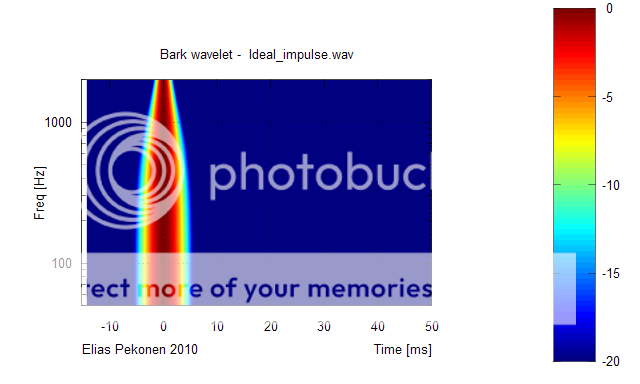
The Bark wavelet on ideal impulse looks like this:
Monopole box:
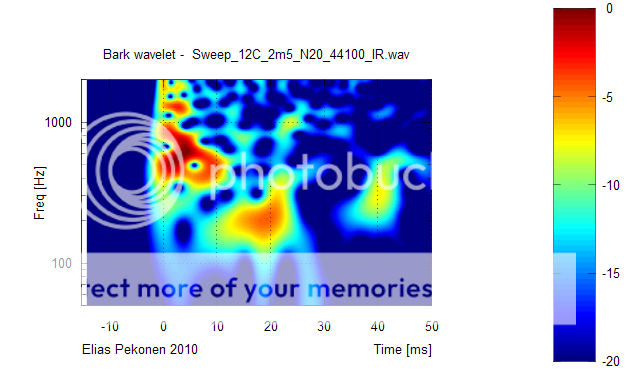
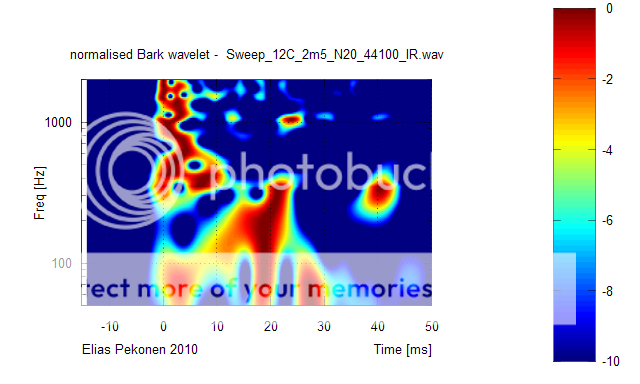
The monopole box response is totally scattered. It is without any structual integrity.
Dipole line array:
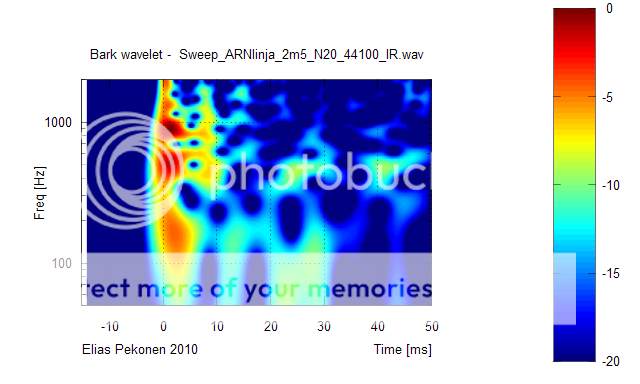
The dipole line array has one coherent and dominating energy wavefront at 0ms. The energy at all frequencies arrive at the same time at the listening position. Main reflection is the front wall reflection at about 8ms.
- Elias
In order to compare how monopole box and dipole line array behave in normal domestic listening room I'm using my recently developed Bark wavelet to analyse the room impulse response. Bark wavelet is based on critical bandwidths of basilar membrane in cochlea.
Monopole box and dipole line array have totally different radiation patterns which of course is the main reason for their characteristic room behaviours.
Here I look at freq range of 50Hz - 2kHz and time scale up to 50ms. Besides my dipole line array is used as an array only up that freq, and that range should capture the main phenomena what affects the room response.
The monopole is a two way with 6.5" bass midrange and a tweeter.
The speakers are placed about 1m from front wall and about 0.8m from the side wall. The room size is about 3.2m * 7m.
The measurement distance is 2.5m which corresponds the real listening distance in this room. Thus the mic is placed at the listening spot above a soffa.
The Bark wavelet on ideal impulse looks like this:
Monopole box:
The monopole box response is totally scattered. It is without any structual integrity.
Dipole line array:
The dipole line array has one coherent and dominating energy wavefront at 0ms. The energy at all frequencies arrive at the same time at the listening position. Main reflection is the front wall reflection at about 8ms.
- Elias
Normalisation highlights the temporal aspects of the room responses.
In comparison to the ideal:
Monopole box seems to have fatal errors in delivering the fine details of the temporal structure of the music to the listener:
Dipole line array on the other hand shines in this respect:
This is not only visible, but it is perceived by ear during my listening test comparing monopole boxes and dipole line array during the past 5 years or so. I've had both types of speakers in my living room for years where I can A/B switch them, and the result remains allways the same. Dipole line array sound so much better in a room!!
- Elias
In comparison to the ideal:
An externally hosted image should be here but it was not working when we last tested it.
Monopole box seems to have fatal errors in delivering the fine details of the temporal structure of the music to the listener:
An externally hosted image should be here but it was not working when we last tested it.
Dipole line array on the other hand shines in this respect:
An externally hosted image should be here but it was not working when we last tested it.
This is not only visible, but it is perceived by ear during my listening test comparing monopole boxes and dipole line array during the past 5 years or so. I've had both types of speakers in my living room for years where I can A/B switch them, and the result remains allways the same. Dipole line array sound so much better in a room!!
- Elias

Nice opening and interesting idea.
It would be interesting to know whether the "line arrayness" or "dipoleness" is the main reason for time coherent wavefront, and if they are both the factors, what are their ratio/proportion in the mix. What do you think, which one is the main factor? It figures that it can be found out by measuring a dipole point source and/or monopole line source the same way (preferably a closed box or a LLT-BR box to avoid group delay as much as possible).
I do also have dipole line arrays, and have also liked their sound. 😉
It would be interesting to know whether the "line arrayness" or "dipoleness" is the main reason for time coherent wavefront, and if they are both the factors, what are their ratio/proportion in the mix. What do you think, which one is the main factor? It figures that it can be found out by measuring a dipole point source and/or monopole line source the same way (preferably a closed box or a LLT-BR box to avoid group delay as much as possible).
I do also have dipole line arrays, and have also liked their sound. 😉
Last edited:

Monopole box:
An externally hosted image should be here but it was not working when we last tested it.
The monopole box response is totally scattered. It is without any structual integrity.
The structure above 400 Hz isn't that bad. We compare a two source system with a multi source system. But how do you explain that the monopole response around 200 Hz starts at least 10 ms after the higher frequencies and is missing almost anything below 100 Hz? Is this a closed box or a BR system?
It would not make much sense if this were a comparison between a poorly designed/equipped mono source against some sophisticated dipole system. Could you give some more info about the sources?
Rudolf
Just for fun, how would you feel about dragging them into the backyard and doing a spectrum for that?

Nice opening and interesting idea.
It would be interesting to know whether the "line arrayness" or "dipoleness" is the main reason for time coherent wavefront, and if they are both the factors, what are their ratio/proportion in the mix.
It is an interesting and fun experiment but I think Legis has a point here.
The differences between the 2 speakers (6" 2 way vs dipole line array) might be too many and to determine if it is indeed the dipole radiation that affects the dispersion one would either have to put the line array in a box or use a simple 2 way dipole. The trouble there is that most dipoles I have seen/heard are large using multiple 12-18" woofers.
So to really determine if it is indeed the dipole radiation one would have to compare a large dipole (as most are) to a similarly sized monopole. Granted, Elias, that one might have similar dipole and monopole speakers lying around so you have merely posted based on the speaker you did have lying around.
What makes you believe that the effects you have measured are due to the dipole radiation pattern? Can you measure the 6" 2 way with the back panel removed? The bass might disapear but the data might be comparable above 200Hz.
Last edited:
Normalisation highlights the temporal aspects of the room responses.
In comparison to the ideal:
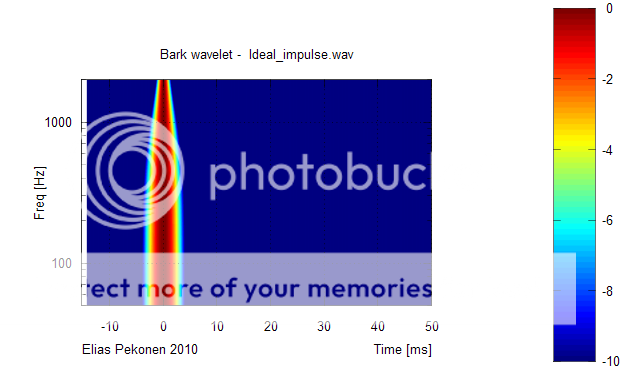
Monopole box seems to have fatal errors in delivering the fine details of the temporal structure of the music to the listener:
Dipole line array on the other hand shines in this respect:
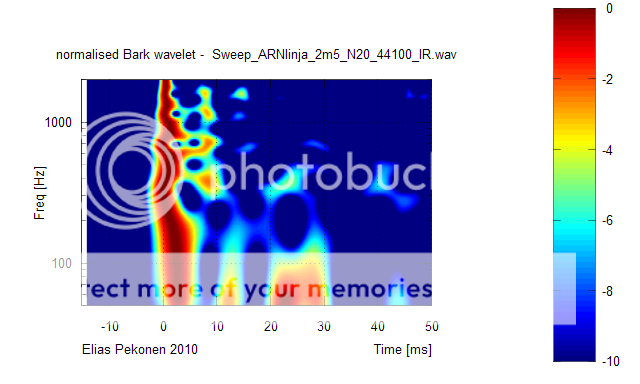
This is not only visible, but it is perceived by ear during my listening test comparing monopole boxes and dipole line array during the past 5 years or so. I've had both types of speakers in my living room for years where I can A/B switch them, and the result remains allways the same. Dipole line array sound so much better in a room!!
- Elias
Nice work.Elias.
I use a dipole line array too,and sometimes a closed box,for casual auditioning.The difference in room loading is enormous.Sadly,I do not have the means, to produce results,even hinting at yours. But I can say that boxed loudspeakers of any kind,are disappointing when compared to a dipole line array of equal proportions.
You are aware of course of Dr Griffin.He wrote a paper on line arrays,and dipole line arrays.There would be no better place to solve anything related to it.
B.L
Hello,
I don't have the ultimate quantified answer yet to set the proportions in the variables of dipole / monopole vs. dipole line array / monopole line array. But based also on my earlier measurements I think the order is:
* dipole line array
* monopole line array
* single dipole
* single monopole
The first in the list gives least room influence, the last one is the most influenced by the room.
What should be interesting is the difference between monopole line array and single dipole. I do have various dipoles to measure, but not any monopole line array.
- Elias
I don't have the ultimate quantified answer yet to set the proportions in the variables of dipole / monopole vs. dipole line array / monopole line array. But based also on my earlier measurements I think the order is:
* dipole line array
* monopole line array
* single dipole
* single monopole
The first in the list gives least room influence, the last one is the most influenced by the room.
What should be interesting is the difference between monopole line array and single dipole. I do have various dipoles to measure, but not any monopole line array.
- Elias
Nice opening and interesting idea.
It would be interesting to know whether the "line arrayness" or "dipoleness" is the main reason for time coherent wavefront, and if they are both the factors, what are their ratio/proportion in the mix. What do you think, which one is the main factor? It figures that it can be found out by measuring a dipole point source and/or monopole line source the same way (preferably a closed box or a LLT-BR box to avoid group delay as much as possible).
I do also have dipole line arrays, and have also liked their sound. 😉
It is an interesting and fun experiment but I think Legis has a point here.
The differences between the 2 speakers (6" 2 way vs dipole line array) might be too many and to determine if it is indeed the dipole radiation that affects the dispersion one would either have to put the line array in a box or use a simple 2 way dipole. The trouble there is that most dipoles I have seen/heard are large using multiple 12-18" woofers.
So to really determine if it is indeed the dipole radiation one would have to compare a large dipole (as most are) to a similarly sized monopole. Granted, Elias, that one might have similar dipole and monopole speakers lying around so you have merely posted based on the speaker you did have lying around.
What makes you believe that the effects you have measured are due to the dipole radiation pattern? Can you measure the 6" 2 way with the back panel removed? The bass might disapear but the data might be comparable above 200Hz.
Hi,
Sometimes "not that bad" is not good enough 😀
There is nothing wrong in the monopole speaker itself I was using. Here's the response at 1m distance. In nearfield the room reflections are at lower level and the response is having some consistency.
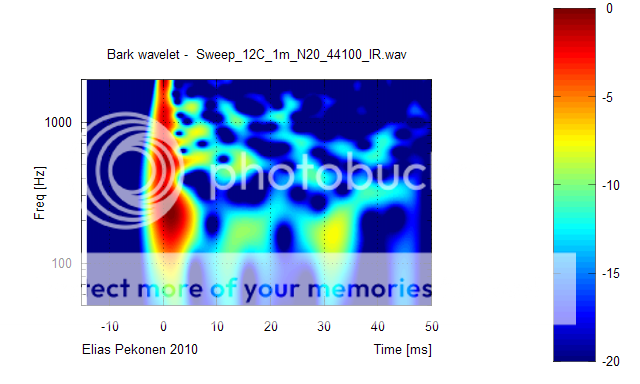
But then the problems come at real listening distances. Here it is at 2.5m distance:
The monopole has too wide radiation pattern, too many room reflections arrive at the listening position and some of them cancel and some of them boost the response. Note that this interference has strong temporal aspect and coherent wavefront is break into 'energy dumbs' that splash the listener.
I don't know, but some say they enjoy omnidirectional speakers (like Pluto) in a room. I know Linkwitz recommends setting the listening distance of Pluto closer than normal, and that is propably the reason why it can sound good.
Please note also that I'm not attacking against Pluto.
It just that I cannot bear the sound of a monopole in a room. It sounds like, you know, like a monopole in a room and nothing more 😀
- Elias
Sometimes "not that bad" is not good enough 😀
There is nothing wrong in the monopole speaker itself I was using. Here's the response at 1m distance. In nearfield the room reflections are at lower level and the response is having some consistency.
But then the problems come at real listening distances. Here it is at 2.5m distance:
The monopole has too wide radiation pattern, too many room reflections arrive at the listening position and some of them cancel and some of them boost the response. Note that this interference has strong temporal aspect and coherent wavefront is break into 'energy dumbs' that splash the listener.
I don't know, but some say they enjoy omnidirectional speakers (like Pluto) in a room. I know Linkwitz recommends setting the listening distance of Pluto closer than normal, and that is propably the reason why it can sound good.
Please note also that I'm not attacking against Pluto.
It just that I cannot bear the sound of a monopole in a room. It sounds like, you know, like a monopole in a room and nothing more 😀
- Elias
The structure above 400 Hz isn't that bad. We compare a two source system with a multi source system. But how do you explain that the monopole response around 200 Hz starts at least 10 ms after the higher frequencies and is missing almost anything below 100 Hz? Is this a closed box or a BR system?
It would not make much sense if this were a comparison between a poorly designed/equipped mono source against some sophisticated dipole system. Could you give some more info about the sources?
Rudolf
Hello Elias,
thank you very much for posting your inroom measurements.
In my opinion there is no "either or" in the dipole vs.
line array effect, the difference is due to both.
Normally we have the distance between speaker and
listening seat in the longest room dimension.
The distance between side walls is then considarably
shorter in most rooms and the floor-ceiling distance
typically is the shortest.
A monopole speaker will produce a reflection from the
floor first and then interact with sidewall/rear wall/ceiling
depending on the distances.
A dipole line array will also interact with all these borders,
but reflections from bottom and ceiling is much reduced or
mitigated by vertical directivity, and the reflections from
the side walls are mitigated by horizontal directivity
caused by the dipole (side) notches.
The reflection from the rear wall will typically be rather
strong, but its traveling path will be about 10ms or more
longer than that of the direct sound to the listener, given
the dipole is placed with appropriate distance to the rear wall.
There have sometimes been discussions here , whether
a speaker's directivity plays a significant role below the
Schröder frequency of the room due to sound quality ...
Since there is modal behaviour of most listening rooms
below 200Hz, some say speaker directivity should not
play a dominant role in that range, only balanced
excitation of room modes is relevant.
Now your measurements show the completely different
result at a realistic inroom listening distance, when
reproducing a broadband transient signal.
The graphical measurement result coincides with
my sonic impression, as i am a dipole line array listener
too and had often the opportunity to compare against
monopoles in the same room.
The monopole cannot compete with the dipole line array
in articulation of transient signals from drums e.g. and
it cannot compete in reproducing the characteristic
vibrational patterns of low notes from e.g. a grand piano
or even a contrabass.
In that respect it does not even matter if that monopole
box is a closed or BR one, or if that monopole box under
question has somewhat higher or lower Q.
The differences between those boxes are relatively small
in a room compared to the noticeable difference a
dipole line array makes.
Now we may discuss, whether the audible difference
- the audible improvement by dipole line arrays IMO -
is (also) caused by the low (below schröder) frequency
behaviour or not.
Your measurements could point towards this being
the fact ...
The particular difference is IMO not only a heard (ears)
but also felt (body).
Kind Regards
Oliver
thank you very much for posting your inroom measurements.
In my opinion there is no "either or" in the dipole vs.
line array effect, the difference is due to both.
Normally we have the distance between speaker and
listening seat in the longest room dimension.
The distance between side walls is then considarably
shorter in most rooms and the floor-ceiling distance
typically is the shortest.
A monopole speaker will produce a reflection from the
floor first and then interact with sidewall/rear wall/ceiling
depending on the distances.
A dipole line array will also interact with all these borders,
but reflections from bottom and ceiling is much reduced or
mitigated by vertical directivity, and the reflections from
the side walls are mitigated by horizontal directivity
caused by the dipole (side) notches.
The reflection from the rear wall will typically be rather
strong, but its traveling path will be about 10ms or more
longer than that of the direct sound to the listener, given
the dipole is placed with appropriate distance to the rear wall.
There have sometimes been discussions here , whether
a speaker's directivity plays a significant role below the
Schröder frequency of the room due to sound quality ...
Since there is modal behaviour of most listening rooms
below 200Hz, some say speaker directivity should not
play a dominant role in that range, only balanced
excitation of room modes is relevant.
Now your measurements show the completely different
result at a realistic inroom listening distance, when
reproducing a broadband transient signal.
The graphical measurement result coincides with
my sonic impression, as i am a dipole line array listener
too and had often the opportunity to compare against
monopoles in the same room.
The monopole cannot compete with the dipole line array
in articulation of transient signals from drums e.g. and
it cannot compete in reproducing the characteristic
vibrational patterns of low notes from e.g. a grand piano
or even a contrabass.
In that respect it does not even matter if that monopole
box is a closed or BR one, or if that monopole box under
question has somewhat higher or lower Q.
The differences between those boxes are relatively small
in a room compared to the noticeable difference a
dipole line array makes.
Now we may discuss, whether the audible difference
- the audible improvement by dipole line arrays IMO -
is (also) caused by the low (below schröder) frequency
behaviour or not.
Your measurements could point towards this being
the fact ...
The particular difference is IMO not only a heard (ears)
but also felt (body).
Kind Regards
Oliver
Last edited:
Elias,
thanks for the comparison of the monopole response at 1 m and 2.5 m distance. I feel more comfortable with those than with your monopole/dipole comparison.
But there are still two problems of interpretation remaining for me:
The lesser one: When measuring at 1 m and 2.5 m in a room, either the speaker or the mic has to move to a different location. This means a different room mode constellation below 300 Hz approx. Perhaps I would need a triplet of measurements to get the full picture: 1 m measurement. Moving the mic 2.5 m away from original position. Moving the driver 2.5 m away.
The more important problem/question:
What of what we see in those wavelets is important to the ear (or the hearing process in general)? You already have raised this question in the WTF! thread, if I remember well. When Oliver says "The graphical measurement result coincides with my sonic impression ...", I want to agree (because the dipole graphic looks "better" than the monopole picture). But is a "better structured" picture automatically a proof for a "better structured" sound. We have learned how secondary for instance an optimized square-wave-reproduction is for the enjoyment of a Beethoven symphony. Don't we need to look more critically at those wavelets before taking "obvious" results from them?
Rudolf
thanks for the comparison of the monopole response at 1 m and 2.5 m distance. I feel more comfortable with those than with your monopole/dipole comparison.
But there are still two problems of interpretation remaining for me:
The lesser one: When measuring at 1 m and 2.5 m in a room, either the speaker or the mic has to move to a different location. This means a different room mode constellation below 300 Hz approx. Perhaps I would need a triplet of measurements to get the full picture: 1 m measurement. Moving the mic 2.5 m away from original position. Moving the driver 2.5 m away.
The more important problem/question:
What of what we see in those wavelets is important to the ear (or the hearing process in general)? You already have raised this question in the WTF! thread, if I remember well. When Oliver says "The graphical measurement result coincides with my sonic impression ...", I want to agree (because the dipole graphic looks "better" than the monopole picture). But is a "better structured" picture automatically a proof for a "better structured" sound. We have learned how secondary for instance an optimized square-wave-reproduction is for the enjoyment of a Beethoven symphony. Don't we need to look more critically at those wavelets before taking "obvious" results from them?
Rudolf
...
But is a "better structured" picture automatically a proof for a "better structured" sound. We have learned how secondary for instance an optimized square-wave-reproduction is for the enjoyment of a Beethoven symphony.
...
Rudolf
Hello Rudolf,
i agree, concluding sound being "better structured"
from the graphical representation of a measurement is
not that easy and maybe also "hasty" ...
Especially in the modal frequency range of the room,
i am not quite sure how important proper resolution
of the time structure is.
In the range above say 200 Hz i am pretty sure,
that measureable differences of up to 20ms in
the maxima of arriving spectral components is
audible. We come close to the duration of certain
speech sounds here which means reaching
time periods relevant for distinction of speech
sounds. It is very improbable for those differences
not to produce audible differences in quality.
I do not mean that speech intellegibility is
seriously affected, speech perception is based on
too many cues for being fooled by such differences.
But an audible difference should occur IMO.
To exclude room modes and speaker/microphone
position one should have averaged measurements
over at least a small set of positions, i agree to that
too.
But if i consider Elias most probably not being a
research institute with appropriate manpower,
i feel very grateful for the hints we have got up to now.
Every result may serve as a starting point for further
research ...
Kind Regards
Last edited:
- Status
- Not open for further replies.
- Home
- General Interest
- Room Acoustics & Mods
- Monopole box vs Dipole Line Array - Or how to overcome the room