

Someone is going to come in here and clean up with a much better response for sure, but lobing to me usually has to do with the individual or total off-axis response of a driver or speaker. It's usually a problem of narrowing in dispersion with increasing frequency, far as I know due to phase cancellation of radiation from a surface larger than the signal wavelength. Even if the entire cone is moving as a piston, because the distance from one point on the piston is farther away from another than a whole wavelength, "launched" waves have a possibility to arrive at one another with large phase differences, nulling each other. The only thing that winds up getting far away from the speaker at high frequencies is the radiation that has no unpaired inverted phase partner coming from a larger ring on the cone. Whether that's very accurate, comb filtering is distinct in that it is more of a broad-band problem occuring from multiple radiators interacting at some distance. If you ever hear comb filtering you'll remember it forever. As you move around signal shows up and drops out at different freequencies almost like you were running your open fingers slowly by your ears between you and a source. (only it can be far more pronounced of a sound)
Last edited:
Selenium posts polar graphs of a lot of their drivers. You can look at those for their selected frequencies and note pretty clearly how the radiation pattern changes for them (generally narrowing at higher frequencies, and even going Behind them for very low ones). That's "lobing" in the frequency sense. There would also be polar response as controlled by horns or other means of directing the shape of the radiated pressure, maybe in a very broad range of frequencies, that you could unmistakenly call lobing. A lobe is just a lobe. It could just be on a cam shaft if it wants.
Last edited:

Cal speak:
The lobe is just a balloon shaped pressure wave radiated out from a point source (your driver). As the frequency increases the outside dimensions of the balloon begins to narrow, based on the frequency and the diameter of the cone. This is what is referred to as beaming. Small drivers begin to beam at much higher frequencies than large drivers. This is taken into account by speaker designers when designing a crossover in order to match the off-axis power response of the woofer with the tweeter's so that, as you walk around the speaker, there won't be any sudden discontinuities or frequency imbalance in the sound of the woofer/tweeter combination.
Comb filtering is when the center to center distance between drivers exceeds a certain distance based on a fraction of the wavelength frequency that is being generated. This allows a null between the drivers, due to beaming at their high end. In the case of a line array this beaming or comb filtering would be detected by a sonic Venetian Blind effect to the sound in the vertical axis.
It is for this very reason that the most advanced theorists/ speaker builders recommend the use of a focused array, which can automatically eliminate comb filtering (and it's evil cousin, time (phase) misalignment).
😀
I hope that some, or all, of this makes sense.
Best Regards,
TerryO
The lobe is just a balloon shaped pressure wave radiated out from a point source (your driver). As the frequency increases the outside dimensions of the balloon begins to narrow, based on the frequency and the diameter of the cone. This is what is referred to as beaming. Small drivers begin to beam at much higher frequencies than large drivers. This is taken into account by speaker designers when designing a crossover in order to match the off-axis power response of the woofer with the tweeter's so that, as you walk around the speaker, there won't be any sudden discontinuities or frequency imbalance in the sound of the woofer/tweeter combination.
Comb filtering is when the center to center distance between drivers exceeds a certain distance based on a fraction of the wavelength frequency that is being generated. This allows a null between the drivers, due to beaming at their high end. In the case of a line array this beaming or comb filtering would be detected by a sonic Venetian Blind effect to the sound in the vertical axis.
It is for this very reason that the most advanced theorists/ speaker builders recommend the use of a focused array, which can automatically eliminate comb filtering (and it's evil cousin, time (phase) misalignment).
😀
I hope that some, or all, of this makes sense.
Best Regards,
TerryO

What You have decribed is beaming......lobing to me usually has to do with the individual or total off-axis response of a driver or speaker. It's usually a problem of narrowing in dispersion with increasing frequency,.....
Lobing involves 2 or more drivers radiating the same range of frequencies. It denotes the frequency dependent change of the angle of the main beam axis.
Comb filtering is caused by the same mechanism as lobing, namely different time delays of frequencies radiated by different sound sources.
Comb filterung is what does the effect of lobing to the frequency response at the point in space where the receiver (listener, microphone) is located. So it is sort of the result of lobing.
Also, lobing is a speaker only related thing, whereas comb filtering can include listening room related effects as well.
What You have decribed is beaming.
Lobing involves 2 or more drivers radiating the same range of frequencies. It denotes the frequency dependent change of the angle of the main beam axis.
Got it, and I figure that's exactly what Cal was asking about too. Thanks for the cleanup.
I kind of understand cocolino and if I may ask:
If I understand correctly, when I am listening to an MTM on it's side, the cancellation effect I hear as I move side to side is comb filtering?
If that's true under what conditions will I hear lobing and what will be different in what I hear?
Thank you for your answers so far.
EDIT: I have re-read Andrews and that does seem to be what I have understood as beaming.
Reading Terry's I seem to get that comb filtering is what I always thought it was and now I think I have no idea how I would detect lobing or what I would be listening for.
If I understand correctly, when I am listening to an MTM on it's side, the cancellation effect I hear as I move side to side is comb filtering?
If that's true under what conditions will I hear lobing and what will be different in what I hear?
Thank you for your answers so far.
EDIT: I have re-read Andrews and that does seem to be what I have understood as beaming.
Reading Terry's I seem to get that comb filtering is what I always thought it was and now I think I have no idea how I would detect lobing or what I would be listening for.

From what I can tell, lobing is when you move around and different frequencies cancel in different positions.
Comb filtering is, when you're stationary, there are dips in the frequency response...
Chris
An externally hosted image should be here but it was not working when we last tested it.
(note: the dips in response here are at a single frequency. There would be more problems higher up, similar to comb filtering.
Comb filtering is, when you're stationary, there are dips in the frequency response...
An externally hosted image should be here but it was not working when we last tested it.

Chris
I kind of understand cocolino and if I may ask:
If I understand correctly, when I am listening to an MTM on it's side, the cancellation effect I hear as I move side to side is comb filtering?
If that's true under what conditions will I hear lobing and what will be different in what I hear?
Cal, I think wether this effect (cancellation) is called lobing or comb filtering might just be a semantic issue. Essentially it`s the same thing.
A distinction may be that lobing generally refers to what the speaker(s) does to the angle of the main lobe axis at discrete frequencies and comb filtering is what this has an effect upon the frequeny response at a fixed position in the room.
Or to put it more simply, one thing is what the speaker does at certain radiating angles and the other is how You perceive this at a certain location.
This would be also in good accordance with what "chris661" said here:
chris661 said:From what I can tell, lobing is when you move around and different frequencies cancel in different positions.
Click the image to open in full size. (note: the dips in response here are at a single frequency. There would be more problems higher up, similar to comb filtering.
Comb filtering is, when you're stationary, there are dips in the frequency response...

I believe lobbing descibes the equal pressure line at specific frequencies, while comb filtering describes the frequency response over a spectrum. Both are the results of the same phenomena involving interference of waves from different sources.

A Comb filter is caused by two or more essentially identical radiators which are not radiating from the same point in space and are reproducing the same frequencies arriving at your ear at different times. Lobing describes this effect as it happens off axis in speakers, where the speakers are not reproducing the same frequency range. In Coaxials it doesn't happen at all. In in an MTM you have MT lobing and MM comb filtering. That is by my definition, anyway... both are caused by summing with a delayed signal, though, so I would say that technically lobing is comb filtering where a crossover is involved. 😉

Klippel scanner measured a full range driver to have lobing between the cone and cap. I assume it can happen in coaxials as well. But I haven't measured any yet.A Comb filter is caused by two or more essentially identical radiators which are not radiating from the same point in space and are reproducing the same frequencies arriving at your ear at different times. Lobing describes this effect as it happens off axis in speakers, where the speakers are not reproducing the same frequency range. In Coaxials it doesn't happen at all. In in an MTM you have MT lobing and MM comb filtering. That is by my definition, anyway... both are caused by summing with a delayed signal, though, so I would say that technically lobing is comb filtering where a crossover is involved. 😉
Klippel scanner measured a full range driver to have lobing between the cone and cap. I assume it can happen in coaxials as well. But I haven't measured any yet.
I think varying amounts of these effects should be detectable in any situation that isn't a point source listening to a point source.

Check this out: http://www.falstad.com/interference/index_ap.html
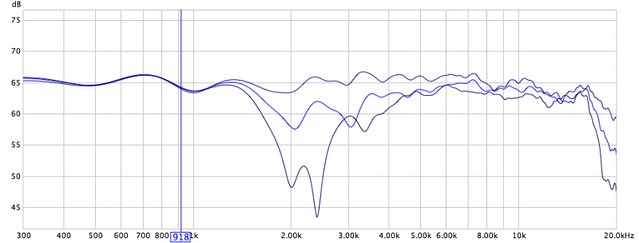
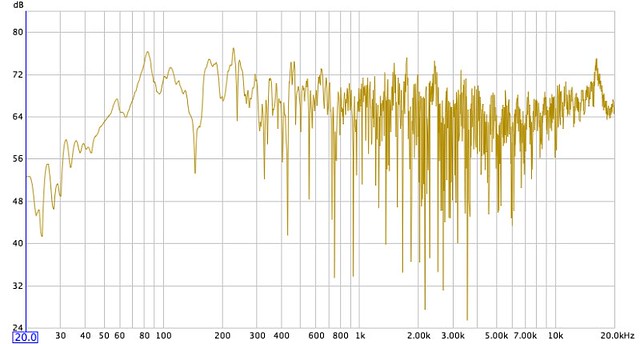
What I've always thought of as lobing as just comb filtering that occurs at the crossover frequency like a two tooth comb that define the shape of the forward lobe. Lobing behavior is dictated by the distance between the drivers, the crossover frequency and slope, phase, and driver directivity at the crossover frequency. Lobing is audible in the nearfield but I can't say I can hear it in the reverberant. Comb filtering occurse at multiple frequencies and has a regularly spaced interval of destructive and constructive interaction that can be seen in a FR graph and are dictated by boundary proximity and directivity. Comb filtering is audible on a swept sine wave, more readily with dipoles near the front wall, as a beating kind of sound. I can't say I've heard comb filtering with music.
Lobing:

Comb filtering:
Dan
What I've always thought of as lobing as just comb filtering that occurs at the crossover frequency like a two tooth comb that define the shape of the forward lobe. Lobing behavior is dictated by the distance between the drivers, the crossover frequency and slope, phase, and driver directivity at the crossover frequency. Lobing is audible in the nearfield but I can't say I can hear it in the reverberant. Comb filtering occurse at multiple frequencies and has a regularly spaced interval of destructive and constructive interaction that can be seen in a FR graph and are dictated by boundary proximity and directivity. Comb filtering is audible on a swept sine wave, more readily with dipoles near the front wall, as a beating kind of sound. I can't say I've heard comb filtering with music.
Lobing:
Comb filtering:
Dan
Ok, this is a great overview. Let me ask about my specific design and get your comments. I am using the 2" Aura driver and want to use 4 of them per side. I anticipate using them from 250-300hz up to about 5khz. How far do these need to be spaced to avoid issues?
Thanks,
Paul
Thanks,
Paul
Hi Cal, all
Combing or comb filtering is caused by having two acoustically separate sources of sound adding together. What you get, the sum, is governed by the phase angles and amplitude of each.
In the simplest case, think of two loudspeakers producing an equal intensify sound BUT where the distance to each source is slightly different and with that difference in distance comes a phase change. When the difference in the two path lengths is 180 degrees (or N odd times 180 degrees) , then you will have a deep cancellation notch because the sounds are equal but opposite.
This can be caused by a single source too if driven by a direct and a time delayed signal as well, when the time delay equals N odd half wavelengths you have the same cancellation notch, when the delay is equal to N even wavelengths the two signals add constructively into a larger signal.
With the case of two acoustic sources, the addition and cancellation is a function of position in space and so when one makes a polar plot of intensity, one sees a pattern of lobes and nulls, the lobes being where the signals add and nulls being regions of cancellation. This pattern of cancellation and addition is also called an interference pattern. If you play pink noise through this system and move around, you hear a swishy swishy sound, classic comb filtering. Also, in a room, a reflected sound is a delayed signal as well and so a strong reflection can also cause combing even with just one source.
In order to add coherently into one new non-interfering source, the sources have to be less than about ¼ wavelength apart. While that condition is easy when the wavelengths are large relative to the source (like with subwoofers) it becomes more difficult as he wavelengths shrink, at 20KHz the wl is about 5/8 inch for example.
A lobe can be caused by an interference pattern but it can also be caused without interference by having directivity such as with a horn behaving normally.
In commercial sound the most popular configuration is one which produces an intense interference pattern, if you have been at an outdoor even using one of these “line arrays” the interference pattern can be evident when the wind blows slightly and you can hear the effect of the combing as it moves back and forth but you can also hear it’s effect if you move closer or farther from the source because the frequency response is different at every location due to the different distances to each source.
Also, while fidelity is usually only a dream for most of these array systems, one can picture why when you consider sending the system a single impulsive signal , what arrives at the microphone or your ears instead is a train of arrivals starting with the closest source and ending with the farthest source.
Doug Jones at work wrote a white paper with illustrations of this stuff if interested. It also explains why we do not make line arrays for large scale sound.
http://www.danleysoundlabs.com/danley/wp-content/uploads/2012/01/line-array-paper.pdf
The difference is plainly audible as well, with a single point source speaker, the response does not change with distance or position because there is no interference pattern. Here are a couple examples if you have headphones on your computer. In spite of the folk lore about line arrays, you can fill a stadium with better sound and have much greater projection / intelligibility / fidelity with a source that only has one arrival.
First Baptist Goodletsville w/Danley JH90 cabinets Main floor on Vimeo
Danley Sound Labs Jericho Horn playing Jennifer Warnes track.MOV - YouTube
Penn State Demo.MOV - YouTube
Also, one can download a free program which allows one to model “what the sound does” when you have more than one source. The first illustrations in the paper above are theoretically ideal point sources (the condition one has when a real driver is small compared to the quarter wavelength). In that program one can either plug in the measured models for our actual loudspeakers or use the theoretical point source models.
DDT Software | Danley Sound Labs, Inc.
Anyway, I hope that helps.
Tom Danley
Some more videos here if interested
Danley Sound Labs, Inc. | Facebook
Combing or comb filtering is caused by having two acoustically separate sources of sound adding together. What you get, the sum, is governed by the phase angles and amplitude of each.
In the simplest case, think of two loudspeakers producing an equal intensify sound BUT where the distance to each source is slightly different and with that difference in distance comes a phase change. When the difference in the two path lengths is 180 degrees (or N odd times 180 degrees) , then you will have a deep cancellation notch because the sounds are equal but opposite.
This can be caused by a single source too if driven by a direct and a time delayed signal as well, when the time delay equals N odd half wavelengths you have the same cancellation notch, when the delay is equal to N even wavelengths the two signals add constructively into a larger signal.
With the case of two acoustic sources, the addition and cancellation is a function of position in space and so when one makes a polar plot of intensity, one sees a pattern of lobes and nulls, the lobes being where the signals add and nulls being regions of cancellation. This pattern of cancellation and addition is also called an interference pattern. If you play pink noise through this system and move around, you hear a swishy swishy sound, classic comb filtering. Also, in a room, a reflected sound is a delayed signal as well and so a strong reflection can also cause combing even with just one source.
In order to add coherently into one new non-interfering source, the sources have to be less than about ¼ wavelength apart. While that condition is easy when the wavelengths are large relative to the source (like with subwoofers) it becomes more difficult as he wavelengths shrink, at 20KHz the wl is about 5/8 inch for example.
A lobe can be caused by an interference pattern but it can also be caused without interference by having directivity such as with a horn behaving normally.
In commercial sound the most popular configuration is one which produces an intense interference pattern, if you have been at an outdoor even using one of these “line arrays” the interference pattern can be evident when the wind blows slightly and you can hear the effect of the combing as it moves back and forth but you can also hear it’s effect if you move closer or farther from the source because the frequency response is different at every location due to the different distances to each source.
Also, while fidelity is usually only a dream for most of these array systems, one can picture why when you consider sending the system a single impulsive signal , what arrives at the microphone or your ears instead is a train of arrivals starting with the closest source and ending with the farthest source.
Doug Jones at work wrote a white paper with illustrations of this stuff if interested. It also explains why we do not make line arrays for large scale sound.
http://www.danleysoundlabs.com/danley/wp-content/uploads/2012/01/line-array-paper.pdf
The difference is plainly audible as well, with a single point source speaker, the response does not change with distance or position because there is no interference pattern. Here are a couple examples if you have headphones on your computer. In spite of the folk lore about line arrays, you can fill a stadium with better sound and have much greater projection / intelligibility / fidelity with a source that only has one arrival.
First Baptist Goodletsville w/Danley JH90 cabinets Main floor on Vimeo
Danley Sound Labs Jericho Horn playing Jennifer Warnes track.MOV - YouTube
Penn State Demo.MOV - YouTube
Also, one can download a free program which allows one to model “what the sound does” when you have more than one source. The first illustrations in the paper above are theoretically ideal point sources (the condition one has when a real driver is small compared to the quarter wavelength). In that program one can either plug in the measured models for our actual loudspeakers or use the theoretical point source models.
DDT Software | Danley Sound Labs, Inc.
Anyway, I hope that helps.
Tom Danley
Some more videos here if interested
Danley Sound Labs, Inc. | Facebook

Some great answers here!
Comb filtering = cause
Lobing = effect.
A speaker cone could be thought of as a large number of tiny sources all connected together and smeared across a plane.
Basically lobing is the result of comb filtering from sources that extremely close together or touching each other in the case of a speaker cone, or farther apart in the case of multiple drivers. As Tom described above, the peaks and nulls depend on distance and frequency.
Comb filtering = cause
Lobing = effect.
A speaker cone could be thought of as a large number of tiny sources all connected together and smeared across a plane.
Basically lobing is the result of comb filtering from sources that extremely close together or touching each other in the case of a speaker cone, or farther apart in the case of multiple drivers. As Tom described above, the peaks and nulls depend on distance and frequency.
- Status
- Not open for further replies.
- Home
- Loudspeakers
- Multi-Way
- Lobing vs. comb filtering