

Hi
this is in continuation of thoughts related to horn honk that started out at Earls thread but was not welcome there
http://www.diyaudio.com/forums/multi-way/103872-geddes-waveguides-79.html#post2090231
http://www.diyaudio.com/forums/multi-way/103872-geddes-waveguides-78.html#post2086927
http://www.diyaudio.com/forums/multi-way/103872-geddes-waveguides-79.html#post2090943
My own intention in investigating "horn honk" is to cut to the bones of that issue, I came across and would love to hear any thoughts related to this topic to possibly bring it down to sort of tech spec finally.
As for now we have :
- soongsc suspecting horn loading
- Jean-Michel suspecting GD
- and me suspecting IM and D-IM
to be the root cause of that strange sonic impact of horns at the lower end of their usable band width.
##########
I don't quite follow your thoughts, Jean-Michel – but to make sure we are on the same track, I run a few simus to show the overlay of the filter function of the horn at ~500Hz and an assumed XO HP filter at 1000Hz .
The simu below should reflect a typical situation of a horn crossed over ~ 1 octave above cut off pretty well :

First trace in GREEN shows the behaviour of the horn alone (3rd order HP filter at 500Hz)
Second trace in BLUE shows the behaviour of the XO alone (3rd order HP filter at 1000Hz)
Third trace in RED shows the combined behaviour of the horn plus XO (3rd order XO-HP filter at 1000Hz on top of 3rd order horn-HP filter at 500Hz)
So – where or how could a GD correction be done any beneficial here - in passive XO?
Michael
this is in continuation of thoughts related to horn honk that started out at Earls thread but was not welcome there
http://www.diyaudio.com/forums/multi-way/103872-geddes-waveguides-79.html#post2090231
http://www.diyaudio.com/forums/multi-way/103872-geddes-waveguides-78.html#post2086927
http://www.diyaudio.com/forums/multi-way/103872-geddes-waveguides-79.html#post2090943
My own intention in investigating "horn honk" is to cut to the bones of that issue, I came across and would love to hear any thoughts related to this topic to possibly bring it down to sort of tech spec finally.
As for now we have :
- soongsc suspecting horn loading
- Jean-Michel suspecting GD
- and me suspecting IM and D-IM
to be the root cause of that strange sonic impact of horns at the lower end of their usable band width.
##########
Hello Michael,
IMHO the GD due to the crossover itself has not to be considered in that discussion because we yet see that we have solutions for the results of the summation of a low-pass and a high-pass crossover to have a (quasi) constant delay.
Then you try to compare GD in horns and in conventional loudspeakers. For conventional loudspeakers the load itself is at the origin of the GD non linearity. The closed enclosure operates as having a second order transfer function and a bass-reflex operates as having a 4th order tranfer function, with the corresponding phase non linearity). So there is theorically no main difference between horns and other loads. But in practice a high order load (as a BR) is rarely used to load a loudspeaker in the medium.
Best regards from Paris, France
Jean-Michel Le Cléac'h
I don't quite follow your thoughts, Jean-Michel – but to make sure we are on the same track, I run a few simus to show the overlay of the filter function of the horn at ~500Hz and an assumed XO HP filter at 1000Hz .
The simu below should reflect a typical situation of a horn crossed over ~ 1 octave above cut off pretty well :
First trace in GREEN shows the behaviour of the horn alone (3rd order HP filter at 500Hz)
Second trace in BLUE shows the behaviour of the XO alone (3rd order HP filter at 1000Hz)
Third trace in RED shows the combined behaviour of the horn plus XO (3rd order XO-HP filter at 1000Hz on top of 3rd order horn-HP filter at 500Hz)
So – where or how could a GD correction be done any beneficial here - in passive XO?
Michael
Last edited:
Hello Michael,
There is 2 different things that I think you are mixing:
1) the use of a high pass crossover frequency Fh above a threshold frequency (defined as the frequency Ft above which the group delay of the uncompensated horn is small enough) .
2) the compensation of the group delay variation under that Ft.
Method 1) is quite similar but a bit more rigourous to the widely used method consisting in setting the crossover frequency Fh an octave above the acoustical cut-off frequency of the horn Fc.
My experience is that a 3rd order transfer function cannot modelize the behaviour of a horn around and below its acoustical cut-off (the GD compensation I used to mention was based on a 4th order transfer function and even it is only partially correct). So I doubt that your simulation is correct.
Also, near and below the acoustical cut-off of the horn, we simply cannot perform such simulation without considering the lower frequency loudspeaker. In the frequency interval inside which the contribution of one or the other of the 2 loudspeaker cannot be forgotten the position of the sound source will result of their mutual operation.
I gave an example of a voice seemingly coming from deep in the horn (near the throat) this is when the high-pass crossover frequency Fh is set to low near the acoustical cut-off Fc. Then the contribution of the horn dominate on the contribution of the LF loudspeaker (both on the frequency response and the group delay which one will show a peak between Fc and Fh).
Now, when we use a the high-pass crossover frequency above the threshold frequency Ft previously mentionned (and a quasioptimal crossover) then the group delay curve of the summation of the 2 loudspeakers shows far less more variation.
This is very clear on a CSD when we are performing the crossover/alignment settings of a 2 ways system (LF loudspeaker + a mid horn).
2) I never explained here until now, how I perform the group delay compensation.
Best regards from Paris, France
and have a good week-end!
Jean-Michel Le Cléac'h
There is 2 different things that I think you are mixing:
1) the use of a high pass crossover frequency Fh above a threshold frequency (defined as the frequency Ft above which the group delay of the uncompensated horn is small enough) .
2) the compensation of the group delay variation under that Ft.
Method 1) is quite similar but a bit more rigourous to the widely used method consisting in setting the crossover frequency Fh an octave above the acoustical cut-off frequency of the horn Fc.
My experience is that a 3rd order transfer function cannot modelize the behaviour of a horn around and below its acoustical cut-off (the GD compensation I used to mention was based on a 4th order transfer function and even it is only partially correct). So I doubt that your simulation is correct.
Also, near and below the acoustical cut-off of the horn, we simply cannot perform such simulation without considering the lower frequency loudspeaker. In the frequency interval inside which the contribution of one or the other of the 2 loudspeaker cannot be forgotten the position of the sound source will result of their mutual operation.
I gave an example of a voice seemingly coming from deep in the horn (near the throat) this is when the high-pass crossover frequency Fh is set to low near the acoustical cut-off Fc. Then the contribution of the horn dominate on the contribution of the LF loudspeaker (both on the frequency response and the group delay which one will show a peak between Fc and Fh).
Now, when we use a the high-pass crossover frequency above the threshold frequency Ft previously mentionned (and a quasioptimal crossover) then the group delay curve of the summation of the 2 loudspeakers shows far less more variation.
This is very clear on a CSD when we are performing the crossover/alignment settings of a 2 ways system (LF loudspeaker + a mid horn).
2) I never explained here until now, how I perform the group delay compensation.
Best regards from Paris, France
and have a good week-end!
Jean-Michel Le Cléac'h
Hi
I don't quite follow your thoughts, Jean-Michel – but to make sure we are on the same track, I run a few simus So – where or how could a GD correction be done any beneficial here - in passive XO?
Last edited:
Ok thanks - there is quite a lot to sort out as it seems
🙂
My starting point (to have a basis) was the group delay plot you calculated from the measurements of my contour
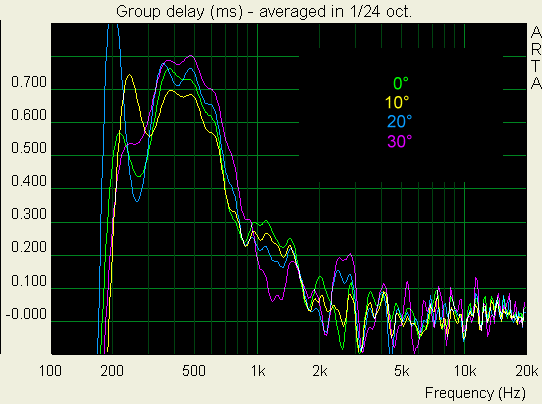
Then I calculated a simple 3rd order Butterworth at 500Hz which – too me – seemed to fit nicely regarding slope and value of group delay:

- I wasn't after precision – just to get a handle on the subject...
Now – for me the question is *if* I model a filter that (more or less) mimcis the same behaviour using a direct radiator – would that one sound the same honky in the lower department?
(I admit I haven't tried, but doubt it would come out that way - but anyway).
Following further your approach I understand that you are after treating the horn's group delay and leave alone the group delay generated by the XO - where you apply some special tricks anyway.
Would you say that we are - so far - on the same track now ?
If so – I think what I did with PC response shaping here
http://www.diyaudio.com/forums/multi-way/100392-beyond-ariel-115.html#post1837992
is basically where you aim for too – no?
Would leave the question if we both have successfully caught "horn honk" already ???
😉
Michael
🙂
My starting point (to have a basis) was the group delay plot you calculated from the measurements of my contour
Then I calculated a simple 3rd order Butterworth at 500Hz which – too me – seemed to fit nicely regarding slope and value of group delay:
- I wasn't after precision – just to get a handle on the subject...
Now – for me the question is *if* I model a filter that (more or less) mimcis the same behaviour using a direct radiator – would that one sound the same honky in the lower department?
(I admit I haven't tried, but doubt it would come out that way - but anyway).
Following further your approach I understand that you are after treating the horn's group delay and leave alone the group delay generated by the XO - where you apply some special tricks anyway.
Would you say that we are - so far - on the same track now ?
If so – I think what I did with PC response shaping here
http://www.diyaudio.com/forums/multi-way/100392-beyond-ariel-115.html#post1837992
is basically where you aim for too – no?
Would leave the question if we both have successfully caught "horn honk" already ???
😉
Michael
Last edited:
Hello Michael,
IMHO the group delay rise of a horn when the frequency decrease toward its acoustical cut-off is only a part of what classically people name "horn sound".
For "honkyness" more important seems to be what I call "tuned pipe effect" which is due to multiple reflections of waves from a truncated mouth to the diaphragm.
But yes, if a loudspeaker + load and/or crossover mimics the illustrated behaviour, the part of the horn sound only related to the group delay variation will be similar. (That's why people for which phase distortion is audible dislike 4th, 6th, 8th order Linkwitz-Riley LP + HP crossovers.
I canot see in your linked measurements the group delay curves or the phase curves...
You probably know better than me that inside the frequency ranges inside which a loudpeaker possess a min phase behaviour linearizing the frequency response curve will also linearize the phase. (IMHO it is not usable to compensate the rise of the group delay of the horn near its cut-off).
But phase equalization may also be used that has no effect on the frequency response curve but only on the phase.
Also with digital technics as FIR filters or with pulse reflection technics we can also linearize both the frequency response and the phase...
My solution is different (I'll explain later more precisely if needed) as it is based on the subtraction of 2 channels to obtain a kind of filter for which the delay will be lower at low frequency than at high frequency (which is the inverse of the normal behaviour of polynomial filters). The output of the first channel delivers the input signal delayed (a special delay is applied to the signal to be filtered by the High Pass crossover) and the second channel delivers theinput signals having been filtered through a 4th order low-pass Linkwitz-Riley having an Fc one octave over the acoustical cut-off of the horn. The two channels are then summed at their output by a simple 2 resistors summator. (one channel inverted to perform the mention subtraction...). Well, this is surely not very clear, and it is time for me to go in week-end
Best regards from Paris, France
Jean-Michel Le Cléac'h
IMHO the group delay rise of a horn when the frequency decrease toward its acoustical cut-off is only a part of what classically people name "horn sound".
For "honkyness" more important seems to be what I call "tuned pipe effect" which is due to multiple reflections of waves from a truncated mouth to the diaphragm.
But yes, if a loudspeaker + load and/or crossover mimics the illustrated behaviour, the part of the horn sound only related to the group delay variation will be similar. (That's why people for which phase distortion is audible dislike 4th, 6th, 8th order Linkwitz-Riley LP + HP crossovers.
I canot see in your linked measurements the group delay curves or the phase curves...
You probably know better than me that inside the frequency ranges inside which a loudpeaker possess a min phase behaviour linearizing the frequency response curve will also linearize the phase. (IMHO it is not usable to compensate the rise of the group delay of the horn near its cut-off).
But phase equalization may also be used that has no effect on the frequency response curve but only on the phase.
Also with digital technics as FIR filters or with pulse reflection technics we can also linearize both the frequency response and the phase...
My solution is different (I'll explain later more precisely if needed) as it is based on the subtraction of 2 channels to obtain a kind of filter for which the delay will be lower at low frequency than at high frequency (which is the inverse of the normal behaviour of polynomial filters). The output of the first channel delivers the input signal delayed (a special delay is applied to the signal to be filtered by the High Pass crossover) and the second channel delivers theinput signals having been filtered through a 4th order low-pass Linkwitz-Riley having an Fc one octave over the acoustical cut-off of the horn. The two channels are then summed at their output by a simple 2 resistors summator. (one channel inverted to perform the mention subtraction...). Well, this is surely not very clear, and it is time for me to go in week-end
Best regards from Paris, France
Jean-Michel Le Cléac'h
My starting point (to have a basis) was the group delay plot you calculated for my contour
Then I calculated a simple 3rd order Butterworth at 500Hz which – too me – seemed to fit nicely regarding slope and value of group delay:
Now – for me the question is *if* I model a filter that (more or less) mimics the same behaviour using a direct radiator – would that one sound the same honky in the lower department?
(I admit I haven't tried, but doubt it would come out that way - but anyway).
Following further your approach I understand that you are after treating the horn's group delay and leave alone the group delay generated by the XO - where you apply some special tricks anyway.
Would you say that we are - so far - on the same track now ?
If so – I think what I did with PC response shaping here
http://www.diyaudio.com/forums/multi-way/100392-beyond-ariel-115.html#post1837992
is basically where you aim for too – no?
Last edited:
I gave an example of a voice seemingly coming from deep in the horn (near the throat) this is when the high-pass crossover frequency Fh is set to low near the acoustical cut-off Fc. Then the contribution of the horn dominate on the contribution of the LF loudspeaker (both on the frequency response and the group delay which one will show a peak between Fc and Fh).
This is clear until the point " the contribution of the horn (will) dominate " .
Sure - I see horn and XO as a combined filter and its easy to understand that it might not be exactly optimal this way from the stand point of smooth merging low and high.
The difference between the BLUE traces (for the XO-HP only) and the RED one (For XO-HP plus horn-HP) in the former posting is an obviously increased GD at the XO frequency.
But to what do you refer as to be "dominating" ?
I mean – if we were *merely* after diminishing GD at and below XO then a valid approach would be to rise the cut off frequency of the horn like below – no ?

again GREEN trace shows the behaviour of the horn alone - 3rd order HP filter at 1000Hz now
RED trace shows the combined behaviour of the horn plus XO (2rd order XO-HP filter at 1000Hz on top of 3rd order horn-HP filter at 1000Hz)
Obviously that's not the solution to treat horn honk – though comparing RED traces (total) GD at XO is ~ the same as before and GD below XO is ~ cut half...
This makes me think about the additional sonic factor that enters the picture regarding horn honk...
Michael
Last edited:
IMHO the group delay rise of a horn when the frequency decrease toward its acoustical cut-off is only a part of what classically people name "horn sound".
For "honkyness" more important seems to be what I call "tuned pipe effect" which is due to multiple reflections of waves from a truncated mouth to the diaphragm.
But yes, if a loudspeaker + load and/or crossover mimics the illustrated behaviour, the part of the horn sound only related to the group delay variation will be similar. (That's why people for which phase distortion is audible dislike 4th, 6th, 8th order Linkwitz-Riley LP + HP crossovers.
Thanks - splitting the issue this way makes a lot of sense to me – have a good weekend
🙂
I'd love to hear more about your GD treatment - possibly some more plots to share ?
Michael
Yup. Everyone should try Jack Bouska's 'towel mod' experiment. Roll up a magazine into a horn and speak through it. Bad honk. Then roll up a towel and wrap it around the mouth of the horn. Much less honk. He even backs it up with measurements showing the period of the modulation is proportional to the horn length.For "honkyness" more important seems to be what I call "tuned pipe effect" which is due to multiple reflections of waves from a truncated mouth to the diaphragm.
I have not the slightest doubt that the towel trick works like a charm....
.... a sharp ended conical is the worst one can possibly think of in terms of diffraction alignment - most anything might work wonders here 😉
the LeCleach contour is the most ingenious and thoughtful approach on the other hand to deal with the transition into free space I can think of
(very little to improve upon IMO - despite maybe a modified approach to "finalize" the contour)
I'm very curious if its possible to get together and sort out the complete horn honk mix
As for the "newspaper horn" we might have to add "flexing of the contour" ?!
🙂
Michael
.... a sharp ended conical is the worst one can possibly think of in terms of diffraction alignment - most anything might work wonders here 😉
the LeCleach contour is the most ingenious and thoughtful approach on the other hand to deal with the transition into free space I can think of
(very little to improve upon IMO - despite maybe a modified approach to "finalize" the contour)
I'm very curious if its possible to get together and sort out the complete horn honk mix
As for the "newspaper horn" we might have to add "flexing of the contour" ?!
🙂
Michael
Last edited:

The towel trick works for sure. See my old thread here:
http://www.diyaudio.com/forums/multi-way/103787-horn-honk-towels.html
Getting rid of the abrupt edge seems to be the key. As in Jean-Michel's profile.
I've even experimented with fleece around the edges of horn tweeters and my big multi-cell horns. There is a difference.
http://www.diyaudio.com/forums/multi-way/103787-horn-honk-towels.html
Getting rid of the abrupt edge seems to be the key. As in Jean-Michel's profile.
I've even experimented with fleece around the edges of horn tweeters and my big multi-cell horns. There is a difference.
Hello Michael,
My solution is different (I'll explain later more precisely if needed) as it is based on the subtraction of 2 channels to obtain a kind of filter for which the delay will be lower at low frequency than at high frequency (which is the inverse of the normal behaviour of polynomial filters). The output of the first channel delivers the input signal delayed (a special delay is applied to the signal to be filtered by the High Pass crossover) and the second channel delivers theinput signals having been filtered through a 4th order low-pass Linkwitz-Riley having an Fc one octave over the acoustical cut-off of the horn. The two channels are then summed at their output by a simple 2 resistors summator. (one channel inverted to perform the mention subtraction...). Well, this is surely not very clear, and it is time for me to go in week-end
Best regards from Paris, France
Jean-Michel Le Cléac'h
This souind like the subtractive-delay approach first presented by Vanderkoov and Lipshtiz, no?
Hi Pano
It took me some time to go through the Jack Bouska threads.
Thanks for pointing me there - very very helpful and detailed, though I have some minor reservations (of course)!
Hello John
Didn't have time to go through that - I'm looking forward to any illuminating discussion with JMLK
From a quick look I'd guess there is no way to compensate the GD of horns for any better when doing XO passively either ~1 octave higher or at cut of (say to shift a Butterworth characteristic into Bessel for example)?
Michael
It took me some time to go through the Jack Bouska threads.
Thanks for pointing me there - very very helpful and detailed, though I have some minor reservations (of course)!
Hello John
Didn't have time to go through that - I'm looking forward to any illuminating discussion with JMLK
From a quick look I'd guess there is no way to compensate the GD of horns for any better when doing XO passively either ~1 octave higher or at cut of (say to shift a Butterworth characteristic into Bessel for example)?
Michael
Hello John
I agree there is some similarities when we consider the horn as a high-pass.
At the time I did those experiments (2006) I did'nt know the search of quasi perfect transient crossovers using delay.
I described that method on the French forum [son-qc]
Yahoo! Groupes
Best regards from Paris, France
Jean-Michel Le Cléac'h
I agree there is some similarities when we consider the horn as a high-pass.
At the time I did those experiments (2006) I did'nt know the search of quasi perfect transient crossovers using delay.
I described that method on the French forum [son-qc]
Yahoo! Groupes
Best regards from Paris, France
Jean-Michel Le Cléac'h
This souind like the subtractive-delay approach first presented by Vanderkoov and Lipshtiz, no?

The loading is explainable in simple physical terms, change of group delay could be a solution to the problem, but I doubt it's the cause. Note that any hong will tend to endure longer than the original signal, so it cannot be exlainable using distortion of any form because when the signal stops, the distortion stops, but the honk remains. Distortion probably is measureable in some relation to the honk, but when we look for cause, we muct look for something that is changeable.
Here is an example to demonstrate that acoustic loading of a horn/guide could vary significantly.
An externally hosted image should be here but it was not working when we last tested it.

The loading is explainable in simple physical terms, change of group delay could be a solution to the problem, but I doubt it's the cause. Note that any hong will tend to endure longer than the original signal, so it cannot be exlainable using distortion of any form because when the signal stops, the distortion stops, but the honk remains. Distortion probably is measureable in some relation to the honk, but when we look for cause, we muct look for something that is changeable.
I thought you understood John's explanation?
Songsc, I really love to take your posts for my daily training to perfect my thought-reading capability, but sometimes – just sometimes - I admit - I would be thankfully for a hint what you mean ?
😀
Michael
John, these filters you linked to look pretty much like a variant of filters that are doable in Accurate. I'm very satisfied with the results so far.
But these are "only" filters for the XO and do not – per se – account for the high group delay from the steep HP of the horn.
So my question to you and Jean-Michel is, if you probably have explored a way to transform the filter type of the horn's HP towards less GD - like Bessel for example.
I know I can do with PC XO in Accourate – no problem – but is there a way to do in passive ?
Michael
But these are "only" filters for the XO and do not – per se – account for the high group delay from the steep HP of the horn.
So my question to you and Jean-Michel is, if you probably have explored a way to transform the filter type of the horn's HP towards less GD - like Bessel for example.
I know I can do with PC XO in Accourate – no problem – but is there a way to do in passive ?
Michael
If we had some nested quote capability, it would probably be easier to track.😀 Is "Quotamaniac" around?Songsc, I really love to take your posts for my daily training to perfect my thought-reading capability, but sometimes – just sometimes - I admit - I would be thankfully for a hint what you mean ?
😀
Michael
In the beginning you mentioned 3 views about the source of HONK. My explanation is that:
1. Any form of distortion is only a measured value, and does not point to what we should fix to reduce it. For example, distortion in an amplifier cannot be the cause of horn HONK even though we measure distortion. Furthermore, when the signal stops, distortion stops, and therefore, horn HONK should stop. In reality, HONK decays much more gradually. So HONK cannot be caused by distortion.
2. None contant group delay exists in probably all speakers. However, the HONK we refer to is uniques to horn/guide. So group delay would not be the source fo HONK. However, control of group delay can be a solution because phase changes can effect damping of a system.
3. This leave us to horn loading. This is where I am showing that acoustic impedance can vary significantly. The data I have shown is variation by just changing the throat and initial expansion section.
IMHO the group delay rise of a horn when the frequency decrease toward its acoustical cut-off is only a part of what classically people name "horn sound".
Yes, I agree upon - could you share a GD plot of the LeCleach contour please ?
######
Someone seen a GD plot of the OS for comparison somewhere ?
Michael
Hello Michael,
The method I indicated fit that purpose. It has nothing to do with the complete system (bass loudspeaker
+low-pass and horn+high-pass.)
The obtained transfer function of the subtractive+delay filter has for unique gieal to compensate (inside an interval of frequency) the variation of the unfiltered horn.
It will be quite difficult to do it only passive as it must use a delay.
Best regards from Paris, France,
Jean-Michel Le Cléac'h
The method I indicated fit that purpose. It has nothing to do with the complete system (bass loudspeaker
+low-pass and horn+high-pass.)
The obtained transfer function of the subtractive+delay filter has for unique gieal to compensate (inside an interval of frequency) the variation of the unfiltered horn.
It will be quite difficult to do it only passive as it must use a delay.
Best regards from Paris, France,
Jean-Michel Le Cléac'h
So my question to you and Jean-Michel is, if you probably have explored a way to transform the filter type of the horn's HP towards less GD - like Bessel for example.
Hello Michael,
I gave a frequency response plot and a group delay crurve obtained from measurements I made on one of my horns in message
http://www.diyaudio.com/forums/multi-way/103872-geddes-waveguides-391.html#post2089515
direct link to the graph.
http://www.diyaudio.com/forums/atta...6483025-geddes-waveguides-gd_compensation.jpg
You'll see both the original group delay curve (in blue) and the curve obtained after the compensation by my method (red curve).
Both curves are without any high-pass crossover.
Best regards,
Jean-Michel Le Cléac'h
I gave a frequency response plot and a group delay crurve obtained from measurements I made on one of my horns in message
http://www.diyaudio.com/forums/multi-way/103872-geddes-waveguides-391.html#post2089515
direct link to the graph.
http://www.diyaudio.com/forums/atta...6483025-geddes-waveguides-gd_compensation.jpg

You'll see both the original group delay curve (in blue) and the curve obtained after the compensation by my method (red curve).
Both curves are without any high-pass crossover.
Best regards,
Jean-Michel Le Cléac'h
Yes, I agree upon - could you share a GD plot of the LeCleach contour please ?
The method I indicated fit that purpose. It has nothing to do with the complete system (bass loudspeaker
+low-pass and horn+high-pass.)
Ah, ok, I missed that - thought its intended for XO.
How complex is it to set up with DCX ?
I gave a frequency response plot and a group delay crurve obtained from measurements I made on one of my horns in message
I was hoping to get a plot where the whole GD peak can be seen – so as to allow me to estimate the HP filter type of the LeCleach contour.
(same I'd like to do for the OS)
I digged through Bjorn Kolbreks paper where a lot of impedance plots are shown for each and any contour – but cant translate that any useful for me – I'm afraid - nor do I have bias for math in general (so don't like to dig into all that formulas)
- Status
- Not open for further replies.
- Home
- Loudspeakers
- Multi-Way
- Horn Honk $$ WANTED $$