

Someone on a car audio forum posed a question about D'Appolito arrays, and I thought I'd answer it here since the subject is of interest to a broad audience. (IE, there are more D'Appolito arrays in the home than in the car.)
I am currently messing around with using some psychoacoustic tricks to "fool" the listener into hearing speakers that aren't there. To do this, I am using a horizontal array of full range speakers, which are waveguide loaded.
The question was, "is this a D'Appolito array?"
The answer is no, but let's explore it a little bit further.
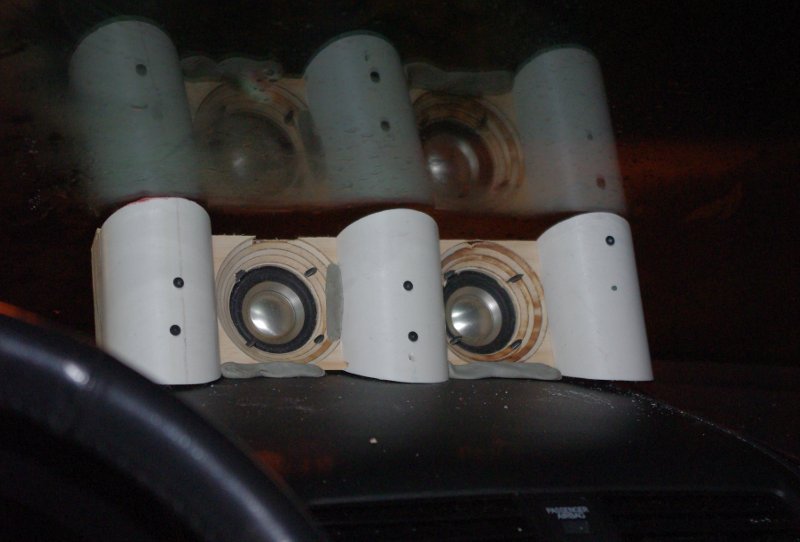
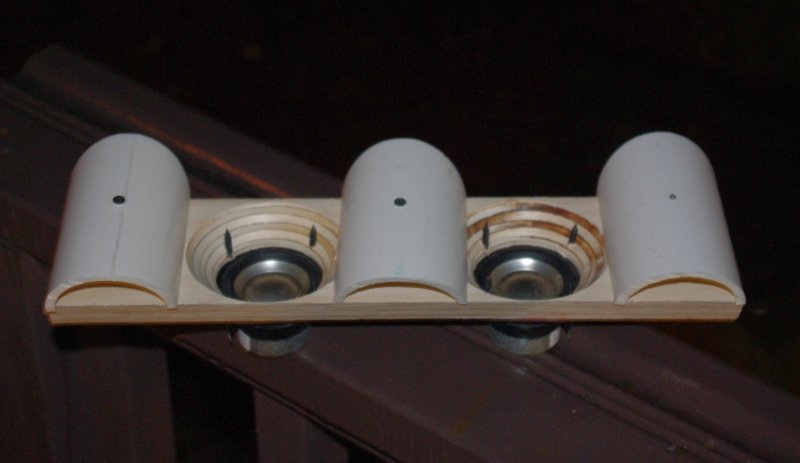 Here's a pic of my contraption. The reason it's NOT a D'Appolito array is that there's no tweeter in the center.
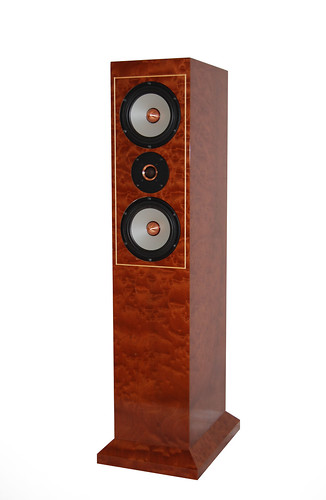 D'Appolito arrays use a specific combination of center-to-center spacing, crossover slope, and crossover frequency to create a forward lobe. Basically it does a crude approximation of a single point source speaker with directivity above the crossover point. About an octave below the crossover point, the directivity disappears, and the speaker is completely omnipolar. This may explain why D'Appolito arrays are well-known for delivering "thunderous bass." The mid and high frequencies have directivity, and the lows do not, so the low frequency response is highly affected by room dimensions and placement.
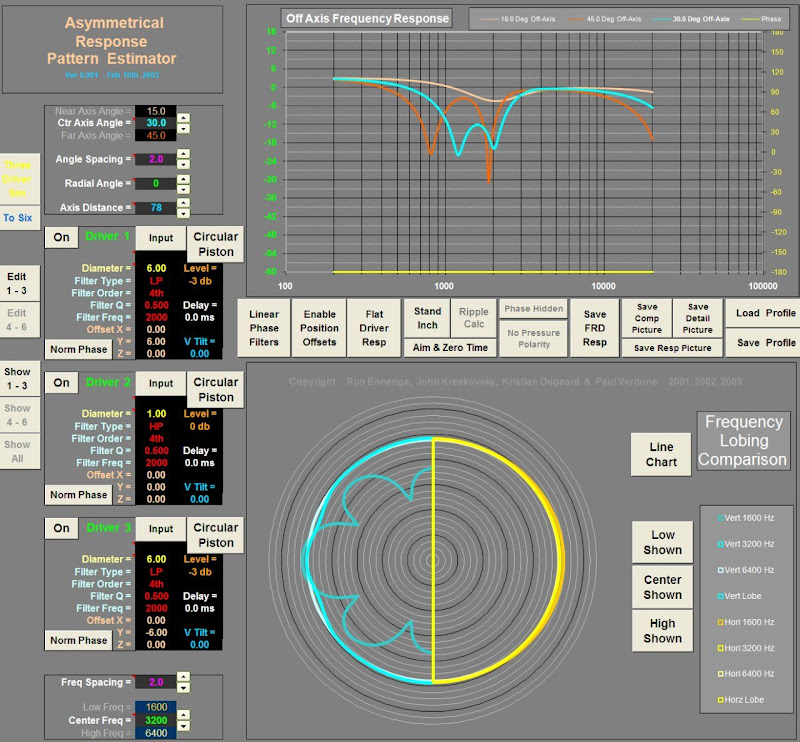 Here's a simulation. In the midrange octave, response falls by as much as TWENTY dB as you move above or below the speaker. This isn't a subtle difference; it's like reducing the amplifier power by as much as 99%! So this is a huuuuuuge null in the midrange.
How this sounds in the real world will depend on a lot of things, particularly the height of the ceilings and the floors, and how reflective they are. Also, computer sims can't predict this perfectly; you really need to build and measure it.
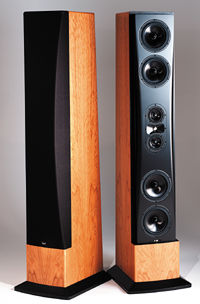
 Here's a nice refinement of a full range array. It's called an "eXpanding array", and was written up in the AES back in the late 80s. Snell built a few of these. In a D'Appolito array we run into deep nulls off-axis because the center-to-center spacing of the midbasses is very high, and the directivity of the tweeter is COMPLETELY different than the midbass. As I see it, the "eXpanding array" addresses a lot of these issues. Here's how:
According to the review in Stereophile, "Smith said that for speaker design he uses "a very complete system and crossover simulator. It takes driver magnitude and phase curves, driver impedances, crossover topologies, crossover values, and physical system layout to give an accurate system response simulation on- and off-axis." In the case of the XA90ps, the computer modeling smoothed the vertical dispersion to within 1dB variation through ±15 degrees. Outside that zone, the array's vertical polar pattern drops off by 4-5dB at 40 degrees, which reduces the energy that bounces off the floor or ceiling."
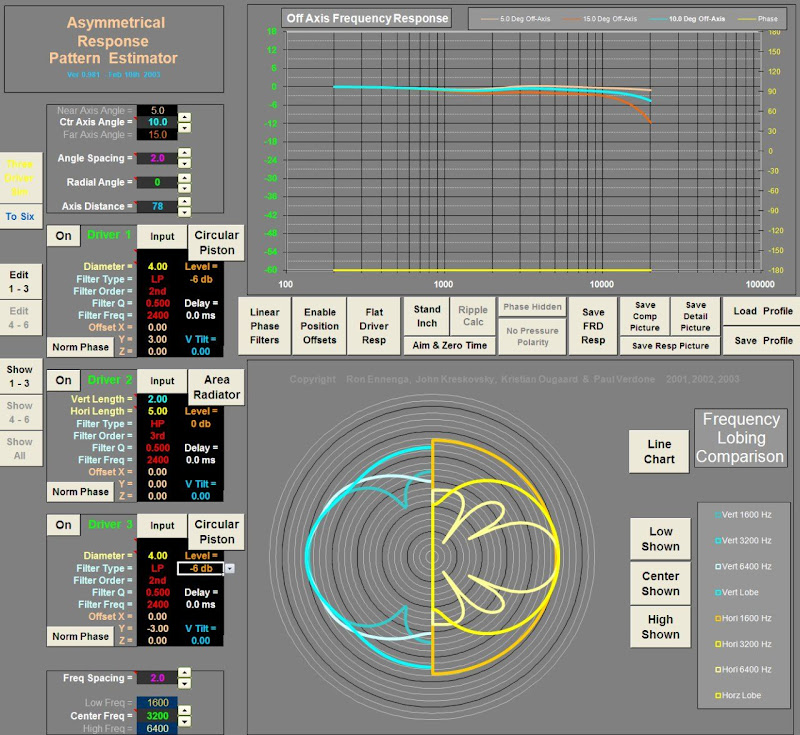
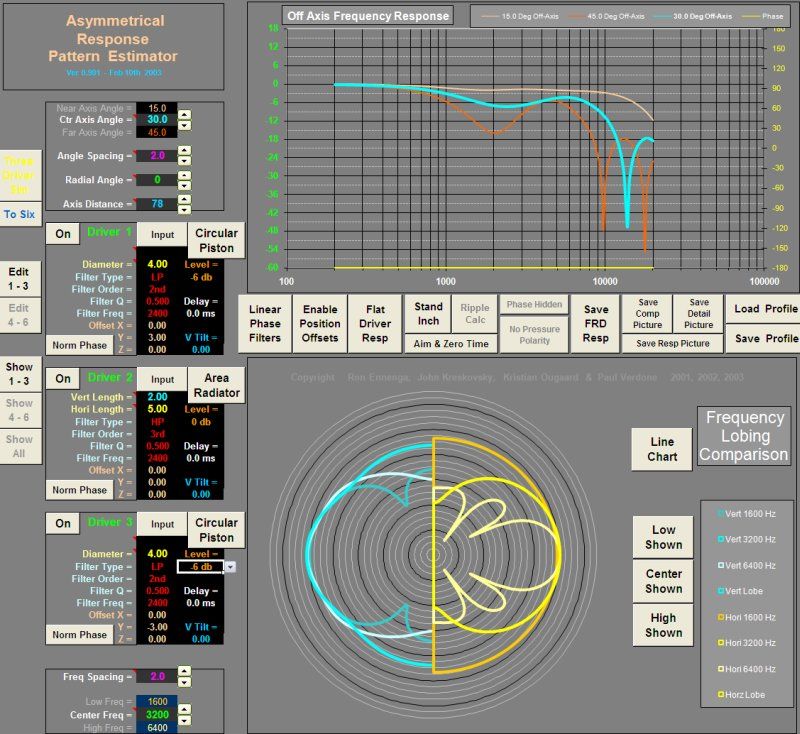
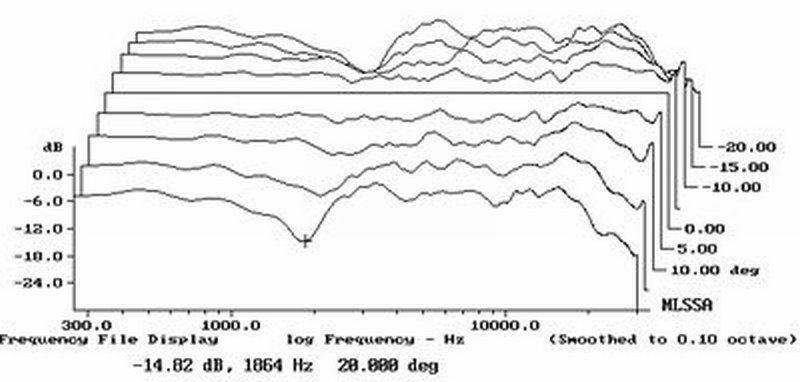
Above are a few simulations of the speaker. In the sims, we can see the following:
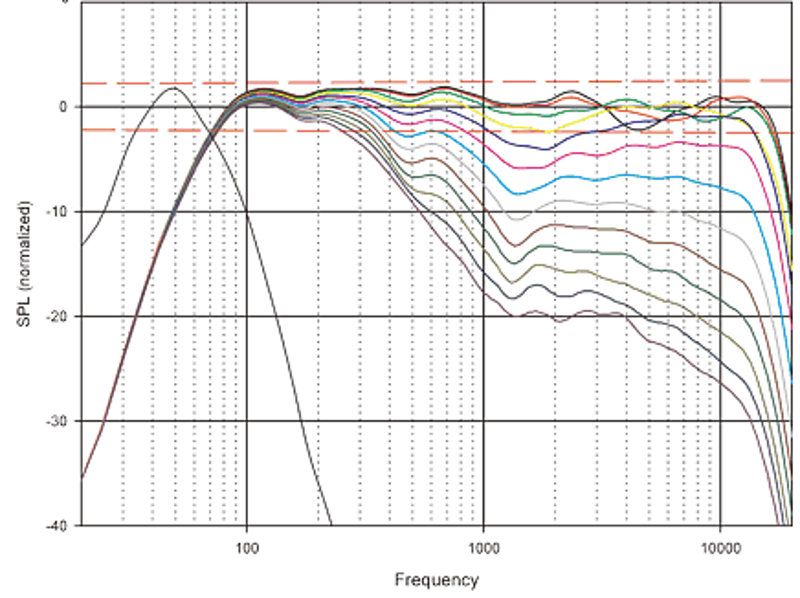 Basically, you can't understand directivity without understanding arrays, because even a full range loudspeaker with one driver behaves like an array. (The shape of the cone changes directivity; you can model the cone as an array.) Waveguides are a convenient way to match the directivity of two drivers. For instance, in my reference speakers, a 15" waveguide is used to match the directivity of a 15" cone. Measured response is above; you can compare it to the simulations of the Snell and the Seas Odin if you'd like.
Let me know if any of this doesn't make sense, or if I've made any mistakes in my simulations. The data for the Snell is all from the Stereophile review: Stereophile: Snell Acoustics XA Reference Tower loudspeaker
I am currently messing around with using some psychoacoustic tricks to "fool" the listener into hearing speakers that aren't there. To do this, I am using a horizontal array of full range speakers, which are waveguide loaded.
The question was, "is this a D'Appolito array?"
The answer is no, but let's explore it a little bit further.
How this sounds in the real world will depend on a lot of things, particularly the height of the ceilings and the floors, and how reflective they are. Also, computer sims can't predict this perfectly; you really need to build and measure it.
- The center-to-center spacing of the midranges and the tweeter is as close as humanly possible; to get any closer you'd have to build an actual coax. Even a Unity horn isn't this tight.
- There's a waveguide on the tweeter. The waveguide transforms the wavefront so that it matches the midrange.
- There is a very specific and well-documented center-to-center spacing for all drivers.
- Due to the very tight spacing, crossover slope isn't as critical; for instance they were able to use 2nd order slopes on everything but the tweeter.
- Because of the wealth of documentation, this is a very easy speaker to clone. They practically list the model numbers in the review.
According to the review in Stereophile, "Smith said that for speaker design he uses "a very complete system and crossover simulator. It takes driver magnitude and phase curves, driver impedances, crossover topologies, crossover values, and physical system layout to give an accurate system response simulation on- and off-axis." In the case of the XA90ps, the computer modeling smoothed the vertical dispersion to within 1dB variation through ±15 degrees. Outside that zone, the array's vertical polar pattern drops off by 4-5dB at 40 degrees, which reduces the energy that bounces off the floor or ceiling."
Above are a few simulations of the speaker. In the sims, we can see the following:
- In the top pic above, I've simmed the off-axis response in five degree increments. It confirms what Smith said - it's within 1dB. (It *does* fall off above 15khz, due to the tweeters directivity.)
- In the pic below that, I've modeled the Snell using the same parameters as the D'Appolito array. We can see that they both have suckouts in the midrange, but the Snell doesn't vary as much with angle, and it's much gentler.
- The thing that I *really* like about the snell is that it's at least 3dB down at 30 degrees off axis across the board. It doesn't take a lot of directivity to reduce off-axis reflections, so even a 3dB reduction is VERY audible. I didn't bother modeling the eights, but Smith uses them to control directivity down into the midbass. If anyone would like to model that, the crossover points, slopes, spacing, and diameters are all in the Stereophile article.
- The very last pic is Stereophile's measured response. It's 100% consistent with what our sims show us. There's a dip at 2khz, and the tweeter's response is narrowing rapidly above 15khz. This is a nice confirmation of the power of the FRD simulator.
Let me know if any of this doesn't make sense, or if I've made any mistakes in my simulations. The data for the Snell is all from the Stereophile review: Stereophile: Snell Acoustics XA Reference Tower loudspeaker

Hi Patrick,
I know this is an older post but I just ran across it while searching for some Snell images.
Glad to see that someone appreciates the XA arrays I did at Snell. Your analysis is on point. I did most of the design with Xopt where you can track a few response angles while manipulating all the variables. I would plot 0, 15 and 40 degrees vertical (either direction, it is symmetrical) and shoot for identical and flat at 0 and 15 and a useful and consistent drop at 40 degrees. Element spacing vs. crossover point is the greatest factor, although I found that steeper crossover on the high pass with gentler on the lowpass usually gave a little better performance.
The physical spacing of the top mids and the tweeter pose the greater challenge so we used smaller mids and unifying plates to squeeze them as close as possible. The waveguide on the tweeter matched directivities to the array in general and picked up some bottom end response to allow pushing the crossover down, further improving the array consistency.
There is an interesting fractal nature to their design. Once you have a formula that works for the central cluster you can scale it up for the next group (the central 3 become the center element for the next three, etc). Don Keele took this to an extreme with a paper on "logarithmic arrays".
Interesting stuff.
David Smith
I know this is an older post but I just ran across it while searching for some Snell images.
Glad to see that someone appreciates the XA arrays I did at Snell. Your analysis is on point. I did most of the design with Xopt where you can track a few response angles while manipulating all the variables. I would plot 0, 15 and 40 degrees vertical (either direction, it is symmetrical) and shoot for identical and flat at 0 and 15 and a useful and consistent drop at 40 degrees. Element spacing vs. crossover point is the greatest factor, although I found that steeper crossover on the high pass with gentler on the lowpass usually gave a little better performance.
The physical spacing of the top mids and the tweeter pose the greater challenge so we used smaller mids and unifying plates to squeeze them as close as possible. The waveguide on the tweeter matched directivities to the array in general and picked up some bottom end response to allow pushing the crossover down, further improving the array consistency.
There is an interesting fractal nature to their design. Once you have a formula that works for the central cluster you can scale it up for the next group (the central 3 become the center element for the next three, etc). Don Keele took this to an extreme with a paper on "logarithmic arrays".
Interesting stuff.
David Smith
Paul W on HTguide built MTM wavguides.
HTGuide Forum - The Raptor ... a 10" MTM
btw, Im not sure why you are calling MTM designs arrays though, they are not line arrays.
HTGuide Forum - The Raptor ... a 10" MTM
btw, Im not sure why you are calling MTM designs arrays though, they are not line arrays.
Paul W on HTguide built MTM wavguides.
btw, Im not sure why you are calling MTM designs arrays though, they are not line arrays.
Array is used as a general term for when there are multiple drivers working together. In adition to line arrays there are MTM or symmetrical arrays, square arrays (such as the older Bozak 2 by 4 arrays) end fire arrays, arced arrays, etc.
XA stood for eXpanding Array.
David
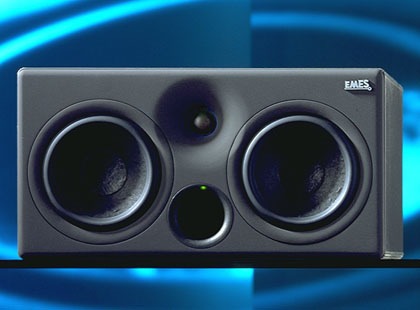
Paul W on HTguide built MTM wavguides.
HTGuide Forum - The Raptor ... a 10" MTM
btw, Im not sure why you are calling MTM designs arrays though, they are not line arrays.
Compare this simulation that I did with the measured response of David's speaker:
See how closely they conform? (Note the narrowing of the polar response at 2khz in both graphs, and the droop at high frequency?)
It's definitely an array. Even better, the FRD tools do a nice job simulating this.
I think the most interesting part of the data is that it demonstrates that you need VERY tight spacing to get a proper wavefront. If possible, you'd want to get the drivers within one half to one quarter wavelength at the crossover point.
To put this into perspective, Paul W would have to cross his tweeter over at three hundred hertz to meet this criteria!
Crazy huh?
The great thing is that it's a lot easier to do this in 2010 than it was twenty years ago, thanks to the ubiquity of neodymium motors.
Paul W on HTguide built MTM wavguides.
HTGuide Forum - The Raptor ... a 10" MTM
btw, Im not sure why you are calling MTM designs arrays though, they are not line arrays.
Line arrays are different than an MTM array.
A MTM array is an array of three drivers.
A line array is an array of arrays. For instance, if you have a line array with a vertical 'stripe' of tweeters, and a vertical 'stripe' of woofers, the line array is an array of tweeter-midrange arrays.
A programmer would call a line array a 'map' or a 'dictionary' 😀
Here's some more rambling on MTM arrays, from my current loudspeaker project:
Audio Psychosis • View topic - Under Dash Horn Alternative
My Infinity Overture 1 speakers, a vintage 1999 pair follow this
4" mids with a 1" soft dome tweeter that nestles into a wave guide. The wave guide does 3 things, it lines up the voice coils of the mids and tweeter on the same axis, it cuts vertical dispersion by around 50% since it is an oval so "matches" the limited vertical dispersion of the mids and it increases SPL. The Infinity crew did a very good job with their wave guide tweeter and I enjoy the sound of the array. The mids cross to a powered 8" woofer at 300Hz for BSC and allow them to be smaller and have actual bass output.
Could a Unity/Synergy Horn be considered a D'Appolito array done right?
4" mids with a 1" soft dome tweeter that nestles into a wave guide. The wave guide does 3 things, it lines up the voice coils of the mids and tweeter on the same axis, it cuts vertical dispersion by around 50% since it is an oval so "matches" the limited vertical dispersion of the mids and it increases SPL. The Infinity crew did a very good job with their wave guide tweeter and I enjoy the sound of the array. The mids cross to a powered 8" woofer at 300Hz for BSC and allow them to be smaller and have actual bass output.
Could a Unity/Synergy Horn be considered a D'Appolito array done right?
My Infinity Overture 1 speakers, a vintage 1999 pair follow this
4" mids with a 1" soft dome tweeter that nestles into a wave guide. The wave guide does 3 things, it lines up the voice coils of the mids and tweeter on the same axis, it cuts vertical dispersion by around 50% since it is an oval so "matches" the limited vertical dispersion of the mids and it increases SPL. The Infinity crew did a very good job with their wave guide tweeter and I enjoy the sound of the array. The mids cross to a powered 8" woofer at 300Hz for BSC and allow them to be smaller and have actual bass output.
Could a Unity/Synergy Horn be considered a D'Appolito array done right?
Yes, the Snell Xpanding array, the Unity horn, the Synergy horn, and the old Quad electrostatics all work on the same principle.
The Dynaudio Evidence is pretty close too.
If you have ten or twenty minutes to kill, go to Stereophile.com and look at John Atkinsons measurements of the Dynaudio flagship, and then look at Focal's flagship. You'll notice that the Dynaudio has quite good directivity and phase response. Especially when compared to the Focal speakers.
I think this is because the Dynaudio is likely adhering to the same playbook as the Snell for the most part. (Using the spacing and xover points to control directivity.)
JBL has also done a few papers on this.
Line Array of a D'Apolitto setup?
Hi,
Experimenting with my Infinity Crescendos, I have found this to be really good sounding. Better than either one solo. They are 9' apart and I sit 9' from them, but it still sounds great three rooms away.
Hi,
Experimenting with my Infinity Crescendos, I have found this to be really good sounding. Better than either one solo. They are 9' apart and I sit 9' from them, but it still sounds great three rooms away.
Attachments


- Status
- Not open for further replies.
- Home
- Loudspeakers
- Multi-Way
- D'Appolito Arrays with Waveguides