
Hi,
I have 2 old 12 inch woofers with Qts = about 0.3, that I want to use for OB, if possible. I have read that Qts will be increased by a series resistor.
Sreten kindly gave me a 'calculator' link some years ago, but I couldn't get it to work then. So, I'm wondering if there is a simple formula to increase a drivers Qts by series R and what other effects this would have on performance/sound of the driver, and, if then, would it be high enough for OB?
It seems obvious that Re and Qts will be increased, but anything else?
I'm just trying to get something for nothing!
For example, raising Eminence Beta15A's from roughly 0.6 to approach the Alpha15A's 1.1? Qts. Is this possible? cheers, grant
I have 2 old 12 inch woofers with Qts = about 0.3, that I want to use for OB, if possible. I have read that Qts will be increased by a series resistor.
Sreten kindly gave me a 'calculator' link some years ago, but I couldn't get it to work then. So, I'm wondering if there is a simple formula to increase a drivers Qts by series R and what other effects this would have on performance/sound of the driver, and, if then, would it be high enough for OB?
It seems obvious that Re and Qts will be increased, but anything else?
I'm just trying to get something for nothing!
For example, raising Eminence Beta15A's from roughly 0.6 to approach the Alpha15A's 1.1? Qts. Is this possible? cheers, grant
http://en.wikipedia.org/wiki/Thiele_small
Qes = 2 * Pi * fs * Mms * Re / (BL) ^2
Now you just add the series R into Re and get a new Qes.
And then you'll have a new Qts.
For most cases, Qes dominates anyway.
In the end, you may probably tune it by ears.
Qes = 2 * Pi * fs * Mms * Re / (BL) ^2
Now you just add the series R into Re and get a new Qes.
And then you'll have a new Qts.
For most cases, Qes dominates anyway.
In the end, you may probably tune it by ears.
You can raise the Qts by adding series resistance, but the efficiency will go down. For OB this may not be a good trade-off, sorry no free lunch.

Efficiency of the speaker itself won't go down.
There is a power loss in the resistor, quite different matter.
To avoid this, an amplifier can be modified to get the required output resistance.
Note that a series resistor has sometimes been used by JBL, I think, because of too low Qts.
As the technique is of so low cost, it is worth to try it.
There is a power loss in the resistor, quite different matter.
To avoid this, an amplifier can be modified to get the required output resistance.
Note that a series resistor has sometimes been used by JBL, I think, because of too low Qts.
As the technique is of so low cost, it is worth to try it.
forr said:Efficiency of the speaker itself won't go down.
There is a power loss in the resistor, quite different matter.
To avoid this, an amplifier can be modified to get the required output resistance.
Note that a series resistor has sometimes been used by JBL, I think, because of too low Qts.
As the technique is of so low cost, it is worth to try it.
Technically the Qts and the efficiency of the driver will not change. But considering his application where he is inserting a resistor between his amp and a particular driver, the net simple way of looking at the system level effect is higher Qts and lower efficiency. While you are technically correct, you are making it more confusing then it really needs to be.

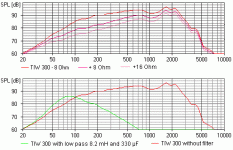
I don't get it how people can see a series resistor as a solution for anything in this application. 🙄 Look at my simulation for a Visaton TIW 300 / 8Ohm with Qts= 0,28 on an open baffle. I added a 8 Ohm resistor and a 16 Ohm resistor to raise Qts. What you get is loss all the way (upper diagram).
A second order filter (in this case designed for a upper limit of 150 Hz) would be much more effective and already include a working low pass (lower diagram).
A second order filter (in this case designed for a upper limit of 150 Hz) would be much more effective and already include a working low pass (lower diagram).
Attachments
MJK,
The Qt..(well how to call it with an OB ?) is affected by the series resistor, that's prescisely its purpose.
Note that the higher power needed for the same level is dissipated in the resistor not in the voice coil.
Mutlisync
---also the effect of the amplifiers' damping factor will go down---
The resistance of the generator seen by the loudspeaker is higher, once again, it is its purpose to decrease the excessive damping.
The damping factor which characterises the output impedance of the amplifier dos not change.
The Qt..(well how to call it with an OB ?) is affected by the series resistor, that's prescisely its purpose.
Note that the higher power needed for the same level is dissipated in the resistor not in the voice coil.
Mutlisync
---also the effect of the amplifiers' damping factor will go down---
The resistance of the generator seen by the loudspeaker is higher, once again, it is its purpose to decrease the excessive damping.
The damping factor which characterises the output impedance of the amplifier dos not change.
If you really want to look at this the correct way then consider the resisted in series with the driver a voltage divider. The effect of the resistor is greatest where the impedance of the driver is the lowest. This means the resistor has little effect around fs where the impedance of the driver is high and the maximum effect through the midrange where the driver impedance is low. If Le is significant then the resistor has decreasing effect as the driver impedance again rises due to Le. This tends to yield a sway back response in a driver which would otherwise be flat though the midrange.
The arguments over changing Qt can be discussed one way or the other depending on what is considered the "system". In any event they are misleading because they consider only the T/S definition of efficiency which applies to the midband assuming the VC impedance is equal to Re alone.
Furthermore, the effective Qt can not be changed much w/o significant wasted power. With a 16 ohm resistor between the amp and a nominal 8 ohm load there could be as much as 9 dB of power wasted midband.
The arguments over changing Qt can be discussed one way or the other depending on what is considered the "system". In any event they are misleading because they consider only the T/S definition of efficiency which applies to the midband assuming the VC impedance is equal to Re alone.
Furthermore, the effective Qt can not be changed much w/o significant wasted power. With a 16 ohm resistor between the amp and a nominal 8 ohm load there could be as much as 9 dB of power wasted midband.

Here are the measured specs from a driver with and without a 20R series resistor.....
Without resistor:
Re 23.69
Qes 3.930
Qts 1.587
With 20R series resistor:
Re 3.67
Qes 0.603
Qts 0.492
Without resistor:
Re 23.69
Qes 3.930
Qts 1.587
With 20R series resistor:
Re 3.67
Qes 0.603
Qts 0.492

I'm just trying to get something for nothing!
Free lunches are like politicians promises; you never really get what you want.
Grant which woofers are they, pix and graphs??
May be possible to use them as a mid-bass but if you want OB bass then you will need to use a dedicated woofer with highish Qts ( 1.00 / 1.5 ?? )
here is an example of the effect of adding a series resistor.
From top down, driver, 4, 8 and 16 ohms series resistance. At the bottom is the driver impedance.
An externally hosted image should be here but it was not working when we last tested it.

From top down, driver, 4, 8 and 16 ohms series resistance. At the bottom is the driver impedance.
Hello John,
some questions WRT your example diagram above:
- Do you show the driver on infinite baffle or in an OB application?
- Are the SPL levels normalised to some 0 dB level or do they show the effective SPL difference between the different resistances?
- What Qts value did you apply for the red curve?
Thanks
Rudolf
some questions WRT your example diagram above:
- Do you show the driver on infinite baffle or in an OB application?
- Are the SPL levels normalised to some 0 dB level or do they show the effective SPL difference between the different resistances?
- What Qts value did you apply for the red curve?
Thanks
Rudolf

john k... said:here is an example of the effect of adding a series resistor..
That graph shows me why a series resistor often works so well with a tweeter.
Rudolf said:Hello John,
some questions WRT your example diagram above:
- Do you show the driver on infinite baffle or in an OB application?
- Are the SPL levels normalised to some 0 dB level or do they show the effective SPL difference between the different resistances?
- What Qts value did you apply for the red curve?
Thanks
Rudolf
Hi Rudolf,
It was an IB simulation. SPL is that showing effect of resistor on actually SPL. Notice at high frequency where Z is very high due to Le, and around fs (=34 Hz) where the driver Z = 50 Ohms, there is little change in SPL. Here is the same driver centered on a 80 cm x 80 cm baffle in dipole mode. As seen the series resistor is not very effective for eq.
An externally hosted image should be here but it was not working when we last tested it.

Driver Fs = 34 Hz, Qts = 0.51 The other point I would make is that whether a series resistor or passive low pass filter is used to "eq" the dipole response there is a lot of amplifier headroom wasted in the eq. Using active eq eliminates this waste of headroom. By head room I mean the required voltage swing to produce the desired SPL output.
With passive eq the amp put out constant voltage vs frequency and then the passive eq reduces the voltage applied to the driver as the frequency rises. With active eq, only the voltage required to produce the necessary SPL output to the driver be the amp.
john k... said:With active eq, only the voltage required to produce the necessary SPL output to the driver be the amp.
So would I be correct in saying that with active EQ the amp would apply additional voltage and current at low frequencies to bring up the SPL response of a lower Qts driver. This would seem to imply more low frequency current in the voice coil and therefore more heating. What advantage does this provide over just using a higher Qts woofer?
MJK said:
So would I be correct in saying that with active EQ the amp would apply additional voltage and current at low frequencies to bring up the SPL response of a lower Qts driver. This would seem to imply more low frequency current in the voice coil and therefore more heating. What advantage does this provide over just using a higher Qts woofer?
If you look at the equation CLS posted,
Qes = 2 * Pi * fs * Mms * Re / (BL) ^2
and assume similar mechanical construction, high Qes is usually achieved by using a weak motor (low BL). So to EQ the two drivers to be equal, you cut the highs of the low-Qes driver rather than boosting the lows. The low Qes driver ends up using less power in the midband to get the job done because of its stronger motor.
catapult said:
If you look at the equation CLS posted,
Qes = 2 * Pi * fs * Mms * Re / (BL) ^2
and assume similar mechanical construction, high Qes is usually achieved by using a weak motor (low BL). So to EQ the two drivers to be equal, you cut the highs of the low-Qes driver rather than boosting the lows. The low Qes driver ends up using less power in the midband to get the job done because of its stronger motor.
I don't disagree. But I believe in the situation that the OP was looking into, the 15" woofer was going to be crossed over to a full range driver in the 150 Hz range. So I am not sure that midrange power consumption is a factor. Looking at just bass output, what advantage does an EQed lower Qts woofer provide over a high Qts woofer (assuming similar mechanical construction and the only difference is magnet strength), again both are crossed over to another driver at about 150 Hz. I would think that for a given SPL level, the displacement capabilities of the two options would need to be the same. That is my first question.
But suppose we follow your logic and need the same SPL in the midrange. If all I need is another dB or two in the midrange where the driver is most efficient, a little more power should not be a big deal, right? This probably would not be a limitation on the driver's performance. That is my second question.
Does all that make sense?
MJK said:
So would I be correct in saying that with active EQ the amp would apply additional voltage and current at low frequencies to bring up the SPL response of a lower Qts driver. This would seem to imply more low frequency current in the voice coil and therefore more heating. What advantage does this provide over just using a higher Qts woofer?
2 different issues Martin. 1) Qts, 2) eq for the dipole roll off. If you can find a driver with Qts and Fs that is acceptable then by all means use it. But there is still the problem of equalizing the response flat above fs. Use of active eq allow taking advantage of the frequency dependent sensitivity of a dipole system. Passive eq discards the increasing (voltage) sensitivity and attempts to make the system look like constant sennsitivity (voltage) to the amplifier. In any case, adding a series resistor is not a very good idea.
- Status
- Not open for further replies.
- Home
- Loudspeakers
- Multi-Way
- Increasing Qts by series R for OB