
Hello again forum
I am pretty new around here, and with speaker DIY so sorry if I am missing some of the obvious.
I am rebuilding/modifying my long loved Kef 104's. They served me well for about ten years and now have dead tweeters and what I fear to be a dying crossover. I decided to put in a pair of XT25's to replace the T27's.
I do not have any serious test equipment setup here. Just a microphone and the ability to meter test tone volumes at any given frequency. According to very basic sweeps the relationship between the two drivers is good. Regardless I can hear the transition. It sounds as if the HPF on the tweeter needs either to be lower or have a much more gentle filter.
I would get to work on a new crossover design but I am missing information on the drivers. I have do not have a impedance graph for the B200 and the other main thing is that the XT25 specs are incomplete on there site. There is no voice coil inductance value at all. Nor wattage for that matter.
Is the only way to get decent results in this situation to measure the drivers myself? I have taken a quick look at speaker workshop but have not gotten my head around it yet. Is there an easier freeware app that has the ability to get the basic values?
Sorry for the rambling post. The is what happens in my head after a week of google. Any assistance or advice would be greatly appreciated.
I am pretty new around here, and with speaker DIY so sorry if I am missing some of the obvious.
I am rebuilding/modifying my long loved Kef 104's. They served me well for about ten years and now have dead tweeters and what I fear to be a dying crossover. I decided to put in a pair of XT25's to replace the T27's.
I do not have any serious test equipment setup here. Just a microphone and the ability to meter test tone volumes at any given frequency. According to very basic sweeps the relationship between the two drivers is good. Regardless I can hear the transition. It sounds as if the HPF on the tweeter needs either to be lower or have a much more gentle filter.
I would get to work on a new crossover design but I am missing information on the drivers. I have do not have a impedance graph for the B200 and the other main thing is that the XT25 specs are incomplete on there site. There is no voice coil inductance value at all. Nor wattage for that matter.
Is the only way to get decent results in this situation to measure the drivers myself? I have taken a quick look at speaker workshop but have not gotten my head around it yet. Is there an easier freeware app that has the ability to get the basic values?
Sorry for the rambling post. The is what happens in my head after a week of google. Any assistance or advice would be greatly appreciated.
find out which b200 is fitted to your 104s.
search this Forum. The T/S data is available for about 4 or 5types of B200.
search this Forum. The T/S data is available for about 4 or 5types of B200.
Sorry I thought I had posted it what version the B200 was. It is the SP1039. As far as I know I have found all the data that can be found on this driver. Via these two documents. Even with this data it seems that 75% of what Speaker Workshop is looking for is missing. I current do not have the needed equipment to test the drivers myself so unfortunately that is not in the picture.
Thanks to www.hifiloudspakers.info and www.t-linespeakers.org/ for this fantastic documentation.
I am beginning to feel that it may be best to simply keep the B200 SP1039 with the current crossover and build the tweeter around it. I was hoping to get the crossover lower than the current 3k. I would be very happy to get down to around 2.5k - 2k.
Can anyone tell me by looking at that crossover how I might do that? I have just started into this area and quite simply are in over my head. I have been running things through "crossover calculators" on line and trying to make sence of it. It does not help that this crossover has three positions for the HF filter.
In regards to the XT25 I feel that I have moved a little bit further along by doing more searching around the web. I found this crossover on the zaph audio site.
http://www.zaphaudio.com/ZD5.html At the very least I can take the Zobel network from that and apply my own crossover frequency. I think that is accurate enough for me at this point.
I wish I had the same information for the B200 SP1039 so I could do my best to flatten it out with a Zobel if need be and apply a simple LPF to it. From there try and sort out phase by tweeter placement. Well thats all ive got for today.
Thanks to www.hifiloudspakers.info and www.t-linespeakers.org/ for this fantastic documentation.
An externally hosted image should be here but it was not working when we last tested it.
An externally hosted image should be here but it was not working when we last tested it.
I am beginning to feel that it may be best to simply keep the B200 SP1039 with the current crossover and build the tweeter around it. I was hoping to get the crossover lower than the current 3k. I would be very happy to get down to around 2.5k - 2k.
Can anyone tell me by looking at that crossover how I might do that? I have just started into this area and quite simply are in over my head. I have been running things through "crossover calculators" on line and trying to make sence of it. It does not help that this crossover has three positions for the HF filter.
In regards to the XT25 I feel that I have moved a little bit further along by doing more searching around the web. I found this crossover on the zaph audio site.
http://www.zaphaudio.com/ZD5.html At the very least I can take the Zobel network from that and apply my own crossover frequency. I think that is accurate enough for me at this point.
I wish I had the same information for the B200 SP1039 so I could do my best to flatten it out with a Zobel if need be and apply a simple LPF to it. From there try and sort out phase by tweeter placement. Well thats all ive got for today.

First of all your substitute Vifa XT25 has a Rvc of 3.0R and your original Kef T27 is 6.25/7.1R@2.3K. As you see you have to completely change your xover. For some more closed equiv.:
REPLACEMENT UNITS->KEF 104/AB wilmslow-audio.co.uk
https://secure.wilmslow-audio.co.uk...8_144&osCsid=61098189923fa7c0be9f0f470201e189
KEF T27 SP1032
http://www.diyaudio.com/forums/showthread.php?threadid=116415
REPLACEMENT UNITS->KEF 104/AB wilmslow-audio.co.uk
https://secure.wilmslow-audio.co.uk...8_144&osCsid=61098189923fa7c0be9f0f470201e189
KEF T27 SP1032
http://www.diyaudio.com/forums/showthread.php?threadid=116415
I did see that page before I bought the XT25's. I was feeling bold at the time and was willing to dig into a bit of a project. I am now wondering if I have made the right decision. If I can get the specs that Solen need then I will most likely just get them to build it.


I'd say the biggest problem is the sensitivity difference T27 at 80dB vs XT25 at 90+. Not sure if the KEF noise method is equivalent but 10dB is a lot.The impedance mismatch will shift the XO frequency.
I'm currently using XT25 ring radiators (not Tymphany) and I like how they sound. Excellent on-axis, smooth off-axis roll off, low distortion. With their low F0 I'd say they were an excellent replacement - just need to fix the XO.
Inductor has a good solution but I'd break it into 2 parts. Start with the level correction which is the 2.2ohm and 3.3ohm resistor (in Inductors schematic) divider right next to the tweeter.
You can make it adjustable by using an 8ohm L-pad as a potentiometer instead of the resistors. Play with the balance between the highs and lows but try to keep the L and R values similar. Some kind of calibrated scale would be useful especially when adjusting levels between XO circuit A/B testing.
You may find that balancing the levels is good enough.
for a while!!!
I'm currently using XT25 ring radiators (not Tymphany) and I like how they sound. Excellent on-axis, smooth off-axis roll off, low distortion. With their low F0 I'd say they were an excellent replacement - just need to fix the XO.
Inductor has a good solution but I'd break it into 2 parts. Start with the level correction which is the 2.2ohm and 3.3ohm resistor (in Inductors schematic) divider right next to the tweeter.
You can make it adjustable by using an 8ohm L-pad as a potentiometer instead of the resistors. Play with the balance between the highs and lows but try to keep the L and R values similar. Some kind of calibrated scale would be useful especially when adjusting levels between XO circuit A/B testing.
You may find that balancing the levels is good enough.
for a while!!!
Try this one, as the impedance is about 5/6 ohm with high frequencies.
If you want to lighten up (from 10k and up) things a little bit (your tweeter) from a relaxed configuration give a cap in parallel of 0.5uF/1uF to the 6R8 resistor.
If you want to lighten up (from 10k and up) things a little bit (your tweeter) from a relaxed configuration give a cap in parallel of 0.5uF/1uF to the 6R8 resistor.
Attachments


a simple to try circuit to hear first
Mike,
where are you up to with your tweeter substitution ?
If you want a simple modification to try first so that you can listen to how the Vifa tweeter sounds with the old B200, then try this:-
Connect a 3.9 ohm, minimum 5 watt, preferably non-inductive, resistor in direct electrical Series with the tweeter
- between the tweeter and the old cross-over.
A 10 watt rated resistor would be better if you intend to play the speakers loudly.
4.7 ohms is close enough if you cannot easily get 3.9 to try.
Remove the 0.6uF capacitor, and the 3 ohm resistor that is in Parallel with the second 10uF capacitor, but leave that 10uF cap in circuit.
Listen to that, then next remove the 10 ohm resistor that is in Parallel with the 0.6mH inductor in the bass circuit.
Listen again, and decide whether you prefer with or with-out that 10 ohm resistor.
If you are happy with all this, then next you can substitute a new 5.1uF or 4.7 uF cap in place of the old 10uF's pair,
and a new 3.9uF, or 4uF, in place of the old 3.3uF.
But, if you are not happy do not buy the new capacitors
-and instead, try Zaph's Vifa option, or whatever else you can find.
I am NOT recommending you send the problem to Solen, because a Simulator produced circuit may not produce what you will actually like the sound from in practice.
Implementing cross-overs for good audible effect in loudspeakers is more complicated than simulators can achieve.
Also, as it has 3rd Order cross-over filter slopes for both drivers, it can be connected in either tweeter Polarity.
There will be audible differences, and you may prefer one option to the other,
thus listen with the tweeter in the Reverse Polarity, as in the original, and then swap the tweeter connections + and - around and listen with the tweeter thus in the same Polarity as the woofer.
Listen more-so on the woofer axis vertically, than on the tweeter axis,
as that will give closer to equal signal arrival times from both drivers,
and thus a more coherent sound.
Expect some of the other members of this Forum to contest some, or all, the suggestions I have made, however I recommend you listen and decide for yourself, and then you will at least understand more about cross-over behavior.
Mike,
where are you up to with your tweeter substitution ?
If you want a simple modification to try first so that you can listen to how the Vifa tweeter sounds with the old B200, then try this:-
Connect a 3.9 ohm, minimum 5 watt, preferably non-inductive, resistor in direct electrical Series with the tweeter
- between the tweeter and the old cross-over.
A 10 watt rated resistor would be better if you intend to play the speakers loudly.
4.7 ohms is close enough if you cannot easily get 3.9 to try.
Remove the 0.6uF capacitor, and the 3 ohm resistor that is in Parallel with the second 10uF capacitor, but leave that 10uF cap in circuit.
Listen to that, then next remove the 10 ohm resistor that is in Parallel with the 0.6mH inductor in the bass circuit.
Listen again, and decide whether you prefer with or with-out that 10 ohm resistor.
If you are happy with all this, then next you can substitute a new 5.1uF or 4.7 uF cap in place of the old 10uF's pair,
and a new 3.9uF, or 4uF, in place of the old 3.3uF.
But, if you are not happy do not buy the new capacitors
-and instead, try Zaph's Vifa option, or whatever else you can find.
I am NOT recommending you send the problem to Solen, because a Simulator produced circuit may not produce what you will actually like the sound from in practice.
Implementing cross-overs for good audible effect in loudspeakers is more complicated than simulators can achieve.
Also, as it has 3rd Order cross-over filter slopes for both drivers, it can be connected in either tweeter Polarity.
There will be audible differences, and you may prefer one option to the other,
thus listen with the tweeter in the Reverse Polarity, as in the original, and then swap the tweeter connections + and - around and listen with the tweeter thus in the same Polarity as the woofer.
Listen more-so on the woofer axis vertically, than on the tweeter axis,
as that will give closer to equal signal arrival times from both drivers,
and thus a more coherent sound.
Expect some of the other members of this Forum to contest some, or all, the suggestions I have made, however I recommend you listen and decide for yourself, and then you will at least understand more about cross-over behavior.
Last edited:
update
The actual value of the input capacitor for the treble filter can be decided after you have decided the amount of Series resistance you prefer with the tweeter.
Kef originally used 4.2uF, though with a .25mH inductor following.
Kef changed to 3.3uF + .3mH to raise the cross over frequency,
however I read that you want to lower the cross over point.
Decide the added resistor, by ear, in the existing cross-over.
You can go higher than 4.7ohm if treble is still too much, but if you go to a much higher resistor, then is when to use an L-pad instead.
Post a reply here if you want any further comment on this.
I am curious what you have achieved to date with the B200 ... ?
The actual value of the input capacitor for the treble filter can be decided after you have decided the amount of Series resistance you prefer with the tweeter.
Kef originally used 4.2uF, though with a .25mH inductor following.
Kef changed to 3.3uF + .3mH to raise the cross over frequency,
however I read that you want to lower the cross over point.
Decide the added resistor, by ear, in the existing cross-over.
You can go higher than 4.7ohm if treble is still too much, but if you go to a much higher resistor, then is when to use an L-pad instead.
Post a reply here if you want any further comment on this.
I am curious what you have achieved to date with the B200 ... ?
Hi there
One of the T27 on my beloved KEF104AB is giving up its ghost. It sounds cracked and at times completely silent. 🙁
The speaker is old and aged. But I still love listening to it play classical or light jazz. I have a properly working pair KEF104, which is older, but have a fairly new matched pair KEF T27 in place.
Considering the Vifa XT25TG30-04 1" and the Dayton Audio DC28F-8 1-1/8", which of them sounds nearer to the T27, and require less workaround on the cross over?
Will be very grateful if someone can advise me. Thanks!
One of the T27 on my beloved KEF104AB is giving up its ghost. It sounds cracked and at times completely silent. 🙁
The speaker is old and aged. But I still love listening to it play classical or light jazz. I have a properly working pair KEF104, which is older, but have a fairly new matched pair KEF T27 in place.
Considering the Vifa XT25TG30-04 1" and the Dayton Audio DC28F-8 1-1/8", which of them sounds nearer to the T27, and require less workaround on the cross over?
Will be very grateful if someone can advise me. Thanks!
Vifa tweeter using 104 approach
Hello Alan
Wilmslow Audio's site recommends the D27TG-35 as a good replacement of the KEF T27, for its quality and 104mm faceplate.
I like the approach you described for tuning the cross over. I have the original KEF104 (with new T27 drivers). I love the sweet sound.
The KEF104 cross over is minimalist in approach: there isn't any 10 ohm resistor in parallel with the 0.6mH inductor in the bass circuit. The T27 is fed thru a HP filter (4u2, .25mH, 5u, L) with no compensation. There isn't any fuses in series. I love the sound stage and the accuracy in vocals. I still find the 104 having an uncanny transparency. Hence, your recommendation should lead to a good sounding 104Ab using the Vifa tweeters.
I hope you would still follow this thread. I shall start rebuilding the KEF104Ab with the D27T, and using the 104 styled cross over with SPL attenuation you described. Cross over capacitors would be from the Mundorf M series. The speaker cabinet I have is in pretty bad shape and this may take sometime for restoration.
Cheers.
Hello Alan
Wilmslow Audio's site recommends the D27TG-35 as a good replacement of the KEF T27, for its quality and 104mm faceplate.
I like the approach you described for tuning the cross over. I have the original KEF104 (with new T27 drivers). I love the sweet sound.
The KEF104 cross over is minimalist in approach: there isn't any 10 ohm resistor in parallel with the 0.6mH inductor in the bass circuit. The T27 is fed thru a HP filter (4u2, .25mH, 5u, L) with no compensation. There isn't any fuses in series. I love the sound stage and the accuracy in vocals. I still find the 104 having an uncanny transparency. Hence, your recommendation should lead to a good sounding 104Ab using the Vifa tweeters.
I hope you would still follow this thread. I shall start rebuilding the KEF104Ab with the D27T, and using the 104 styled cross over with SPL attenuation you described. Cross over capacitors would be from the Mundorf M series. The speaker cabinet I have is in pretty bad shape and this may take sometime for restoration.
Cheers.
Last edited:
tweeters and capacitors
Hi nimo_jon,
Wilmslow likely recommend the Vifa D27TG-35 because it has almost the same size face-plate as a Kef T27, but I wouldn't use it with a B200,
because the D27TG is about 6 or 7 dB greater Sensitivity thus will need a lot of resistive damping ... and that will change the sound.
Also, it will require a significantly different crossover because it's Fs, Qt and Frequency Response are very different to a T27.
Will you only use a same sized face-plate tweeter, or will you consider another size if the other characteristics allow better working with a B200 ?
Also, I am not sure from your post ... do you prefer a sound that is similar to an original 104 crossover, or to a 104ab ?
I have another idea for crossover modification which may give a sound about half-way between 104 and 104ab.
I will describe it if you are interested, but first we will need to decide a tweeter to adapt it to.
What is your budget for new tweeters - can you afford Hiquphon OW1 ?
At lower price, and could work OK with a B200 is Morel Classic CAT 298.
It will need some resistive damping, but not as much as the Vifa.
Another idea is to look on ebay for a working Kef T27 or T27A.
The SP1032 version was used in the 104 and 104ab.
Why do you want to use Mundorf caps ?
Mundorf caps are only available in a limited range of values, but depending on the Impedance decided with the tweeter they may have values to work with it.
Hi nimo_jon,
Wilmslow likely recommend the Vifa D27TG-35 because it has almost the same size face-plate as a Kef T27, but I wouldn't use it with a B200,
because the D27TG is about 6 or 7 dB greater Sensitivity thus will need a lot of resistive damping ... and that will change the sound.
Also, it will require a significantly different crossover because it's Fs, Qt and Frequency Response are very different to a T27.
Will you only use a same sized face-plate tweeter, or will you consider another size if the other characteristics allow better working with a B200 ?
Also, I am not sure from your post ... do you prefer a sound that is similar to an original 104 crossover, or to a 104ab ?
I have another idea for crossover modification which may give a sound about half-way between 104 and 104ab.
I will describe it if you are interested, but first we will need to decide a tweeter to adapt it to.
What is your budget for new tweeters - can you afford Hiquphon OW1 ?
At lower price, and could work OK with a B200 is Morel Classic CAT 298.
It will need some resistive damping, but not as much as the Vifa.
Another idea is to look on ebay for a working Kef T27 or T27A.
The SP1032 version was used in the 104 and 104ab.
Why do you want to use Mundorf caps ?
Mundorf caps are only available in a limited range of values, but depending on the Impedance decided with the tweeter they may have values to work with it.
Hello Allan,
Thank you very much for the reply.
T27 is the choice but I am dropping it because of availability and durability. I used up my last pair of T27 stock a few years ago restoring my KEF104. I do not believe I can buy a good pair of T27 again, even if I am lucky. I do own two pairs of KEF LS3/5a. I wonder when will I need to replace the T27 on them. 🙁
Hiquphon tweeters, can't afford them.
Over ten years ago, I repaired/modified a pair of Mission 760i bookshelf using the Morel MDT 29 and (JPW or scanspeak?) woofer. The old Mission 760i is still singing in my kid's bedroom. If the Morel Classic CAT 298 sounds close to the MDT 29, or better, then it is a good choice. However, I am not sure if it is as analog as the T27.
I have good experiences with the Mundorf caps in the high pass filters. I would say the sound is to my liking. At least, the M caps sound smoother and extended than using Solen.
I will be very grateful if you would elaborate on how to adapt the CAT 298 as a T27 replacement.
Cheers.
Thank you very much for the reply.
T27 is the choice but I am dropping it because of availability and durability. I used up my last pair of T27 stock a few years ago restoring my KEF104. I do not believe I can buy a good pair of T27 again, even if I am lucky. I do own two pairs of KEF LS3/5a. I wonder when will I need to replace the T27 on them. 🙁
Hiquphon tweeters, can't afford them.
Over ten years ago, I repaired/modified a pair of Mission 760i bookshelf using the Morel MDT 29 and (JPW or scanspeak?) woofer. The old Mission 760i is still singing in my kid's bedroom. If the Morel Classic CAT 298 sounds close to the MDT 29, or better, then it is a good choice. However, I am not sure if it is as analog as the T27.
I have good experiences with the Mundorf caps in the high pass filters. I would say the sound is to my liking. At least, the M caps sound smoother and extended than using Solen.
I will be very grateful if you would elaborate on how to adapt the CAT 298 as a T27 replacement.
Cheers.
tweeters
Hi nimo_jon,
the old Morel MDT 29 rolled off treble quite significantly from 10kHz.
That would not be a noticeable problem with the small Mission l'speakers,
because they have rolled off low bass, thus with similar roll-off at both ends of the spectrum the sound is quite balanced,
and especially so for young people's Pop music recordings, because those are also bandwidth reduced so that they will sound OK from Boom-Box
all-in-one systems, and similar bandwidth {and Dynamic Range} limited systems.
Newer CAT 298 is slightly better at 10kHz, but still rolls off above.
They would possibly give a balanced sound in KEF's LS3/5A copy, because that is bandwidth limited,
however in the wide-band 104 you would notice the less above 10kHz than T27 has, unless you have lost a lot of your high frequency hearing
-{age related}- though some of us don't lose it to drastic degree -{I haven't}.
CAT 298 would still need more resistive attenuation than I think best for treble transient response,
and if I did use a 90dB Sensitivity tweeter in lower price ranges I would use ScanSpeak D2905/9500,
{or one of about 3 or 4 SEAS models, depending on the outer diameter size you will accept}.
Better looks to be Dayton Audio RS28F-4, with 104.5mm outer diameter.
88dB Sensitivity, but as 4 ohms impedance one simply adds sufficient resistance to drop it about 2 or 3 dB
{depending on whether you want flat treble response, or slightly lower treble than mids as KEF had in 104}.
It has a suitable Frequency Response and Impedance versus Frequency to allow a simpler crossover than the 104ab revision.
I do mean their RS__F tweeter, and NOT their RS__A, or DC28 series tweeters.
Basically we would use an original 104 type crossover plus a small value resistor, or perhaps two if we have to match Impedance to the limited capacitance values Mundorf have, {but only 2 if necessary, you may be lucky and 1 may suffice}.
For capacitors, ClarityCap PX series and Sonic Craft's Sonicap Gen I are available in greater number of values, and are audibly better than Solen.
A second choice for tweeter would be Usher 9950C-15,
which is a bit more expensive and not quite as good response, but is useable.
I do mean their C-15, and not the 9950-20, nor their 9930 series models.
Data for both the above tweeters can be found by clicking on the Specifications box under each on their basic description pages in Parts Express web-site.
There is no "analog" of a T27, but if you want to look through all of Monacor's tweeters you may find something close:
Monacor International
If you go to their German page, then Click on the British Flag logo at top of page for English language,
then Click on Complete Product Range in the Left-sde column,
then under Speakers, click on HiFi tweeters - there are 18 models to look through !
I recommend you decide which of the above tweeters you want to try,
then we will proceed to the crossover adaption for it.
Hi nimo_jon,
the old Morel MDT 29 rolled off treble quite significantly from 10kHz.
That would not be a noticeable problem with the small Mission l'speakers,
because they have rolled off low bass, thus with similar roll-off at both ends of the spectrum the sound is quite balanced,
and especially so for young people's Pop music recordings, because those are also bandwidth reduced so that they will sound OK from Boom-Box
all-in-one systems, and similar bandwidth {and Dynamic Range} limited systems.
Newer CAT 298 is slightly better at 10kHz, but still rolls off above.
They would possibly give a balanced sound in KEF's LS3/5A copy, because that is bandwidth limited,
however in the wide-band 104 you would notice the less above 10kHz than T27 has, unless you have lost a lot of your high frequency hearing
-{age related}- though some of us don't lose it to drastic degree -{I haven't}.
CAT 298 would still need more resistive attenuation than I think best for treble transient response,
and if I did use a 90dB Sensitivity tweeter in lower price ranges I would use ScanSpeak D2905/9500,
{or one of about 3 or 4 SEAS models, depending on the outer diameter size you will accept}.
Better looks to be Dayton Audio RS28F-4, with 104.5mm outer diameter.
88dB Sensitivity, but as 4 ohms impedance one simply adds sufficient resistance to drop it about 2 or 3 dB
{depending on whether you want flat treble response, or slightly lower treble than mids as KEF had in 104}.
It has a suitable Frequency Response and Impedance versus Frequency to allow a simpler crossover than the 104ab revision.
I do mean their RS__F tweeter, and NOT their RS__A, or DC28 series tweeters.
Basically we would use an original 104 type crossover plus a small value resistor, or perhaps two if we have to match Impedance to the limited capacitance values Mundorf have, {but only 2 if necessary, you may be lucky and 1 may suffice}.
For capacitors, ClarityCap PX series and Sonic Craft's Sonicap Gen I are available in greater number of values, and are audibly better than Solen.
A second choice for tweeter would be Usher 9950C-15,
which is a bit more expensive and not quite as good response, but is useable.
I do mean their C-15, and not the 9950-20, nor their 9930 series models.
Data for both the above tweeters can be found by clicking on the Specifications box under each on their basic description pages in Parts Express web-site.
There is no "analog" of a T27, but if you want to look through all of Monacor's tweeters you may find something close:
Monacor International
If you go to their German page, then Click on the British Flag logo at top of page for English language,
then Click on Complete Product Range in the Left-sde column,
then under Speakers, click on HiFi tweeters - there are 18 models to look through !
I recommend you decide which of the above tweeters you want to try,
then we will proceed to the crossover adaption for it.
Last edited:
Hello Allan,
Thanks for the wealth of information on the types of tweeters. I had been in touch with Parts Express, Wilmslow and also Falcon on the replacement tweeters. Various choices have been offered, and I am glad everyone allows me time to ponder over which to go for.
You are right that the MDT29 has its limitation. I remember I chose the MDT29 for its price and dimensions to repair the Mission. And its good for general easy listening; it can do a great job. Well its not of the same league as the T27 though.
Before we continue with the tweeter replacement, here are the pictures of my 104s.
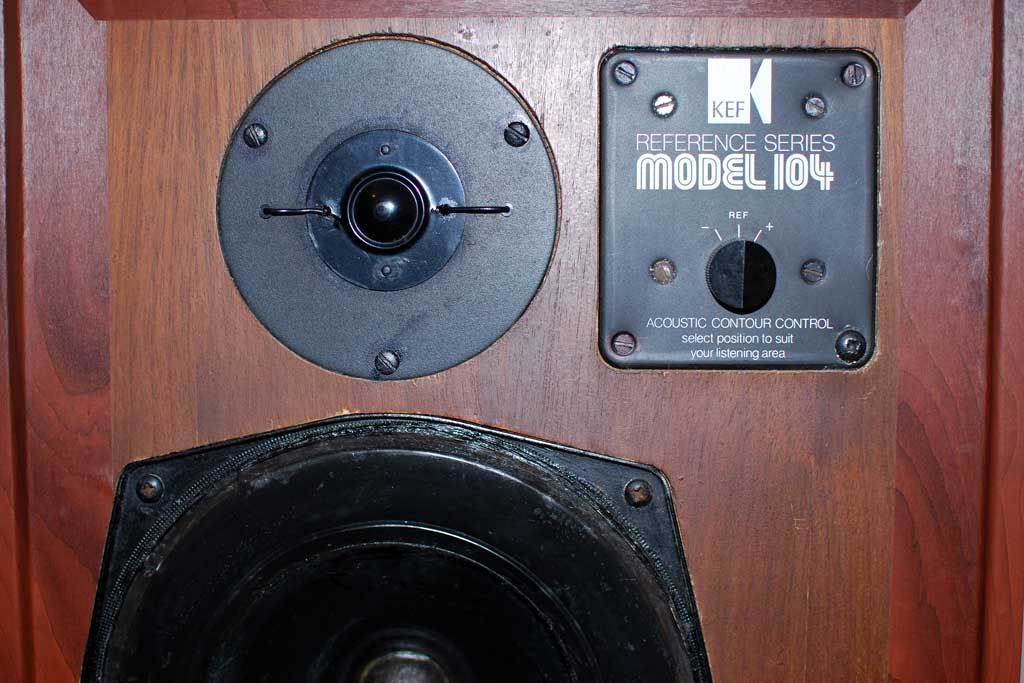
This KEF104 S/No. 10139 was first bought in Northampton England. Over time it nearly qualified itself for the junk yard, but I restored it. The T27 are matched pair and fairly new (relatively), bought from a collector in UK. Cross over capacitors were upgraded from the Alcaps to the Kimber caps from Russ Andrews. The B200 drivers were restored by a skilled speaker repairman in Singapore.
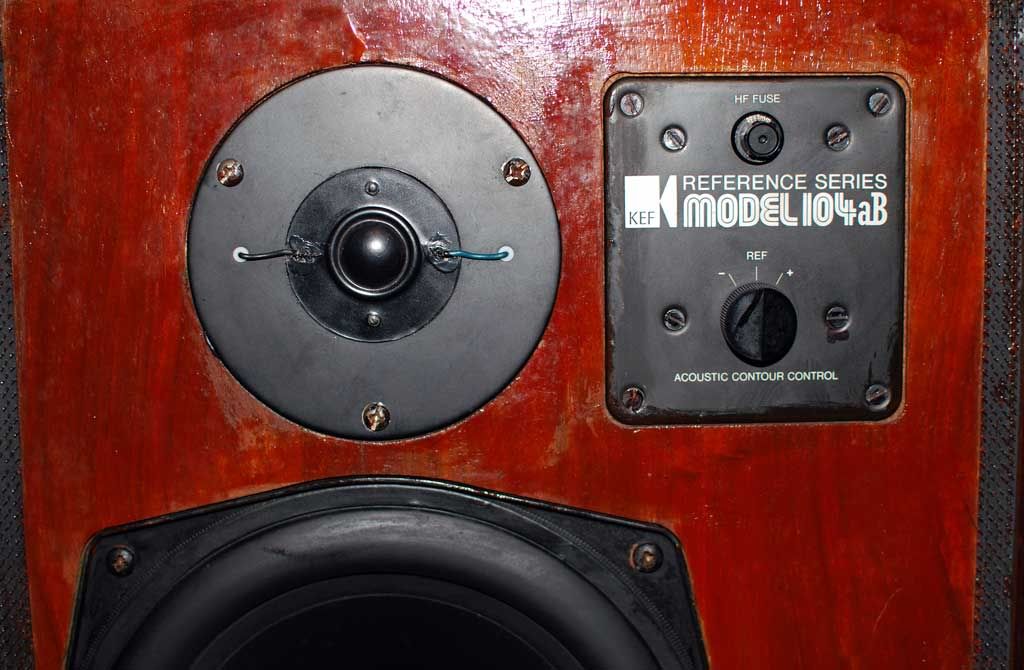
This is the KEF104AB we are talking about. It has been repaired by a rather careless repairman before, who made a couple of mistakes and partially damaged the enclosure. The tweeters were replaced once due to the age of the speakers. The rest of the driver units are still in good shape. The T27 actually is still usable, but I need to put some pressure on the + terminal. It still breaks up awful at random instances when playing certain musical passages. The T27 is beyond repair and I need to replace it. This is the time to restore the crossover and the speaker enclosure as well. I already have the driver units removed and sent to a carpenter to start work on the box.
So, which tweeter now?
Thanks for the wealth of information on the types of tweeters. I had been in touch with Parts Express, Wilmslow and also Falcon on the replacement tweeters. Various choices have been offered, and I am glad everyone allows me time to ponder over which to go for.
You are right that the MDT29 has its limitation. I remember I chose the MDT29 for its price and dimensions to repair the Mission. And its good for general easy listening; it can do a great job. Well its not of the same league as the T27 though.
Before we continue with the tweeter replacement, here are the pictures of my 104s.
This KEF104 S/No. 10139 was first bought in Northampton England. Over time it nearly qualified itself for the junk yard, but I restored it. The T27 are matched pair and fairly new (relatively), bought from a collector in UK. Cross over capacitors were upgraded from the Alcaps to the Kimber caps from Russ Andrews. The B200 drivers were restored by a skilled speaker repairman in Singapore.
This is the KEF104AB we are talking about. It has been repaired by a rather careless repairman before, who made a couple of mistakes and partially damaged the enclosure. The tweeters were replaced once due to the age of the speakers. The rest of the driver units are still in good shape. The T27 actually is still usable, but I need to put some pressure on the + terminal. It still breaks up awful at random instances when playing certain musical passages. The T27 is beyond repair and I need to replace it. This is the time to restore the crossover and the speaker enclosure as well. I already have the driver units removed and sent to a carpenter to start work on the box.
So, which tweeter now?
Parts Express stocks both the Morel CAT298, Dayton RS28F-4. Both are silk dome and of very similar prices in the low cost category. They did mention the Dayton unit and indicates it will be a good replacement, with minimum resistive alteration on the crossover.
I have heard of the ScanSpeak D2905-970000 29mm silk dome. I thought it was meant for car audio? As for Usher drivers, I have never heard of them. Do they sell raw drivers?
Incidentally, I have heard of a DIY LS3/5X clone which employs the SPH135AD as the B110 replacement, and the DT 254(?) tweeter as the T27. It sounded a lot more modern and detailed than the LS3/5 I know, and also appeared to have more bite that the Stirling LS3/5 V2. Then again, I am not making a fair comparison as they were all driven by different sources, amplification chains, in different environment with me in a different mood.
Here is a source in Singapore who can supply me a good range of Mundorf caps:
Leda Resources
I have given up on Solen with T27 because Solen appear to have a signature shrill. I will check out the ClarityCap PX series and Sonic Craft's Sonicap Gen for sure.
For both price and parts availability, I shall decide on the Dayton Audio RS28F-4. My only concern is when driven by tube SE amplifier, will it post a problem?
Hard to believe the difficulties to replace the T27, which is of the 60/70 vintage. Raymond Cooke has indeed created the legend.
Thank you very much for your time and great advises. 🙂
I have heard of the ScanSpeak D2905-970000 29mm silk dome. I thought it was meant for car audio? As for Usher drivers, I have never heard of them. Do they sell raw drivers?
Incidentally, I have heard of a DIY LS3/5X clone which employs the SPH135AD as the B110 replacement, and the DT 254(?) tweeter as the T27. It sounded a lot more modern and detailed than the LS3/5 I know, and also appeared to have more bite that the Stirling LS3/5 V2. Then again, I am not making a fair comparison as they were all driven by different sources, amplification chains, in different environment with me in a different mood.
Here is a source in Singapore who can supply me a good range of Mundorf caps:
Leda Resources
I have given up on Solen with T27 because Solen appear to have a signature shrill. I will check out the ClarityCap PX series and Sonic Craft's Sonicap Gen for sure.
For both price and parts availability, I shall decide on the Dayton Audio RS28F-4. My only concern is when driven by tube SE amplifier, will it post a problem?
Hard to believe the difficulties to replace the T27, which is of the 60/70 vintage. Raymond Cooke has indeed created the legend.
Thank you very much for your time and great advises. 🙂
Last edited:
Tube amplifier Impedance matching
Hi nimo_jon,
ScanSpeak make drivers for several applications.
Their D2905-970000 is not a car audio tweeter {though perhaps a few people have used it for such}.
It is one of their best Home-audio tweeters, but will not be as easy to adapt to the KEF 104 as the 950000 version,
which is also a Home-audio tweeter, though I think it may not sound its best if reduced by about -4 to -5dB to match a B200.
DT 254 is a Monacor tweeter, but of too high Sensitivity for your application, and is 110mm diameter.
It would work well with SPH135AD in a LS3/5A clone, and I don't doubt that version had more "bite" than the Stirling, and sounded more modern than older LS3/5As, because of the higher Sensitivity of both Monacor drivers, thus easier to drive ... and perhaps it has a somewhat different crossover.
LS3/5A was not designed to have "bite".
It was designed to be a spoken voice monitor that could be listened to at close range for long sessions.
It is not actually a true High Fidelity loudspeaker, and it wasn't intended to be, though given its now legendary status don't expect its fans to agree with my statement, though its design brief is stated in the original publication about it.
People misunderstand what is meant by the term "Monitor" when applied to a loudspeaker.
It simply means to monitor something - in the LS3/5A case primarily to monitor speech sound through a fairly close-placed microphone.
Different loudspeaker Monitors have different applications, and not all those applications require neutral, transparent to source reproduction.
Hah, a Tube amplifier - now we may have a limitation for choice of tweeter.
What are the Impedance specifications of its output taps ?
... and perhaps there is only one output tap ?
Is this your own design, or a kit, or a manufactured brand ?
Regardless of the above, it will likely give its best performance with as flat Impedance as possible across the audio-band,
though most well designed SE output amps are more tolerant of Impedance variations than PP output amps.
Probably it will be best to have tweeter impedance the same as woofer impedance, thus that Dayton RS model is not likely to be suitable because it will require so much Series connected resistance to equal that of the woofer that its output will be too low.
Better choice will now be the Usher 9950C-15 {which is in Parts Connection's catalog list - I looked again now}.
Usher are made in Germany.
{Usher make some of the Dayton drivers for Parts Connection, but perhaps not that RS model.}
Is there no 104mm diameter tweeter with less than 90dB sensitivity in the Monacor catalog ?
Monacor are reputed to make replacements for the old KEF drivers, but perhaps they no longer make substitutes for them all ...
What tweeter did "Falcon" recommend ?
If your T27 can be got to work by pressing on the wire connection terminal, then likely the fault is simplt a worn connection behind that,
and that could probably be repaired.
Did you enquire of the Singapore repairer about that ?
Search the KEF Forum about possible repairers, though who-ever they know may be only in Britain,
but perhaps there is someone in the USA or Canada.
Go to:
www.hifiloudspeakers.info
and Click on the "Forum" word at the top of the page.
Parts ConneXion in Canada sell Mundorf capacitors - likely all those on that Singapore list.
Hi nimo_jon,
ScanSpeak make drivers for several applications.
Their D2905-970000 is not a car audio tweeter {though perhaps a few people have used it for such}.
It is one of their best Home-audio tweeters, but will not be as easy to adapt to the KEF 104 as the 950000 version,
which is also a Home-audio tweeter, though I think it may not sound its best if reduced by about -4 to -5dB to match a B200.
DT 254 is a Monacor tweeter, but of too high Sensitivity for your application, and is 110mm diameter.
It would work well with SPH135AD in a LS3/5A clone, and I don't doubt that version had more "bite" than the Stirling, and sounded more modern than older LS3/5As, because of the higher Sensitivity of both Monacor drivers, thus easier to drive ... and perhaps it has a somewhat different crossover.
LS3/5A was not designed to have "bite".
It was designed to be a spoken voice monitor that could be listened to at close range for long sessions.
It is not actually a true High Fidelity loudspeaker, and it wasn't intended to be, though given its now legendary status don't expect its fans to agree with my statement, though its design brief is stated in the original publication about it.
People misunderstand what is meant by the term "Monitor" when applied to a loudspeaker.
It simply means to monitor something - in the LS3/5A case primarily to monitor speech sound through a fairly close-placed microphone.
Different loudspeaker Monitors have different applications, and not all those applications require neutral, transparent to source reproduction.
Hah, a Tube amplifier - now we may have a limitation for choice of tweeter.
What are the Impedance specifications of its output taps ?
... and perhaps there is only one output tap ?
Is this your own design, or a kit, or a manufactured brand ?
Regardless of the above, it will likely give its best performance with as flat Impedance as possible across the audio-band,
though most well designed SE output amps are more tolerant of Impedance variations than PP output amps.
Probably it will be best to have tweeter impedance the same as woofer impedance, thus that Dayton RS model is not likely to be suitable because it will require so much Series connected resistance to equal that of the woofer that its output will be too low.
Better choice will now be the Usher 9950C-15 {which is in Parts Connection's catalog list - I looked again now}.
Usher are made in Germany.
{Usher make some of the Dayton drivers for Parts Connection, but perhaps not that RS model.}
Is there no 104mm diameter tweeter with less than 90dB sensitivity in the Monacor catalog ?
Monacor are reputed to make replacements for the old KEF drivers, but perhaps they no longer make substitutes for them all ...
What tweeter did "Falcon" recommend ?
If your T27 can be got to work by pressing on the wire connection terminal, then likely the fault is simplt a worn connection behind that,
and that could probably be repaired.
Did you enquire of the Singapore repairer about that ?
Search the KEF Forum about possible repairers, though who-ever they know may be only in Britain,
but perhaps there is someone in the USA or Canada.
Go to:
www.hifiloudspeakers.info
and Click on the "Forum" word at the top of the page.
Parts ConneXion in Canada sell Mundorf capacitors - likely all those on that Singapore list.
Last edited:
Hello Allan
Greetings from MA. The weather is getting crazy, and the snow is piling up sky high. I thought this is a good time to run the SE tube amplifier hot to stay warm 😱 (Its a 6SN7/EL34 kit I purchased off Epay. 10W with multiple taps for 4/8 ohms). I usually run the KEF 104 with the Naim NAC42/NAP135. Source can be a Denon SACD/DAC or Rega LP.
You are right, I am indeed looking for a flat Impedance as possible across the audio-band for the KEF104aB. Falcon Acoustics recommends I stay put with the T27A SP1032, and not to deviate from a classic design. Till date, I still cannot find a good KEFT27A. Folks in Falcon are helping me find one.
I have read your reply to Mattias l KEF104 capacitor choice. I have some caps at hand, namely the Alcaps, Auricaps, Clarity caps and Mundorf (from Madisound). I have already tried those out on the original KEF 104 and I understand the differences using the modern PP caps as opposed to the electrolytic caps. There are two schools of thoughts (rather, preferences in flavours) here. I listen to quartets, Carol Kidd and slow BosaNova a lot, so I prefer to use the original cross over in hybrid configuration. I am excited to try out on the KEF104aB. Since I am using a new driver, I need not worry about authenticity. But I still need a warm, detail and relaxed sound.
I have consulted some friends who attempted to repair the T27A before. I managed to remove the voice coil from the main assembly using the 'kiss' method. Under a magnifying glass (my eye sight is still good, but the wire is too thin really) I can see that the (+) end has thinned down considerably, either due to age or it was driven near destruction at one time. There is no way to solder it back, even using a thin bridging wire. The (-) end is going as well. I would say this T27A born Jul 1977 should RIP.
As I was about to order the Dayton units, I stumbled upon one driver. The Eton 19SD-1 , a ¾” Soft Dome Tweeter with a response to 30 kHz. What really interests me are electrical equivalent circuit, as if a brother of the T27A:
Znom 8 ohm (T27 = 8 ohm)
Re 6.3 ohm (T27 = 6.25 ohm)
Le 0.018 mH (T27 = 0.050 mH)
fs 1100 Hz (fs 1200hz +/- 200hz)
Mms 0.16 g (0.37 g)
Sd 3.9 cm2 (4.52 cm2)
Xmax - 0.75 mm peak (?)
VC Ø 19 mm (T27 Ø 19mm)
Sensitivity 1W / 1m 89 dB (T27 = 80 dB, USHER = 88db ave various F)
Mounting wise, slight woodworking on the speaker cabinet should be fine. After all, the chip board is somewhat falling apart after all these years.
There may be more work on the speaker cabinet itself than working on the crossover/new tweeter.
Flange 110mm (T27 = 108mm, USHER =104mm)
Cut-out 74mm (T27 = 75mm, USHER = 75.3mm)
It looks like the Eton driver (Madisound) is not only a close approximation to the T27A, it is also very similar to the Usher 9950C-15 (also from Parts Express). Close German origin (I was told the T27A voice coil was originally made in Germany until KEF bought it). Eton or Usher should be the one.
Cross over wise, on the High pass section, I suppose the original KEF description of the acoustic Butterworth circuit as in fig 2 can be adapted. With R to match the higher sensitivity of the tweeters?
How about the Low pass section. Designs like Tangent TM1 uses a 10R 50u Zobel. Have you tried a 8R 4.7uf impedance matching on the B200 before?
Thanks and regards
Jonathan
Greetings from MA. The weather is getting crazy, and the snow is piling up sky high. I thought this is a good time to run the SE tube amplifier hot to stay warm 😱 (Its a 6SN7/EL34 kit I purchased off Epay. 10W with multiple taps for 4/8 ohms). I usually run the KEF 104 with the Naim NAC42/NAP135. Source can be a Denon SACD/DAC or Rega LP.
You are right, I am indeed looking for a flat Impedance as possible across the audio-band for the KEF104aB. Falcon Acoustics recommends I stay put with the T27A SP1032, and not to deviate from a classic design. Till date, I still cannot find a good KEFT27A. Folks in Falcon are helping me find one.
I have read your reply to Mattias l KEF104 capacitor choice. I have some caps at hand, namely the Alcaps, Auricaps, Clarity caps and Mundorf (from Madisound). I have already tried those out on the original KEF 104 and I understand the differences using the modern PP caps as opposed to the electrolytic caps. There are two schools of thoughts (rather, preferences in flavours) here. I listen to quartets, Carol Kidd and slow BosaNova a lot, so I prefer to use the original cross over in hybrid configuration. I am excited to try out on the KEF104aB. Since I am using a new driver, I need not worry about authenticity. But I still need a warm, detail and relaxed sound.
I have consulted some friends who attempted to repair the T27A before. I managed to remove the voice coil from the main assembly using the 'kiss' method. Under a magnifying glass (my eye sight is still good, but the wire is too thin really) I can see that the (+) end has thinned down considerably, either due to age or it was driven near destruction at one time. There is no way to solder it back, even using a thin bridging wire. The (-) end is going as well. I would say this T27A born Jul 1977 should RIP.
As I was about to order the Dayton units, I stumbled upon one driver. The Eton 19SD-1 , a ¾” Soft Dome Tweeter with a response to 30 kHz. What really interests me are electrical equivalent circuit, as if a brother of the T27A:
Znom 8 ohm (T27 = 8 ohm)
Re 6.3 ohm (T27 = 6.25 ohm)
Le 0.018 mH (T27 = 0.050 mH)
fs 1100 Hz (fs 1200hz +/- 200hz)
Mms 0.16 g (0.37 g)
Sd 3.9 cm2 (4.52 cm2)
Xmax - 0.75 mm peak (?)
VC Ø 19 mm (T27 Ø 19mm)
Sensitivity 1W / 1m 89 dB (T27 = 80 dB, USHER = 88db ave various F)
Mounting wise, slight woodworking on the speaker cabinet should be fine. After all, the chip board is somewhat falling apart after all these years.
There may be more work on the speaker cabinet itself than working on the crossover/new tweeter.
Flange 110mm (T27 = 108mm, USHER =104mm)
Cut-out 74mm (T27 = 75mm, USHER = 75.3mm)
It looks like the Eton driver (Madisound) is not only a close approximation to the T27A, it is also very similar to the Usher 9950C-15 (also from Parts Express). Close German origin (I was told the T27A voice coil was originally made in Germany until KEF bought it). Eton or Usher should be the one.
Cross over wise, on the High pass section, I suppose the original KEF description of the acoustic Butterworth circuit as in fig 2 can be adapted. With R to match the higher sensitivity of the tweeters?
How about the Low pass section. Designs like Tangent TM1 uses a 10R 50u Zobel. Have you tried a 8R 4.7uf impedance matching on the B200 before?
Thanks and regards
Jonathan
- Status
- Not open for further replies.
- Home
- Loudspeakers
- Multi-Way
- Kef 104ab with XT25 - looking for info/advice with crossovers