
I’ve been playing with the example compression driver described in the Akabak manual.
It looks like it should be reasonably straightforward to “adjust” the parameters to simulate say a B&C DE250. My approach is to match the SPL and Impedance curves given by B&C for a DE250 mounted on a ME45 waveguide. Assuming the ME45 is a true exponential waveguide it is possible to add this to the compression driver model and use Akabak to generate SPL and Impedance curves for the DE250/ME45 combination.
I would appreciate guidance from others more expert than I on whether they think I am wasting my time, or whether it is best to assume a simple cone type driver paired with the waveguide for a first stab, and then to rely on practical measurements to resolve crossover issues etc
Is it sufficient to match the SPL and Impedance curves when it is possible to achieve this using many wrongs to make a right? As B&C only quote Re and L values the Akabak model requires many others to be adjusted using the graphical fit technique. My instinct is that it should be possible to get a reasonable model if other values such as BL and Mms were known, plus other geometric measurements taken on a partially stripped compression driver. I have sought more data from B&C but no luck so far.
The DIY fraternity now have many super tools to evaluate speaker designs but the modeling of compression drivers remains a real challenge, hence my question.
It looks like it should be reasonably straightforward to “adjust” the parameters to simulate say a B&C DE250. My approach is to match the SPL and Impedance curves given by B&C for a DE250 mounted on a ME45 waveguide. Assuming the ME45 is a true exponential waveguide it is possible to add this to the compression driver model and use Akabak to generate SPL and Impedance curves for the DE250/ME45 combination.
I would appreciate guidance from others more expert than I on whether they think I am wasting my time, or whether it is best to assume a simple cone type driver paired with the waveguide for a first stab, and then to rely on practical measurements to resolve crossover issues etc
Is it sufficient to match the SPL and Impedance curves when it is possible to achieve this using many wrongs to make a right? As B&C only quote Re and L values the Akabak model requires many others to be adjusted using the graphical fit technique. My instinct is that it should be possible to get a reasonable model if other values such as BL and Mms were known, plus other geometric measurements taken on a partially stripped compression driver. I have sought more data from B&C but no luck so far.
The DIY fraternity now have many super tools to evaluate speaker designs but the modeling of compression drivers remains a real challenge, hence my question.

I've done a lot of compression driver modeling. Here is how I get the parameters. Measure the impedance curve withoput a horn and model this. Measure the impedance curve with the front port blocked off - model this. If possible run the impedance curve with the back off and model this. With these two or three measurements run the model with the known values fixed while varying the unknown values until you get a good match to all of the impedance curves simultaneously. When you get this as good as you can then you have the proper set of parameters for the driver. The advantage of this approach is that you don't have to destroy the device to get the values.
Earl,
Thankyou for the advice. I had hoped to be able to screen compression drivers from published data, plus maybe some additional info from others. At least I know that hands on measurement is the way to go, which will no doubt save me much wasted time and anguish.
I purchased SPEAK a few years ago because it covered a full speaker design i.e. multi drivers, full frequency range, crossover and waveguides. I would like to know if you use SPEAK to model compression drivers (on waveguides + crossover) or is there a special unreleased version to do this. Wouldn't blame you if there were as ultimate refinements represent your livlihood. The guidance you freely give is always very relevant and saves many of us from fruitless ventures.
Thanks again for your very prompt reply.
Tom
Thankyou for the advice. I had hoped to be able to screen compression drivers from published data, plus maybe some additional info from others. At least I know that hands on measurement is the way to go, which will no doubt save me much wasted time and anguish.
I purchased SPEAK a few years ago because it covered a full speaker design i.e. multi drivers, full frequency range, crossover and waveguides. I would like to know if you use SPEAK to model compression drivers (on waveguides + crossover) or is there a special unreleased version to do this. Wouldn't blame you if there were as ultimate refinements represent your livlihood. The guidance you freely give is always very relevant and saves many of us from fruitless ventures.
Thanks again for your very prompt reply.
Tom
I still do rough designs with SPEAK, but the more accurate approachs are proprietary. These later approachs involve a combination of measurements and models which I have found to be quite accurate. Accurate enough that I can use the models with confidence that the final design will be right on once its built.
Hello,
For what is worth, you may find the Hornresp model I designed for a TAD TD2001 compression driver, in Audio Asylum message :
http://db.audioasylum.com/cgi/m.mpl?forum=hug&n=128658
(better to use Ang = 2,0 Pi)
Best regards from Paris, France
Jean-Michel Le Cléac'h
For what is worth, you may find the Hornresp model I designed for a TAD TD2001 compression driver, in Audio Asylum message :
http://db.audioasylum.com/cgi/m.mpl?forum=hug&n=128658
(better to use Ang = 2,0 Pi)
Best regards from Paris, France
Jean-Michel Le Cléac'h
thosuk said:I’ve been playing with the example compression driver described in the Akabak manual.
...
The DIY fraternity now have many super tools to evaluate speaker designs but the modeling of compression drivers remains a real challenge, hence my question.
Thanks Jean-Michel,
I shall experiment with the values you suggest and try to adjust in due course for the DE250.
I became interested in the modelling of compression drivers as I could not see a way of modelling compression driver / waveguide / crossover interactions in a single package except using Akabak. In theory I hoped this would produce an accurate model - provided of course that suitable parameter values could be obtained for the Akabak compression driver model.
Earl suggested a way to refine the Akabak model values but I would love to know if this is essential for accurate modelling, or whether the simplified model you suggest supplemented by practical experimention is just as good. My feeling is that accurate modelling should minimise the trial and error experimental stage.
Tom
I shall experiment with the values you suggest and try to adjust in due course for the DE250.
I became interested in the modelling of compression drivers as I could not see a way of modelling compression driver / waveguide / crossover interactions in a single package except using Akabak. In theory I hoped this would produce an accurate model - provided of course that suitable parameter values could be obtained for the Akabak compression driver model.
Earl suggested a way to refine the Akabak model values but I would love to know if this is essential for accurate modelling, or whether the simplified model you suggest supplemented by practical experimention is just as good. My feeling is that accurate modelling should minimise the trial and error experimental stage.
Tom
thosuk said:Earl suggested a way to refine the AkAbak model values but I would love to know if this is essential for accurate modelling, or whether the simplified model you suggest supplemented by practical experimention is just as good.
Hi Tom,
You might be interested to know that Hornresp has been used by the P.Audio System Company of Thailand, to model horn systems with compression drivers.
Kind regards,
David
Hello Thosuk,
Let's take as an example the TAD TD2001 compression driver modelisation.
Akabak will allow you to add the effect of the cavity inside which the voice coil moves (responsible of a bump in the electrical impedance curve and a hole in the response curve around 1600Hz) and eventually few other minor resonances above 10kHz ... Is this useful, in the initial design process of a horn or a waveguide I doubt ...
More complex modelisation integrating the coupling between, mechanical, thermal, acoustics ... need more complex software suites (FEM...).
But for a first step in the design of a horn or a waveguide, if you don't need to link the crossover (is it so useful), Hornresp will allow you to do the job more more easily and more rapidly.
Best regards from Paris, France
Jean-Michel Le Cléac'h
Let's take as an example the TAD TD2001 compression driver modelisation.
Akabak will allow you to add the effect of the cavity inside which the voice coil moves (responsible of a bump in the electrical impedance curve and a hole in the response curve around 1600Hz) and eventually few other minor resonances above 10kHz ... Is this useful, in the initial design process of a horn or a waveguide I doubt ...
More complex modelisation integrating the coupling between, mechanical, thermal, acoustics ... need more complex software suites (FEM...).
But for a first step in the design of a horn or a waveguide, if you don't need to link the crossover (is it so useful), Hornresp will allow you to do the job more more easily and more rapidly.
Best regards from Paris, France
Jean-Michel Le Cléac'h
thosuk said:Thanks Jean-Michel,
I shall experiment with the values you suggest and try to adjust in due course for the DE250.
I became interested in the modelling of compression drivers as I could not see a way of modelling compression driver / waveguide / crossover interactions in a single package except using Akabak. In theory I hoped this would produce an accurate model - provided of course that suitable parameter values could be obtained for the Akabak compression driver model.
Earl suggested a way to refine the Akabak model values but I would love to know if this is essential for accurate modelling, or whether the simplified model you suggest supplemented by practical experimention is just as good. My feeling is that accurate modelling should minimise the trial and error experimental stage.
Tom

David McBean said:
Hi Tom,
You might be interested to know that Hornresp has been used by the P.Audio System Company of Thailand, to model horn systems with compression drivers.
Kind regards,
David
Any chance you might be able to get a hold of some input parameters from them? Several different models would be a bonus. Had to ask.
Rgs, JLH
Thanks David and thanks to all.
I'm very happy to take all the advice as clearly you've been there before. I shall compare simplified models with the limited published data for real compression drivers as I'm curious about how many parameters are real and how many are contrived.
Its pretty clear how to approach first estimate modelling and I shall no doubt find out in due course about the interactions when crossovers are introduced. An inductor can improve low frequency response, and can be modelled in Horn Response, so clearly there must in general be an influence. It may well be, as Jean-Michel implies, that the subtleties are small and acceptable for DIYers. I just wanted to find out how to address the problems for this aspect of speaker design, which is not well documented. Only those who have been there will know whether going to a lot more trouble is worth it.
Tom
I'm very happy to take all the advice as clearly you've been there before. I shall compare simplified models with the limited published data for real compression drivers as I'm curious about how many parameters are real and how many are contrived.
Its pretty clear how to approach first estimate modelling and I shall no doubt find out in due course about the interactions when crossovers are introduced. An inductor can improve low frequency response, and can be modelled in Horn Response, so clearly there must in general be an influence. It may well be, as Jean-Michel implies, that the subtleties are small and acceptable for DIYers. I just wanted to find out how to address the problems for this aspect of speaker design, which is not well documented. Only those who have been there will know whether going to a lot more trouble is worth it.
Tom
JLH said:Any chance you might be able to get a hold of some input parameters from them? Several different models would be a bonus.
Hi JLH,
The only input parameter values I have are for the 120 watt PA-D120N compression driver. The actual figures used by P.Audio in their Hornresp simulations were:
Sd = 34.00 sq cm
Bl = 8.00 tesla.m
Cms = 6.20E-05 m/newton
Rms = 0.74 newton.sec/m
Mmd = 2.77 gm
Le = 0.35 millihenrys
Re = 4.70 ohms
Vrc = 0.10 litres
Lrc = 0.10 cm
Fr = 0.00 rayls/cm
Tal = 0.00 cm
Vtc = 0.24 cc
Atc = 34.00 sq cm
It is interesting to note that with Vtc = 0.24 cc and Atc = 34 sq cm the average theoretical distance between the diaphragm and the front of the throat chamber is only 0.07 mm, which allows for virtually no diaphragm movement. The very small value of 0.1 cm for Lrc is also rather strange.
Despite using very short front and rear chamber lengths in the simulations, the on-axis frequency response predicted by Hornresp is pleasingly close to the actual measured test result for the prototype P.Audio horn. I can post copies of the two charts if anyone is interested in seeing them.
Kind regards,
David
Thank you David. This is great information to have. I believe that at the least having a general model can help a lot.
Here is a link to one of Jean-Michel's posts on a model for the TAD TD-2001
Hornresp and TD2001 simulation - Jmmlc - High Efficiency Speaker Asylum
Below is the important model information for the TD-2001:
Sd = 18,10 cm²
Cms = 1,60E-04 m/N
Mmd = 1,60 gm
Re = 6,30 ohms
Bl = 7,20 tesla.m
Rms = 2,72 newton.sec/m
Le = 0,06 millihenrys
Nd = 1 (single driver)
Vrc = 0,14 litres
Fr = 40,00 rayls/cm
Vtc = 0,81 cm3
Lrc = 2,70 cm3
Tal = 1,00 cm
Atc = 18,10 cm3
There is also a compression driver model in this paper :
Sehr geehrter Besucher
The important model information is below:
| AkAbak example script - Compression driver
Def_Const
{ Ree=13; |Voice coil resistance [ohm]
Le=0.5e-3; |Voice coil inductance [H]
Bl=8; |Motor conversion factor F=Bl*i [Tm]
Mms=1.1e-3; |Mechanical mass [kg]
Rms=0.4; |Mechanical resistance [Ns/m]
Cms=140e-6; |Mechanical compliance [N/m]
dDi=4.5e-2; |Diameter centre diaphragm [m]
dDa=5.3e-2; |Diameter outer diaphragm [m]
Hi=1e-3; |Distance between diaphragm and phase plug
Ha=13e-3; |Eff. height of outer chamber under the ring
ds=0.2e-3; |Slit between voice coil and magnet
ls=15e-3; } |Length of voice coil path
Hopefully everyone will find this information useful. Having all the information in one place should help.
Dr. Geddes would you be willing to "throw us a bone" and share what information you have for modeling your compression drivers? Or at least comment on what has been shared so far?
Rgs, JLH
Here is a link to one of Jean-Michel's posts on a model for the TAD TD-2001
Hornresp and TD2001 simulation - Jmmlc - High Efficiency Speaker Asylum
Below is the important model information for the TD-2001:
Sd = 18,10 cm²
Cms = 1,60E-04 m/N
Mmd = 1,60 gm
Re = 6,30 ohms
Bl = 7,20 tesla.m
Rms = 2,72 newton.sec/m
Le = 0,06 millihenrys
Nd = 1 (single driver)
Vrc = 0,14 litres
Fr = 40,00 rayls/cm
Vtc = 0,81 cm3
Lrc = 2,70 cm3
Tal = 1,00 cm
Atc = 18,10 cm3
There is also a compression driver model in this paper :
Sehr geehrter Besucher
The important model information is below:
| AkAbak example script - Compression driver
Def_Const
{ Ree=13; |Voice coil resistance [ohm]
Le=0.5e-3; |Voice coil inductance [H]
Bl=8; |Motor conversion factor F=Bl*i [Tm]
Mms=1.1e-3; |Mechanical mass [kg]
Rms=0.4; |Mechanical resistance [Ns/m]
Cms=140e-6; |Mechanical compliance [N/m]
dDi=4.5e-2; |Diameter centre diaphragm [m]
dDa=5.3e-2; |Diameter outer diaphragm [m]
Hi=1e-3; |Distance between diaphragm and phase plug
Ha=13e-3; |Eff. height of outer chamber under the ring
ds=0.2e-3; |Slit between voice coil and magnet
ls=15e-3; } |Length of voice coil path
Hopefully everyone will find this information useful. Having all the information in one place should help.
Dr. Geddes would you be willing to "throw us a bone" and share what information you have for modeling your compression drivers? Or at least comment on what has been shared so far?
Rgs, JLH

This is from the Hornresp thread:
http://www.diyaudio.com/forums/showthread.php?s=&threadid=119854&perpage=25&pagenumber=3
http://www.diyaudio.com/forums/showthread.php?s=&threadid=119854&perpage=25&pagenumber=3
revintage said:This is from the Hornresp thread:
http://www.diyaudio.com/forums/showthread.php?s=&threadid=119854&perpage=25&pagenumber=3
Here are the JBL 375 parameters in English units. Note it is a 16 ohm model. The units would need to be converted to Metric to be used in Hornresp.
http://www.diyaudio.com/forums/attachment.php?s=&postid=1489918&stamp=1208804423
Let's see how many more compression driver parameters can be found. Get busy guys!
Rgs, JLH
revintage said:This is from the Hornresp thread:
http://www.diyaudio.com/forums/showthread.php?s=&threadid=119854&perpage=25&pagenumber=3
Lars,
I see you had a JBL 2441 Hornresp input screen shot here:
http://www.diyaudio.com/forums/attachment.php?s=&postid=1536087&stamp=1213172475
How close do you believe these values are to real life?
Rgs, JLH
I´m beginning to reconsider this as I think one should include the length from the membrane to the 49mm opening in the horn.
So given the fact that the conearea is 80cm2 and the specifications from JBL says compression 10:1 we should probably use 8cm2 as S1.
I have measured the last part and it is 6,9cm long with an initial area of 11,6cm2 ending at 18,9cm2.
Remains to find out the length of the first part.
In other words I not convinced my figures are valid IRL😕.
So given the fact that the conearea is 80cm2 and the specifications from JBL says compression 10:1 we should probably use 8cm2 as S1.
I have measured the last part and it is 6,9cm long with an initial area of 11,6cm2 ending at 18,9cm2.
Remains to find out the length of the first part.
In other words I not convinced my figures are valid IRL😕.
Can anyone confirm which parameters of those posted for the simplified models are actuals? Obviously the remaining parameters need to be contrived.
The contrived parameters are likely to be quirky because a typical compression driver has a second front chamber which is connected via the gap (slit) between the voice coil former and magnet. The Akabak model I have been playing with is EXTREMELY sensitive to the flow properties of this gap. The simple model assumes only a single chamber between diaphragm and perforated phase plug
The Akabak compression driver model uses 21 parameters. I could only find 2 parameter values quoted by B&C (Re and Le). The other 19 have to be guessed unless someone can provide them. Matching the SPL and Impedance values for the DE250 on a B&C ME45 waveguide has been fun but also frustrating because a few more actual values, physical or electrical measurements, would make things much easier. Trying to adjust 19 interactive parameters is akin to juggling jellyfish!
For those who wish to play with the complex Akabak model the script is given below.
It’s a fairly close match to graphs on the B&C site. Matching data generated using the strategy suggested by Earl would be better but I haven’t yet commissioned my test gear.
In an ideal world I would also prefer to model drivers ( using any suitable theoretical model) before deciding to buy.
The simple model recommended has the obvious advantage of using far less parameters. Again, it would be great to know which parameters could use actual values.
| AkAbak script - DE250 Compression driver
| Parameters preceeded by ...... need to be defined
Def_Const
{ Ree=6.3; |Voice coil resistance [ohm] ......(Re)
Le=0.11e-3; |Voice coil inductance [H] ......(Le)
Bl=6.0; |Motor conversion factor F=Bl*i [Tm]......(BL)
Mms=1e-3; |Mechanical mass [kg] ......(Mms)
Rms=0.4; |Mechanical resistance [Ns/m] ......(Rms)
Cms=30e-6; |Mechanical compliance [N/m] ......(Cms)
dDi=40e-3; |Diameter centre diaphragm [m] ......(Diam of inner magnet)
dDa=47e-3; |Diameter outer diaphragm [m] ......(Diam of outer chamber)
Hi=1.0e-3; |Eff. height of outer chamber under the ring ......(gap between diaphragm and phase plug)
Ha=4.5e-3; |Eff height of outer chamber under the ring ......(Averaged height of annular chamber)
ds=0.20e-3; |Slit between voice coil and magnet ........(Annular gap between magnet and voice coil former)
ls=11e-3; } |Length of voice coil path .......(Length of annular gap)
System 'DE250'
|Voice coil (frequency-non-linear resistance and reactance)
Impedance 'Ze' Node=1=2 Z={ Ree*(1 + f/35e3) + j*(w*Le)^0.6; } |.......(f/? , w*Le^?)
|Motor
Gyrator 'Gy1' Node=2=0=3=4 Bl={Bl}
|Reverse side with enclosure
Coupler Node=4=0=100 dD={dDa}
Enclosure 'Eb' Node=100 Vb=20cm3 Qb/fo=0.005 | .......(Vb , Qb/fo)
|Mechanical part (Mms frequency depending, cut-off at ? kHz)
Impedance 'Zms' Node=3=5
Z={ wo=2*pi*15000; Zms=Rms + j*(w*Mms/(1 + w/wo) - 1/(w*Cms)) } | ......(2*pi*?)
|Outer diaphragm (ring) with cavity
Coupler Node=5=6=200 SD={ pi*(sqr(dDa/2)-sqr(dDi/2)) }
Enclosure 'Efo' Node=200 Vb={ SD=pi*(sqr(dDa/2)-sqr(dDi/2)); Vb=SD*Ha }
|Centre diaphragm with compression chamber
Coupler Node=6=0=300 dD={dDi}
Enclosure 'Efi' Node=300 Vb={ SD=pi*sqr(dDi/2); Vb=SD*Hi }
|Voice coil tunnel between outer ring cavity and compression chamber
Duct 'Dvp' Node=200=300 SD={ U=pi*dDi; SD=U*ds } Len={ ls } QD/fo=0.0035 | .......(QD/fo)
|Horn inside compression driver (
Waveguide 'Wpp' Node=300=400 dTh=2.32cm dMo=1in Len=3.0cm Conical |......dTh, dMo, Len
Horn 'H1' Node=400 dTh=2.54cm dMo=19.1cm Len=12.4cm T=1 |ME45 equiv
| ME45 assumed to be true exponential expansion of equiv circular area
The contrived parameters are likely to be quirky because a typical compression driver has a second front chamber which is connected via the gap (slit) between the voice coil former and magnet. The Akabak model I have been playing with is EXTREMELY sensitive to the flow properties of this gap. The simple model assumes only a single chamber between diaphragm and perforated phase plug
The Akabak compression driver model uses 21 parameters. I could only find 2 parameter values quoted by B&C (Re and Le). The other 19 have to be guessed unless someone can provide them. Matching the SPL and Impedance values for the DE250 on a B&C ME45 waveguide has been fun but also frustrating because a few more actual values, physical or electrical measurements, would make things much easier. Trying to adjust 19 interactive parameters is akin to juggling jellyfish!
For those who wish to play with the complex Akabak model the script is given below.
It’s a fairly close match to graphs on the B&C site. Matching data generated using the strategy suggested by Earl would be better but I haven’t yet commissioned my test gear.
In an ideal world I would also prefer to model drivers ( using any suitable theoretical model) before deciding to buy.
The simple model recommended has the obvious advantage of using far less parameters. Again, it would be great to know which parameters could use actual values.
| AkAbak script - DE250 Compression driver
| Parameters preceeded by ...... need to be defined
Def_Const
{ Ree=6.3; |Voice coil resistance [ohm] ......(Re)
Le=0.11e-3; |Voice coil inductance [H] ......(Le)
Bl=6.0; |Motor conversion factor F=Bl*i [Tm]......(BL)
Mms=1e-3; |Mechanical mass [kg] ......(Mms)
Rms=0.4; |Mechanical resistance [Ns/m] ......(Rms)
Cms=30e-6; |Mechanical compliance [N/m] ......(Cms)
dDi=40e-3; |Diameter centre diaphragm [m] ......(Diam of inner magnet)
dDa=47e-3; |Diameter outer diaphragm [m] ......(Diam of outer chamber)
Hi=1.0e-3; |Eff. height of outer chamber under the ring ......(gap between diaphragm and phase plug)
Ha=4.5e-3; |Eff height of outer chamber under the ring ......(Averaged height of annular chamber)
ds=0.20e-3; |Slit between voice coil and magnet ........(Annular gap between magnet and voice coil former)
ls=11e-3; } |Length of voice coil path .......(Length of annular gap)
System 'DE250'
|Voice coil (frequency-non-linear resistance and reactance)
Impedance 'Ze' Node=1=2 Z={ Ree*(1 + f/35e3) + j*(w*Le)^0.6; } |.......(f/? , w*Le^?)
|Motor
Gyrator 'Gy1' Node=2=0=3=4 Bl={Bl}
|Reverse side with enclosure
Coupler Node=4=0=100 dD={dDa}
Enclosure 'Eb' Node=100 Vb=20cm3 Qb/fo=0.005 | .......(Vb , Qb/fo)
|Mechanical part (Mms frequency depending, cut-off at ? kHz)
Impedance 'Zms' Node=3=5
Z={ wo=2*pi*15000; Zms=Rms + j*(w*Mms/(1 + w/wo) - 1/(w*Cms)) } | ......(2*pi*?)
|Outer diaphragm (ring) with cavity
Coupler Node=5=6=200 SD={ pi*(sqr(dDa/2)-sqr(dDi/2)) }
Enclosure 'Efo' Node=200 Vb={ SD=pi*(sqr(dDa/2)-sqr(dDi/2)); Vb=SD*Ha }
|Centre diaphragm with compression chamber
Coupler Node=6=0=300 dD={dDi}
Enclosure 'Efi' Node=300 Vb={ SD=pi*sqr(dDi/2); Vb=SD*Hi }
|Voice coil tunnel between outer ring cavity and compression chamber
Duct 'Dvp' Node=200=300 SD={ U=pi*dDi; SD=U*ds } Len={ ls } QD/fo=0.0035 | .......(QD/fo)
|Horn inside compression driver (
Waveguide 'Wpp' Node=300=400 dTh=2.32cm dMo=1in Len=3.0cm Conical |......dTh, dMo, Len
Horn 'H1' Node=400 dTh=2.54cm dMo=19.1cm Len=12.4cm T=1 |ME45 equiv
| ME45 assumed to be true exponential expansion of equiv circular area

I’ve been playing with the example compression driver described in the Akabak manual.
It looks like it should be reasonably straightforward to “adjust” the parameters to simulate say a B&C DE250. My approach is to match the SPL and Impedance curves given by B&C for a DE250 mounted on a ME45 waveguide. Assuming the ME45 is a true exponential waveguide it is possible to add this to the compression driver model and use Akabak to generate SPL and Impedance curves for the DE250/ME45 combination.
I would appreciate guidance from others more expert than I on whether they think I am wasting my time, or whether it is best to assume a simple cone type driver paired with the waveguide for a first stab, and then to rely on practical measurements to resolve crossover issues etc
Is it sufficient to match the SPL and Impedance curves when it is possible to achieve this using many wrongs to make a right? As B&C only quote Re and L values the Akabak model requires many others to be adjusted using the graphical fit technique. My instinct is that it should be possible to get a reasonable model if other values such as BL and Mms were known, plus other geometric measurements taken on a partially stripped compression driver. I have sought more data from B&C but no luck so far.
The DIY fraternity now have many super tools to evaluate speaker designs but the modeling of compression drivers remains a real challenge, hence my question.
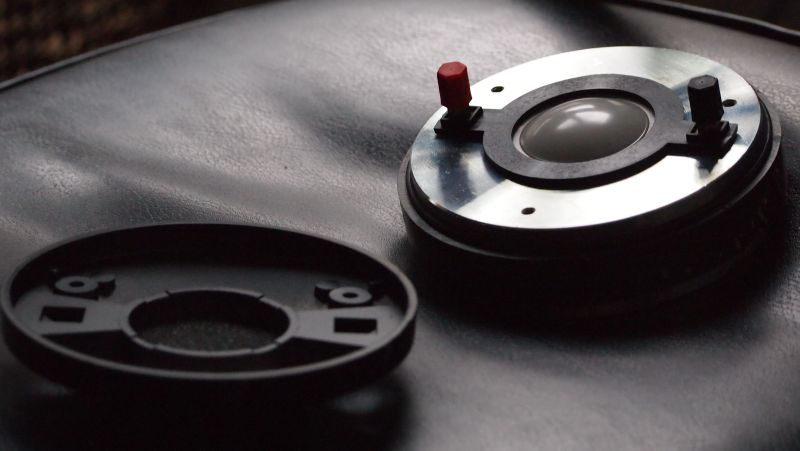
Tom, it took a few hours of number crunching, but I came up with the following specs:
Sd = 14.66 (note this isn't 22cm - I can post why that is if anyone's curious)
Cms = 1.80e-05
mmd = 3.08gm
Re = 6.3ohm
Bl = 18.00
Rms = 1.0
Le = 0.11
Fs = 672hz
Qes = 0.26
Qms = 13.15
Vas = 0.01
Qts = 0.25
These numbers are based on a combination of what Earl and John published, plus a bit of number crunching on my end. In particular, I think the mmd numbers that people have been using are too low.
The higher mmd extends the response a few dB on the low end, and costs a few dB at the top end. This seems to be consistent with the B&C's performance, which is excellent at the bottom of it's bandwidth but running out of steam above 16khz, due to mylar's low density when compared to aluminum and beryllium.
More data here: Audio Psychosis • View topic - Simulating a B&C DE25
- Status
- Not open for further replies.
- Home
- Loudspeakers
- Multi-Way
- Modelling compression drivers