
virtual sound imaging
Has anyone else seen this,
[/url]Patent Searching Database/result.html?query_txt=7760895&sort=relevance&srch=top&search=
This is a method for creating a virtual source of the sound of the tweeter by reflecting some of the sound of the tweeter off of a concave reflector towards the listener. The idea is to make it seem like the plane of reproduction is apparently some distance behind the location of a pair of stereo speakers and disassociated from the speakers.
Do you think that this has merit? Any other comments about it?
Regards,
Pete
Has anyone else seen this,
[/url]Patent Searching Database/result.html?query_txt=7760895&sort=relevance&srch=top&search=
This is a method for creating a virtual source of the sound of the tweeter by reflecting some of the sound of the tweeter off of a concave reflector towards the listener. The idea is to make it seem like the plane of reproduction is apparently some distance behind the location of a pair of stereo speakers and disassociated from the speakers.
Do you think that this has merit? Any other comments about it?
Regards,
Pete
virtual sound imaging reprise
Now that I have the attention of all of you? The saying goes that a picture is worth a thousand words.
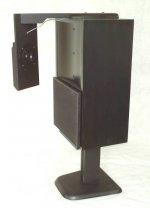
Attached is a photo of the right channel speaker system of a pair that I built according to the principles of the patent (see the above post). This is a closed-box two way system where the box measures 12.5" wide by 8.5" deep by 20.5" high. It could be smaller by maybe a third, but it needs to be somewhat on the larger side to accomplish the special imaging.
As you will see in the photo, the tweeter on its own little baffle is extended out in front of the system's cabinet and partially facing a concave reflector at the upper front of the cabinet. Admittedly the speaker has a sort of ungraceful appearance, but I've seen worse.
The imaging is great IMO.
Now that I have the attention of all of you? The saying goes that a picture is worth a thousand words.
Attached is a photo of the right channel speaker system of a pair that I built according to the principles of the patent (see the above post). This is a closed-box two way system where the box measures 12.5" wide by 8.5" deep by 20.5" high. It could be smaller by maybe a third, but it needs to be somewhat on the larger side to accomplish the special imaging.
As you will see in the photo, the tweeter on its own little baffle is extended out in front of the system's cabinet and partially facing a concave reflector at the upper front of the cabinet. Admittedly the speaker has a sort of ungraceful appearance, but I've seen worse.
The imaging is great IMO.
Attachments

Roam treatments. Period. Nothing you do to the speakers will do a thing until you get the room correct. The first time you hear an off-stage sound precisely OUTSIDE the room dimensions, your jaw will drop.
Tricks with reflection (Bose), phase tricks ( Polk) and many others are barely past parlor tricks. They work OK in a parlor I guess. Not in my listening room.
Tricks with reflection (Bose), phase tricks ( Polk) and many others are barely past parlor tricks. They work OK in a parlor I guess. Not in my listening room.

Room treatments. Period. Nothing you do to the speakers will do a thing until you get the room correct. The first time you hear an off-stage sound precisely OUTSIDE the room dimensions, your jaw will drop.
The last happens in my room all the time. No explicit treatments. The room is designed for a hifi thou.
dave

The last happens in my room all the time. No explicit treatments. The room is designed for a hifi thou.
dave
You've probably posted it before, but do you have any links to what went into the construction of your room?
Roam treatments. Period. Nothing you do to the speakers will do a thing until you get the room correct. The first time you hear an off-stage sound precisely OUTSIDE the room dimensions, your jaw will drop.
Tricks with reflection (Bose), phase tricks ( Polk) and many others are barely past parlor tricks. They work OK in a parlor I guess. Not in my listening room.
In that case I would think that you would want to ban stereo reproduction from your listening room too. Stereo depends on the creation of phantom localization of sound. Isn't phantom sound also "barely past" a parlor room trick?

Heaven forbid surround sound!

In my setup I havent ever heard images beyond the walls, perhaps the back wall, but not the side walls. I do hear images outside of the speaker up to the left and right wall boundaries.
In my experience, in untreated rooms, I rarely if ever have heard images extending beyond the cabinets (right of the right speaker and left of the left speaker) on the horizontal plane. I have heard truly wonderful sounding systems in untreated rooms, but the images were mostly localized to between the speakers.
I am not going to get into arguing peoples claims. If someone says they hear clear distinct images beyond the walls in a untreated room, who am I to dispute the claim? All I can say is, in my room, that would be impossible.
In my experience, in untreated rooms, I rarely if ever have heard images extending beyond the cabinets (right of the right speaker and left of the left speaker) on the horizontal plane. I have heard truly wonderful sounding systems in untreated rooms, but the images were mostly localized to between the speakers.
I am not going to get into arguing peoples claims. If someone says they hear clear distinct images beyond the walls in a untreated room, who am I to dispute the claim? All I can say is, in my room, that would be impossible.
All I can say is, in my room, that would be impossible.
perhaps with whatever speakers you're using....
- Status
- This old topic is closed. If you want to reopen this topic, contact a moderator using the "Report Post" button.
- Home
- Loudspeakers
- Multi-Way
- How do you get good imaging?