
Beside that Big OB plan which got zero insterest, I'm thinking of building a bass module with cardioid characteristic into that system instead of dipole.
My main thinking is to get better directivity control, reduce reflections and room modes, and higher output.
Here are some thoughts:
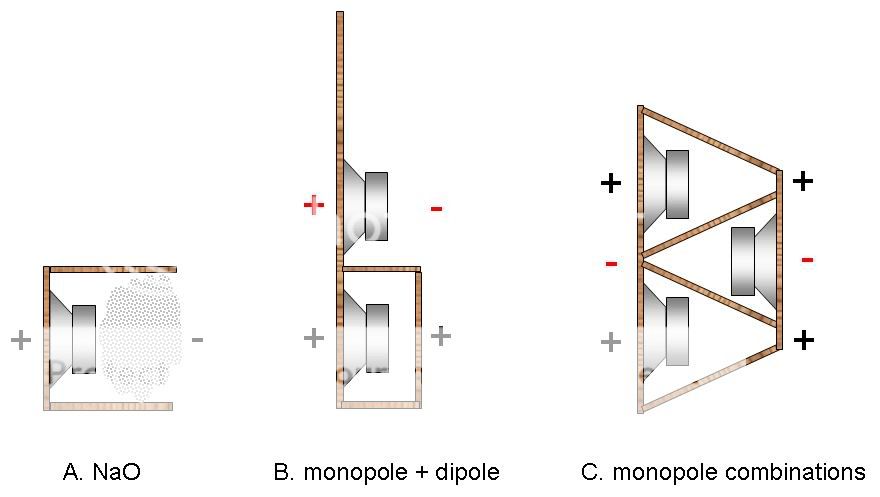
A is well-known NaO which is a semi open back U frame.
B is a combination of monopole and dipole. There'd be cancellation on the back.
C is stolen from here: http://www.duran-audio.com/pdfs/downloads/brochures/AXYS_Target_brochure.pdf
(In the middle of page 3, you may see a cardioid configuration.)
At the first glance, C seems to be a waste of drivers because 2 of them work in a way almost identical to 1 in dipole configuration.
The AXYS system emphansizes DSP. Does this do anything good to that "waste" mentioned above?
Any thoughts and suggestions? 🙂
My main thinking is to get better directivity control, reduce reflections and room modes, and higher output.
Here are some thoughts:
A is well-known NaO which is a semi open back U frame.
B is a combination of monopole and dipole. There'd be cancellation on the back.
C is stolen from here: http://www.duran-audio.com/pdfs/downloads/brochures/AXYS_Target_brochure.pdf
(In the middle of page 3, you may see a cardioid configuration.)
At the first glance, C seems to be a waste of drivers because 2 of them work in a way almost identical to 1 in dipole configuration.
The AXYS system emphansizes DSP. Does this do anything good to that "waste" mentioned above?
Any thoughts and suggestions? 🙂
Have a look at this:
http://kotisivu.dnainternet.net/anukaa/CardSub/CARDSUB.html
It's Finnish, but one can have a look at the concepts and the response graphs.
http://kotisivu.dnainternet.net/anukaa/CardSub/CARDSUB.html
It's Finnish, but one can have a look at the concepts and the response graphs.

In a small room, i.e. not an auditorium, there is very little to be gained from a directional bass source. SO basically all of the configurations that you showed are simply ways to expend more money with no net gain.
In a large venue there is some reason for directional bass, but the configurations that you show above would not work very well. 1) is not going to work because the delay of the front from the rear is not great enough to do anything - it will be a dipole. 2) will have trouble because the outputs of the two sources won't track each other (monpole versus dipole) and so without some complex EQ this won't work very well. 3) may work to some extent, but again probably not very well without some signal processing.
The best is a forward facing driver or two and a rear facing one like 3) above, but with some signal processing control on the rear facing driver. This can be made to work quite well and has been sold by JBL in the past.
In a large venue there is some reason for directional bass, but the configurations that you show above would not work very well. 1) is not going to work because the delay of the front from the rear is not great enough to do anything - it will be a dipole. 2) will have trouble because the outputs of the two sources won't track each other (monpole versus dipole) and so without some complex EQ this won't work very well. 3) may work to some extent, but again probably not very well without some signal processing.
The best is a forward facing driver or two and a rear facing one like 3) above, but with some signal processing control on the rear facing driver. This can be made to work quite well and has been sold by JBL in the past.
The benefits of cardioid or quasi-cardioid response in a listening room have been addressed by Backman, (AES paper 5867, 2003). Cardioid bass and monopole bass both are capable of taking advantage of room pressurization below the room fundamental where as a dipole woofer does not. Whether you view that as a positive or negative depends on what you are trying to accomplish. However, all dipole and cardioid sources have fundamentally a 1st order gradient response with reduction in efficiency of 6dB/octave, compared to a monopole, as the frequency drops and must be equalized for flat response. Again, whether this requirement is viewed as a draw back depends on how it is weighted against the other design factors.
The conventional way to produce a cardioid response is through two monopole sources separated by some distance, d, operating out of phase with the input of one source delayed by Td = d/c where c is the speed of sound. This delay can be introduced through any means available over the frequency range required. A digital delay can be used for a pure time delay. A suitable analog all pass delay can also be used but yields a constant delay of a limited frequency range.
Rather than using two separate monopole sources, which add to expense, a single source mounted in an open backed enclosure can be used. In such a case, without going in to detail, the cavity of the rear enclosure must be damped. This helps damp the cavity resonance and also forms an acoustic low pass filter. The damping must be "tuned" so that the combined effects of resonance damping and low pass filtering yield the correct delay relative to the front to back length of the cavity. If the length is again d, then the damping must be adjusted so that the cavity delay at the rear exit plane is Td = d/c. When correctly tuned the opened backed system, AKA an acoustic resistance box (Holmes, AES, 1986), will tend to a cardioid at low frequency. Only when undamped it will tend to a dipole. The damped cavity is the NaO woofer as shown in A. Figures B and C are similar to each other in operation. In both cases they result in a dipole summed to a monopole. In both cases the dipole (consisting of one front driver and the rear driver in figure C) must be equalized to have the same on axis response as the monopole driver. Additionally, to form a cardioid the acoustic centers of the monopole and dipole components must be correctly aligned. Further more, since the sensitivity of the dipole and monopole as well as the on axis response must be matched, it is likely that the dipole and monopole components of configurations B and C will require separate amplifiers.
While it is possible to obtain a cardioid response over a wider frequency range with configurations B and C (since there is no cavity resonance) the additional cost of the added drivers makes them less attractive than configuration A. If additional drivers are to be used it would be better to use them as in A to increase the SPL capability of the system.
The conventional way to produce a cardioid response is through two monopole sources separated by some distance, d, operating out of phase with the input of one source delayed by Td = d/c where c is the speed of sound. This delay can be introduced through any means available over the frequency range required. A digital delay can be used for a pure time delay. A suitable analog all pass delay can also be used but yields a constant delay of a limited frequency range.
Rather than using two separate monopole sources, which add to expense, a single source mounted in an open backed enclosure can be used. In such a case, without going in to detail, the cavity of the rear enclosure must be damped. This helps damp the cavity resonance and also forms an acoustic low pass filter. The damping must be "tuned" so that the combined effects of resonance damping and low pass filtering yield the correct delay relative to the front to back length of the cavity. If the length is again d, then the damping must be adjusted so that the cavity delay at the rear exit plane is Td = d/c. When correctly tuned the opened backed system, AKA an acoustic resistance box (Holmes, AES, 1986), will tend to a cardioid at low frequency. Only when undamped it will tend to a dipole. The damped cavity is the NaO woofer as shown in A. Figures B and C are similar to each other in operation. In both cases they result in a dipole summed to a monopole. In both cases the dipole (consisting of one front driver and the rear driver in figure C) must be equalized to have the same on axis response as the monopole driver. Additionally, to form a cardioid the acoustic centers of the monopole and dipole components must be correctly aligned. Further more, since the sensitivity of the dipole and monopole as well as the on axis response must be matched, it is likely that the dipole and monopole components of configurations B and C will require separate amplifiers.
While it is possible to obtain a cardioid response over a wider frequency range with configurations B and C (since there is no cavity resonance) the additional cost of the added drivers makes them less attractive than configuration A. If additional drivers are to be used it would be better to use them as in A to increase the SPL capability of the system.
Thanks a lot for all your replies🙂 All are helpful.
First of all, I'd like to say actually I've heard different kinds of good basses, i.e., sealed, vented, horn, OB(dipole).... etc. So I do believe many solutions can lead to excellent sound quality.
Among all these, I myself once experienced huge booms by the corner BR cabs, I needed very deep notches to smooth things out:
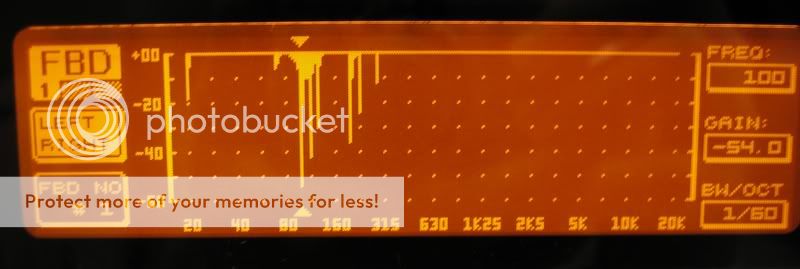
Without these deep notches, the upper bass booms were just too much to take. Here's the picture of the system:
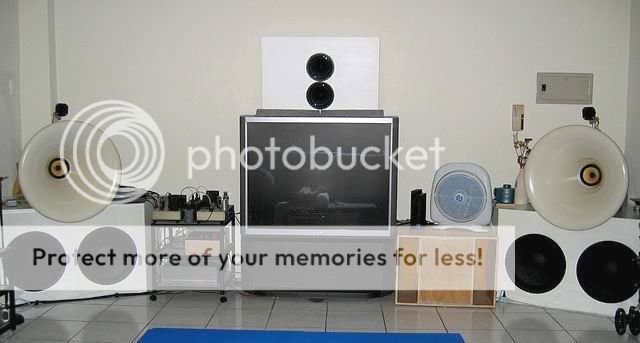
The bass cabs were fixed into the corners.
Later, I moved to another apartment with a much smaller living room. I thought to myself, this space is not gonna take it. So I built dipole bass this time.
And this is the notch setting for the OB bass:
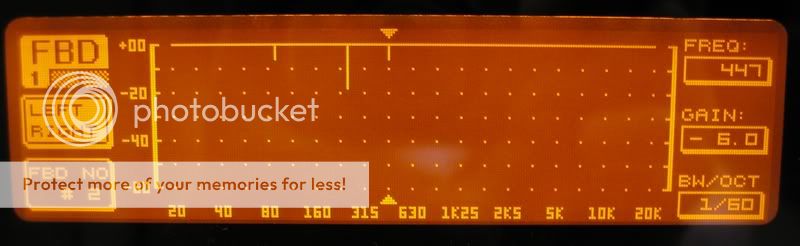
The big OB still overloads the relative small room, but much smoother and much less boomy overall.
-----------------
gedlee, I've learned a lot from your kind posts. I should say thank you for that. I've also read somewhere else that you don't think dipole bass is a good idea. However this conflicts my own experiences.
Beside the example above, I've also heard other good dipole basses. So, maybe these are not all that scientific and come with so many variables, but they still impressed me by their clear and smooth sound.
These experiences give me the motivations to build another dipole speakers....
------------------
Now this system (bass module) is not going to be home use. The target space is about 7~8m wide x 25m deep with very high ceiling, up to about 15~20 seats. And high sound quality is the main goal.
I got more confidence with dipole bass in reagard of the sound quality, but also worry it may not have enough energy to fill the bigger than average room. So, cardioid comes to mind.
Now it seems cardioid response is not easy to get right 🙁 The complexity seem unavoidable in the settings and integrations.
Anyway, I'll give it a try and see how it works. Will update for progress in the future.
Meantime, any comments and suggestions are welcome🙂
First of all, I'd like to say actually I've heard different kinds of good basses, i.e., sealed, vented, horn, OB(dipole).... etc. So I do believe many solutions can lead to excellent sound quality.
Among all these, I myself once experienced huge booms by the corner BR cabs, I needed very deep notches to smooth things out:
Without these deep notches, the upper bass booms were just too much to take. Here's the picture of the system:
The bass cabs were fixed into the corners.
Later, I moved to another apartment with a much smaller living room. I thought to myself, this space is not gonna take it. So I built dipole bass this time.
And this is the notch setting for the OB bass:
The big OB still overloads the relative small room, but much smoother and much less boomy overall.
-----------------
gedlee, I've learned a lot from your kind posts. I should say thank you for that. I've also read somewhere else that you don't think dipole bass is a good idea. However this conflicts my own experiences.
Beside the example above, I've also heard other good dipole basses. So, maybe these are not all that scientific and come with so many variables, but they still impressed me by their clear and smooth sound.
These experiences give me the motivations to build another dipole speakers....
------------------
Now this system (bass module) is not going to be home use. The target space is about 7~8m wide x 25m deep with very high ceiling, up to about 15~20 seats. And high sound quality is the main goal.
I got more confidence with dipole bass in reagard of the sound quality, but also worry it may not have enough energy to fill the bigger than average room. So, cardioid comes to mind.
Now it seems cardioid response is not easy to get right 🙁 The complexity seem unavoidable in the settings and integrations.
Anyway, I'll give it a try and see how it works. Will update for progress in the future.
Meantime, any comments and suggestions are welcome🙂

gedlee said:In a small room, i.e. not an auditorium, there is very little to be gained from a directional bass source. SO basically all of the configurations that you showed are simply ways to expend more money with no net gain.
This statement made me laugh so hard I almost died.
But I am here. Still
😉

This exactly the way MEG does it in their reference monitor series (with the suffix K for "Kardioid"). MEG was the then supplier of broadcast and studio monitors in the former GDR. Their speakers have a very good reputation and are known for precise and almost fullrange even directivity and contantly also gain a following among HiFi-Enthusiasts now. All systems are "almost" coax. Interesting detail is that the mid driver is also acoustically laid out as a cardioid in order to make the coax work properly, wrt directivity.john k... said:Rather than using two separate monopole sources, which add to expense, a single source mounted in an open backed enclosure can be used. In such a case, without going in to detail, the cavity of the rear enclosure must be damped. This helps damp the cavity resonance and also forms an acoustic low pass filter. The damping must be "tuned" so that the combined effects of resonance damping and low pass filtering yield the correct delay relative to the front to back length of the cavity. If the length is again d, then the damping must be adjusted so that the cavity delay at the rear exit plane is Td = d/c. When correctly tuned the opened backed system, AKA an acoustic resistance box (Holmes, AES, 1986), will tend to a cardioid at low frequency.
http://www.me-geithain.de
http://www.me-geithain.de/presse/ppeng/presseppeng.html
Klaus
"However this conflicts my own experiences."
🙂
I've been reading a few posts where people are saying that monopole bass/dipole mids is the way to do it, but my experience is telling me that it's the other way around. I'm never gonna make it as an audiophile. 😀
🙂
I've been reading a few posts where people are saying that monopole bass/dipole mids is the way to do it, but my experience is telling me that it's the other way around. I'm never gonna make it as an audiophile. 😀
CLS, I think your ideas are fine. For DIY I think it would be especially useful to have adjustable directivity within a certain range, this would be doable in the "overkill" approaches B & C. In the end this means reversing the standard first order microphone equations and their consequences. As there are :
- cardioid (0.5 + 0.5 cos x): maximum backwards axis attenuation
- supercardioid (0.366 + 0.634 cos x) : minimum total output into the back hemisphere
- hypercardioid (0.25 + 0.75 cos x) : maximum directivity index (4.0), minimum total output off axis, quite perfect full cancellation angles (+-109deg)
Those conditions are for far distance, free field of course, what really happens in a specific room surely will have to be found experimentally
My personal "best of" bass experience is btw close-field dipole, completely sans baffle, free floating suspended 18" drivers, properly equalized to close-field conditions. Also it is best for the neighbours as does not exite the room very much (which some people seem to like, wanting the bass to very "physically" present, shaking doors, tables, cupboards etc.)
- Klaus
- cardioid (0.5 + 0.5 cos x): maximum backwards axis attenuation
- supercardioid (0.366 + 0.634 cos x) : minimum total output into the back hemisphere
- hypercardioid (0.25 + 0.75 cos x) : maximum directivity index (4.0), minimum total output off axis, quite perfect full cancellation angles (+-109deg)
Those conditions are for far distance, free field of course, what really happens in a specific room surely will have to be found experimentally
My personal "best of" bass experience is btw close-field dipole, completely sans baffle, free floating suspended 18" drivers, properly equalized to close-field conditions. Also it is best for the neighbours as does not exite the room very much (which some people seem to like, wanting the bass to very "physically" present, shaking doors, tables, cupboards etc.)
- Klaus
AJ said:"However this conflicts my own experiences."
🙂
I've been reading a few posts where people are saying that monopole bass/dipole mids is the way to do it, but my experience is telling me that it's the other way around. I'm never gonna make it as an audiophile. 😀
It depends on what your goals are. Cardioid bass is the least sensitive to room/listener placement. But form a uniformity of total radiated power it can be argued tha dipole mids with monopole bass is the more desirable way to go.
Discussion here: http://www.musicanddesign.com/PowerMatching.html
Some comparitive measurements of monopole (yellow), dipole (red), and cardioid (white) woofers in my listening room with the mic at my listening position are shown here:
An externally hosted image should be here but it was not working when we last tested it.
Below 100 Hz the cardioid has the smoothest response. Below 25 Hz the dipole shows the lack of room pressurization

I tried U-Frame, H-Frame, Boxed etc. and still the most natural-sounding result is plain OB. Obviously the tradeoff is bass SPL but easily rectified using active equalisation.
john k... said:
Some comparitive measurements of monopole (yellow), dipole (red), and cardioid (white) woofers in my listening room with the mic at my listening position are shown here:
Below 100 Hz the cardioid has the smoothest response. Below 25 Hz the dipole shows the lack of room pressurization
John
Its good to see some actual data. I would concur with your measurements as typical of what I have found, except for several details which you do not mention.
This is statistically only a single sample and would differ quite significantly with different source locations and seating locations as well as the room itself.
The room dominates the situation, not the source type.
Given these facts, the best approach, regardless of source type, is the use of multiple subs at differing locations. Thus, I would claim that two monpole sources at two diifferent locations would yield a better statistical average response than using those two sources in a cardiod pattern.
In my AES paper on LF response in rooms, a cardiod was also one of the sources. It worked just about the same as the monopole. The dipole, as you noted, mostly just rolled off the LF response, but did not yield any smoother response.
The issue of LF response in small rooms is one of number of sources and locations far more than any of this talk about mono versus dipole or cardiod. Room damping is also a big factor but thats a seperate topic.
KSTR said:...
In the end this means reversing the standard first order microphone equations and their consequences. As there are :
- cardioid (0.5 + 0.5 cos x): maximum backwards axis attenuation
- supercardioid (0.366 + 0.634 cos x) : minimum total output into the back hemisphere
- hypercardioid (0.25 + 0.75 cos x) : maximum directivity index (4.0), minimum total output off axis, quite perfect full cancellation angles (+-109deg)
Those conditions are for far distance, free field of course, what really happens in a specific room surely will have to be found experimentally
...
Thanks a lot for the info, but here I can not follow 😱
Would you please explan a little more? 🙂
And back to my "primitive" plans, according to the responses above, the main problem seems to be the accuracy of phase (delay) in the back? (to form an efficiently cancellation)
So, I'm thinking of making the plan "B" a very shallow and wide shape, to minimize the difference of path lengths. I guess this might help. 😀
Those mic equations describe the summing needed from a monopole and a dipole, and give a polar plot. In mic lingo, monopole=omnidirectional, dipole=figure-of-eight or bidirectional.
The "cos x" term is the polar equation for the dipole and gives the figure-of-eight pattern with the two opposite polarity lobes, while that for a monopole is just 1, unity (same output in any direction).
Take eg the cardioid. We nead equal amounts of monopole and dipole action, thus 0.5 + 0.5*cos x.
An overview is here:
http://www.tonmeister.ca/main/textbook/node463.html
This all assumes that monopole and dipole have equal amplitude and phase response and that is where the problem might appear, to get exactly that (that's what Earl meant with saying "some complex EQ will be needed").
This is all (a bit too) theoretical, no much need to dig in there too deep, as in real room the theory doesn't work that well -- as usual.
I'd just build the thing (I'd prefer variation C) and play with the rear delay and level, monitoring the response curve at the listening pos. until it has the lowest ripple, ingoring any overall trend slopes at first. And then equalize it flat. I would use a PC with a muti-channel output soundcard to do all the tweaking and from that I'd probably try to use or make a hardware solution for the eq/delay/xover.
Nice horns, btw, are those ORIS? I heard them once, with AER's, somewhat typical "Horn sound" but quite involving type of character.
- Klaus
The "cos x" term is the polar equation for the dipole and gives the figure-of-eight pattern with the two opposite polarity lobes, while that for a monopole is just 1, unity (same output in any direction).
Take eg the cardioid. We nead equal amounts of monopole and dipole action, thus 0.5 + 0.5*cos x.
An overview is here:
http://www.tonmeister.ca/main/textbook/node463.html
This all assumes that monopole and dipole have equal amplitude and phase response and that is where the problem might appear, to get exactly that (that's what Earl meant with saying "some complex EQ will be needed").
This is all (a bit too) theoretical, no much need to dig in there too deep, as in real room the theory doesn't work that well -- as usual.
I'd just build the thing (I'd prefer variation C) and play with the rear delay and level, monitoring the response curve at the listening pos. until it has the lowest ripple, ingoring any overall trend slopes at first. And then equalize it flat. I would use a PC with a muti-channel output soundcard to do all the tweaking and from that I'd probably try to use or make a hardware solution for the eq/delay/xover.
Nice horns, btw, are those ORIS? I heard them once, with AER's, somewhat typical "Horn sound" but quite involving type of character.
- Klaus
Count me in the multiple monopole club as well. I took some measurements today to show why 🙂. In my listening room, I've got one main couch with 3 seets as the listening positions. I use TrueRTA (easy) in 1/24th octave mode with pink noise, spatially average over 5 measurements in each listening position corresponding roughly to the two shoulders, the chin, the top of the head, and about six inches above the knees of a listener, and then 1/6th octave smooth that average. I believe this gives a good picture of what is going on. The graphs below show the left and right channels summed with the subs, 4 ported 18s located around the room (after some guessing and a bit of trial and error). Note they are 20-200 Hz and the vertical scale is 40 dB. There is 1 band of parametric EQ applied and the subs are mated to the midbasses at 80 Hz.
Listening position 1:
Listening position 1:
Attachments


Thanks🙂
In variant C, I might try building them into 3 indepent boxes for easier transport.
A further question is, if these are bass reflection cabs, the outputs of the ports would mess things up, wouldn't they?
I'm thinking of the the tunings and the actual outputs of ports might differ somewhat. Or I can ignore this influence?
In variant C, I might try building them into 3 indepent boxes for easier transport.
A further question is, if these are bass reflection cabs, the outputs of the ports would mess things up, wouldn't they?
I'm thinking of the the tunings and the actual outputs of ports might differ somewhat. Or I can ignore this influence?
Thanks for the info, Rybaudio.
🙂
However the measuring range seems too narrow for my application🙁 I'll need constant response over a wider range than a couch, say, maybe 10 seats, or simply walking around within a few steps.
🙂
Rybaudio said:....
spatially average over 5 measurements in each listening position corresponding roughly to the two shoulders, the chin, the top of the head, and about six inches above the knees of a listener, and then 1/6th octave smooth that average. ....
However the measuring range seems too narrow for my application🙁 I'll need constant response over a wider range than a couch, say, maybe 10 seats, or simply walking around within a few steps.
- Status
- Not open for further replies.
- Home
- Loudspeakers
- Multi-Way
- Cardioid Bass