
I've got a problem with the XO in one of the speakers I'm building (Magna Cum Laude's, design at Parts Express).
The Problem: When I turn the volume up on the amplifier (or on my computer), the amp's overcurrent protection kicks in and shuts it down.
This is the second speaker in the stereo pair. The first one seems to work just fine, so I'm pretty sure that there was an error in building the XO, or I have a bad component.
Tests done:
Ran test tones at max volume to determine which portion of the XO it was. A 50Hz tone reliably tripped the overcurrent protection. Suspect problem in bass unit.
Compared sound side by side with first speaker. Bass is significantly attenuated in second speaker. This may be a result of a different box stuffing material though.
Where I get lost:
If it were a simple short (two wires touching), the overcurrent would trip at a much lower volume level (I have to turn it up decently far to trip it). This would account for weaker bass though.
This is a dual woofer design, each woofer with Dual voice coils. Inadvertently wiring them to give a lower than 8 ohm load would trip the OC, but theoretically the bass would be much louder.
I don't have a good multimeter, so I'm not exactly sure as to how to test for bad components.
Any advice would be much appreciated! Thanks!
The Problem: When I turn the volume up on the amplifier (or on my computer), the amp's overcurrent protection kicks in and shuts it down.
This is the second speaker in the stereo pair. The first one seems to work just fine, so I'm pretty sure that there was an error in building the XO, or I have a bad component.
Tests done:
Ran test tones at max volume to determine which portion of the XO it was. A 50Hz tone reliably tripped the overcurrent protection. Suspect problem in bass unit.
Compared sound side by side with first speaker. Bass is significantly attenuated in second speaker. This may be a result of a different box stuffing material though.
Where I get lost:
If it were a simple short (two wires touching), the overcurrent would trip at a much lower volume level (I have to turn it up decently far to trip it). This would account for weaker bass though.
This is a dual woofer design, each woofer with Dual voice coils. Inadvertently wiring them to give a lower than 8 ohm load would trip the OC, but theoretically the bass would be much louder.
I don't have a good multimeter, so I'm not exactly sure as to how to test for bad components.
Any advice would be much appreciated! Thanks!

Don't know if you've checked these or not, but . . .
Did you check the crossover to see if everything was connected according to the plan?
Also, sometimes a weakly soldered connection can look together, but might come loose if wiggled.
Compare the crossover of the questionable one with the one that operates correctly.
Hope this helps.
Dave R
Did you check the crossover to see if everything was connected according to the plan?
Also, sometimes a weakly soldered connection can look together, but might come loose if wiggled.
Compare the crossover of the questionable one with the one that operates correctly.
Hope this helps.
Dave R
When I looked at it last, it looked the same as the schematic. I'll open it up again when the thing is upright (I assembled it horizontal and flipped it upright) to see if something is loose then.
Are there any characteristics to component failures?
I'll post back with the results of taking the thing apart in a little.
Are there any characteristics to component failures?
I'll post back with the results of taking the thing apart in a little.
*update*
XO wiring had one error (I think). The capacitor in the woofer section was wired incorrectly. Fixed this, but still no change in the OC shut down problem.
New Test: Took wires directly out of amp, and wired them after XO (i.e. XO still attached, but amp signal bypassed directly to woofers). OC shut down still occurs.
Woofers are dual 8 ohm voice coils. The voice coils on each woofer are wired in series, and the woofers are wired in parallel.
XO wiring had one error (I think). The capacitor in the woofer section was wired incorrectly. Fixed this, but still no change in the OC shut down problem.
New Test: Took wires directly out of amp, and wired them after XO (i.e. XO still attached, but amp signal bypassed directly to woofers). OC shut down still occurs.
Woofers are dual 8 ohm voice coils. The voice coils on each woofer are wired in series, and the woofers are wired in parallel.
Minimize the number of possible problems.
1. Swap speakers, does the problem follow the xover/speaker or follow the channel? Next swap speaker cables, this confirms amplifier and or speaker cable is not the problem.
Now power down and disconnect speakers from amp.
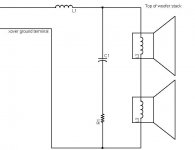
2. Use Ohm-meter measure across woofers, from xover ground terminal to top of woofer stack, compare to other speaker. Also measure DC Ohms across xover input (disconnect mid/tweet for this measurement), again compare to good speaker.
3. If design has one, measure zobel network. Measure to verify that you don't have a bad capacitor. Again compare to good channel.
If this doesn't help, please post design or a link to where design can be found.
1. Swap speakers, does the problem follow the xover/speaker or follow the channel? Next swap speaker cables, this confirms amplifier and or speaker cable is not the problem.
Now power down and disconnect speakers from amp.
2. Use Ohm-meter measure across woofers, from xover ground terminal to top of woofer stack, compare to other speaker. Also measure DC Ohms across xover input (disconnect mid/tweet for this measurement), again compare to good speaker.
3. If design has one, measure zobel network. Measure to verify that you don't have a bad capacitor. Again compare to good channel.
If this doesn't help, please post design or a link to where design can be found.
I swapped speakers (switched L/R), but kept the same cables on each channel. The problem still occured. I unplugged the non-working speaker (meaning that the working speaker is now plugged into the non-working speaker's channel, and is using the non-working speaker's cable) and this resolved the problem.
Sorry, but I don't quite understand what "xover ground terminal to top of woofer stack" means...could you elaborate for me? What part of the woofer XO/driver system is the top?
There isn't a zobel network, but I'll try and check the capacitor in the XO.
Here is the link to the XO design:
http://www.partsexpress.com/projectshowcase/magna/crossover.html
Thanks for the help!
Sorry, but I don't quite understand what "xover ground terminal to top of woofer stack" means...could you elaborate for me? What part of the woofer XO/driver system is the top?
There isn't a zobel network, but I'll try and check the capacitor in the XO.
Here is the link to the XO design:
http://www.partsexpress.com/projectshowcase/magna/crossover.html
Thanks for the help!
I made a small sketch to illustrate the nodes I used in my post.
The basic idea is to isolate the various parts and thereby find the problem. The first pass is crude with few parts isolated, if this doesn't work, more and more parts must be disconnected until the culprit is found.
Please verify very carefully the connections to the dual winding on each woofer, I am guessing that this or maybe a shorted capacitor is your best bet.
The basic idea is to isolate the various parts and thereby find the problem. The first pass is crude with few parts isolated, if this doesn't work, more and more parts must be disconnected until the culprit is found.
Please verify very carefully the connections to the dual winding on each woofer, I am guessing that this or maybe a shorted capacitor is your best bet.
Attachments
It may also be possible that voice coils of one woofer is wrongly marked
Disconnect the woofers and use a battery to determine the right phase on each of the windings individually...when cone moves outwards you have + where its connected to battery +
Are you absolutely sure that both left/right xo are mounted absolutely indentical...a messy layout can be very difficult...and faulty
I suppose that a shorted cap could be the reason, but I have never had that doubtfull pleasure
Disconnect the woofers and use a battery to determine the right phase on each of the windings individually...when cone moves outwards you have + where its connected to battery +
Are you absolutely sure that both left/right xo are mounted absolutely indentical...a messy layout can be very difficult...and faulty
I suppose that a shorted cap could be the reason, but I have never had that doubtfull pleasure
I'm heading back to college today, so I won't be able to do these tests for a while  . Last night I ran a 1hz test tone through the system (for kicks and giggles), and If I remember correctly, both woofer cones moved together, so would that be the same thing as the battery test?
The cap wasn't clamped, it was just sorta hanging out next to the inductor.
I've triple checked the wiring on the bass unit, and it all looks fine. I could be misunderstanding something in the schematic however. I'll try rewiring it from scratch to see if that helps.
Could one of the other XO's be shorting out? How would I tell?
. Last night I ran a 1hz test tone through the system (for kicks and giggles), and If I remember correctly, both woofer cones moved together, so would that be the same thing as the battery test?The cap wasn't clamped, it was just sorta hanging out next to the inductor.
I've triple checked the wiring on the bass unit, and it all looks fine. I could be misunderstanding something in the schematic however. I'll try rewiring it from scratch to see if that helps.
Could one of the other XO's be shorting out? How would I tell?
- Status
- This old topic is closed. If you want to reopen this topic, contact a moderator using the "Report Post" button.
- Home
- Loudspeakers
- Multi-Way
- XO help plz!