

If I understand correctly, aperiodic alignments are effectively ‘between’ sealed and vented, sounding more like sealed(?).
Is the bass rolloff generally more like sealed or vented, and f3? - -
Would get close using a sealed model (eg in Unibox) are there Qtc values that approximate to ~ hole sizes relative to box volume?
Or is this planet 10 proprietary? 😉
Thanks
Is the bass rolloff generally more like sealed or vented, and f3? - -
Would get close using a sealed model (eg in Unibox) are there Qtc values that approximate to ~ hole sizes relative to box volume?
Or is this planet 10 proprietary? 😉
Thanks
Dickason plots aperiodic as a sealed box with a single impedance peak, and implies the sole benefit vs sealed is a flattening of the impedance curve, but seems to know little about them . .
Dave,
I’m deciding how to use my just arrived Fostex 85Ken’s. 🙂
I could simply do your design, but that would remove the most interesting part of a project to me, the design.
I modelled the 85Ken’s actual TS in sealed and vented. One of my vented sims is close to your posted Fonken aperiodic sim; though your sim table mentioned both 4th order . . and a closed box Qtc (at 0.58 is a little lower my driver’s 0.61).
Is the main attraction ease of tunability? If tunability is part of the deal, it’d be great to understand the basis for selecting hole sizes 😉
I’m also getting intrigued with what can aperiodics can do for other projects, eg CSS 125’s . . but I don’t want to copy a design, at the very least unless I understand its benefits & trade-offs.
Dave,
I’m deciding how to use my just arrived Fostex 85Ken’s. 🙂
I could simply do your design, but that would remove the most interesting part of a project to me, the design.
I modelled the 85Ken’s actual TS in sealed and vented. One of my vented sims is close to your posted Fonken aperiodic sim; though your sim table mentioned both 4th order . . and a closed box Qtc (at 0.58 is a little lower my driver’s 0.61).
Is the main attraction ease of tunability? If tunability is part of the deal, it’d be great to understand the basis for selecting hole sizes 😉
I’m also getting intrigued with what can aperiodics can do for other projects, eg CSS 125’s . . but I don’t want to copy a design, at the very least unless I understand its benefits & trade-offs.

Greets!
Aperiodic is defined as without period, i.e. NO impedance peak, so the roll off slope will depend on the driver, ergo enough stuffing to accomplish this tends to 'suck the life' out of ~full-range' drivers, being best suited for controlling under-damped alignments. Consequently most 'aperiodic' alignments are only semi-aperiodic, i.e. just enough to damp any objectionable 'ringing'.
MJK's will sim it up to the point where > 1.0 lb/ft^3 is required. After that, you'll have to stuff/measure the impedance if you want it truly aperiodic with the understanding that at some point any more stuffing will actually reduce damping.
GM
Aperiodic is defined as without period, i.e. NO impedance peak, so the roll off slope will depend on the driver, ergo enough stuffing to accomplish this tends to 'suck the life' out of ~full-range' drivers, being best suited for controlling under-damped alignments. Consequently most 'aperiodic' alignments are only semi-aperiodic, i.e. just enough to damp any objectionable 'ringing'.
MJK's will sim it up to the point where > 1.0 lb/ft^3 is required. After that, you'll have to stuff/measure the impedance if you want it truly aperiodic with the understanding that at some point any more stuffing will actually reduce damping.
GM
otto88 said:If I understand correctly, aperiodic alignments are effectively ‘between’ sealed and vented, sounding more like sealed(?).
Is the bass rolloff generally more like sealed or vented, and f3? - -
Would get close using a sealed model (eg in Unibox) are there Qtc values that approximate to ~ hole sizes relative to box volume?
Or is this planet 10 proprietary? 😉
Thanks
The bass roll off is more similar to a closed box or an infinite baffle but the sound quality is nothing like a sealed box. It has a more open sound in the lower midrange and midbass and better transient response at lower frequencies than a sealed box does. At least, in semi aperiodic form. It's best to tune it by ear for the best sound and use it for a midrange enclosure. It also makes amazing center channel speakers where there is not going to be much low bass information.
Compared to sealed and bass reflex, I feel the aperiodic has the best timbre quality and the best sounding bass (pitch definition), but not the most extended bass.
THe aperiodic makes an outstanding mid/bass or low reaching midrange/ fullrange loading for a three way or four way speaker system where the lowest bass driver can operate in a seperate vented or other cabinet loading.
If you want midrange quality "to die for", this is one approach to help get it. If the midrange enclosure is small but can be aperiodically tuned and vented to the outside of the cabinet this will also help the sound quality be more open sounding than keeping the midrange stuffed in a small sealed sub-enclosure.

There is very little difference mathematically between a leaky sealed box and a damped ported box. The effects of stuffing are difficult to model. In order to characterize the stuffing you would have to measure the effects and make assumptions that won't hold true in all cases.
Empirically, you can:
Model it as a sealed box with a loss Q of ~2-3
That is Q =1/(1/Qa+1/Ql)
Model as a ported box with a similar loss Q
Q=1/(1/Qa+1/Ql+1/Qp) with port losses dominant
Qa = absorptive loss component ~=5-10 in a stuffed box, 15-30+ in an empty box.
Ql=leakage losses ~=10-20 depending on box size
Qp=port losses ~5ish in a stuffed port, ~30-50 in a good port (Oh I forgot to mention, it's level dependent 😉)
If you wish to tighten up your models, build a box, measure impedance and vary Q components until the measured and modeled impedance are similar. Compare close-miked measurements with modeled results. Scratch your head... ROTFL!
Life is not deterministic, neither should your speaker be....
Empirically, you can:
Model it as a sealed box with a loss Q of ~2-3
That is Q =1/(1/Qa+1/Ql)
Model as a ported box with a similar loss Q
Q=1/(1/Qa+1/Ql+1/Qp) with port losses dominant
Qa = absorptive loss component ~=5-10 in a stuffed box, 15-30+ in an empty box.
Ql=leakage losses ~=10-20 depending on box size
Qp=port losses ~5ish in a stuffed port, ~30-50 in a good port (Oh I forgot to mention, it's level dependent 😉)
If you wish to tighten up your models, build a box, measure impedance and vary Q components until the measured and modeled impedance are similar. Compare close-miked measurements with modeled results. Scratch your head... ROTFL!
Life is not deterministic, neither should your speaker be....

Aperiodic predates me by quite a bit. The 1st published paper that i am aware of is Ted Jordan's article (that was related to the release of the Goodmans ARU -- acoustic resistance unit)
http://p10hifi.net/planet10/TLS/downloads/TedJordanAperiodic.pdf
The most widely spread aperiodic enclosures were the Dynaco A10 & A25, The A35 & A50 were also an aperiodic variation. The Fried R & Q are also examples as is one of the more recent NAIMs was configured similar to the A35/A50
GM is pretty bang on the money ... he should be, i he was one of the guys i learned from 🙂
MJK would sim aperiodic enclosures is Martin had calibrated data for the resistance units. As GM points out 1 lb/ft^3 can get some boxes pretty close (a classic TL -- of which there are few true examples) is aperiodic.
One can think of aperiodic as in between BR & sealed, with a continuum of near aperiodic going in either direction. Different drivers will work best at different places on the continuum. (for the rest of this ramble i'm just goig to use aperiodic to mean the space between BR & sealed). Aperiodic has the advantage over a BR in that it is more tolerent to the changes in T/S parameters that occur as you turn the volume up or as the weather changes. It has the advantage over sealed in that it is lower pressure or can get you a lower Q out of a smaller box.
One can use standard simulation tools to get a starting point, but after that it is seat-of-the-pants. A impedance measure tool, GM's clik test, and lots of listening help fine tune.
I approach designing an aperiodic box one of 2 ways.
1/ If the driver works in a sealed box (ie FR125, SDX7), i'll design for a Q higher than i'd like (a bit over 1 is my usual target, but i have one in the works where i'll start with Q=0,7) and then add resistive ports as in the holes + foam behind (borrowed from PEARL/Bill Perkins), or a slot with squished fiberglass (as in Dyna A25 -- the SS variovent is similar, but the long narrow slot is easier to tune)
2/ If the driver really needs the support on the bottom that a BR gives (ie all the Fonkens), i design a BR with a very specific shape roll-off and then make the ports long and with a high aspect ratio to add restance to the port. If this is not enuff to achieve the goal i'll add a specific open cel foam to the port. (this last is the same idea as stuffing a sock in the port)
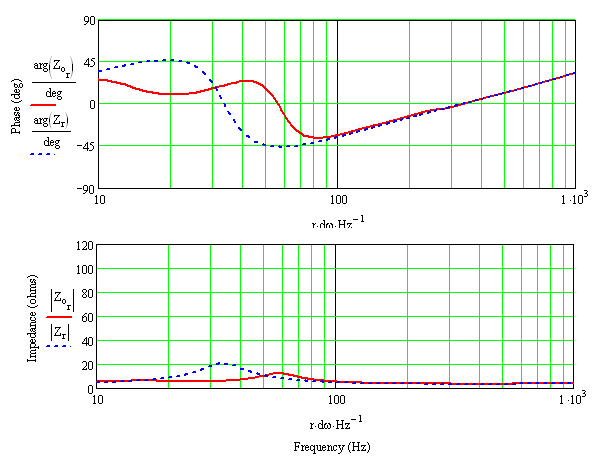
some graphic support:
impedance of a push-push SDX7 aperiodic TL i am working on
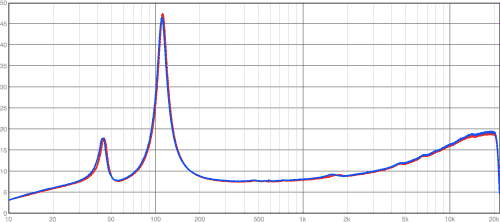
impedance of a Fonken (you can see that this is way closer to the BR end of the spectrum)
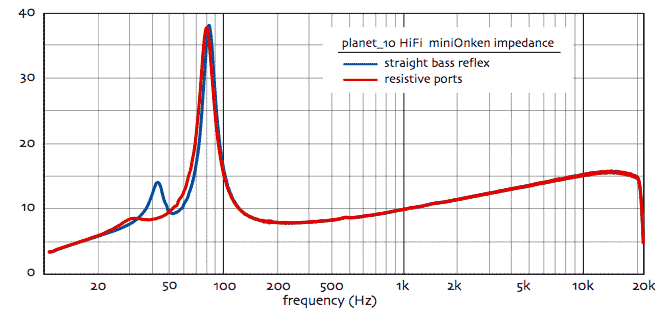
and the before & after of a miniOnken with stuffed ports
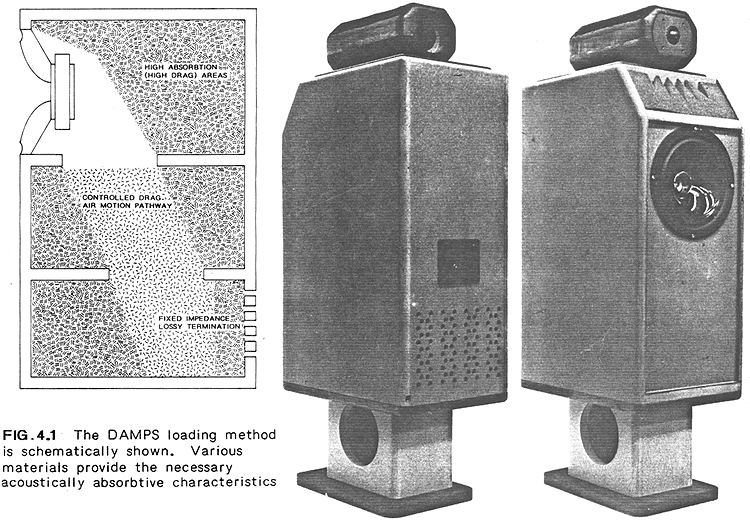
PEARL PR-2
dave
http://p10hifi.net/planet10/TLS/downloads/TedJordanAperiodic.pdf
The most widely spread aperiodic enclosures were the Dynaco A10 & A25, The A35 & A50 were also an aperiodic variation. The Fried R & Q are also examples as is one of the more recent NAIMs was configured similar to the A35/A50
GM is pretty bang on the money ... he should be, i he was one of the guys i learned from 🙂
MJK would sim aperiodic enclosures is Martin had calibrated data for the resistance units. As GM points out 1 lb/ft^3 can get some boxes pretty close (a classic TL -- of which there are few true examples) is aperiodic.
One can think of aperiodic as in between BR & sealed, with a continuum of near aperiodic going in either direction. Different drivers will work best at different places on the continuum. (for the rest of this ramble i'm just goig to use aperiodic to mean the space between BR & sealed). Aperiodic has the advantage over a BR in that it is more tolerent to the changes in T/S parameters that occur as you turn the volume up or as the weather changes. It has the advantage over sealed in that it is lower pressure or can get you a lower Q out of a smaller box.
One can use standard simulation tools to get a starting point, but after that it is seat-of-the-pants. A impedance measure tool, GM's clik test, and lots of listening help fine tune.
I approach designing an aperiodic box one of 2 ways.
1/ If the driver works in a sealed box (ie FR125, SDX7), i'll design for a Q higher than i'd like (a bit over 1 is my usual target, but i have one in the works where i'll start with Q=0,7) and then add resistive ports as in the holes + foam behind (borrowed from PEARL/Bill Perkins), or a slot with squished fiberglass (as in Dyna A25 -- the SS variovent is similar, but the long narrow slot is easier to tune)
2/ If the driver really needs the support on the bottom that a BR gives (ie all the Fonkens), i design a BR with a very specific shape roll-off and then make the ports long and with a high aspect ratio to add restance to the port. If this is not enuff to achieve the goal i'll add a specific open cel foam to the port. (this last is the same idea as stuffing a sock in the port)
some graphic support:
impedance of a push-push SDX7 aperiodic TL i am working on
impedance of a Fonken (you can see that this is way closer to the BR end of the spectrum)
and the before & after of a miniOnken with stuffed ports
PEARL PR-2
dave
For the record, the click test is either Olson's or one of Altec's engineers.
Note that Rick Shultz's Alpha TL and Omega Quarter Wave Reflex math assumes a ~aperiodic alignment, so an easy way to design them with the understanding that they may severely over-damp a ~full range driver's HF due to the high stuffing densities required.
GM
Note that Rick Shultz's Alpha TL and Omega Quarter Wave Reflex math assumes a ~aperiodic alignment, so an easy way to design them with the understanding that they may severely over-damp a ~full range driver's HF due to the high stuffing densities required.
GM
planet10 said:It has the advantage over sealed in that it is lower pressure or can get you a lower Q out of a smaller box.
You will find that the pressure in a box is directly related to the sound output-no matter what the design. This whole supposed "issue" with "lower pressure" is a handyman's intuitive fantasy.
Hi,
Whilst often described as a cross between vented and sealed
loading I do have a problem with this description. You can have
a vented alignment with damping added to the ports, e.g.
drinking straws but this is not aperoidic, the alignment you end
up with is still less damped than the sealed box variant.
I think the crucial point is the phase inversion of the port such
that its output is in phase with the main driver at and above
the port resonance. For an aperiodic port / opening this inversion
does not occur, whatever port / opening output there is cancels
with the main driver output reducing it. This is also the case for
an overdamped transmission line.
So as ever you do not get something for nothing. An aperoidic
box (Qbox and Fbox lower than sealed) has less maximum SPL
in the bass than sealed. I'm not arguing that damped vented
alignments are not a good idea, just that they are not aperoidic.
A damped vented alignment may have a lower impedance peak
at the lower frequency, but it still pushes the other peak up in
frequency and Q.
🙂/sreten.
Whilst often described as a cross between vented and sealed
loading I do have a problem with this description. You can have
a vented alignment with damping added to the ports, e.g.
drinking straws but this is not aperoidic, the alignment you end
up with is still less damped than the sealed box variant.
I think the crucial point is the phase inversion of the port such
that its output is in phase with the main driver at and above
the port resonance. For an aperiodic port / opening this inversion
does not occur, whatever port / opening output there is cancels
with the main driver output reducing it. This is also the case for
an overdamped transmission line.
So as ever you do not get something for nothing. An aperoidic
box (Qbox and Fbox lower than sealed) has less maximum SPL
in the bass than sealed. I'm not arguing that damped vented
alignments are not a good idea, just that they are not aperoidic.
A damped vented alignment may have a lower impedance peak
at the lower frequency, but it still pushes the other peak up in
frequency and Q.
🙂/sreten.
Thanks for all your responses
(the phone based net connection has been down here for a few days . . hence my delayed response)
GM,
> the roll off slope will depend on the driver
Entirely, ie the box/ stuffing makes no? difference
The 1 lb/ ft^3 stuffing is in the box, not the port (hole)?
What is the clik test?
Hezz,
> It's best to tune it by ear for the best sound
Makes sense. I’ve read Dave:
“Modeling to get in the ballpark, experience to get me the 1st draft and then by ear for tuning. Finally impedance to make sure i'm in the intended ballpark”
I’m only at stage 1 (without experience), deciding the box size, happy to tune from an appropriate size and “holed” base . .
> It also makes amazing center channel speakers where there is not going to be much low bass information.
(I’ve not had a center channel, only knowing its key for dialogue), but there’s not much bass in the center channel?
> The aperiodic makes an outstanding mid/bass or low reaching midrange/ fullrange loading for a three way or four way speaker system where the lowest bass driver can operate in a separate vented or other cabinet loading.
That’s very encouraging . . .
> If you want midrange quality "to die for", this is one approach to help get it. If the midrange enclosure is small but can be aperiodically tuned and vented to the outside of the cabinet this will also help the sound quality be more open sounding than keeping the midrange stuffed in a small sealed sub-enclosure.
I wonder why more people don’t do aperiodic, lack of awareness & understanding?
Ron,
Thank you for your formulae; though while by themselves they make sense, with them being level dependent etc not sure how to apply them usefully.
Dave,
Thank you for your info
> Aperiodic predates me by quite a bit
I appreciate that, my “planet 10 proprietary” was a so-so joke alluding to the knowledge behind the models you have developed.
With limited time available now & in the foreseeable future, experimenting isn’t a realistic option *** (BAWL)
So as I’m some CSS 125’s are on their way to me, for now I’ll probably be better to use one of your designs. If I’ve correctly interpreted the results of your designs –
The small FF85k’s microOnken has twin impedance peaks, it’s close to a BR; while the resistive ports removed the lower of the miniOnken’s (relatively well bass endowed from CSS 125’s?) impedance peaks: closer to a sealed box?
Are there FR plots for the miniOnken or slotted port BR 125 posted ?
Sreten,
> I think the crucial point is the phase inversion of the port such
that its output is in phase with the main driver at and above
the port resonance. For an aperiodic port / opening this inversion
does not occur, whatever port / opening output there is cancels
with the main driver output reducing it.
What alignments then have port output in phase with the main driver ~ all or some BR?
Thanks
(the phone based net connection has been down here for a few days . . hence my delayed response)
GM,
> the roll off slope will depend on the driver
Entirely, ie the box/ stuffing makes no? difference
The 1 lb/ ft^3 stuffing is in the box, not the port (hole)?
What is the clik test?
Hezz,
> It's best to tune it by ear for the best sound
Makes sense. I’ve read Dave:
“Modeling to get in the ballpark, experience to get me the 1st draft and then by ear for tuning. Finally impedance to make sure i'm in the intended ballpark”
I’m only at stage 1 (without experience), deciding the box size, happy to tune from an appropriate size and “holed” base . .
> It also makes amazing center channel speakers where there is not going to be much low bass information.
(I’ve not had a center channel, only knowing its key for dialogue), but there’s not much bass in the center channel?
> The aperiodic makes an outstanding mid/bass or low reaching midrange/ fullrange loading for a three way or four way speaker system where the lowest bass driver can operate in a separate vented or other cabinet loading.
That’s very encouraging . . .
> If you want midrange quality "to die for", this is one approach to help get it. If the midrange enclosure is small but can be aperiodically tuned and vented to the outside of the cabinet this will also help the sound quality be more open sounding than keeping the midrange stuffed in a small sealed sub-enclosure.
I wonder why more people don’t do aperiodic, lack of awareness & understanding?
Ron,
Thank you for your formulae; though while by themselves they make sense, with them being level dependent etc not sure how to apply them usefully.
Dave,
Thank you for your info
> Aperiodic predates me by quite a bit
I appreciate that, my “planet 10 proprietary” was a so-so joke alluding to the knowledge behind the models you have developed.
With limited time available now & in the foreseeable future, experimenting isn’t a realistic option *** (BAWL)
So as I’m some CSS 125’s are on their way to me, for now I’ll probably be better to use one of your designs. If I’ve correctly interpreted the results of your designs –
The small FF85k’s microOnken has twin impedance peaks, it’s close to a BR; while the resistive ports removed the lower of the miniOnken’s (relatively well bass endowed from CSS 125’s?) impedance peaks: closer to a sealed box?
Are there FR plots for the miniOnken or slotted port BR 125 posted ?
Sreten,
> I think the crucial point is the phase inversion of the port such
that its output is in phase with the main driver at and above
the port resonance. For an aperiodic port / opening this inversion
does not occur, whatever port / opening output there is cancels
with the main driver output reducing it.
What alignments then have port output in phase with the main driver ~ all or some BR?
Thanks
otto88 said:Are there FR plots for the miniOnken or slotted port BR 125 posted ?
not that i have seen
dave

planet10 said:Aperiodic predates me by quite a bit. The 1st published paper that i am aware of is Ted Jordan's article (that was related to the release of the Goodmans ARU -- acoustic resistance unit)
http://homepage.mac.com/planet10/TLS/downloads/TedJordanAperiodic.pdf
Hmm, the link does not seem to be working.
Quite interesting though is that I had some success in lowering the impedance peak while damping out a small higher peak using a Jordan Jx125 driver.
Edit:
I do remember this article. If one looks at the math model concept, it is clear that there are different ways of implementing the design. Now if I can find a link to the patent...
Recently I also tested an old enclosure using the SAFE concept which pretty much shows a similar trend.
soongsc said:Hmm, the link does not seem to be working.
I took Grade 11 Math instead of Grade 10 typing -- i'm a bit challenged with a keyboard... i fixed the typos... link works now.
dave
otto88 said:
Sreten,
> I think the crucial point is the phase inversion of the port such
that its output is in phase with the main driver at and above
the port resonance. For an aperiodic port / opening this inversion
does not occur, whatever port / opening output there is cancels
with the main driver output reducing it.
What alignments then have port output in phase with the main driver ~ all or some BR?
Thanks
Hi,
For all reasonant BR / vented systems the port output is in phase
with the driver output above the resonant frequency of the port.
Below the resonant frequency it is out of phase.
This can be gleaned by imagining bouncing a weight on a spring
on the end of your finger. At low frequences they move together.
At one frequency they move in exactly opposite directions and it
is very easy to drive. At higher frequencies (not obvious) they
still move in opposite directions but the weight movement drops.
Considering this analogy, if you add foam to the spring such that
the resonance cannot occur then your finger and the weight will
allways move in the same direction, the weight getting harder
to move as you go up in frequency.
🙂/sreten.
Here is an impedance comparison of the JX92S in free air versus in a Symmetric Air Friction Enclosure (SAFE)
An externally hosted image should be here but it was not working when we last tested it.
Hmmm........
Dropping the free air resonance point is a new one me ....
However specs suggest this is sealed loading vs SAFE.
🙂/sreten.
Dropping the free air resonance point is a new one me ....
However specs suggest this is sealed loading vs SAFE.
🙂/sreten.
I trust my measurements.🙂sreten said:Hmmm........
Dropping the free air resonance point is a new one me ....
However specs suggest this is sealed loading vs SAFE.
🙂/sreten.
otto88 said:
. . Do you have some you can post?
Thanks
Not yet. Over the next 6 months the plan is to learn the measure tools and build a gang plank in aid of getting better low frequency resolution than in-room.
dave
 variety, methinks, but for what?
- Home
- Loudspeakers
- Multi-Way
- How should we model aperiodic boxes