
Hello,
I was wondering if one can measure the tuning frequency of the finished speaker enclouser using the same proceedure as used to measure the TS parameters?? e.g. one low voltage point being the resonant freq. of the port and then continuing up in frequency until another low point is voltage is measured, this being the resonant freq. of the driver? This all of course being measured in the final enclouser.
Am I correct in this assumption? I also have measurement mic and R plus D acoustic measurment program. Would this be more accurate to use, maybe doing a close mic of the driver and then one of the port? If so how can you tell the tuning freq. using the software method when looking at the freq. response graph?
Hope all this makes sense
Thanks,
Dallaire
I was wondering if one can measure the tuning frequency of the finished speaker enclouser using the same proceedure as used to measure the TS parameters?? e.g. one low voltage point being the resonant freq. of the port and then continuing up in frequency until another low point is voltage is measured, this being the resonant freq. of the driver? This all of course being measured in the final enclouser.
Am I correct in this assumption? I also have measurement mic and R plus D acoustic measurment program. Would this be more accurate to use, maybe doing a close mic of the driver and then one of the port? If so how can you tell the tuning freq. using the software method when looking at the freq. response graph?
Hope all this makes sense
Thanks,
Dallaire

Hi again Dallaire,
Yup, you're on the right track here. The impedance curve of a ported speaker will have two peaks, the port tuning being the low between the peaks.
You can also put a mic in the port and the port tuning will appear as a peak in the acoustic output.
You can also get close enough by just feeling the air in the port with your hand as you sweep the sig gen.
See if you can get a copy of Joe D'Appolito's book "Testing Loudspeakers" It's the best reference I've found. It tells you how to do this and anything else you can think of.
Yup, you're on the right track here. The impedance curve of a ported speaker will have two peaks, the port tuning being the low between the peaks.
You can also put a mic in the port and the port tuning will appear as a peak in the acoustic output.
You can also get close enough by just feeling the air in the port with your hand as you sweep the sig gen.
See if you can get a copy of Joe D'Appolito's book "Testing Loudspeakers" It's the best reference I've found. It tells you how to do this and anything else you can think of.
Thanks, I will order this book tonight! sounds like just what I am looking for. 😀
Regards,
dallaire
Regards,
dallaire
Its seems based on what I have read and measured with my volt meter that votage starts high at 20hz then voltage decreases as frequency is increased to a "peak low voltage" THIS must be the tuning frequency right? at the top of the first peak? Then of course going higher in frequency the volatage increases to a valley "high voltage point" then as frequency is increased more it forms another peak at another "low voltage peak" this must be the resonance of the driver right?
I want to make sure the "top" of the first peak is the tuning frequency, and not the valley between the two peaks? you had said in your above post that the tune frequency is in the "valley", just a little confused. It seems to me that the air in the port for the speaker I'm testing is greatest st the frequency of the first "peak" and NOT the valley between the two peaks...
Is this correct? Is the first "peak" the tune frequency or is the "valley" the tune frequency?????
I want to make sure the "top" of the first peak is the tuning frequency, and not the valley between the two peaks? you had said in your above post that the tune frequency is in the "valley", just a little confused. It seems to me that the air in the port for the speaker I'm testing is greatest st the frequency of the first "peak" and NOT the valley between the two peaks...
Is this correct? Is the first "peak" the tune frequency or is the "valley" the tune frequency?????
Hi,
the impedance of the vented speaker has two low frequency peak and a low value between.
The port frequency virtually coincides with the low impedance "valley" frequency.
The two impedance peaks can be the same or can be deliberately set to be different. The "sound" of the speaker will change as you change the relative height of these peaks, by changing the length of the port.
How are you measuring the low frequency impedance variations?
Vdrop across the speaker or Vdrop across the series test resistor?
the impedance of the vented speaker has two low frequency peak and a low value between.
The port frequency virtually coincides with the low impedance "valley" frequency.
The two impedance peaks can be the same or can be deliberately set to be different. The "sound" of the speaker will change as you change the relative height of these peaks, by changing the length of the port.
How are you measuring the low frequency impedance variations?
Vdrop across the speaker or Vdrop across the series test resistor?
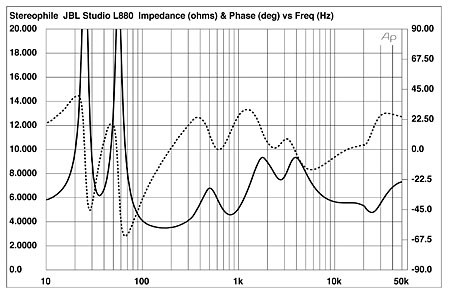
Hi,
is that JBL L880 example rated as a 4ohm or 6ohm speaker?
I see high phase angle at 70Hz resulting in ~8ohm and 65degree phase and up at 80Hz this becomes ~4.5ohm and 45degree phase.
At these frequencies sustained bass notes could take output stages close to or beyond 100mS SOAR.
I suppose these two spot impedances are not too bad, if it's classed as a 4ohm speaker.
How would others assess this loading?
is that JBL L880 example rated as a 4ohm or 6ohm speaker?
I see high phase angle at 70Hz resulting in ~8ohm and 65degree phase and up at 80Hz this becomes ~4.5ohm and 45degree phase.
At these frequencies sustained bass notes could take output stages close to or beyond 100mS SOAR.
I suppose these two spot impedances are not too bad, if it's classed as a 4ohm speaker.
How would others assess this loading?
Hi,
The speaker is nominally according to spec 8 Ohm.
In reality its a reasonable 4 ohm load.
The worst points are pretty much where the phase and impedances
cross giving the worst product of impedance times phase angle, the
90Hz point really making a 4ohm amplifier suitable. You could call it
6 ohm only because I've seen far more onerous "4 ohm" speakers.
🙂/sreten.
The speaker is nominally according to spec 8 Ohm.
In reality its a reasonable 4 ohm load.
The worst points are pretty much where the phase and impedances
cross giving the worst product of impedance times phase angle, the
90Hz point really making a 4ohm amplifier suitable. You could call it
6 ohm only because I've seen far more onerous "4 ohm" speakers.
🙂/sreten.
Just one of many reasons I don't like passive crossovers. That really is a nasty load for an amplifier - I'd call it 4ohms and a challenging 4ohms at that. The speakers probably are 8 ohm speakers but the crossover is shunting a low impedance to get the response right.
No wimpy amps for these puppies
P.S. Sreten, I grew up in Brighton, Palmeira Ave to be precise. Did they ever fix the pier?
No wimpy amps for these puppies
P.S. Sreten, I grew up in Brighton, Palmeira Ave to be precise. Did they ever fix the pier?
Andrew, to answer your question, I am measuring the voltage drop across the resistor...
Thanks,
now I,ve got it!
dallaire
Thanks,
now I,ve got it!
dallaire
so, the voltage across the resistor is at a minimum when the speaker impedance is at a maximum and vice versa.dallaire said:to answer your question, I am measuring the voltage drop across the resistor...
Yes Andrew that is correct. So in my case then, this would put the voltage at a high point when in the "valley" at the tuning frequency.
Dallaire
Dallaire
Yes, the resistor voltage is maximum when the speaker impedance is at minimum.
But that tells you nothing about how it sounds.
You have to tune the cabinet to suit your room/music/ears/audience.
Try fitting different port lengths, listening to each for a day or so. I suggest 10% length change between tries. Going all the way to double length will probably be too long.
trying from 90% to 150% seems more likely to find a compromise that suits your ears. Probably adding a thin layer of damping to the speaker wall will help and maybe some heavy damping on the back of the driver.
Then you might want to repeat the port tuning.
But that tells you nothing about how it sounds.
You have to tune the cabinet to suit your room/music/ears/audience.
Try fitting different port lengths, listening to each for a day or so. I suggest 10% length change between tries. Going all the way to double length will probably be too long.
trying from 90% to 150% seems more likely to find a compromise that suits your ears. Probably adding a thin layer of damping to the speaker wall will help and maybe some heavy damping on the back of the driver.
Then you might want to repeat the port tuning.
- Status
- Not open for further replies.
- Home
- Loudspeakers
- Multi-Way
- fine tuning port in enclouser