
Hello,
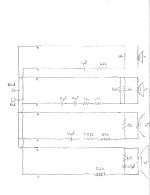
A friend has a pair of McIntosh ML-1C speakers. He is trying to convert them from 4-way to 3-way, perhaps Linkwitz-Riley, I think. We're not sure what order/design is being used in the crossover in the image attached. Can anyone help identify what design is being used? Thanks!
A friend has a pair of McIntosh ML-1C speakers. He is trying to convert them from 4-way to 3-way, perhaps Linkwitz-Riley, I think. We're not sure what order/design is being used in the crossover in the image attached. Can anyone help identify what design is being used? Thanks!
Attachments
Hi,
The electrical design of a crossover is not the required acoustic design.
ML-1C Loudspeaker system, 4-way bookshelf system has :
12" woofer, 8"lower mid, 1-1/2" soft dome upper mid and 2-1/4" tweeter.
Crossover frequencies: 250 Hz, 1.5kHz and 7kHz
Impedance: 8 ohms
Output: 89dB @1w/1m
Power rating: 100w
Size: 26"H, 15"W and 13-1/2"D
Weight: 64lbs.
Sold from: 1970 to 1975
Last retail price: $399.00 each
W is 1st order electrical low pass with zobel
LM is 1st order electrical low and high pass
UM is 1st order lelectrical low pass and 2nd order electrical high pass
T is 2nd order electrical high pass
note the acoustic slopes are not known,
the c/o points above should be acoustic, not electrical.
 /sreten.
The electrical design of a crossover is not the required acoustic design.
ML-1C Loudspeaker system, 4-way bookshelf system has :
12" woofer, 8"lower mid, 1-1/2" soft dome upper mid and 2-1/4" tweeter.
Crossover frequencies: 250 Hz, 1.5kHz and 7kHz
Impedance: 8 ohms
Output: 89dB @1w/1m
Power rating: 100w
Size: 26"H, 15"W and 13-1/2"D
Weight: 64lbs.
Sold from: 1970 to 1975
Last retail price: $399.00 each
W is 1st order electrical low pass with zobel
LM is 1st order electrical low and high pass
UM is 1st order lelectrical low pass and 2nd order electrical high pass
T is 2nd order electrical high pass
note the acoustic slopes are not known,
the c/o points above should be acoustic, not electrical.
/sreten.Thanks, sreten! I admittedly don't know a lot about crossovers. I have been doing more with single-driver designs. Your point about electrical versus acoustical turned what little I thought I knew about crossover design into confusion, but I have a few books on order and will read more about it.
Thanks again!
Thanks again!
At its most basic - all drivers exhibit their own rolloff at the top / bottom of their operating ranges. This natural rolloff - combined with any electrical crossover slope gives the acoustic rolloff.
For example. Take a theoretical midrange driver that is already rolling off at 200Hz down to 100Hz at a rate of 6dB (first order being one octave between 200Hz and 100Hz). Put a 1st order highpass crossover on the midrange (so it can crossover to the woofer) - you will end up with a 2nd order acoustic slope (more or less). The 6dB of electrical slope combines with the drivers natural 6dB fall from 200Hz to 100Hz to give a 2nd order (12dB) slope.
Cheers,
David.
For example. Take a theoretical midrange driver that is already rolling off at 200Hz down to 100Hz at a rate of 6dB (first order being one octave between 200Hz and 100Hz). Put a 1st order highpass crossover on the midrange (so it can crossover to the woofer) - you will end up with a 2nd order acoustic slope (more or less). The 6dB of electrical slope combines with the drivers natural 6dB fall from 200Hz to 100Hz to give a 2nd order (12dB) slope.
Cheers,
David.
- Status
- This old topic is closed. If you want to reopen this topic, contact a moderator using the "Report Post" button.