
1Mohm as in the schematic. I'm playing a bass with preamp.deepthrob said:Resistance - pin 7 to gnd = ?
@ Kramerguy
It's sad when intensive knowledge is lost when people pass away. Hopefully your grandfather will be around for his 100 years birthday, but at 85 he has done well.
I'm looking forward to hear his opinion on this, it's very kind of him too take his time into it.
I have an update on the voltage drop.
R8 = 64mV I didn't notice as I was using the 200V scale 🙂
BTW I have a 10kOhm mid pot, not 250kOhm as in the schematic.
Regards,
Nordskov
I hope so to. But that being siad he has a form of a lukiemia like condition "Non Cancerous" from being irradiated by high power RFI sources so he is no longer producing good healthy red blood cells and white cells. With a few newer medications like ProKrit he is hanging in there but the long term outlook isn;t good. He is also taking care of my grandmother "Wife of 65yrs" as well and she is in very poor health. I was glad to make time to se them this year for the holidays we spent 2 weeks in town. But between the wear of taking care of my Grandmother and himself I found it odd he though he could lend you a hand but being busy is always good for the elderly.
He wrote many good papers on using heat trasnfer tubes and holds many patents on receiving "12ax7 and similar" and broadcast tubes as well as a few TV picture tubes. It will be a great loss when he passes to the entire tube community as he worked at the best manufacturers during what is arguably the greatest spot in the history of tube design and application.
IF I get a reply from him today I will post it up.
He wrote many good papers on using heat trasnfer tubes and holds many patents on receiving "12ax7 and similar" and broadcast tubes as well as a few TV picture tubes. It will be a great loss when he passes to the entire tube community as he worked at the best manufacturers during what is arguably the greatest spot in the history of tube design and application.
IF I get a reply from him today I will post it up.
Nordskov said:
1Mohm as in the schematic. I'm playing a bass with preamp.
@ Kramerguy
It's sad when intensive knowledge is lost when people pass away. Hopefully your grandfather will be around for his 100 years birthday, but at 85 he has done well.
I'm looking forward to hear his opinion on this, it's very kind of him too take his time into it.
I have an update on the voltage drop.
R8 = 64mV I didn't notice as I was using the 200V scale 🙂
BTW I have a 10kOhm mid pot, not 250kOhm as in the schematic.
Regards,
Nordskov

I'm sorry to hear that. Cancer is an ugly disease.
I don't think they really understood the connexion between high power RFI and cancer 60 years ago, unfortunately.
Taking care of your grandmother while in his condition is a great credit on his behalf.
I'm a school teacher, and a year ago a 12 year old student of mine caught leukaemia too. She went into intensive treatment and is now through the critical stage.
When the going gets tough, the tough gets going - and she is very tough, like your grandfather 🙂
I think you are right about elderly keeping their mind fresh with some brain exercise. It gives them something to live for and move focus from illness to something interesting 🙂
I'm looking forward for his reply.
Regards,
Nordskov
I don't think they really understood the connexion between high power RFI and cancer 60 years ago, unfortunately.
Taking care of your grandmother while in his condition is a great credit on his behalf.
I'm a school teacher, and a year ago a 12 year old student of mine caught leukaemia too. She went into intensive treatment and is now through the critical stage.
When the going gets tough, the tough gets going - and she is very tough, like your grandfather 🙂
I think you are right about elderly keeping their mind fresh with some brain exercise. It gives them something to live for and move focus from illness to something interesting 🙂
I'm looking forward for his reply.
Regards,
Nordskov
LOL deepthrob, read the schematics. R3 = 1.5kOhm as stated 😀deepthrob said:Sorry, I meant pin 8 to gnd
Why do you ask? Do you think it could be a faulty component?
Regards,
Nordskov
Because if I had those voltage readings the first thing I would look for is an open cathode resistor.
Hi deepthrob.
That was my first thought too, but both cathode resistors on both amps are fine. They measure within specs.
I have a bad feeling that the second triode on both of my 12AX7 (one for each amp) have gone south, as they have no voltage reading on either anode nor cathode resistors.
But the same applies to 3 12AU7 (ECC82) tubes I have tried, and that would be very unlikely, wouldn't it?
How about the mismatch in voltage drop across R4 and R8 (in the time it had reading 🙁 )?
What can cause 5 tubes to draw too much current when the supply is within the acceptable range (< 300 V)?
Could it be a DC conducting capacitor: C3 or C4?
Hmm... I will check this first thing when I get home from work.
Thank you for your interest,
Nordskov
That was my first thought too, but both cathode resistors on both amps are fine. They measure within specs.
I have a bad feeling that the second triode on both of my 12AX7 (one for each amp) have gone south, as they have no voltage reading on either anode nor cathode resistors.
But the same applies to 3 12AU7 (ECC82) tubes I have tried, and that would be very unlikely, wouldn't it?
How about the mismatch in voltage drop across R4 and R8 (in the time it had reading 🙁 )?
What can cause 5 tubes to draw too much current when the supply is within the acceptable range (< 300 V)?
Could it be a DC conducting capacitor: C3 or C4?
Hmm... I will check this first thing when I get home from work.
Thank you for your interest,
Nordskov
The resistor may measure correctly but did you remove the tube and measure from the pin at the top of the socket to gnd ?
No I didn't, but that's done now. R3 and R7 are okay.
C3, C4 and C5 all measure infinite resistance. I guess that means no DC leak.
But still, something is crapping out on me.
I don't believe it is an underdimensioned PS as the trannies hardly gets warm under long term load (< 30 degrees celcius) and still measure 280V.
I think I'll try and connect the input to the second triode to see if it works. That will tell if the tube is dead.
There is some confusion on the internet about the heater voltage on the 12AX7 compared to the ECC83, the first being American the second European. Some indicates that 12AX7 uses 12.6V and ECC83 uses 6.3V.
As I see it, both uses the same heater voltage: 12.6V for the heaters in series and 6.3V in parallel.
I use 6.3V in parallel.
My hair is turning gray real fast, as you see
C3, C4 and C5 all measure infinite resistance. I guess that means no DC leak.
But still, something is crapping out on me.
I don't believe it is an underdimensioned PS as the trannies hardly gets warm under long term load (< 30 degrees celcius) and still measure 280V.
I think I'll try and connect the input to the second triode to see if it works. That will tell if the tube is dead.
There is some confusion on the internet about the heater voltage on the 12AX7 compared to the ECC83, the first being American the second European. Some indicates that 12AX7 uses 12.6V and ECC83 uses 6.3V.
As I see it, both uses the same heater voltage: 12.6V for the heaters in series and 6.3V in parallel.
I use 6.3V in parallel.
My hair is turning gray real fast, as you see
Nordskov said:
There is some confusion on the internet about the heater voltage on the 12AX7 compared to the ECC83, the first being American the second European. Some indicates that 12AX7 uses 12.6V and ECC83 uses 6.3V.
As I see it, both uses the same heater voltage: 12.6V for the heaters in series and 6.3V in parallel.
I use 6.3V in parallel.
Correct, both can be wired as serial or parallel - they are essentially the same valve.
Hey guys, thanks for the help. The supply voltage off the PSU was 370VDC and after the first set of plate resistors it was showing around 260VDC. I put in a couple of 100K 3W resistors on the plates and that brought it down to 202V. Exactly in line with what I measured on a friend's real F2-B. Nice chunky tube sound comes out now!
One thing I am noticing is that there is a lot of hum in the circuit. It might be related to where the wiring is running (first try is a bit of a mess!) But I'm wondering if an AC filter cap on the B+ leads to the tube would help clear this up. Its a constant hum, which disappears when the mains is turned off and the caps are discharging (about 5-8 seconds before the tube "goes out").
Here's another question. Would any of the hum be caused by the heaters? The 12AX7 is indirectly heated, but me being a Tube Nube, I'm just not sure.
My PSU is completely different than what Alembic made, heaters are set at 12V (not using the centre tap) and its DC being supplied to the heaters, not AC like in the original design, so there's a bridge rectifier inline to convert it.
One thing I am noticing is that there is a lot of hum in the circuit. It might be related to where the wiring is running (first try is a bit of a mess!) But I'm wondering if an AC filter cap on the B+ leads to the tube would help clear this up. Its a constant hum, which disappears when the mains is turned off and the caps are discharging (about 5-8 seconds before the tube "goes out").
Here's another question. Would any of the hum be caused by the heaters? The 12AX7 is indirectly heated, but me being a Tube Nube, I'm just not sure.
My PSU is completely different than what Alembic made, heaters are set at 12V (not using the centre tap) and its DC being supplied to the heaters, not AC like in the original design, so there's a bridge rectifier inline to convert it.
Hi mtyndorf.
Can you show us some pictures and descriptions of the layout of the signal path.
If you are using rectified current on the heaters, that shouldn't induce hum.
It's more likely due to your ground wiring. Did you use isolated in and out jacks?
Im glad to hear that your project actually works. Congratulations
I hope you find a way to deal with the hum.
Unfortunately I'm still stucked with two non-working units
Edit: Wait, did you use any filter caps in the heater circuit?
Can you show us some pictures and descriptions of the layout of the signal path.
If you are using rectified current on the heaters, that shouldn't induce hum.
It's more likely due to your ground wiring. Did you use isolated in and out jacks?
Im glad to hear that your project actually works. Congratulations
I hope you find a way to deal with the hum.
Unfortunately I'm still stucked with two non-working units
Edit: Wait, did you use any filter caps in the heater circuit?
Nordskov i just cant get a grip with what your trying to do to the circuit. Best thing is to redo it like this. I have built 3 of these and never had a problem. B+ v can range from 255 to 280v is good. Anything higher is bad.
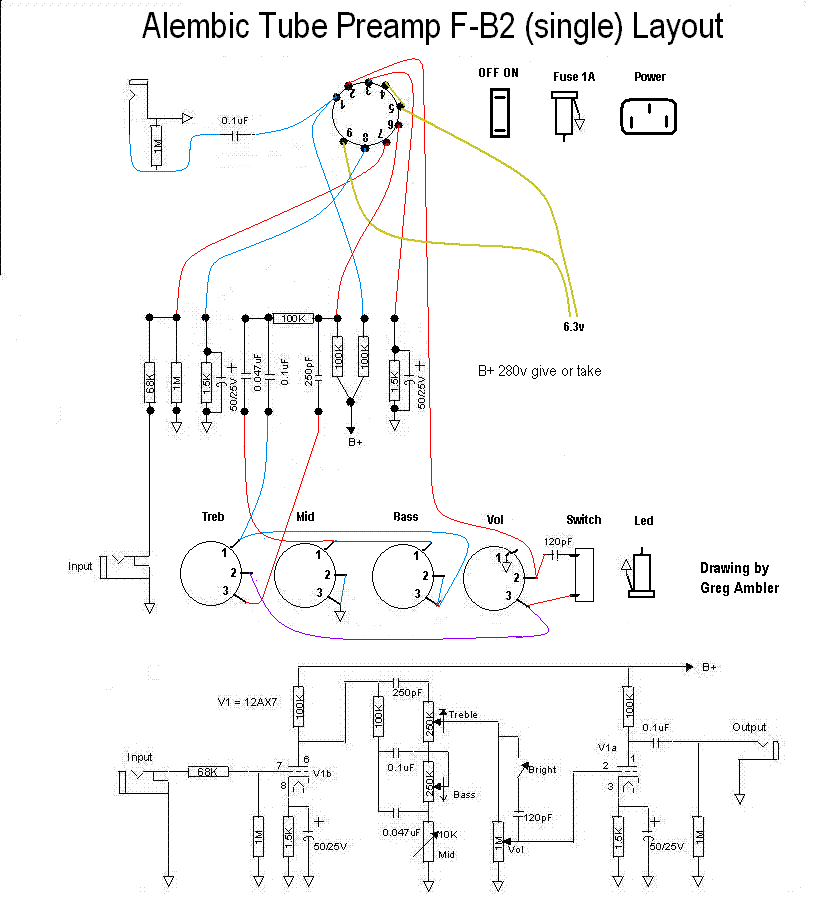
This is fantastic, Groundhanger.
I started a rewiring one of the amps according to your diagram - and bingo - lots of sound, no squeals. Perfect!
I had my mind set on the tone stack being miswired, and it certainly was. But that still don't explain the nasty feedback when bypassing he tone stack.
But who give a damned when the thing is working.
The B+ is a little high at 286V, but I guess it'll drop when I mount the shunt resistor from B+ to ground.
There's a little noise, but it can be dealt with.
Thanks so much Groundhanger, your diagram did the trick. Phantastic


I started a rewiring one of the amps according to your diagram - and bingo - lots of sound, no squeals. Perfect!
I had my mind set on the tone stack being miswired, and it certainly was. But that still don't explain the nasty feedback when bypassing he tone stack.
But who give a damned when the thing is working.
The B+ is a little high at 286V, but I guess it'll drop when I mount the shunt resistor from B+ to ground.
There's a little noise, but it can be dealt with.
Thanks so much Groundhanger, your diagram did the trick. Phantastic
Great to here that its going the right way for you, i know how frustrating it can be when you get stuck. 286v is ok. Ive experimented with voltages ranging from 240 - 330v. The original Alembic sits around 254v but mine is at 282v at present. It seems to be quite happy there.
Now that its working ok you can nut those noises out with a bit of time and careful wiring. Low noise cable to the pots, 6v/12v line clear of other wiring and use good earth practices. Keeping the unit away from the amp helps also, even rotating it on the spot helps. Its a very sensitive unit so care in every possible is the key. Have you got a closeup gut shot you can post? Id be interested to have a look.
Hangloose,
Greg
Now that its working ok you can nut those noises out with a bit of time and careful wiring. Low noise cable to the pots, 6v/12v line clear of other wiring and use good earth practices. Keeping the unit away from the amp helps also, even rotating it on the spot helps. Its a very sensitive unit so care in every possible is the key. Have you got a closeup gut shot you can post? Id be interested to have a look.
Hangloose,
Greg
I rehoused my F2b, it was in a very tiny box and didn't have a proper power supply, as I was going to do an external one (which didn't quite happen).
Bought a set of components on eBay, for a tube preamp, someones project that didn't happen, it had a 1HE 19" case, a toroidal xformer, some pots, nice knobs. So I decided to do a proper bass preamp 🙂
The powersupply has a rectified and regulated heater supply of 12 volts (didn't bother to lift it to get to 12,6). And a B+ supply with a insane amount of capacitance because I have a bunch of big caps I soldered from MRI equipment, right now it has 3x 450uF. The secondary voltage on the toroid was higher than I'd like, but sometimes you just have to work with what you've got, so there is 10k series between the first and second cap and another 15k between second and third. Right now, I am at 300v B+ not sure what this translates to on the plates.
When building it for the first time (in the very small enclosure) i remembered only using the first couple of degrees on the volume pot, so I made a -10dB pad (switchable). I still had more gain than I cared for, so I also added a 200k resistor parallel to the 100k on the second plate.
I think anyone using active instruments will find these two additions worthwhile.
It's a superb preamp, excellent sound, and despite having only a single tube very tube-y.
There are some extra switches on there as well, a treble shift and bass shift, I copied those from the preamp of a Mesa Bass400
Best regards,
Jarno.
Bought a set of components on eBay, for a tube preamp, someones project that didn't happen, it had a 1HE 19" case, a toroidal xformer, some pots, nice knobs. So I decided to do a proper bass preamp 🙂
The powersupply has a rectified and regulated heater supply of 12 volts (didn't bother to lift it to get to 12,6). And a B+ supply with a insane amount of capacitance because I have a bunch of big caps I soldered from MRI equipment, right now it has 3x 450uF. The secondary voltage on the toroid was higher than I'd like, but sometimes you just have to work with what you've got, so there is 10k series between the first and second cap and another 15k between second and third. Right now, I am at 300v B+ not sure what this translates to on the plates.
When building it for the first time (in the very small enclosure) i remembered only using the first couple of degrees on the volume pot, so I made a -10dB pad (switchable). I still had more gain than I cared for, so I also added a 200k resistor parallel to the 100k on the second plate.
I think anyone using active instruments will find these two additions worthwhile.
It's a superb preamp, excellent sound, and despite having only a single tube very tube-y.
An externally hosted image should be here but it was not working when we last tested it.

An externally hosted image should be here but it was not working when we last tested it.

There are some extra switches on there as well, a treble shift and bass shift, I copied those from the preamp of a Mesa Bass400
An externally hosted image should be here but it was not working when we last tested it.

An externally hosted image should be here but it was not working when we last tested it.

Best regards,
Jarno.
Greg, look at page two, top post. It shows inside and front.
What do you mean by low-noise cables to the pots, shielded?
Both in- and output are isolated and are connected vis shielded cable (PC connections from CD-drive to sound card).
I use star-ground located close to input with signal ground upstream from PSU ground.
The chassis is a GX247:
http://www.hifi2000.it/default.asp?id=106&mnu=106
Jarno, someone specificly wrote NOT to use the 2. primary to achieve B+. He was afraid of high voltage puncture of the windings. This is why I used two toroids back-to-back.
Do you think this is an issue?
I will look into your idea of a bass shift. In time I will experiment with different tonestacks. Maybe a four band parametric EQ from Rod Elliot.
What do you mean by low-noise cables to the pots, shielded?
Both in- and output are isolated and are connected vis shielded cable (PC connections from CD-drive to sound card).
I use star-ground located close to input with signal ground upstream from PSU ground.
The chassis is a GX247:
http://www.hifi2000.it/default.asp?id=106&mnu=106
Jarno, someone specificly wrote NOT to use the 2. primary to achieve B+. He was afraid of high voltage puncture of the windings. This is why I used two toroids back-to-back.
Do you think this is an issue?
I will look into your idea of a bass shift. In time I will experiment with different tonestacks. Maybe a four band parametric EQ from Rod Elliot.
Hello, first post!
I've built an f-2b as my first tube project and it sounds wonderful!
However, I am getting output voltages that are scary high.
As this is my first tube project, I'm not exactly sure of where to start debugging...
Heaters 12.5vdc
B+ 301vdc
My output voltages with the vol pot centered are as high as 15vac (while playing loudly)!!!
It still works and sounds fine if I keep the volume pot at nearly full resistance. Is this a common problem?! Where should I start looking?
Thanks! This thread has been so very helpful!
I've built an f-2b as my first tube project and it sounds wonderful!
However, I am getting output voltages that are scary high.
As this is my first tube project, I'm not exactly sure of where to start debugging...
Heaters 12.5vdc
B+ 301vdc
My output voltages with the vol pot centered are as high as 15vac (while playing loudly)!!!
It still works and sounds fine if I keep the volume pot at nearly full resistance. Is this a common problem?! Where should I start looking?
Thanks! This thread has been so very helpful!
What do you mean by low-noise cables to the pots, shielded?
-----------------------------------
A DIY wiring mistake I often see is using a shield to carry signal in a hi-z circuit. I find a shield is seldom needed but if it is, use a separate wire for the signal return (ground). Don't use the shield.
Another is using the chassis for signal ground. If you want a really quiet project, isolate all jacks from the chassis and run a ground wire to each one.
Frank
http://newmex.com/f10
-----------------------------------
A DIY wiring mistake I often see is using a shield to carry signal in a hi-z circuit. I find a shield is seldom needed but if it is, use a separate wire for the signal return (ground). Don't use the shield.
Another is using the chassis for signal ground. If you want a really quiet project, isolate all jacks from the chassis and run a ground wire to each one.
Frank
http://newmex.com/f10
I wired mine like a stompbox before I read this article (it was hummy) http://www.geofex.com/article_folders/stargnd/stargnd.htm
The use of electrical tape around the jacks (to isolate) and shielded cable on input and output made a big difference in noise for me.
I used moosapotamus's layouts and found those ground planes to be pretty quiet. I wired each board to a single point then that to chassis (similar to star ground in a way, I suppose).
Why would you not want to use the core of the coax for signal and run the shield to ground? Isn't that the point of shielding low voltage signal runs?
The use of electrical tape around the jacks (to isolate) and shielded cable on input and output made a big difference in noise for me.
I used moosapotamus's layouts and found those ground planes to be pretty quiet. I wired each board to a single point then that to chassis (similar to star ground in a way, I suppose).
Why would you not want to use the core of the coax for signal and run the shield to ground? Isn't that the point of shielding low voltage signal runs?
- Status
- Not open for further replies.
- Home
- Live Sound
- Instruments and Amps
- Alembic F2-B