
Hello there,
A friend of mine was hooked by Lowther recently. I'm now helping him on the cabinet design...
As I've seen various measured data, many of the Lowthers have a rising response begins at 1kHz. Huge peaks above that, and relatively much lower SPL between 100 ~ 1kHz is commonly seen. So I think a short front horn (or WG) should be needed to help on the mid-midbass, otherwise the boosted bass by BLH might overwhelm the mid. Together with the HF peaks, it'd be an unbalanced response.
So, here they are.
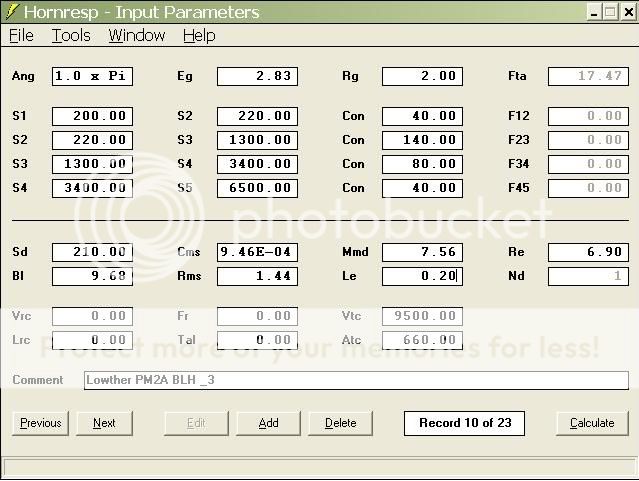
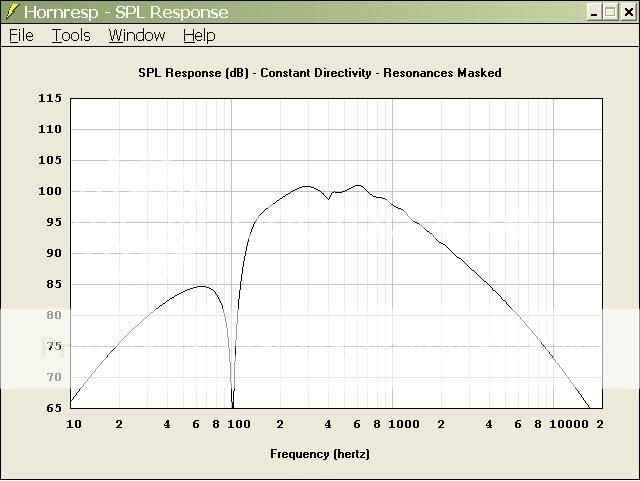
The 1st version is based on PM2A. With the real measured parameters I occasionally got from the web, I ran some sims on hornresp. Finally I got a result which is satisfying -- a 'real' horn instead of a pipe with ragged response:
Data of BLH:
SPL of BLH:
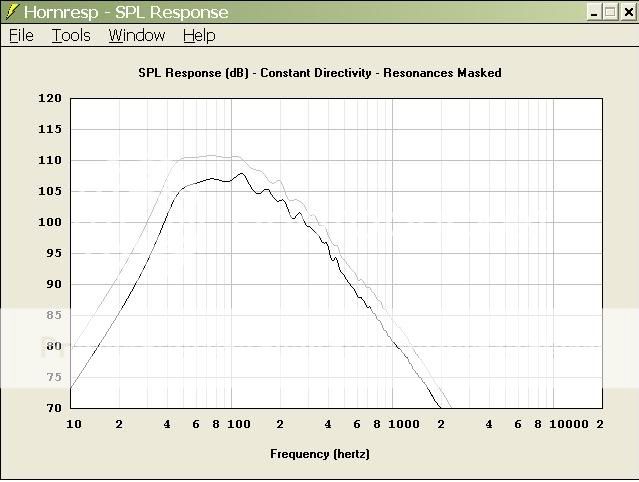
(grey is at corner)
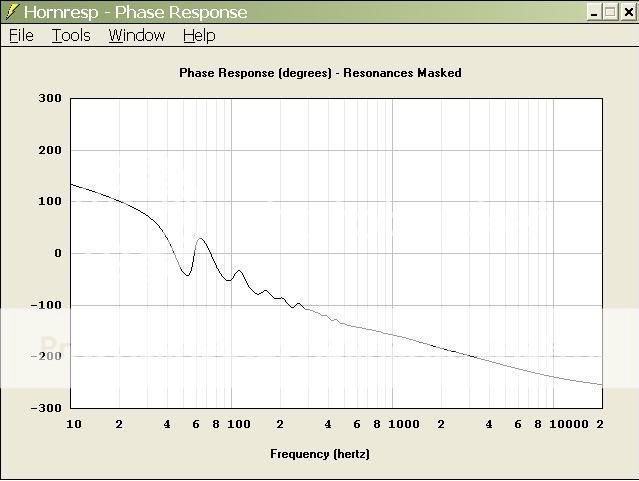
Phase of BLH:
Followings are for the short front horn:
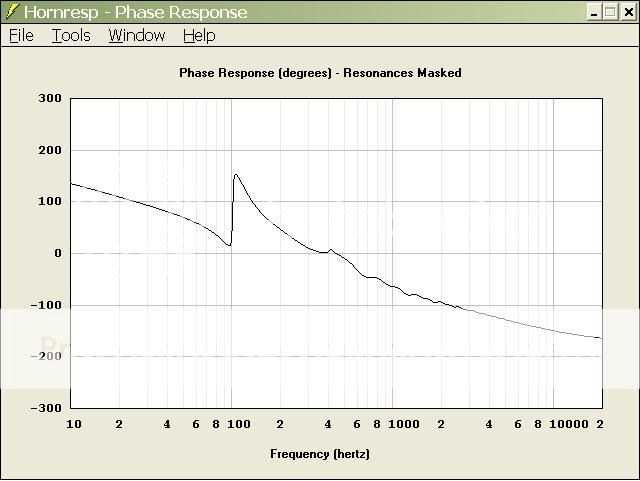
Phase:
SPL:
Data:
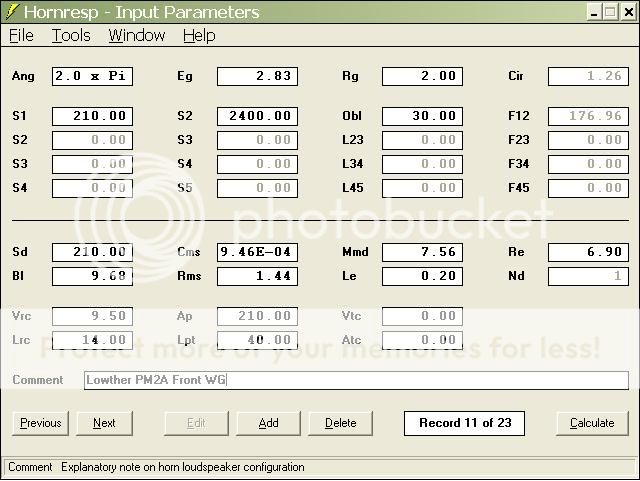
The screen shots above are arranged in such a way that you may compare the phase with ease -- that's what I'm concerning. On the frequencies which front and back's phase are 180 degree apart, they should cancel each other out.
According to the sims, when the front and back are out of phase, the SPLs they produce are also very different. So they more or less dominate on their own range indivdually, thus there'd be no obvious cancellation, which is of course a good thing.
Bad thing is, this cab is HeeeEEEUUUUGE !! When finished, the total volume exceeds 500 Lt -- more or less like a refrigerator
A friend of mine was hooked by Lowther recently. I'm now helping him on the cabinet design...
As I've seen various measured data, many of the Lowthers have a rising response begins at 1kHz. Huge peaks above that, and relatively much lower SPL between 100 ~ 1kHz is commonly seen. So I think a short front horn (or WG) should be needed to help on the mid-midbass, otherwise the boosted bass by BLH might overwhelm the mid. Together with the HF peaks, it'd be an unbalanced response.
So, here they are.
The 1st version is based on PM2A. With the real measured parameters I occasionally got from the web, I ran some sims on hornresp. Finally I got a result which is satisfying -- a 'real' horn instead of a pipe with ragged response:
Data of BLH:
SPL of BLH:
(grey is at corner)
Phase of BLH:
Followings are for the short front horn:
Phase:
SPL:
Data:
The screen shots above are arranged in such a way that you may compare the phase with ease -- that's what I'm concerning. On the frequencies which front and back's phase are 180 degree apart, they should cancel each other out.
According to the sims, when the front and back are out of phase, the SPLs they produce are also very different. So they more or less dominate on their own range indivdually, thus there'd be no obvious cancellation, which is of course a good thing.
Bad thing is, this cab is HeeeEEEUUUUGE !! When finished, the total volume exceeds 500 Lt -- more or less like a refrigerator
Part- II, the BVR
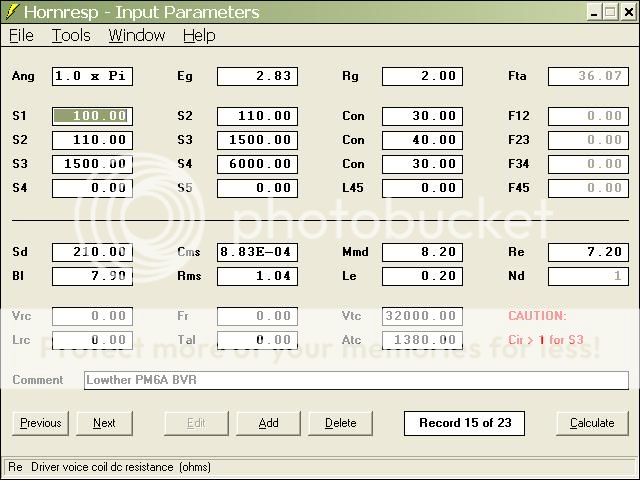
So, a smaller version is needed. Here are the sims based on PM6A in a BVR, also with front loaded short horn:
BVR data:
BVR SPL:
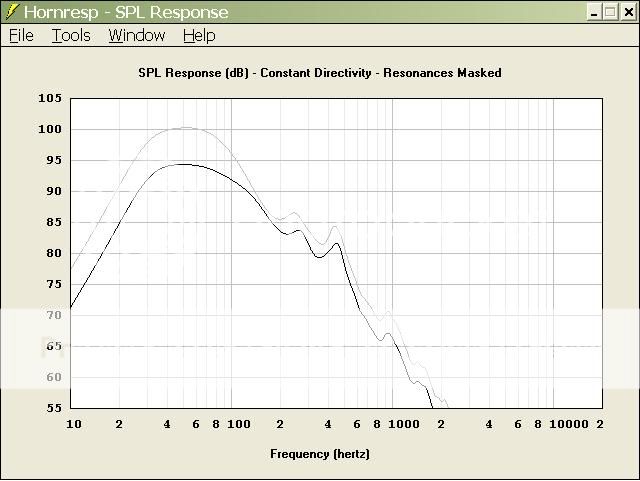
(grey is at corner)
BVR phase:
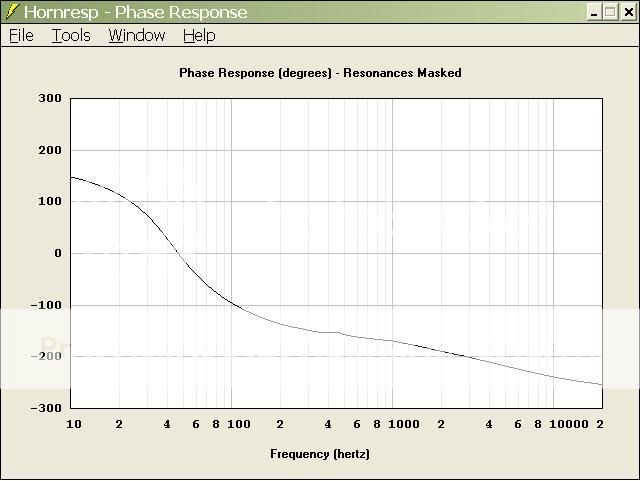
Front horn phase:
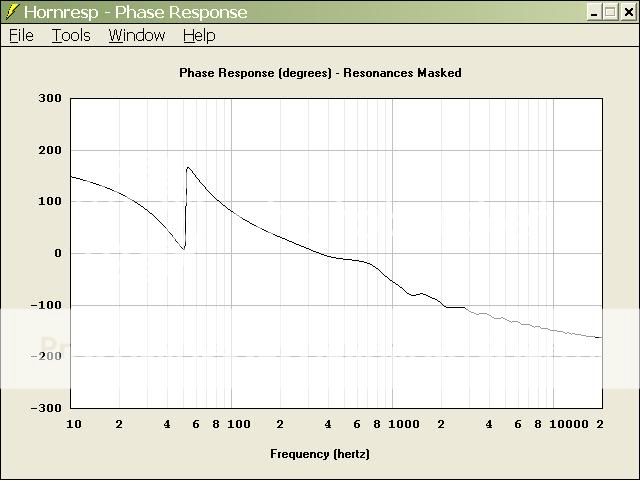
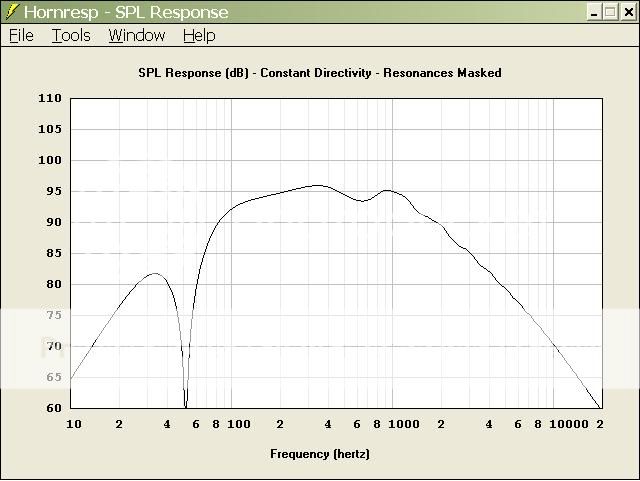
Front horn SPL:
Front horn data:
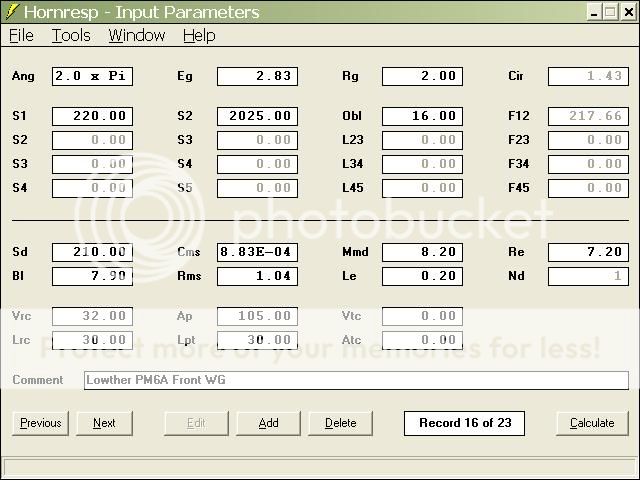
As can be seen on the screen shots, at 100Hz, front and back are almost perfectly out of phase. While their SPLs are simular, so a severe dip may happen here.
I don't worry about the far more humble performance of this BVR version, and the much more reasonable size is welcome, but the midbass hole would probably a real problem.
Did I miss anything? How accurate are the sims? And the most important, how do other BVRs perform in real life?
According to the short paths of BVR (related to the real horn), midbass cancellation seem unavoidable. How do you guys resolve this?
Any comments?
PS. Sorry for the long posts and thanks for reading. 🙂
So, a smaller version is needed. Here are the sims based on PM6A in a BVR, also with front loaded short horn:
BVR data:
BVR SPL:
(grey is at corner)
BVR phase:
Front horn phase:
Front horn SPL:
Front horn data:
As can be seen on the screen shots, at 100Hz, front and back are almost perfectly out of phase. While their SPLs are simular, so a severe dip may happen here.
I don't worry about the far more humble performance of this BVR version, and the much more reasonable size is welcome, but the midbass hole would probably a real problem.
Did I miss anything? How accurate are the sims? And the most important, how do other BVRs perform in real life?
According to the short paths of BVR (related to the real horn), midbass cancellation seem unavoidable. How do you guys resolve this?
Any comments?
PS. Sorry for the long posts and thanks for reading. 🙂
Re: Part- II, the BVR
Hi CLS,
Hornresp Version 21.00 can model conical and/or exponential compound horns. The attached screenprint shows the input parameter values for your design assuming radiation into half-space, but with the oblate spheroidal waveguide approximated by a conical horn.
The Combined Response tool can be used to show the overall output from the front and rear horns.
Kind regards,
David
CLS said:Here are the sims based on PM6A in a BVR, also with front loaded short horn.
Hi CLS,
Hornresp Version 21.00 can model conical and/or exponential compound horns. The attached screenprint shows the input parameter values for your design assuming radiation into half-space, but with the oblate spheroidal waveguide approximated by a conical horn.
The Combined Response tool can be used to show the overall output from the front and rear horns.
Kind regards,
David
Attachments

Hi David,
Thanks a lot for your input.
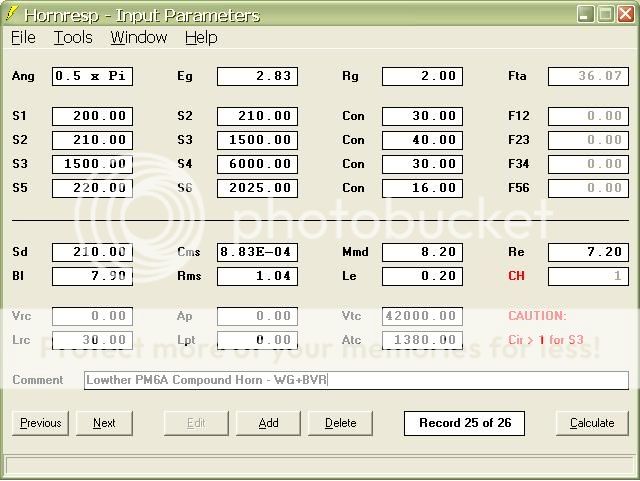
I modified it somewhat (enlarge the duct and chamber to boost up more bass):
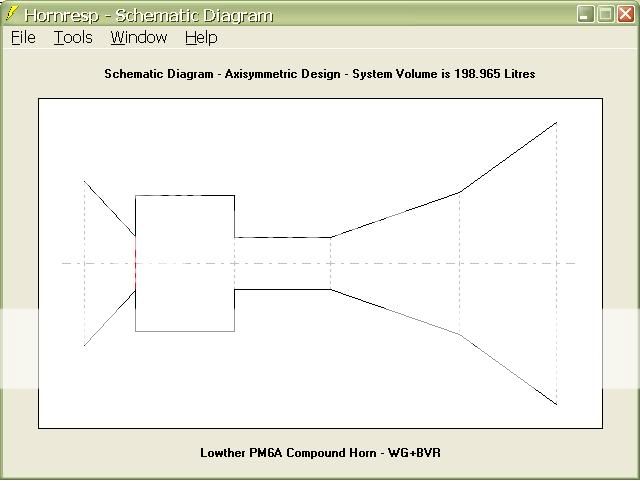
And the 'thing' will look like this:
And I got the response as:
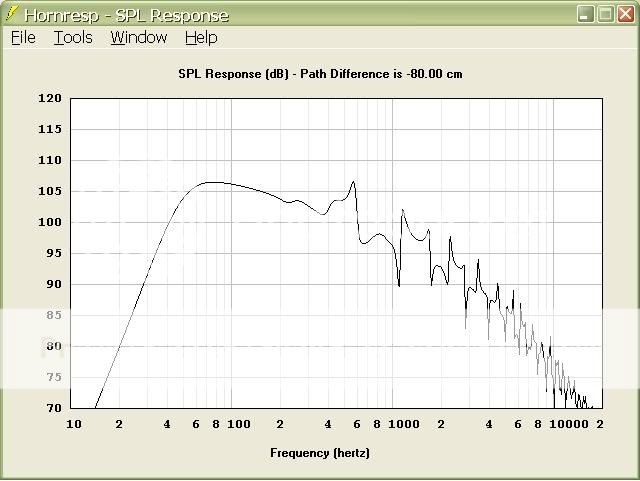
It looks pretty good, I guess. As long as the midhigh resonance peaks are well damped.
I set the path length difference as -80cm because I plan to put the mouth of BVR to the rear of cabinet and let it faces the wall or even corner. 80cm is more or less the depth of cabinet plus some of the width.
I'll play with the models some more.
Thanks again 😀
Thanks a lot for your input.
I modified it somewhat (enlarge the duct and chamber to boost up more bass):
And the 'thing' will look like this:
And I got the response as:
It looks pretty good, I guess. As long as the midhigh resonance peaks are well damped.
I set the path length difference as -80cm because I plan to put the mouth of BVR to the rear of cabinet and let it faces the wall or even corner. 80cm is more or less the depth of cabinet plus some of the width.
I'll play with the models some more.
Thanks again 😀
I modeled this thing:
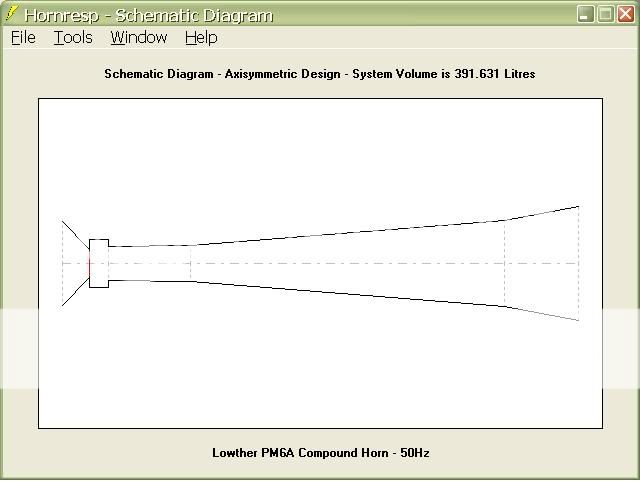
And got this if I set the BLH mouth facing forward:
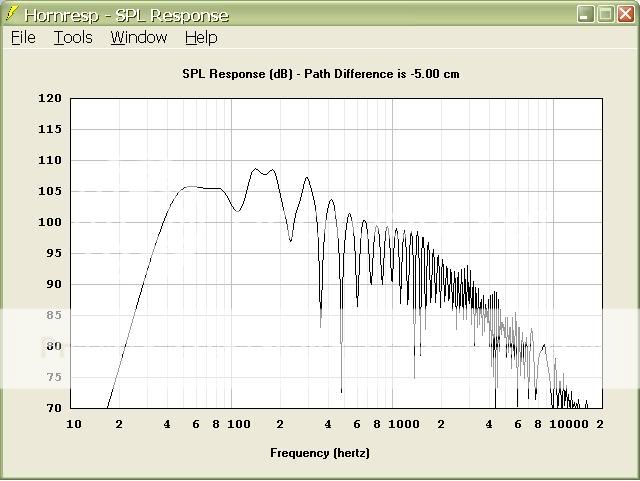
This if I set the BLH mounth on the back and facing a corner:
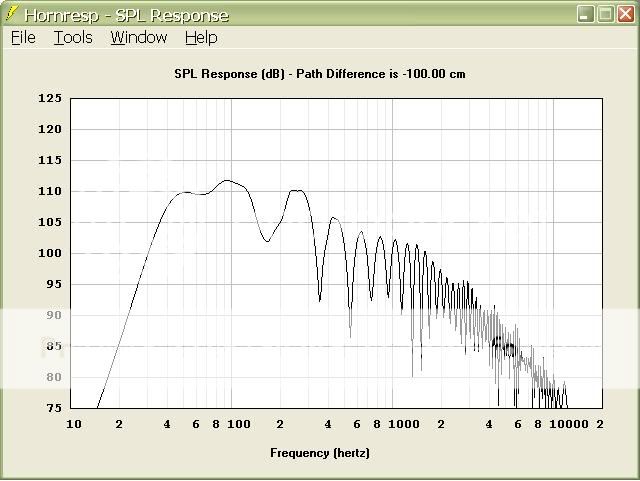
TBH this case looks worse, to me.
So it turns out quite the opposite of my previous expectation.
And got this if I set the BLH mouth facing forward:
This if I set the BLH mounth on the back and facing a corner:
TBH this case looks worse, to me.
So it turns out quite the opposite of my previous expectation.


Assuming you design sufficient gain into the back-horn, & the driver selected has a reasonably low mass-corner, going compound to lift the lower midband makes perfect sense, although the trick is always to get the crossover between them right.
Thanks for the comments 🙂
Hi hm,
Actually I've looked into some of your designs, they are very interesting indeed.
However, when a 'horn' is largely narrowed, it's character tends to a "pipe", that is, a zig-zag response and lower efficiency.
I back-engineered an Acousta (with PM6A), and got this:
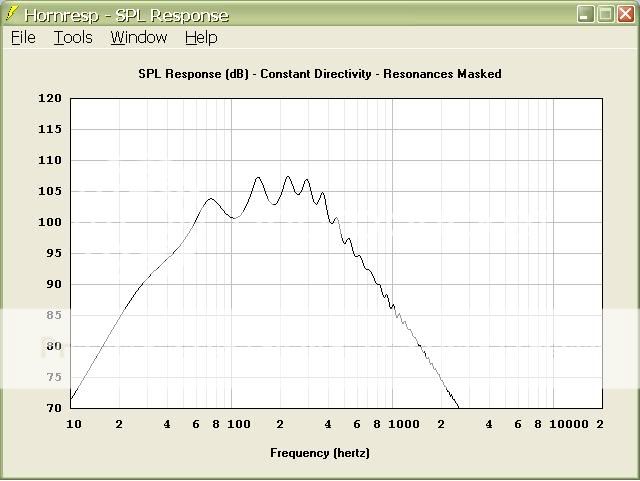
(placed at 1/4 space -- 1 pi )
Like very many other "commercial products", the CSA's along the 'horn' are highly reduced, thus a bad looking response and lower effeciency.
Getting into such 'trouble' of making a horn, I really hope a good result and don't want such a compromise.
I also thought of helper woofer or clear 2 way. Although those are technically correct, it's still somewhat disappointing to an enthusiast of single driver fullrange speaker ( -- especially a Lowther lover, I guess). This decision is not mine, as mentioned in the very beginning -- this is for a friend.
Hi Scottmoose,
Thanks for the advice. I thoght the same. I've listened to a pair of PM4A with Oris 150 horn. I like the sound very much. Tonal balace is excellent (for my taste, a little bit warm).
Without front loaded section, Lowthers sound too thin. It grabs attentions at first but becomes fatiguing quickly.
So I'll stick to the compound design and see what can be done.
Hi hm,
Actually I've looked into some of your designs, they are very interesting indeed.
However, when a 'horn' is largely narrowed, it's character tends to a "pipe", that is, a zig-zag response and lower efficiency.
I back-engineered an Acousta (with PM6A), and got this:
(placed at 1/4 space -- 1 pi )
Like very many other "commercial products", the CSA's along the 'horn' are highly reduced, thus a bad looking response and lower effeciency.
Getting into such 'trouble' of making a horn, I really hope a good result and don't want such a compromise.
I also thought of helper woofer or clear 2 way. Although those are technically correct, it's still somewhat disappointing to an enthusiast of single driver fullrange speaker ( -- especially a Lowther lover, I guess). This decision is not mine, as mentioned in the very beginning -- this is for a friend.
Hi Scottmoose,
Thanks for the advice. I thoght the same. I've listened to a pair of PM4A with Oris 150 horn. I like the sound very much. Tonal balace is excellent (for my taste, a little bit warm).
Without front loaded section, Lowthers sound too thin. It grabs attentions at first but becomes fatiguing quickly.
So I'll stick to the compound design and see what can be done.
Right, if you're going to back load, they need a big horn to damp that HF / midband sufficiently.
Hello,
simulations are not all,
AFAIK Hornresponse shows the horn mouth not the sum driver with horn,
in AJhorn it looks different,
so you need experience to get an idea what happens in real
and the room.
simulations are not all,
AFAIK Hornresponse shows the horn mouth not the sum driver with horn,
in AJhorn it looks different,
so you need experience to get an idea what happens in real
and the room.
Hello CLS,
I'm working on a simular setup for my lowther DX3
Also simming with hornresp.
Will follow your progress with a lot of attention.
I also studied Horst's work with interrest !!
Very subttle approach!!with a "filler"driver.
But to my regrets I must admit that I'm a purist.
So I'm going for ONE driver!!
James M. explaines in his paper that there will still be a hole from 300-1000Hz after using a BLH.
BLH only works till about 300Hz ( Horst says the same, I think)
So filling this hole with a front horn only seems justified!!
Question of finding the right balance between front and back.
Beauhorn uses this principle, and reading about Beauhorn, they seem to be "warm"sounding ; exactly what I'm looking for.
I found some round conical pieces that I would like to use as a fronthorn.
I will post a pic later this day.
Great to get some advice from the man with the hands : Horst, and the great Scott as well, this will be a stunning topic!!
I'm working on a simular setup for my lowther DX3
Also simming with hornresp.
Will follow your progress with a lot of attention.
I also studied Horst's work with interrest !!
Very subttle approach!!with a "filler"driver.
But to my regrets I must admit that I'm a purist.
So I'm going for ONE driver!!
James M. explaines in his paper that there will still be a hole from 300-1000Hz after using a BLH.
BLH only works till about 300Hz ( Horst says the same, I think)
So filling this hole with a front horn only seems justified!!
Question of finding the right balance between front and back.
Beauhorn uses this principle, and reading about Beauhorn, they seem to be "warm"sounding ; exactly what I'm looking for.
I found some round conical pieces that I would like to use as a fronthorn.
I will post a pic later this day.
Great to get some advice from the man with the hands : Horst, and the great Scott as well, this will be a stunning topic!!
Planning on using this as a conical front horn.
size diam. large : 35 cm
diam. small : 15 cm.
length : 20 cm.
I will need a front box as well, calculated 0,5 liter.
Or I will have to trim the small diam. till ~18 cm , lenght resulting in 16 cm.
My mini bamboe Ikea speaker, with a foster 085 for size comparing.
size diam. large : 35 cm
diam. small : 15 cm.
length : 20 cm.
I will need a front box as well, calculated 0,5 liter.
Or I will have to trim the small diam. till ~18 cm , lenght resulting in 16 cm.
My mini bamboe Ikea speaker, with a foster 085 for size comparing.
Attachments
![imgp0112 [640x480].jpg](/community/data/attachments/112/112880-278cc37b310951233fe63289249251c3.jpg?hash=J4zDezEJUS)
hm said:AFAIK Hornresponse shows the horn mouth not the sum driver with horn.
Hi hm,
The Hornresp Combined Response tool calculates the overall front plus rear SPL response 🙂.
Kind regards,
David
From my own very limited experiences, hornresp is quite accurate. The results of the real things are very close to the simulations. (And I remember reading many other's similar comments. ) So I inevitably use it for planning.
If I've already done many trial and errors and had my own 'database', then I'd be more confident. But I have not, so now I choose to trust the simulations. OTOH, my friend trusts me blindly, it's almost a bet for him. I'll give him the drawing and he'll pay for the carpentry and drivers. I'm not quite sure what he will finally get....
If I've already done many trial and errors and had my own 'database', then I'd be more confident. But I have not, so now I choose to trust the simulations. OTOH, my friend trusts me blindly, it's almost a bet for him. I'll give him the drawing and he'll pay for the carpentry and drivers. I'm not quite sure what he will finally get....
For higher efficiency, I go for horn eventually and ended up with something like the attached drawing. (And it is now built by a professional capenter... )
According to the sims by hornresp, the combined responses changed significantly with the path length variations. So I placed the horn mouth to the sides of cabinet and expected this can provide a multiple differences thus averaging out the irregulations of response.
Hope it'll come out all right.
According to the sims by hornresp, the combined responses changed significantly with the path length variations. So I placed the horn mouth to the sides of cabinet and expected this can provide a multiple differences thus averaging out the irregulations of response.
Hope it'll come out all right.
Attachments

Hello,
nice construction,
the flare rate for the bass horn is a bit large,
which low frequenz you want to get.
nice construction,
the flare rate for the bass horn is a bit large,
which low frequenz you want to get.
More or less as those sims on the first several posts, target is 40Hz. With the position very near or at the corner.
We'll see how it goes maybe 1 week later 😀
We'll see how it goes maybe 1 week later 😀
According to the sims by hornresp, the combined responses changed significantly with the path length variations.
I'd be worried if it didn't... 😉
Be interesting to hear how it works out.

- Status
- Not open for further replies.
- Home
- Loudspeakers
- Full Range
- Dilemmas, as always -- BLH vs BVR