

Resistor codes? Sure in this day of cut and paste, it costs virtually nothing to add it to the manual.
better be right or your great big venture goes west.
How to read the code is easily found on the web, but even though I have that handy memory jogger, as presbyopia set in around age 44, I found it much easier to just measure them with my cheap DMM I even measure to be sure that mouser or digikey's machine put the right value in the bag.
better be right or your great big venture goes west.
How to read the code is easily found on the web, but even though I have that handy memory jogger, as presbyopia set in around age 44, I found it much easier to just measure them with my cheap DMM
I even measure to be sure that mouser or digikey's machine put the right value in the bag.I have a couple of thoughts on this subject....
1) In our "free market" economy we vote with our dollars. If we don't get satisfaction from brand X we buy from brand Y. For example, right now I'm very dissatisfied with my car. In the future I plan not to buy that brand.
2) I also understand the point of view of the person creating the product. As has been mentioned previously, the return on the dollar spent for design goes to almost nil if the price is low and the need for support is high.
3) The possibility of people like Brian and Peter offering their products to us, before the age of the internet, is low, unless they advertised in magazines.
4) Thankfully, we have this forum from which to learn and some pretty smart people who are willing to help. By the way, thanks to all of you who are helpful!
1) In our "free market" economy we vote with our dollars. If we don't get satisfaction from brand X we buy from brand Y. For example, right now I'm very dissatisfied with my car. In the future I plan not to buy that brand.
2) I also understand the point of view of the person creating the product. As has been mentioned previously, the return on the dollar spent for design goes to almost nil if the price is low and the need for support is high.
3) The possibility of people like Brian and Peter offering their products to us, before the age of the internet, is low, unless they advertised in magazines.
4) Thankfully, we have this forum from which to learn and some pretty smart people who are willing to help. By the way, thanks to all of you who are helpful!

I've only just found this thread and I have some sympathies with each side of the argument!
But I would add this from my experiences with Decibel Dungeon. No matter how carefully that you try and explain something, there will always be some people who don't understand it. To make it foolproof (or Dummyproof) is just not practical.
Judging by the amount of time that I spend answering questions through DD, I can really understand the workload of anybody selling DIY kits.
And producing adequate documentation is not as easy, quick or simple as may have been implied in this thread. People selling kits are generally good at electronics, not Powerpoint presentations. The example of providing a guide on how to read resistor values was given. Sure, it is easy to cut and paste these days but it's also very easy to find that sort of information for yourself!
I agree that some kits can be confusing for a complete novice. But there is no need to be a complete novice these days. It's easy enough to get soldering practise, while sites such as my own and Rod Elliot's (to name but two of many) will bring even the complete beginner up to a level where building a GC kit will not be such a complete mystery!
But I would add this from my experiences with Decibel Dungeon. No matter how carefully that you try and explain something, there will always be some people who don't understand it. To make it foolproof (or Dummyproof) is just not practical.
Judging by the amount of time that I spend answering questions through DD, I can really understand the workload of anybody selling DIY kits.
And producing adequate documentation is not as easy, quick or simple as may have been implied in this thread. People selling kits are generally good at electronics, not Powerpoint presentations. The example of providing a guide on how to read resistor values was given. Sure, it is easy to cut and paste these days but it's also very easy to find that sort of information for yourself!
I agree that some kits can be confusing for a complete novice. But there is no need to be a complete novice these days. It's easy enough to get soldering practise, while sites such as my own and Rod Elliot's (to name but two of many) will bring even the complete beginner up to a level where building a GC kit will not be such a complete mystery!

Interesting thread.
Personally, I think you need to understand the motivation of the people that produce boards and kits. Most of the offerings here on diyAudio are from enthusiasts, and are nowhere near commercial. Yes, they might make a bit of pocket money, but that's all, as a business enterprise they don't even get off first base, as our American cousins would say.
I don't know of any kit provided by a diyAudio member that is anything near what a commercial offering would really cost if everything was factored in. I can give an example, the KSA50 GB I designed the PCB for. I spent probably about 5-600 hours on this design, modding the PCB, making and testing prototypes, researching and sourcing components, and that doesn't even include the time that Mark Gulbrandsen spent doing the admin work on the production and distribution side . I wanted to produce a build manual, (and still might) but that would probably take another couple of hundred hours to do properly. If all these costs were taken into account, we would be looking at about 300$ per board.
So, if you want something as cheap as you get it on this board, or from other hobbyist sites, then I feel that it is important that it is understood that you have to be prepared to invest a little time on your own to do the appropriate research. Even for the money making kits and boards, the only return would come if the sales were up in the thousands, not the dozens or occasionally hundreds. You're still getting much more than your money's worth!
Oh, and if this sounds a bit bitter and twisted, I'm not. At the moment I'm looking at two preamp circuits, and another power amp, all of which will be GBs, so no money for me there either!
Personally, I think you need to understand the motivation of the people that produce boards and kits. Most of the offerings here on diyAudio are from enthusiasts, and are nowhere near commercial. Yes, they might make a bit of pocket money, but that's all, as a business enterprise they don't even get off first base, as our American cousins would say.
I don't know of any kit provided by a diyAudio member that is anything near what a commercial offering would really cost if everything was factored in. I can give an example, the KSA50 GB I designed the PCB for. I spent probably about 5-600 hours on this design, modding the PCB, making and testing prototypes, researching and sourcing components, and that doesn't even include the time that Mark Gulbrandsen spent doing the admin work on the production and distribution side . I wanted to produce a build manual, (and still might) but that would probably take another couple of hundred hours to do properly. If all these costs were taken into account, we would be looking at about 300$ per board.
So, if you want something as cheap as you get it on this board, or from other hobbyist sites, then I feel that it is important that it is understood that you have to be prepared to invest a little time on your own to do the appropriate research. Even for the money making kits and boards, the only return would come if the sales were up in the thousands, not the dozens or occasionally hundreds. You're still getting much more than your money's worth!
Oh, and if this sounds a bit bitter and twisted, I'm not. At the moment I'm looking at two preamp circuits, and another power amp, all of which will be GBs, so no money for me there either!

Any one doing amps etc should have a DMM and measure every component before it goes in. Hugh provides a resistor chart in the AKSA kits but have never used it as it's quicker with a DMM (next kit Hugh, leave that page out for me ).
When entering DIY, the builder has to make the effort and do some learning at great resources like Rod's site.... it's not easy but has to be done. It's the only way you will learn otherwise you will spend all your time asking questions and have doubts about your ability and possibly fry yourself or your family. It's not a safe hobby without the knowledge.
I do agree that instructions do have to be detailed enough to ensure safety, show where components go and any testing procedures. Other than that, it's DIY.
These guys that sell the chipamp kits for example, only make peanuts for all the effort they put in and to me is more a service to the DIY community.... I'm thankful they do it.
).When entering DIY, the builder has to make the effort and do some learning at great resources like Rod's site.... it's not easy but has to be done. It's the only way you will learn otherwise you will spend all your time asking questions and have doubts about your ability and possibly fry yourself or your family. It's not a safe hobby without the knowledge.
I do agree that instructions do have to be detailed enough to ensure safety, show where components go and any testing procedures. Other than that, it's DIY.
These guys that sell the chipamp kits for example, only make peanuts for all the effort they put in and to me is more a service to the DIY community.... I'm thankful they do it.

Rabbitz -- I think of sites like chipamp.com as a service to the community rather than a business venture as well. BTW, thanks for the great Wiki entry, LOTS of info in there I'd been trying to dig up! The fact that they offer a known-good PCB + components at roughly the same price as the components from Digikey in low volume is really great!
Wintermute -- I just built my first amp, a BrianGT LM3886 kit. I could have built the amp on protoboard from the notes on the nat semi site, but it would have probably taken me an extra 500 hours to sort out a result which worked as well (and I would have given up before that). I consider the debugged schematic and PCBs to be a real boon, because with Brian's kits, it literally takes an hour or two per channel to put together.
My formal electronics training is an 11th grade class in electronics (I skipped 9th and 10th grades due to hobby experience, and in the 11th grade I stayed an average of 6 hours per week after class... had to change schools to take electronics, so I wanted to get the most out of one semester as possible), plus my dad taught me how to solder etc. when I was 8 and I read a lot of electronics mags as a youngster. Most of my electronics work has been digital (oh, and I have a university intro level course in digital design, but that was more VHDL than practical electroncs).
But I digress. It is my opinion that anybody who got an A in 9th grade electronics could throw these amps together with few issues, as long as they are careful. The hard part isn't the boards, it's damned chassis (at least in my experience).
BrianGTs LM3886 boards do in fact allow the use of the amp PCB as the star ground. This wasn't evident to me when I first started the project, so I spent a lot of time agonizing about how I was going to ground the amp. In the end, I just connected everything as labelled on the PCB silkscreen and got excellent results. It's possible that a dedicated grounding scheme as suggested by CarlosFM might produce better sonics, but the "default" is okay too. I think the default setup is in fact very close to the way 47 labs does things.
Resistor colour codes -- can any of you guys actually READ those things on those little Phoenix SRS (etc) resistors? Maybe I'm getting blind in my old age! Now maybe I understand better why my dad used to make me sort his resistors when I was young! I measured them all, which was convenient anyhow, as that allowed me to match the two channels as precisely as the random components would allow (random placement could have allowed differences up to 2%, by measuring, I should be within 0.5%).
Although Brian's instructions are excellent, one thing that I don't think is mentioned in these kits enough is the use of a lamp lead during testing, and progressive testing! I tested each part as I built it, everything worked the first try, but it was definately not a waste of time. And testing the amp as a whole through the lamp lead was fun, watching the bulb pulse in time with the bass!
You also mentioned the phase of the secondaries... Huh? Does it really matter with a dual-bridge/dual-supply setup? What happens if it's wrong? Is it possible that I got lucky twice? (I have two PS boards). I thought that the only difference would be when the DC pulses arrived at the capacitors, but the caps are supposed to turn those into flat lines anyhow.
Wes
Wintermute -- I just built my first amp, a BrianGT LM3886 kit. I could have built the amp on protoboard from the notes on the nat semi site, but it would have probably taken me an extra 500 hours to sort out a result which worked as well (and I would have given up before that). I consider the debugged schematic and PCBs to be a real boon, because with Brian's kits, it literally takes an hour or two per channel to put together.
My formal electronics training is an 11th grade class in electronics (I skipped 9th and 10th grades due to hobby experience, and in the 11th grade I stayed an average of 6 hours per week after class... had to change schools to take electronics, so I wanted to get the most out of one semester as possible), plus my dad taught me how to solder etc. when I was 8 and I read a lot of electronics mags as a youngster. Most of my electronics work has been digital (oh, and I have a university intro level course in digital design, but that was more VHDL than practical electroncs).
But I digress. It is my opinion that anybody who got an A in 9th grade electronics could throw these amps together with few issues, as long as they are careful. The hard part isn't the boards, it's damned chassis (at least in my experience).
BrianGTs LM3886 boards do in fact allow the use of the amp PCB as the star ground. This wasn't evident to me when I first started the project, so I spent a lot of time agonizing about how I was going to ground the amp. In the end, I just connected everything as labelled on the PCB silkscreen and got excellent results. It's possible that a dedicated grounding scheme as suggested by CarlosFM might produce better sonics, but the "default" is okay too. I think the default setup is in fact very close to the way 47 labs does things.
Resistor colour codes -- can any of you guys actually READ those things on those little Phoenix SRS (etc) resistors? Maybe I'm getting blind in my old age! Now maybe I understand better why my dad used to make me sort his resistors when I was young! I measured them all, which was convenient anyhow, as that allowed me to match the two channels as precisely as the random components would allow (random placement could have allowed differences up to 2%, by measuring, I should be within 0.5%).
Although Brian's instructions are excellent, one thing that I don't think is mentioned in these kits enough is the use of a lamp lead during testing, and progressive testing! I tested each part as I built it, everything worked the first try, but it was definately not a waste of time. And testing the amp as a whole through the lamp lead was fun, watching the bulb pulse in time with the bass!
You also mentioned the phase of the secondaries... Huh? Does it really matter with a dual-bridge/dual-supply setup? What happens if it's wrong? Is it possible that I got lucky twice? (I have two PS boards). I thought that the only difference would be when the DC pulses arrived at the capacitors, but the caps are supposed to turn those into flat lines anyhow.
Wes

Hi Wes,
no problem with what you are saying here, I just don't like the idea of someone who has never picked up a soldering iron or had any experience at all in electronics doing a mains powered project edit: I should probably qualify that, there are allways people who have never done something and have a natural aptitude for it, and in these cases there shouldn't be a problem, but at the same time the mains can be dangerous (here in Aus it is 240V which will kill you)..... I got a 240V shock years ago because I didn't use any insulation on the pot/switch I used and didn't unplug from the power point before poking around the volume pot. I was lucky stupid but lucky!
I'm not sure about dual bridges, haven't thought about it, I was only thinking about a single bridge when I wrote that (all I have ever used), I have seen kits out there that use a single bridge, and there it does matter. Probably should have been more clear on that (or though about it a bit more) Sorry if I confused anyone!
Tony.
no problem with what you are saying here, I just don't like the idea of someone who has never picked up a soldering iron or had any experience at all in electronics doing a mains powered project
edit: I should probably qualify that, there are allways people who have never done something and have a natural aptitude for it, and in these cases there shouldn't be a problem, but at the same time the mains can be dangerous (here in Aus it is 240V which will kill you)..... I got a 240V shock years ago because I didn't use any insulation on the pot/switch I used and didn't unplug from the power point before poking around the volume pot. I was lucky stupid but lucky! I'm not sure about dual bridges, haven't thought about it, I was only thinking about a single bridge when I wrote that (all I have ever used), I have seen kits out there that use a single bridge, and there it does matter. Probably should have been more clear on that (or though about it a bit more)
Sorry if I confused anyone!Tony.

Thanks guys for the help I decided to check the web and found tons of sites on how to read resistor codes. fortuneatly the first number on three of the four resistor type was different meaning I only had to figure out one number. had it been any more difficult I would have had a lot of trouble. Those things are tiny!!! Labeling them doesn't seem like an issue of significant overhead to me, just laziness or carelessness especially if you were made aware in advance that the buyer is a beginner.
I knew I could solder, but it was the impression from that manual that anyone can build one no matter how inexperienced they are, that sold me. So when it did require a little more thinking and research I got a little shock. I soldered everything last night Now I just have to figure out chassis layout, toroid, switch, LED etc.
But oh well I'm sure everybody here will be more then happy to help.
I knew I could solder, but it was the impression from that manual that anyone can build one no matter how inexperienced they are, that sold me. So when it did require a little more thinking and research I got a little shock. I soldered everything last night Now I just have to figure out chassis layout, toroid, switch, LED etc.
But oh well I'm sure everybody here will be more then happy to help.

MY PROPOSAL
All of this makes good reading, but the fact is, there are frustrations and concerns on both sides. These issues need to be addressed in general, so let's stick to generalities. There is no need to name names.
So, we do we as noobs get our needs served, and how do you, kit makers, stay in business and continue to provide us with your valuable and innovative ideas? I agree completely that kit makers can be overwhelmed into oblivion, and that's not what we wish to see. So you expect us to know how to solder, read the value on a resistor, etc... On the other hand, we want our kits to be complete, to have good instructions, to expect a decent and timely response to our questions, etc...
I would to propose a DIY Bill of Rights, permanently posted on this site, a document that governs how business should be conducted between all vendors and customers (private transations do not apply), just as how we are expected to behave on this forum when we post threads. The document will have 2 columns, one that outlines the commitment of the vendor, the other the responsibilities of the DIYer. By buying this kit, you are entitled to certain rights, but also are relieving the vendor from certain liabilities.
What do you think?
Regards,
Hong
All of this makes good reading, but the fact is, there are frustrations and concerns on both sides. These issues need to be addressed in general, so let's stick to generalities. There is no need to name names.
So, we do we as noobs get our needs served, and how do you, kit makers, stay in business and continue to provide us with your valuable and innovative ideas? I agree completely that kit makers can be overwhelmed into oblivion, and that's not what we wish to see. So you expect us to know how to solder, read the value on a resistor, etc... On the other hand, we want our kits to be complete, to have good instructions, to expect a decent and timely response to our questions, etc...
I would to propose a DIY Bill of Rights, permanently posted on this site, a document that governs how business should be conducted between all vendors and customers (private transations do not apply), just as how we are expected to behave on this forum when we post threads. The document will have 2 columns, one that outlines the commitment of the vendor, the other the responsibilities of the DIYer. By buying this kit, you are entitled to certain rights, but also are relieving the vendor from certain liabilities.
What do you think?
Regards,
Hong

My  from someone who's been both consumer and seller...
This has a lot to do with history and the angle from which it entered into so called commercial territory. For those of us that were around when the [chip amp PCB] designs were being conceived right here on this forum, these kits mean something a little different because they allowed more of us to get involved and try these chip amps for a tiny fraction of a similar commercial design. Essentially we were all hearing this gainclone buzzword and wanted in, but understood that we still had to do research work and get answers by searching this forum.
Offering these kits and PCB's was a huge step to give more people the enjoyment of audio DIY, and with the huge cost saving while also raising the average quality level of the physical implementation. So then the manual was created based on some feedback (again things that were thrashed out on this forum) to make it that little bit easier and less daunting for the DIYer.
Now the newer gen see the pretty websites and manual etc. and perhaps expect a much more polished and complete system but have less understanding (through no fault of their own) that this wasn't the essence of it to begin with.
A consumer will argue their right to be hand held when handing over their cash (and rightly so), and a seller will eventually have to factor this in the cost. So here we are losing the essence of the idea with which it all started.
---------
flaevor, you need a multimeter. Remember you're building an electrical project here! It will help you later when testing/debugging conenctions, measuring DC offset, and is a neccessary safety test tool when working with power amps. And you won't have to mess around reading resistor codes
Tony, I've had 240v go through me on a number of occassions That would make me infinitely more stupid (and luckier perhaps).
from someone who's been both consumer and seller...This has a lot to do with history and the angle from which it entered into so called commercial territory. For those of us that were around when the [chip amp PCB] designs were being conceived right here on this forum, these kits mean something a little different because they allowed more of us to get involved and try these chip amps for a tiny fraction of a similar commercial design. Essentially we were all hearing this gainclone buzzword and wanted in, but understood that we still had to do research work and get answers by searching this forum.
Offering these kits and PCB's was a huge step to give more people the enjoyment of audio DIY, and with the huge cost saving while also raising the average quality level of the physical implementation. So then the manual was created based on some feedback (again things that were thrashed out on this forum) to make it that little bit easier and less daunting for the DIYer.
Now the newer gen see the pretty websites and manual etc. and perhaps expect a much more polished and complete system but have less understanding (through no fault of their own) that this wasn't the essence of it to begin with.
A consumer will argue their right to be hand held when handing over their cash (and rightly so), and a seller will eventually have to factor this in the cost. So here we are losing the essence of the idea with which it all started.
---------
flaevor, you need a multimeter. Remember you're building an electrical project here! It will help you later when testing/debugging conenctions, measuring DC offset, and is a neccessary safety test tool when working with power amps. And you won't have to mess around reading resistor codes
Tony, I've had 240v go through me on a number of occassions
That would make me infinitely more stupid (and luckier perhaps). 
Re: MY PROPOSAL
I think that transactions between buyers and sellers are between buyers and sellers. Getting this totally non-profit forum somehow stuck in the middle or trying to dictate a one-size-fits-all set of rules is a recipe for disaster.
hongrn said:
What do you think?
I think that transactions between buyers and sellers are between buyers and sellers. Getting this totally non-profit forum somehow stuck in the middle or trying to dictate a one-size-fits-all set of rules is a recipe for disaster.
I was just doing final assembly on my amp, and realized -- one more thing which needs to be documented in these kits are the screw and wire sizes that the PCBs are made for!
I wound up drilling some of my PCBs to accept 6-32 screws; the BrianGT kits are made for M3. Fortunately I had enough M3 standoffs around that I could get away with only drilling the power supply PCBs.
Wires -- I wound up counting copper strands as all I had lying around the house was 16 and 14 awg that were suitable for the power supply and speakers. Smaller gauge would have made the assembly easier; I'm thinking those PCBs are probably made for 18-20 awg.
Wes
I wound up drilling some of my PCBs to accept 6-32 screws; the BrianGT kits are made for M3. Fortunately I had enough M3 standoffs around that I could get away with only drilling the power supply PCBs.
Wires -- I wound up counting copper strands as all I had lying around the house was 16 and 14 awg that were suitable for the power supply and speakers. Smaller gauge would have made the assembly easier; I'm thinking those PCBs are probably made for 18-20 awg.
Wes

Those pcbs are also made for 4-40 screws (not M3). I don't see a need to fasten screws into standoofs, but rather use 6-32 standoffs as spaces for 4-40 screws.
While 6-32 hardware could be used as well, if you make holes bigger, it somehow does not match the small size of the boards.
While 6-32 hardware could be used as well, if you make holes bigger, it somehow does not match the small size of the boards.
Oh, well there you go -- case in point! FWIW, the M3s worked very well.
> I don't see a need to fasten screws into standoofs
Absolutely necessary for my power supply boards due to chassis design, and a nice safety factor the amp boards. Actually, is it even possible to fasten the PS boards to a metal chassis without standoffs??
> While 6-32 hardware could be used as well, if you make holes bigger,
> it somehow does not match the small size of the boards
Well, 6-32 isn't *that* much bigger (think computer harddrive screws) but they are definately the biggest you can get away with (and you have to be carefull what screws you use -- computer case screws would REALLY be pushing it, especially near the rectifier diodes).
I was really getting frustrated trying to find smaller-than-6-32 stand offs around town; all the computer shops are using 6-32 hardware at the moment, Canadian Tire doesn't carry standoffs of any type, and the smallest I could get from Home Despot was quarter-inch. So, I said, "Screw it!" and keyed up the 9/64s bit on the drill press... I wasn't about to drive 2.5 hours to TO just get freakin' hardware. LOL.
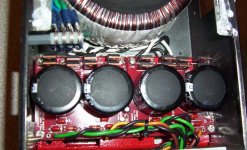
Attached is what the PSU looks like with 6-32 hardware.
Wes
> I don't see a need to fasten screws into standoofs
Absolutely necessary for my power supply boards due to chassis design, and a nice safety factor the amp boards. Actually, is it even possible to fasten the PS boards to a metal chassis without standoffs??
> While 6-32 hardware could be used as well, if you make holes bigger,
> it somehow does not match the small size of the boards
Well, 6-32 isn't *that* much bigger (think computer harddrive screws) but they are definately the biggest you can get away with (and you have to be carefull what screws you use -- computer case screws would REALLY be pushing it, especially near the rectifier diodes).
I was really getting frustrated trying to find smaller-than-6-32 stand offs around town; all the computer shops are using 6-32 hardware at the moment, Canadian Tire doesn't carry standoffs of any type, and the smallest I could get from Home Despot was quarter-inch. So, I said, "Screw it!" and keyed up the 9/64s bit on the drill press... I wasn't about to drive 2.5 hours to TO just get freakin' hardware. LOL.
Attached is what the PSU looks like with 6-32 hardware.
Wes
Attachments
wes-ninja250 said:Actually, is it even possible to fasten the PS boards to a metal chassis without standoffs??
I was actually suggesting using the standoffs as spacers only, so the thread on the screw and inside the stanoff doesn't neccessarily need to match, if you know what I mean.
I think that transactions between buyers and sellers are between buyers and sellers. Getting this totally non-profit forum somehow stuck in the middle or trying to dictate a one-size-fits-all set of rules is a recipe for disaster.
Why would posting a "code of business conduct" be a disaster for diyaudio? We're not asking the forum to either arbitrate, mediate, or police the transactions. The forum will just help bridge (pun intended) the needs of vendors and buyers alike. I think it will serve to enhance the relationship between the two sides, encourage more people to get involved in DIY, instead of this constant trepidation we all read here. The more I read about bad experiences a DIYer is having with a particular vendor, the less confidence I have with the latter. The code of conduct allows both sides to resolve these issues way before they get posted on the forum.
Hong
Hi Hong,
IMO your suggestion starts to move into legal teritory, something that I am sure the DIY Audio team do not want to be involved in
It is my observation that in general, forums of all sorts tend to give a skewed perspective when it comes to problems, because people are much more likely to post problems, (and perhaps dare I say it exagerate, or perhaps not post the full story), than they are to provide positive feedback....
The only kits I have ever bought came from Jaycar and Dick Smith electronics. Both of these companies have store fronts, neither provides any support to the kit builder if they run into problems!
They have disclaimers about the fact that they can't control the quality of the labour that the builder provides and I think that the both say up front that if you have problems the only form of support they offer is that you can send it into them and they will try to debug it at a cost of $70 per hour, and that it may take many hours to solve the problem. These are large companies!!!! The guys we are talking about here are doing it as a service to our community!!!
Do some research on what you can expect from "real comercial" entities and you may decide that what our forum members are providing goes well beyond that
Tony.
IMO your suggestion starts to move into legal teritory, something that I am sure the DIY Audio team do not want to be involved in
It is my observation that in general, forums of all sorts tend to give a skewed perspective when it comes to problems, because people are much more likely to post problems, (and perhaps dare I say it exagerate, or perhaps not post the full story), than they are to provide positive feedback....
The only kits I have ever bought came from Jaycar and Dick Smith electronics. Both of these companies have store fronts, neither provides any support to the kit builder if they run into problems!
They have disclaimers about the fact that they can't control the quality of the labour that the builder provides and I think that the both say up front that if you have problems the only form of support they offer is that you can send it into them and they will try to debug it at a cost of $70 per hour, and that it may take many hours to solve the problem. These are large companies!!!! The guys we are talking about here are doing it as a service to our community!!!
Do some research on what you can expect from "real comercial" entities and you may decide that what our forum members are providing goes well beyond that
Tony.
As to legal issues, in the end you can not waiver your life, at least in this country. Add to that the fact that internal voltage in any of these things can kill you (passives excepted). It makes for a real legal mess for the providing company in the event something unfortunate happens. Too, our society is increasingly litigious (or is that decreasingly responsible?). I'm surprised some of these companies ship to individuals, to be honest. I'm glad they do, but dang.
I'd recommend someone go into a hi-fi store and ask to listen to a real setup before building, be that a good integrated and a small pair of high-quality bookshelves or something larger. That will create more desire to complete the build, or start it in the first place. Initial builds should also be simple - pAiNfully simple.
One further suggestion - for the total newbs provide some good practical guidance for case layout, and sources for cases. Point out sources and keep them up to date.
Hope it helps.
I'd recommend someone go into a hi-fi store and ask to listen to a real setup before building, be that a good integrated and a small pair of high-quality bookshelves or something larger. That will create more desire to complete the build, or start it in the first place. Initial builds should also be simple - pAiNfully simple.
One further suggestion - for the total newbs provide some good practical guidance for case layout, and sources for cases. Point out sources and keep them up to date.
Hope it helps.
The newbie has to start out in electronics with some non mains voltage stuff. There are plenty of small low voltage kits to learn on so you can get the fried caps, exploding caps, cooked resistors out of the way and start learning diagnostic skills.
I still remember the sound of frying caps, smell of cooking resistors and the bang of wiring a transformer incorrectly and still cringe each time I turn the power on for the first time on any project..... waiting.... waiting....ahhhh, it works.... phew. So now, every amp fires up perfectly each time.
There is plenty of information on this site on layouts and plenty of pics to illustrate it.
I still remember the sound of frying caps, smell of cooking resistors and the bang of wiring a transformer incorrectly and still cringe each time I turn the power on for the first time on any project..... waiting.... waiting....ahhhh, it works.... phew. So now, every amp fires up perfectly each time.
There is plenty of information on this site on layouts and plenty of pics to illustrate it.
- Status
- This old topic is closed. If you want to reopen this topic, contact a moderator using the "Report Post" button.
- Home
- General Interest
- Everything Else
- Suggestions for Companies Selling Kits