
This circuit dont use feedback, have 3,5 ohm of input impedance, and very low distortion , it gave only 0.000005% of distortion in the LTspice simulator at 2,5Vrms.
Yesterday, come to the conclusion that i need a new dac, so i will use the pcm1794 and dir9001, just because already have them.
I dont like the I/V of the pcm1794 datasheet, so i remember to use a circuit that i have design for a non feedback amp.
in attachment there is the asc file for the simulation. dont forget to go to control panel / compression , and turn off all compression for better visualization of fft.
if you have any doubt please fell free to ask 🙂
Yesterday, come to the conclusion that i need a new dac, so i will use the pcm1794 and dir9001, just because already have them.
I dont like the I/V of the pcm1794 datasheet, so i remember to use a circuit that i have design for a non feedback amp.
in attachment there is the asc file for the simulation. dont forget to go to control panel / compression , and turn off all compression for better visualization of fft.
if you have any doubt please fell free to ask 🙂
Attachments
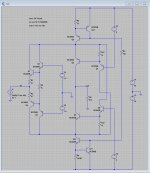

Just a few comments. Real life might have more distortion because you won't get such near-perfect cancellation in the push-pull grounded base BJTs - you might need offset trimming. You seem to have bias applied from voltage sources via emitter followers: the followers will degrade the perfect voltage sources (in simulation - real life will be different), and of course followers work by using feedback. You might not have signal feedback, but your bias uses feedback.
Just a few comments. Real life might have more distortion because you won't get such near-perfect cancellation in the push-pull grounded base BJTs - you might need offset trimming. You seem to have bias applied from voltage sources via emitter followers: the followers will degrade the perfect voltage sources (in simulation - real life will be different), and of course followers work by using feedback. You might not have signal feedback, but your bias uses feedback.
DF96 this is only a simulation circuit, not the final project.
of course the circuit need offset trimming, a dc servo will be use.
the voltage sources will be replaced by zeners or voltage references.
when i say no feedback, i mean no closed loop (global feedback).
i will post a more simplified circuit, for better understanding.
Last edited:
this is the more simplified circuit. and have 0.008% distortion.
the only sources of distortion are the currents from the bases of the transistores( that's the reason for using the extra four transistors ),
and the fact that the 2 current sources in the first circuit are not perfect.
the only sources of distortion are the currents from the bases of the transistores( that's the reason for using the extra four transistors ),
and the fact that the 2 current sources in the first circuit are not perfect.
Attachments


You are using a perfect current source, infinite z out. DAC's in real life are worse.
Use a voltage source instead, and put a 1k resistor between it and your input. This is closer to reality. Use 1Volt per ma the DAC puts out.
Better would be to build and measure though...not much sense to believe these Simulation numbers, you might be disappointed.
Use a voltage source instead, and put a 1k resistor between it and your input. This is closer to reality. Use 1Volt per ma the DAC puts out.
Better would be to build and measure though...not much sense to believe these Simulation numbers, you might be disappointed.

This is very similar to Dr. Leach's moving coil head amp:
Moving Coil Cartridge Head Amps
So, you will achieve lower noise and lower input impedance by removing the emitter resistors R1, R2. If you use current mirrors as suggested by Dr. Leach, then a further improvement should occur. You can lower the input impedance even more by doubling up the input BJT's. I have a similar circuit that has about 1 ohm input impedance.
The DACs that you like have DC current on their output pins which will upset the balance of your circuit. The PCM1794a for example puts out -6.2mA of DC current. Something has to be done about that as well.
Moving Coil Cartridge Head Amps
So, you will achieve lower noise and lower input impedance by removing the emitter resistors R1, R2. If you use current mirrors as suggested by Dr. Leach, then a further improvement should occur. You can lower the input impedance even more by doubling up the input BJT's. I have a similar circuit that has about 1 ohm input impedance.
The DACs that you like have DC current on their output pins which will upset the balance of your circuit. The PCM1794a for example puts out -6.2mA of DC current. Something has to be done about that as well.
Nico Ras has just posted a link to the following article with some relevancy with DAC/opamp design issue: "Dangers of Rounded Numbers, Typical Specifications, and Simulations"
The Dangers of Rounded Numbers, Typical Specifications, and Simulations - Tutorial - Maxim
The Dangers of Rounded Numbers, Typical Specifications, and Simulations - Tutorial - Maxim

This circuit dont use feedback, have 3,5 ohm of input impedance, and very low distortion , it gave only 0.000005% of distortion in the LTspice simulator at 2,5Vrms.
....
if you have any doubt please fell free to ask 🙂
My doubt is - DAC chips don't put out sinewaves, yet you're simulating with a sinewave source. So I can't but help thinking all those zeroes in your distortion figure are rather meaningless.
A modern CMOS DAC such as the PCM179x puts out some very fast edges with rise times perhaps <1nS. Have you considered using transient simulation ? - you can input a .wav file containing a sinewave which will be somewhat closer to reality because it'll have steps. It will still not really be close enough though as it won't have all the out of band hash that's intrinsic to S-D converters.
Nico Ras has just posted a link to the following article with some relevancy with DAC/opamp design issue: "Dangers of Rounded Numbers, Typical Specifications, and Simulations"
The Dangers of Rounded Numbers, Typical Specifications, and Simulations - Tutorial - Maxim
Well, according to a couple of engineers I know from Analog Devices, the version of SPICE they use is far advanced from anything you can buy on the street. People who design chips must get it right the first time because tooling is so expensive. That's my understanding anyway.
As for us amateurs, we can tweek a circuit all we want because we have the time to do so. Obviously, circuits like this I/V converter requires matched transistors. Many audiophile circuits required matched components, which is not in the realm of practical for mass produced stuff.
Of course, the article is correct in that relying too much on a SPICE model, or expecting exactly the same results from a real version of the model, is not realistic. I know that. I consider the tests (FFT, noise, etc) in SPICE to be a mere guide for the performance of the real device.
My doubt is - DAC chips don't put out sinewaves, yet you're simulating with a sinewave source. So I can't but help thinking all those zeroes in your distortion figure are rather meaningless.
A modern CMOS DAC such as the PCM179x puts out some very fast edges with rise times perhaps <1nS. Have you considered using transient simulation ? - you can input a .wav file containing a sinewave which will be somewhat closer to reality because it'll have steps. It will still not really be close enough though as it won't have all the out of band hash that's intrinsic to S-D converters.
Yeah, you're right, plus the fact that SPICE models for these DAC chips are not available as far as I can tell. I have not advanced far enough yet to be able to create a sine WAVE file with the stair step overlay that would be the actual output from a DAC.
You are using a perfect current source, infinite z out. DAC's in real life are worse.
Use a voltage source instead, and put a 1k resistor between it and your input. This is closer to reality. Use 1Volt per ma the DAC puts out.
Better would be to build and measure though...not much sense to believe these Simulation numbers, you might be disappointed.
I tried your suggestion and got even better performance for my circuit in simulation. I was using a current source with 1Mohm impedance originally.
If I had an Audio Precision analyzer then I could verify the design in real life. The best I have is a computer based real time spectrum analyzer with a higher noise floor than the AP analyzer. Nothing I have has a higher spec than the PCM1794a chip, so there's no way I can verify or optimize what ever I build with it.
You may try to convert a sine to a .wav in LT Spice, and then feed the I/V input with the .wav
It's possible in LT Spice, but I never tried this.
Generally, I wouldn't trust sim distortion numbers anyway. It can give you a hint about the direction you can take, but exact numbers?
A common base I/V is a good starting point to build upon anyway.
It's possible in LT Spice, but I never tried this.
Generally, I wouldn't trust sim distortion numbers anyway. It can give you a hint about the direction you can take, but exact numbers?
A common base I/V is a good starting point to build upon anyway.
[...] Nothing I have has a higher spec than the PCM1794a chip, so there's no way I can verify or optimize what ever I build with it.
Maybe not with gear, but if your ears are happy, go for it...
Oh, btw, open loop common base stages are not THAT low distortion, you may well be able to measure it.
Maybe not with gear, but if your ears are happy, go for it...
Oh, btw, open loop common base stages are not THAT low distortion, you may well be able to measure it.
Well, I think that any I/V stage should be measured with the DAC in real life, since they are interrelated (the performance of the DAC is somewhat dependent on the characteristics of the I/V stage it's driving, for example). So, measuring the performance of an I/V stage in a vacuum is not very meaningful in my opinion, but can point in the right direction, as you suggested.
I have read that high quality DAC's are trimmed at the factory while they are driving the opamp I/V stage shown in the datasheet, so that's something to consider when designing a different I/V stage.
You may try to convert a sine to a .wav in LT Spice, and then feed the I/V input with the .wav
It's possible in LT Spice, but I never tried this.
Generally, I wouldn't trust sim distortion numbers anyway. It can give you a hint about the direction you can take, but exact numbers?
A common base I/V is a good starting point to build upon anyway.
Yeah, there is a facility in the SPICE version I use that allows a custom waveform. I have not explored that yet.
I have read that high quality DAC's are trimmed at the factory while they are driving the opamp I/V stage shown in the datasheet, so that's something to consider when designing a different I/V stage.
Where did you read that? It might have been true for the old style multibit DACs - they relied on laser trimming of their resistor networks. That's one reason for why PCM1704 is so much more expensive than say PCM1792. But CMOS DACs such as the PCM179x series are designed not to need trimming - that's one of the big advantages in manufacturing for S-D type DACs.
You are using a perfect current source, infinite z out. DAC's in real life are worse.
Use a voltage source instead, and put a 1k resistor between it and your input. This is closer to reality. Use 1Volt per ma the DAC puts out.
Better would be to build and measure though...not much sense to believe these Simulation numbers, you might be disappointed.
Hi Zinsula,
i was told that the output impedance of the pcm1794 is 2M with 22pf, try to find in internet for the real value, but no luck 🙁.
this circuit was design with that in mind, with a source of 1k the distortion is a lot worse (0.008%). but i have made some changes in the input and got 0.000064% thd with 1k input impedance see circuit below
how do you come to 1k 😕, i think is very low for a current source, if someone knows the real value please post.
Attachments


I think this topology is also very interesting for a Transimpedance MC phono stage.
The only thing that worries m is noise into low impedance, say an MC cartridge that has 6 Ohm DC impedance. On one hand the ist the R9 4kOhm resistor. On the other hand there is Q2, Q5. The Base-Emitter resistance is in the noise loop even when the bias to that transistors is made very low impedance. What whould happen if R9 will be shunted by a big Electrolytic ?
The only thing that worries m is noise into low impedance, say an MC cartridge that has 6 Ohm DC impedance. On one hand the ist the R9 4kOhm resistor. On the other hand there is Q2, Q5. The Base-Emitter resistance is in the noise loop even when the bias to that transistors is made very low impedance. What whould happen if R9 will be shunted by a big Electrolytic ?
My doubt is - DAC chips don't put out sinewaves, yet you're simulating with a sinewave source. So I can't but help thinking all those zeroes in your distortion figure are rather meaningless.
A modern CMOS DAC such as the PCM179x puts out some very fast edges with rise times perhaps <1nS. Have you considered using transient simulation ? - you can input a .wav file containing a sinewave which will be somewhat closer to reality because it'll have steps. It will still not really be close enough though as it won't have all the out of band hash that's intrinsic to S-D converters.
sorry to disagree with you. but simulating this circuit with a sine source is enough.
this circuit is very fast and dont have slew problems, if you care to simulate in ltspice, you will see that there is no voltage variations, only in the output so there is no parasitic capacitors to charge and discharge. i will explain better how this topology works.

- Home
- Source & Line
- Digital Source
- dac I/V convertion with very low distortion