

OK, I redid the I2S connections and the PS to the isolator. Now I do have (distorted) sound! Apparently there was a bad connection somewhere in the connector to the header.Are you still using the isolated out and is the power still applied to the output side of the isolator?
When you send music to the WaveIO, is there voltage on the data output? With no music there should be no voltage and with music there should be voltage.
If you get output from the LR, BC, and DT and the wiring is correct to the dac chip (check for shorts to ground - check that there is voltage at the dac inputs), then check your dac. Check for correct power supply voltage at the chip, check for loose wires, bad solder connections, and that all grounds are connected.
Good luck.
Strange, because I tested for continuity and shorts a dozen of times...
Thank you for the help.
NOw try and fix things which I've broken to get things working (like the 8 dacs in parallel).
MArco
I am very interested to order a WaveIO board to play together with the SotM tX-USB exp PCI Express Card, using the buffered SPDIF out of the WaveIO.
Are there any known issues with this combination?
I have the PCI version in combination with Alix 1 board. A dream. Beats anything I had before. I run MPDPUP.
Wave IO power supply
Hi, wondering if anyone has any idea what is causing an issue I am having.
The WaveIO card works fine when I run it off of the LCDS from Twisted Pair, I wanted to try another supply I have that is a better supply. It is a 5v 2A supply, when I hook it up then power everything up, my computer does not have the Luckit driver any more. If I reconnect things the way they were it appears again. Any idea why this would happen?
Thanks,
Mark
Hi, wondering if anyone has any idea what is causing an issue I am having.
The WaveIO card works fine when I run it off of the LCDS from Twisted Pair, I wanted to try another supply I have that is a better supply. It is a 5v 2A supply, when I hook it up then power everything up, my computer does not have the Luckit driver any more. If I reconnect things the way they were it appears again. Any idea why this would happen?
Thanks,
Mark

Noisy Ground with Isolated I2S
My WaveIO is currently connected to my veroboard tda1541a dac using the isolated I2S outputs. The WaveIO has its own independent power supply on the input side with its own transformer, and the isolator is powered by its own regulator at the power pins and sharing a transformer with the reclock and dem frequency divider chips and I2S attenuators on the dac board. The WaveIO input side ground is not connected to the dac side ground. The transformer primaries do share the ac mains power.
Using an old 35MHz oscilloscope the power supplies and ground on the dac appear relatively noise free, except for noise with a amplitude of approximately 30 mV peak to peak at the MCLK frequency of the WaveIO. The frequency would change with the change of 44.1 kHz music to 96 kHz music. The MCLK isolated output is not connected to the dac as I have used a clock on the dac side (not at the same frequency as the WaveIO MCLK) for reclocking.
Prior to using the I2S isolated output, the dac was connected to the non-isolated I2S and there was noise from the computer and usb harddrives getting through to the dac (approximately 0.5 volts in the region of 180kHz). The isolated outputs appear to be free of this noise.
I don't think that I have wired up the WaveIO incorrectly. Anyone else experience this? Or any ideas why this is happening or what I may have done wrong?
My WaveIO is currently connected to my veroboard tda1541a dac using the isolated I2S outputs. The WaveIO has its own independent power supply on the input side with its own transformer, and the isolator is powered by its own regulator at the power pins and sharing a transformer with the reclock and dem frequency divider chips and I2S attenuators on the dac board. The WaveIO input side ground is not connected to the dac side ground. The transformer primaries do share the ac mains power.
Using an old 35MHz oscilloscope the power supplies and ground on the dac appear relatively noise free, except for noise with a amplitude of approximately 30 mV peak to peak at the MCLK frequency of the WaveIO. The frequency would change with the change of 44.1 kHz music to 96 kHz music. The MCLK isolated output is not connected to the dac as I have used a clock on the dac side (not at the same frequency as the WaveIO MCLK) for reclocking.
Prior to using the I2S isolated output, the dac was connected to the non-isolated I2S and there was noise from the computer and usb harddrives getting through to the dac (approximately 0.5 volts in the region of 180kHz). The isolated outputs appear to be free of this noise.
I don't think that I have wired up the WaveIO incorrectly. Anyone else experience this? Or any ideas why this is happening or what I may have done wrong?
Me Too
Returning to this thread after more than a year.
In contrast to most other users of WaveIO, my experience is that regardless of ground noise from non-isolated I2S, my TDA1541A based DAC still sound better with it than isolated I2S of current WaveIO. This is my personal opinion and I have no measurements to prove it.
Nonetheless, I wish to have USB isolation without resultant higher jitter from NVE IL715. Thus,
One daughter board for me as well:
1. hirez69
2. analog_sa
3. m.massimo
4. ozlegend
5. luisbock
6. vitalica
7. palmito
8. gabanyayaya
9. danny_66
10. shoom
11.12. kp93300 X 2
13. lindamar
14. merlin el mago
15. Reo
16. arkadiush1
17. jmltinc
18. zibra
19. tagheuer
20. hochopeper
21. hacker
22. Bemused
23. vanwykca
24. sandor
25. jrling
26. bismuth
27. necplusultra
28. flocchini
29. ichiban
30. edbk
31. Nikon1975
32. pawlus
33. dubai2000
34. henri47
35. presapian
36. Corpius
37. Ryssen
38. carsten.witt
39. Sidiropa
40. Ryelands
41. krautxy
42. 43. 44. 45. Mats x 4
46. ecchecequa
47. 48. lm1no2 x 2
49. Magsy
50. Jogi
51. CKL
52. needsp
53. number9
54. steve jones
55. nuriasanta
56. miksi
57. audiodesign
58. hordmop
59. cjunkk
60. Thermio
61. dex-rex
62. & 63. Claudius J. x2
64. boggy62
65. sck2288
66. rjbaldwin
67. ravid
68. igor
69. neugruen
70. Miclaud
71. Luxury54
72. mjock3
73. JLOP
74. Stixx
75. CeeVee
76. Blitz
77. Spev
78. new2hifi

Hello and sorry to all members here on this board, because, I did not read all comments in this thread yet, and it could be, that my question is mentioned before.
Want to buy the Wave I/O board, but I have to know if the board, software and all needed drivers are running under Windows 8? And how long is the delivery time?
Greetings Rainer
Want to buy the Wave I/O board, but I have to know if the board, software and all needed drivers are running under Windows 8? And how long is the delivery time?
Greetings Rainer
That group buy is for the Daughter card (in development) but can be purchased with a WaveIO for all that does not have one already. As for prices, are unknown so far but will be available when I'll finish it. Thanx!What is the price of the waveIO group buy?
Hello Rainer, you have PM but it comes a little bit late, I'm sorry as I had to solve some personal issues and this ruined all my plans with dispatch dates. Given this, it becomes longer than posted on WaveIO's web page but I'll work close to catch it up from behind.Hello and sorry to all members here on this board, because, I did not read all comments in this thread yet, and it could be, that my question is mentioned before.
Want to buy the Wave I/O board, but I have to know if the board, software and all needed drivers are running under Windows 8? And how long is the delivery time?
Greetings Rainer
Thank you for understanding, L
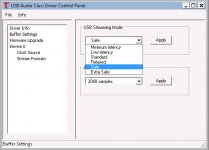
USB Streaming Mode
Hi Lorien:
I am sorry if the question has been already asked and answered but please help me understand a setting in driver's control panel
USB Streaming Mode
Minimum latency
Low latency
Standard
Relaxed
Extra Safe
Do these settings only relate to buffer size? Any effect on USB streaming/clocking? Do these settings affect jitter at all? Please write in detail.
Thanks
Hi Lorien:
I am sorry if the question has been already asked and answered but please help me understand a setting in driver's control panel
USB Streaming Mode
Minimum latency
Low latency
Standard
Relaxed
Extra Safe
Do these settings only relate to buffer size? Any effect on USB streaming/clocking? Do these settings affect jitter at all? Please write in detail.
Thanks
Attachments

I've tried with 5v (datasheet of the isolator specifies a max of 7v). No sound ...
Trying onlyone dac chip is very difficult. I can't easily take one out of the tower.
Or would it be enough to remove the power supply to 7 of the 8 dac chips?
Is there a way to measure if levels to the dac chips are ok? I don't have a scope ...
Thanks, marco
Setting up TDA1543 towers is tricky on itself (adjusting both V+ and the Rref, and settling for the non-clipping point). During most settings I tried it failed, even failed for no reasons at all (i understood) and sometimes haphazardly.
- Did the tower work in a different setting (CD player for instance); i did not see you mentioned that.
Of course remove power of chips is OK to start; but then you need approx. an 8x as high Rref to get the same Vref...

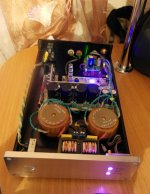
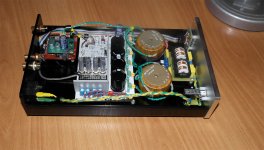
Hi! This is my implementation based on the WaveIO and ArpeggioT2 DAC
Attachments
@ new2hifi: I've forwarded your question to Thesycon as I don't know how that Control Panel was designed nor knowledge about how it works. I'll post their answer right after I'll get it.
@ Klim: very nice project you have there! Can I post them on luckit.biz @ Gallery section?
Cheers,
L
@ Klim: very nice project you have there! Can I post them on luckit.biz @ Gallery section?
Cheers,
L
Last edited:
@Lorien:Thanks! WaveIO- very good sound, stable device.
No problem about gallery.
One question about samlerate settings in control panel (WIN 7)
Regardless of the frequency of the playing file output format remains the same as defined in the device settings. Hence, resampling occurs means the operating system kernel? Or the driver? How can I make the output bitrate automatic switch would be match the playing file bitrate?
p.s. sorry for my bad English :^)
No problem about gallery.
One question about samlerate settings in control panel (WIN 7)
Regardless of the frequency of the playing file output format remains the same as defined in the device settings. Hence, resampling occurs means the operating system kernel? Or the driver? How can I make the output bitrate automatic switch would be match the playing file bitrate?
p.s. sorry for my bad English :^)
- Home
- Source & Line
- Digital Line Level
- XMOS-based Asynchronous USB to I2S interface