
I have understood your claim well.jkeny said:Wolfson should be kicked hard for this - putting the chips on the board & charging you for them & then not allowing you to use them - crazy!!
Along your context, TI should be kicked because their evaluation board product for TAS5706 Class-D Amplifier chip
http://focus.tij.co.jp/jp/general/docs/litabsmultiplefilelist.tsp?literatureNumber=slou220
does not implement USB audio streaming functionality neither in spite of their use of TAS1020B for I2C control to TAS5706 chip.
Your comment on the sound makes sense to me. Do you have the same impression even if you attenuate WM8741 output via USB control and compensate it with your HPA? I'm afraid that output gain setting of OPamp system on the board is somewhat high.prinzinio said:Ofcourse it plays nice in overall meaning, but HIGH frequency is extremelly harsh for me, I cant listen to it for a long period of time.
Guys, do i have to change all four opamps on the pcb if I want to have only unbalanced (RCA) stereo playback?
@jkeny
primary reason why I bought this board was that i thought i will be able to send audio from my pc via USB. I was sooooo disapointed afterwords..
Do you employ a good power supply for +-12V?
(In my case "No". I'm not sure that a good power supply can improve quality of the analog sound or not.)
Anyway, you can pass the whole OPA227s and connect your own analog systems to the raw analog voltage output tap of the evaluation board. I have tried connecting my balance-input accepting headphone amplifier to the H2A and H4A points on the board. This means no LPF at all. The result is really "awful". Very harsh and crude treble! I think you need certain LPF circuits of balanced manner. One possible way is to install "line transformer" as LINN KLIMAX DS does.
To tell the truth, I had also expected the USB Audio functionality before I received the actual product. However, as it was not my primary purpose, I disappointed not so much.
Bunpei
Bunpei said:
I have understood your claim well.
Along your context, TI should be kicked because their evaluation board product for TAS5706 Class-D Amplifier chip
http://focus.tij.co.jp/jp/general/docs/litabsmultiplefilelist.tsp?literatureNumber=slou220
does not implement USB audio streaming functionality neither in spite of their use of TAS1020B for I2C control to TAS5706 chip.
To tell the truth, I had also expected the USB Audio functionality before I received the actual product. However, as it was not my primary purpose, I disappointed not so much.
I didn't know about the TAS5706 board until you pointed this out - absolutely no excuse for TI - TAS1020B is their USB controller!! I see that they have put a disclaimer in large letters (outlined in orange box) on the the USB & SPDIF schematic sheets in the PDF "Engineering Evaluation Only". So that is how they avoid the issue but a large kicking is deserved.
..I would return all such eval boards & demand a full refund. I imagine it could be argued under the legal consumer protection right "not fit for the purpose"? Unless it was clearly stated beforehand that USB was not operational!Originally posted by prinzinio
primary reason why I bought this board was that i thought i will be able to send audio from my pc via USB. I was sooooo disapointed afterwords
This exposes the mistake people often make that the eval boards from the manufacturer are the best implementation of that chip! (I'm thinking of stuffed boards for sale here that are just copies of eval boards)
Bunpei said:Chiaki is planning to design and release a new PCB board kit with necessary components. Please let us know your opinions.
bunpei<at>ta2<dot>so-net<dot>ne<dot>jp
(The improved version may have a simple LCD display.)
Chiaki completed his PCB design of "SDTrans192" and sent an order to a manufacturer. We will produce 10 sets this time and hopefully distribute 6 or 7 sets internationally.
Detailed information will be posted as soon as Chiaki test the PCB version and his release OK decision is asserted.
The board contains,
1. SDHC/SD memory card reader
2. MPU: Microchip MCP130T-300I/TT (100MIPS 8051 architecture)
3. TCXO: Fox Electronics FXO-HC735-22.5792,24.5760 (stablitiy to +- 20ppm)
4. I2S signal generator: Altera EP3C16E144C8N(FPGA)
5. S/PDIF Interface : Cirrus Logic CS8406 (192kHz Digital Audio Interface Transmitter)
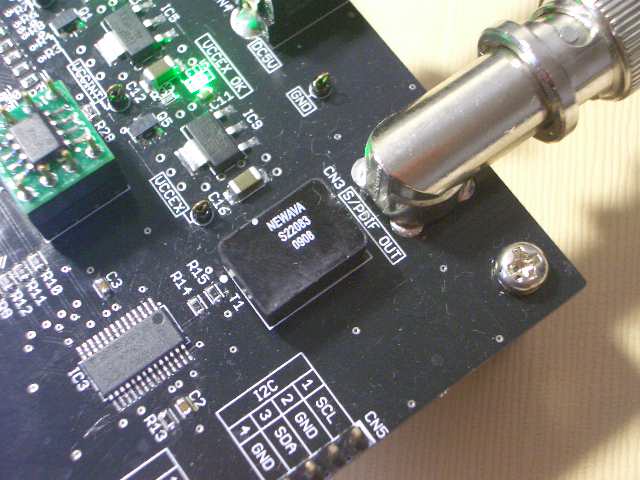
6. S/PDIF Pulse Transformer: Newava Technology S22083
7. LCD: 16-char, x 2-line for human interface
8. LED: 7 LEDs including an indicator for "I2S output buffer empty"
9. Buttons: 4 buttons (Mode, FWD, PLAY, REW )
10. Power Supply Unit: 5V 2A switching power supply ( 100-240V AC input)
The transport can play
1. WAV format file ( no FLAC, MP3) of
2. 44.1, 48, 88.2, 96, 176.4, 192kHz sampling rates
3. 16, 24 bit data length
stored on
1. SDHC (maximum data size limit 32GB)
2. SD ( MiniSD, MicroSD compatible if proper adapters are used)
formatted as
1. FAT16
2. FAT32
and output
1. I2S audio signals
2. S/PDIF signal via 75 ohm BNC connector (no RCA, TOSLINK)
If you have any questions, please contact to Bunpei via e-mail
bunpei<at>ta2<dot>so-net<dot>ne<dot>jp
Bunpei
Attachments

Sorry Bunpei,
Didn't mean to hijack your thread!
You managed to get 24bit/192KHz working concurrently with reading FAt32 from SDHC & output to LCD screen? No hiccups?
Are you selling a kit or the bare boards? I like your choice of most components but I already have some of these anyway (Tent clock in this speed, LCD screen, power supply). I wouldn't be interested in the S/PDIF parts. Can you give me an idea of pricing?
Didn't mean to hijack your thread!
You managed to get 24bit/192KHz working concurrently with reading FAt32 from SDHC & output to LCD screen? No hiccups?
Are you selling a kit or the bare boards? I like your choice of most components but I already have some of these anyway (Tent clock in this speed, LCD screen, power supply). I wouldn't be interested in the S/PDIF parts. Can you give me an idea of pricing?
jkeny said:You managed to get 24bit/192KHz working concurrently with reading FAt32 from SDHC & output to LCD screen? No hiccups?
Are you selling a kit or the bare boards?
Dear jkeny,
As for the first version of prototype, we have no LCD. We just have 3 buttons and two LEDs. In this situation, Chiaki have achieved a necessary data transfer rate for 192kHz 24bit with about 60% cpu load (He invented a good data transfer scheme). I have seldom observed I2S output FIFO buffer empty status.
We prospect that 32bit might be also available if we can test it with 32bit compatible DAC chip.
Hence, even if we add a tiny simple LCD screen to it, we think we can guarantee the necessary transfer rate.
We are planning to sell a kit with all necessary components
(No casing, interface cables and connectors).
Some of important LSIs are to be soldered already on the board.
Bunpei

Hi Bunpei
cool project. Admirable skills!
Hardware and concept seems to be a winner design. But everybody has other targets or expectations. So, in a subjective way I would rate
good:
+ SDHC support to 32GB (or greater?)
+ good clock
+ WAV until 24/192
+ I2S interface
not so good/ wishes:
- S/PDIF only via BNC (I prefer TOSLINK or RCA)
- remote control !!!!!!!!!!!!!
- 4x16 LCD with backlight
- gapless playback (a must have!!!)
- good user interface with play time, song title, artist, album
- firmware updates via SD-card
Put me on the list please!
cool project. Admirable skills!
Hardware and concept seems to be a winner design. But everybody has other targets or expectations. So, in a subjective way I would rate
good:
+ SDHC support to 32GB (or greater?)
+ good clock
+ WAV until 24/192
+ I2S interface
not so good/ wishes:
- S/PDIF only via BNC (I prefer TOSLINK or RCA)
- remote control !!!!!!!!!!!!!
- 4x16 LCD with backlight
- gapless playback (a must have!!!)
- good user interface with play time, song title, artist, album
- firmware updates via SD-card
Put me on the list please!
Thomas, BNC is a Mans digital connection, with RCA being a technical/cost based cop out that isn't even a real 75R connection. As for toslink, well that has limitations, but maybe it could be an addon?
Good call on gapless playback though!
Good call on gapless playback though!
Hey, Bunpei, anymore news on this very interesting project?
good:
+ SDHC support to 32GB (or greater?)
+ good clock
+ WAV until 24/192
+ I2S interface
not so good/ wishes:
- S/PDIF only via BNC (I prefer TOSLINK or RCA)
- remote control !!!!!!!!!!!!!
- 4x16 LCD with backlight
- gapless playback (a must have!!!)
- good user interface with play time, song title, artist, album
- firmware updates via SD-card
We are very sorry that we have provided no news for a long while on this thread.
We'd like to announce Chiaki's PCB version of SDHC Memory Card Transport, "SDTrans192".
<http://www.chiaki.cc/Transport/images/sdtrans192r20-pcb1.jpg>
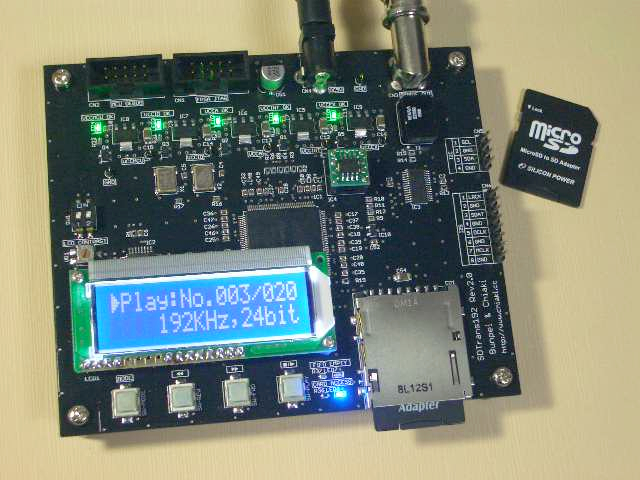
He designed the PCB by himself and outsourced PCB production. Surprisingly enough, he finished all soldering by hand in spite of the use of numerous surface-mounting parts.
He has just finished two as of now and will expect additional three as a first lot.
He added a LCD that displays a play number and WAV file parameters and
error messages if necessary. A "gapless playback" is not supported.
<http://www.chiaki.cc/Transport/images/sdtrans192r20-ui1.jpg>
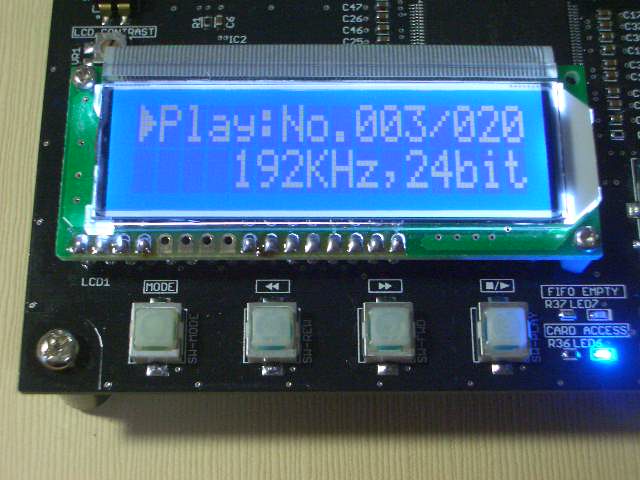
As a human interface, 4 buttons and 2 LED are employed.
This transport has both I2S and S/PDIF (BNC, 75 ohm) interfaces.
<http://www.chiaki.cc/Transport/images/sdtrans192r20-i2ci2s1.jpg>
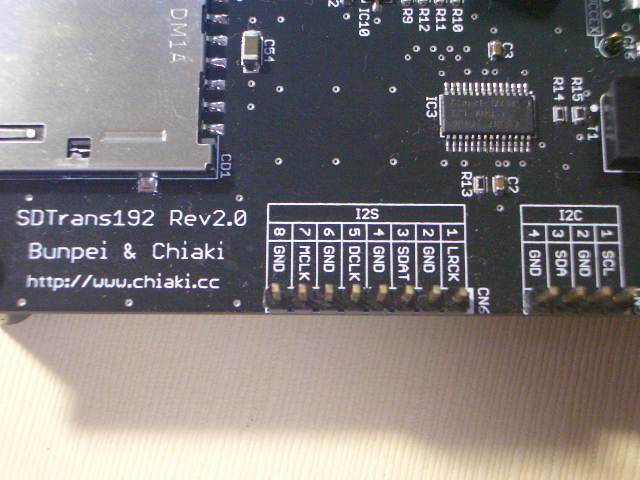
<http://www.chiaki.cc/Transport/images/sdtrans192r20-spdif1.jpg>
Main devices are MPU, SiLabs C8051F361 (25.4 MHz, 100 MIPS) [left in the following picture] and FPGA, Altera CycloneIII
.
<http://www.chiaki.cc/Transport/images/sdtrans192r20-mcu1.jpg>
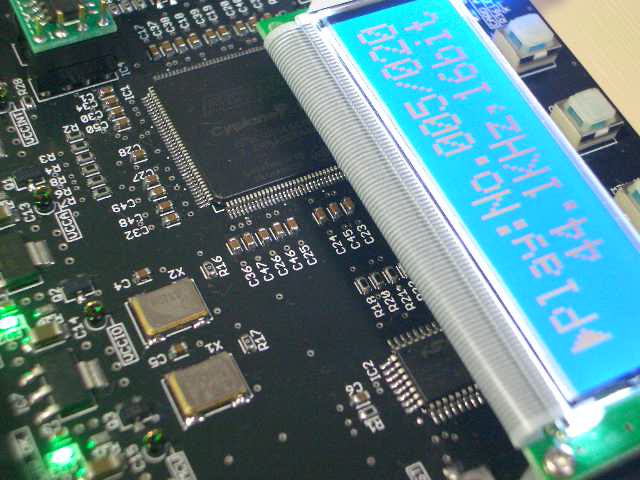
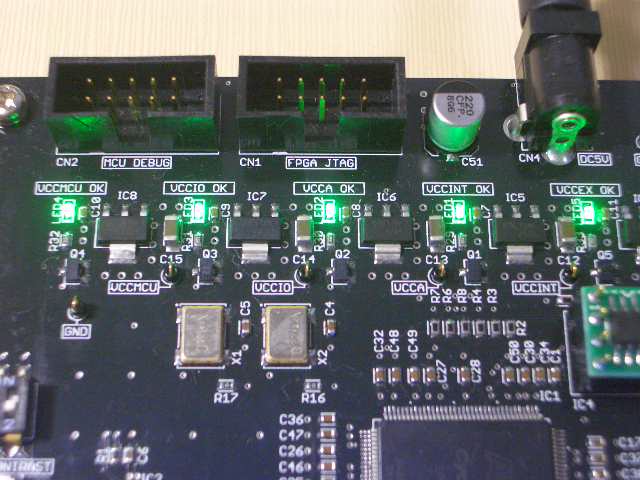
Chiaki selected such high-precision components as two TCXOs and five voltage regulators.
<http://www.chiaki.cc/Transport/images/sdtrans192r20-pwr1.jpg>
If you want to try this "SDTrans192", its price is 350 USD and additional delivery charge. Only payment via PAYPAL will be accepted.
If you do not satisfied with its quality of the transport in an initial one-month trial period, we will provide a refund after your return.
For requesting details in this distribution plan, please contact to Bunpei by e-mail.
bunpei<at>ta2<dot>so-net<dot>ne<dot>jp
<http://www.chiaki.cc/Transport/images/sdtrans192r20-mcu1.jpg>
Chiaki selected such high-precision components as two TCXOs and five voltage regulators.
<http://www.chiaki.cc/Transport/images/sdtrans192r20-pwr1.jpg>
If you want to try this "SDTrans192", its price is 350 USD and additional delivery charge. Only payment via PAYPAL will be accepted.
If you do not satisfied with its quality of the transport in an initial one-month trial period, we will provide a refund after your return.
For requesting details in this distribution plan, please contact to Bunpei by e-mail.
bunpei<at>ta2<dot>so-net<dot>ne<dot>jp

at last I have this transport in my system running. First impression is very positive but I need more burn in and time for criitical listening .
Here is a picture with the transport connected to a naked dac
Here is a picture with the transport connected to a naked dac
Attachments

Last edited:
It is quite some time that the 192trans is playng in my system, now I can post some more insight opinion. The 192trans is quite a costy $360 board shipping included then you need a box and a power supply, I compared it with my usual cd player that is a Sony esd557 used as transport only, it is old but the mechanic of this unit is the best drive made by Sony and used by many upmarket brand. The cds I used for listening session were ripped with Eac in accurate mode, every ripping take a lenghty 15 minutes with my pc (four year old) but I wanted the most accurate result as possible. The 192trans is housed in hifi2000 23x17cm box and powered by a 5v Jung superegulator. Cd and 192trans are connected to a 4397dac.
The music played included all genre jazz, classical, pop. The sdhc player is very very different from the cd player, my first impression are confirmed the 192trans open a new window in digital music . His strenght are : solid image, exceptional naturality, harmonics richness, lifelike dinamics. In a quartet music each instrument is so naturally different and recognisible as never been before. Complex music is easily followed and enjoied. Only now I can hear how the cdplayer sound is boxed and artificial . The initial investment is largely rewarded , this board is actually a bargain in term of dollars for sound quality
But there are area of improvement as well, first in the software infact the board most of the time doen't see the tracks sequence as in the original cd, and I can't understand the logic it uses . This problem is overcome by Eac ripping the cd as image but in this way I can't surf throw the tracks.
Second the bass is very good but I'd like a better control, it make an image a bit too large.
In conclusion, 192trans is now my main digital source and I really want to thank you Bunpei and Chiaki for made this possible and their contribution in making a big step in music enjoiment
The music played included all genre jazz, classical, pop. The sdhc player is very very different from the cd player, my first impression are confirmed the 192trans open a new window in digital music . His strenght are : solid image, exceptional naturality, harmonics richness, lifelike dinamics. In a quartet music each instrument is so naturally different and recognisible as never been before. Complex music is easily followed and enjoied. Only now I can hear how the cdplayer sound is boxed and artificial . The initial investment is largely rewarded , this board is actually a bargain in term of dollars for sound quality
But there are area of improvement as well, first in the software infact the board most of the time doen't see the tracks sequence as in the original cd, and I can't understand the logic it uses . This problem is overcome by Eac ripping the cd as image but in this way I can't surf throw the tracks.
Second the bass is very good but I'd like a better control, it make an image a bit too large.
In conclusion, 192trans is now my main digital source and I really want to thank you Bunpei and Chiaki for made this possible and their contribution in making a big step in music enjoiment

Hi all,
Forgive me the dumb question, but could somebody explain me the rationale behind the SD memory music source? I mean no music can be purchased on such media in the music stores. Perhaps it will in the future as SD will become cheap. But today the primary medium is CD, so one has the option of a) either buy the music on CD (but then what is the point of copying it to SD card? To make it portable without the quality degradation of MP3?) or b) borrow it from someone (then the copyright is breached BTW). In either case, one needs an intermediate step (and time) to rip the music onto the hard disk of a PC, then copy it from the hard disk onto the SD card. Or did I miss something? Is there a purpose-built hardware to copy the CD onto SD card in one quick step?
Excuse me again if the answers are evident for all but myself.
Forgive me the dumb question, but could somebody explain me the rationale behind the SD memory music source? I mean no music can be purchased on such media in the music stores. Perhaps it will in the future as SD will become cheap. But today the primary medium is CD, so one has the option of a) either buy the music on CD (but then what is the point of copying it to SD card? To make it portable without the quality degradation of MP3?) or b) borrow it from someone (then the copyright is breached BTW). In either case, one needs an intermediate step (and time) to rip the music onto the hard disk of a PC, then copy it from the hard disk onto the SD card. Or did I miss something? Is there a purpose-built hardware to copy the CD onto SD card in one quick step?
Excuse me again if the answers are evident for all but myself.
Chiaki and Bunpei much appreciated and enjoyed giolight's evaluation report. Thank you very much for the posting.But there are area of improvement as well, first in the software infact the board most of the time doen't see the tracks sequence as in the original cd, and I can't understand the logic it uses . This problem is overcome by Eac ripping the cd as image but in this way I can't surf throw the tracks.
Second the bass is very good but I'd like a better control, it make an image a bit too large.
In conclusion, 192trans is now my main digital source and I really want to thank you Bunpei and Chiaki for made this possible and their contribution in making a big step in music enjoiment
Chiaki is improving the software for human interface now. We will let you know when a firmware update is ready in the near future.
The first concept at the beginning of this project was;Hi all,
but could somebody explain me the rationale behind the SD memory music source?
"How can we provide audio data to DAC with a bit perfect manner and with minimum jitters? Establishing a simple path by eliminating devices involved as possible." One solution is a SD Memory Card transport.
In Japan, a young female singer, Mai Kuraki released her recent album in such multiple media, CD/MicroSD Memory Card/USB Memory/MiniDisc(MD)/LP/Cassette Tape. Of course, this is an experimental approach.I mean no music can be purchased on such media in the music stores. Perhaps it will in the future as SD will become cheap.
I think SD/MicroSD Memory Card media can be compared to iPod. Anyway, both require PC.But today the primary medium is CD, so one has the option of a) either buy the music on CD (but then what is the point of copying it to SD card? To make it portable without the quality degradation of MP3?) or b) borrow it from someone (then the copyright is breached BTW). In either case, one needs an intermediate step (and time) to rip the music onto the hard disk of a PC, then copy it from the hard disk onto the SD card. Or did I miss something?
Chiaki is improving the software for human interface now. We will let you know when a firmware update is ready in the near future.
Any news regarding the new firmware?
Hi there.
Bunpei, did you ever consider a digital volume control for your device? That would make it IMO a complete solution.
Cheers
Bunpei, did you ever consider a digital volume control for your device? That would make it IMO a complete solution.
Cheers

A bit expensive @ 350USD...
Have you considered making a conventional through hole board for this project that the average DIY'er could easily assemble? Obviously some of he parts need to be SMT so you could provide a part assembled board for a much reduced price 😉
Its a great product by the way 🙂
Have you considered making a conventional through hole board for this project that the average DIY'er could easily assemble? Obviously some of he parts need to be SMT so you could provide a part assembled board for a much reduced price 😉
Its a great product by the way 🙂
Hi there.
Bunpei, did you ever consider a digital volume control for your device? That would make it IMO a complete solution.
Cheers
Isn't I2C connection already planned to add a volume microcontroller? Is it the firmware ready to this function?
Soundcheck, some DAC's have this option already (i.e. TPA Buffalo 32 bits, via I2C plus “volumite” microcontroller). You could use all them together.

Bunpei, have you considered designing a SDHC transport that streams back DSD (from DFF/ DSDIFF/DSF files)? It would be terrific! 😀
We are sorry to say that no new remarkable improvements on human interface are achieved yet. Chiaki is very busy for his own business at this time of the year. The firmware is coded in an assembly language of 8051 CPU. This is also one of reasons that modifications are not easy.Any news regarding the new firmware?
Instead, Chiaki made some basic improvements for firmware updating and WAV header interpretations.
Bunpei
Hi there.
Bunpei, did you ever consider a digital volume control for your device? That would make it IMO a complete solution.
Cheers
When we think of "a digital volume control", two approaches are possible.
1. This player outputs volume cntrolled PCM data.
On this point, we can't do this because our CPU 8051 has no enough power to achieve this.
2. This player outputs I2C commands for controling an external DAC device.
It might be possible if we could target such a specific DAC chip as WM8741.
I hope "soundcheck" will understand these difficulties well.
Bunpei
- Home
- Source & Line
- Digital Source
- MicroSD Memory Card Transport Project