

Eric,
It was just a remark, not a criticism by all means.
I guess we take different approaches in certain peripheries like power supply.
When I am finished with mine, maybe we have a better basis for exchanging notes.
😉
Best regards,
Patrick
It was just a remark, not a criticism by all means.
I guess we take different approaches in certain peripheries like power supply.
When I am finished with mine, maybe we have a better basis for exchanging notes.
😉
Best regards,
Patrick

Hi Patrick,Eric,
It was just a remark, not a criticism by all means.
I guess we take different approaches in certain peripheries like power supply.
When I am finished with mine, maybe we have a better basis for exchanging notes.
😉
Best regards,
Patrick
I didn't feel any criticism at all. I laugh when I read your post; I'm glad to see someone else interesting with this part 😉
It will be very interesting to made evaluation with two different approaches.
Best regards,
Eric
Tried this DAC chip yesterday, and it's very easy to build. Noticed that it's quite sensitive to good power supply, running from a standard regulator it sounded very thin.
With decent power supply it sounds OK, but also quite "edgy", not very pleasant to listen to, but with plenty of detail, and some sound stage. For the money (one can build a DAC for like 10 euro's) it's a nice IC.
With decent power supply it sounds OK, but also quite "edgy", not very pleasant to listen to, but with plenty of detail, and some sound stage. For the money (one can build a DAC for like 10 euro's) it's a nice IC.
Hi Hobbit13,
Thanks for your feedback.Tried this DAC chip yesterday...
To avoid unpleasant effect, increase capacitor decoupling on negative charge pump pin 5 and take care on part quality. Ti's recommendations (2.2µF) are a bit short....With decent power supply it sounds OK, but also quite "edgy", not very pleasant to listen to...
Do you know when diminishing returns begin with increasing that capacitor?
I just wish there was a little bit more insight into the pcm5122 and what additional features that contains.
I just wish there was a little bit more insight into the pcm5122 and what additional features that contains.

Why the interest in this chip?
Hi Eric,
Would you explain why you find this chip to be particulaly interesting?
It features relatively poor THD figures for a sigma-delta converter. The integrated digital filter does not feature a true apodizing mode, it simply has a minimum-phase mode which is only part of a true apodizing filter. In addition, the filter has quite poor stop-band rejection. Not to mention the potential audible consequences of using a charge pump (which is simply a cost saving measure) to generate the negative supply needed to produce a ground centered output rather than require an extenal negative supply be provided.
Hi Eric,
Would you explain why you find this chip to be particulaly interesting?
It features relatively poor THD figures for a sigma-delta converter. The integrated digital filter does not feature a true apodizing mode, it simply has a minimum-phase mode which is only part of a true apodizing filter. In addition, the filter has quite poor stop-band rejection. Not to mention the potential audible consequences of using a charge pump (which is simply a cost saving measure) to generate the negative supply needed to produce a ground centered output rather than require an extenal negative supply be provided.

Well Ken I think you're missing the point.
This is TIs attempt at producing an inexpensive DAC that requires an extremely small number of supporting components and only requires a single 3.3v PSU from which to work. This will fit it into a great number of systems without requiring any additional supporting hardware, on that note the built in PLL also removes the need for the master clock, once again aiding in ease of use and simplifying design.
If you're expecting class leading THD/SNR and digital filtering then you are not appreciating what this device is supposed to be used for, it isn't intended as a top line audiophile product. No doubt those will come later, after-all the PCM1792/4 flagship products are ~10 years old and will probably be replaced at some point.
This is TIs attempt at producing an inexpensive DAC that requires an extremely small number of supporting components and only requires a single 3.3v PSU from which to work. This will fit it into a great number of systems without requiring any additional supporting hardware, on that note the built in PLL also removes the need for the master clock, once again aiding in ease of use and simplifying design.
If you're expecting class leading THD/SNR and digital filtering then you are not appreciating what this device is supposed to be used for, it isn't intended as a top line audiophile product. No doubt those will come later, after-all the PCM1792/4 flagship products are ~10 years old and will probably be replaced at some point.
ESS Tech also introduced the ES9022/9023 for the same intended application.
And there are quite a few people here who have done extensive experimentation with that chip.
I can tell you from my own experience that what Eric said has a lot of truth to it.
And you should not underestimate how good these modern "low end" chip sound.
I have more than a few neutral feedbacks that ES9022 when done properly outplays the ES9018 datsheet implementation.
Patrick
And there are quite a few people here who have done extensive experimentation with that chip.
I can tell you from my own experience that what Eric said has a lot of truth to it.
And you should not underestimate how good these modern "low end" chip sound.
I have more than a few neutral feedbacks that ES9022 when done properly outplays the ES9018 datsheet implementation.
Patrick

I think similar technique was used by YM 3623B receiver; I liked that chip a lot. Yamaha chip was locking on an external clock and then disconnecting that input while using an internal PLL controlled oscillator to provide clock signals internally. This was also an attempt to isolate cheap quartz xtal oscillator from receiver internal processing. It seemed that it worked quite well - this receiver was regarded as one of the better sounding chips...
Boky
Hi Boky, there has not been a worse receiver than YM3623B. Good old CS8412 was way better. You also needed to stop the external clock when the receiver locked which was not provided in the chip so the external clock interfered (AFAIK as this was many years ago). Elektor published oscilloscope pics of what happened and introduced the "diode-mod" which was very effective.
From what I can tell from the data sheet ES9022/3 are ahead of this TI chip. But as always the proof of the pudding is in the eating.....
There is one significant difference with this DAC that deserves some consideration as compared to the 9022/23 - the master clock implementation.
The 9022/23 requires an external low noise master clock whether working synchronously or asynchronously.
From the datasheet the 150x chips can generate the master clock from the incoming data stream using a internal PLL and no external master clock input or oscillator. In doing so it supports any sample rate frequency directly with only the bit clock, L/R, and data signals. A good question is how well it does this? It would be very interesting to see how good this internal PLL and oscillator are by building one and doing some testing.
If this PLL mode works well this may be an interesting way to shave off the expense of the external oscillator and its low noise power supply (as compared to the 9022/23 at least).
If it does not work as well in PLL mode as the 9022/23, an external oscillator can be supplied to the 1502 but it must be selected to work on either 44.1KHz multiples or 48KHz multiples. It won't do both with one clock frequency.
The best performance looks to be achieved with an external low noise oscillator and working synchronously from an SD player or a fixed rate transport, etc. This is probably where the comparison between the 9022/23 and the 1502 should be made because it is the closest thing to an apples-to-apples comparison.
Food for thought...
I am looking forward to someone trying it out.
Dave
Good info Dave. I think I will continue my plans with ES9023. I have a gut feeling that ES9023 is also better with jitter figures in real life but I don't have any equipment for measuring that. I think you measured it to have 3 ps jitter ?!
Last edited:
Thanks Jean-Paul.
I did measure very low jitter levels with the 9023 using the jtest method. If you look at the fourth graph here you will see it. It is important to point out that this test is really an indication of the data correlated jitter performance of the whole DAC as a system - the reciever, layout, power supplies, etc., not just that of the 9023 itself. Still extremely good that a 2 dollar DAC chip with a 4 dollar reciever chip can perform at this level. The random jitter is also very low as seen by the noise floor in the graphs. It took quite a bit of power supply work to get the other sources quiet enough to see this.
Best of all, it also sounds great 🙂
Dave
I did measure very low jitter levels with the 9023 using the jtest method. If you look at the fourth graph here you will see it. It is important to point out that this test is really an indication of the data correlated jitter performance of the whole DAC as a system - the reciever, layout, power supplies, etc., not just that of the 9023 itself. Still extremely good that a 2 dollar DAC chip with a 4 dollar reciever chip can perform at this level. The random jitter is also very low as seen by the noise floor in the graphs. It took quite a bit of power supply work to get the other sources quiet enough to see this.
Best of all, it also sounds great 🙂
Dave

Hi Boky, there has not been a worse receiver than YM3623B. Good old CS8412 was way better. You also needed to stop the external clock when the receiver locked which was not provided in the chip so the external clock interfered (AFAIK as this was many years ago). Elektor published oscilloscope pics of what happened and introduced the "diode-mod" which was very effective.
I've moded few Audio Note DAC's that used this receiver; together with current out DAC's ... they are still the most musical, analog-sounding DAC's available while providing neutral insight in to music presentation that only current-out DAC’s can give. The receiver measurements may be mediocre – but it just worked really nice with AD and BB current-out DAC’s of that era.
Boky
We were talking SPDIF receivers here and IMO not many will agree that YM3623B was a good product. I used both YM3623B, CS8412 and CS8414 and the Crystal products were better just as they are better than the newer CS8416. The same DAC you mention sounds better with a better receiver (or front end if you like as the SPDIF transformer is curious too). Less jitter will give better results in most DACs.
The choice of current-out DAC chips was always right at AN, no doubt about that. Also their tube/transformer outputs make a analog sounding warm experience. It is unto the listener to decide if the latter is true to reality or not. It sounds musical to me although distortion might be the reason for that 🙂
I am very curious how an AN DAC will sound with Wolfson WM8804/5 (if possible, I haven't checked). I have not seen such mods yet.
The choice of current-out DAC chips was always right at AN, no doubt about that. Also their tube/transformer outputs make a analog sounding warm experience. It is unto the listener to decide if the latter is true to reality or not. It sounds musical to me although distortion might be the reason for that 🙂
I am very curious how an AN DAC will sound with Wolfson WM8804/5 (if possible, I haven't checked). I have not seen such mods yet.
Last edited:
We were talking SPDIF receivers here and IMO not many will agree that YM3623B was a good product. I used both YM3623B, CS8412 and CS8414 and the Crystal products were better just as they are better than the newer CS8416. The same DAC you mention sounds better with a better receiver (or front end if you like as the SPDIF transformer is curious too). Less jitter will give better results in most DACs.
The choice of current-out DAC chips was always right at AN, no doubt about that. Also their tube/transformer outputs make a analog sounding warm experience. It is unto the listener to decide if the latter is true to reality or not. It sounds musical to me although distortion might be the reason for that 🙂
I did not want to admit, but this is exactly my finding as well... too clean and jitter-free sounds too sterile..... however, getting the least power supply / ground plane noise and lowest jitter can be offset by using foil capacitors and other "soft-sounding" components - the whole process is way to expensive for “ordinary” mods that do not cost arm and leg to implement.
Boky
I am very curious how an AN DAC will sound with Wolfson WM8804/5 (if possible, I haven't checked). I have not seen such mods yet.

Can I use a microprocessador to have a usb assync 24/192khz like this: Open-source USB interface: Audio Widget?
here comes the answer: USB5102 now available. George just did it. 🙂
Last edited:

fwiw, here's a link to a hand-built pcm5102 demo board that I have running from the 'audio widget' i2s lines:
http://www.diyaudio.com/forums/digi...b-interface-audio-widget-106.html#post2891002
there's no software interface; its just receiving i2s data and converting it to analog. sounds good, though! took me the better part of the day to hand solder all this mess 😉
using 3 lm1117 3.3v regs, as per the spec sheet. lots and lots of bypasses, too, of course.
fwiw.
http://www.diyaudio.com/forums/digi...b-interface-audio-widget-106.html#post2891002
there's no software interface; its just receiving i2s data and converting it to analog. sounds good, though! took me the better part of the day to hand solder all this mess 😉
using 3 lm1117 3.3v regs, as per the spec sheet. lots and lots of bypasses, too, of course.
fwiw.
update: moved the pcm5102 over to its new devel home; a wm8805 chip on a fiio DAC (commercial made) board. I'm stealing its 3 i2s lines.
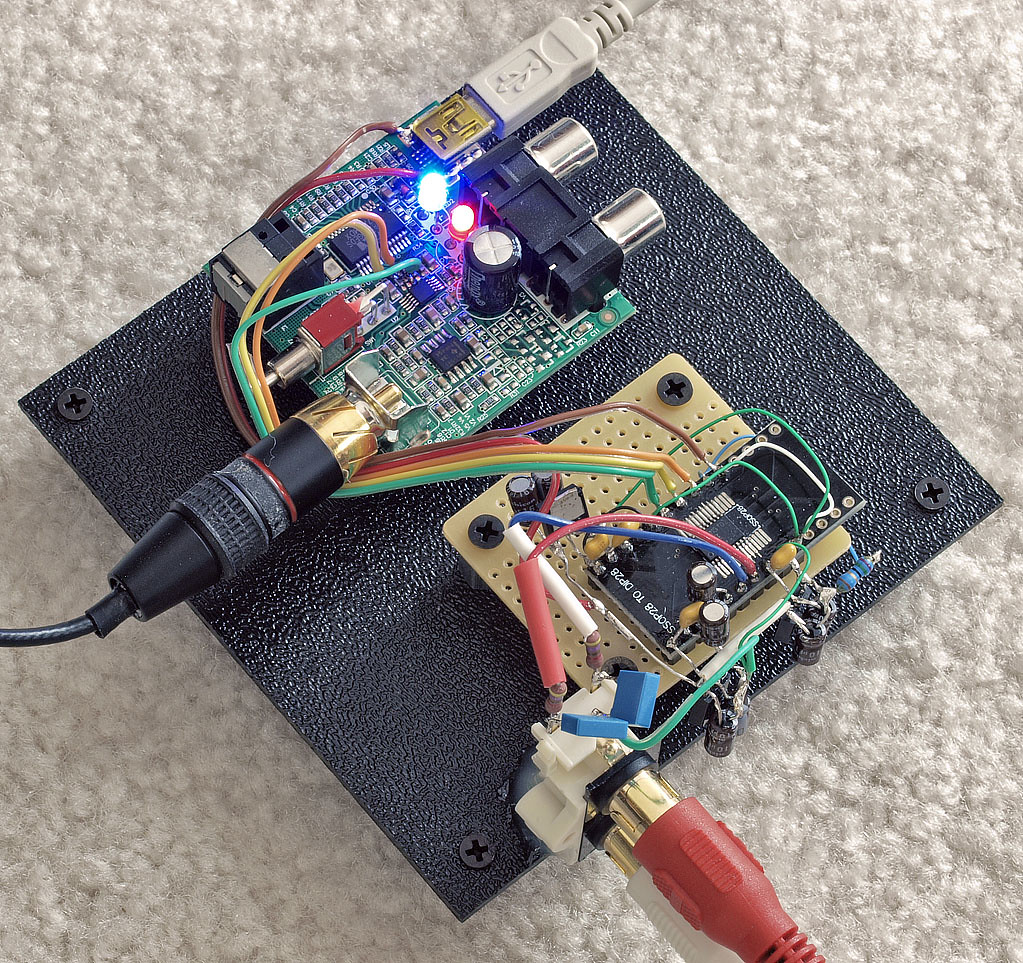
this was NOT EASY, lol.
I really don't know why I torture myself like this 😉 soldering where you can't even see anymore. well, flux and solder wick are my new best friends.
sound wise, I'm very impressed. I think this dac chip has a future to it.
this was NOT EASY, lol.
I really don't know why I torture myself like this 😉 soldering where you can't even see anymore. well, flux and solder wick are my new best friends.
sound wise, I'm very impressed. I think this dac chip has a future to it.
some rmaa test results:
RightMark Audio Analyzer test: comparison
I took the unit over to AMB's place and we did an rmaa test. in that web link is a compare to his gamma2 (wolfson chip) vs this pcm5102 of my own chip-carrier build.
it compared well, overall. the numbers are a bit better on that high end wolfson dac chip but the 'foam dac' (lol) did a pretty respectable showing.
test setup was an m-audio firewire rme box as digital-out and analog-in using rmaa freeware.
RightMark Audio Analyzer test: comparison
I took the unit over to AMB's place and we did an rmaa test. in that web link is a compare to his gamma2 (wolfson chip) vs this pcm5102 of my own chip-carrier build.
it compared well, overall. the numbers are a bit better on that high end wolfson dac chip but the 'foam dac' (lol) did a pretty respectable showing.
test setup was an m-audio firewire rme box as digital-out and analog-in using rmaa freeware.
update: am now using my own wm8804 spdif receiver perf board (chip carrier) and that's connected to the pcm5102 via the 3 wire ribbon cable.
it sounds good to me. the previous build was showing some strange bass distortion but this version of the build sounds fine.
what I like about this 8804 chip is that it takes in spdif and creates a clean spdif out *concurrent with* i2s, to drive a dac. I can get analog *and* digital out from this at the same time. I think that's cool 😉
it sounds good to me. the previous build was showing some strange bass distortion but this version of the build sounds fine.
what I like about this 8804 chip is that it takes in spdif and creates a clean spdif out *concurrent with* i2s, to drive a dac. I can get analog *and* digital out from this at the same time. I think that's cool 😉
An externally hosted image should be here but it was not working when we last tested it.

An externally hosted image should be here but it was not working when we last tested it.

Very nice!. Is the gamma 2 with a WM8741?. Did you redo the tests with the 8804? Thanks for sharing...
I think he has an 8741 in his y2.
I have not re-run the tests.
I may also have spoken too soon about this being such a great chip ;( I'm seeing some clipping going on when the input reaches 0db (as seen on various spdif monitoring meter displays).
I'd like someone else to check for this and see if its just me or if this dac chip is extra sensitive to near-zero db values.
I have not re-run the tests.
I may also have spoken too soon about this being such a great chip ;( I'm seeing some clipping going on when the input reaches 0db (as seen on various spdif monitoring meter displays).
I'd like someone else to check for this and see if its just me or if this dac chip is extra sensitive to near-zero db values.
- Status
- Not open for further replies.
- Home
- Source & Line
- Digital Line Level
- PCM5102, 2VRMS ground centered direct output with two digital filters